GRADE & PURITYMoligand™?Moligand™ — Aladdin's line of ligands and bioactive small molecules. Use for receptor, pathway, and binding studies needing defined small-molecule tools.≥99%
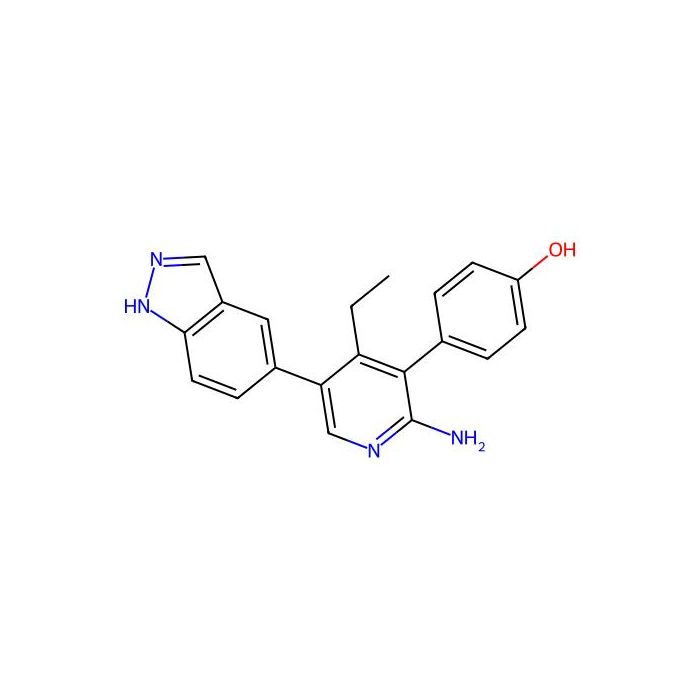
GNE-6640 is a selective and non-covalent inhibitor of ubiquitin epecific peptidase 7 (USP7), with IC50 values of 0.75 μM, 0.43 μM, 20.3 μM and 0.23 μM for full length USP7, USP7 catalytic domain, full length USP47 and Ub-MDM2, respectively
GNE-6640 is a selective and non-covalent inhibitor of ubiquitin epecific peptidase 7 (USP7) , with IC 50 values of 0.75 μM, 0.43 μM, 20.3 μM and 0.23 μM for full length USP7 , USP7 catalytic domain, full length USP43 and Ub-MDM2, respectively.
Storage
Store at -20°C
Shipped In
Ice chest + Ice pads
This product requires cold chain shipping. Ground and other economy services are not available.
This compound belongs to the class of organic compounds known as phenylpyridines. These are polycyclic aromatic compounds containing a benzene ring linked to a pyridine ring through a CC or CN bond.
External Descriptors
Not available
1. Djoumbou Feunang Y, Eisner R, Knox C, Chepelev L, Hastings J, Owen G, Fahy E, Steinbeck C, Subramanian S, Bolton E, Greiner R, and Wishart DS. ClassyFire: Automated Chemical Classification With A Comprehensive, Computable Taxonomy. Journal of Cheminformatics, 2016, 8:61.
Determine the necessary mass, volume, or concentration for preparing a solution.
Dilution Calculator
Determine the dilution needed to prepare a stock solution.
Reconstitution Calculator
Reviews
Customer Reviews
Application Protocols
No tested application protocols are provided for this item in the product data.
Recommended assay types, dilutions, or plate formats: Not specified for this item; refer to CoA/Spec Sheet.
Positive controls/standards: Not specified for this item; refer to CoA/Spec Sheet.
For internal method development, follow your laboratory’s validated SOPs for compound stock preparation, dilution schemes, and assay-specific handling, and confirm compatibility empirically.
Biological Roles
No biological target, pathway, or mode-of-action information is provided in this listing for GNE-6640. Accordingly, no innate biological role can be ascribed here.
General considerations for research tool compounds (not item-specific claims):
Tool ligands are commonly used to interrogate protein targets, pathways, or phenotypes in vitro (biochemical or cell-based). Their “role” is experimental and context-dependent, defined by the user’s system and protocol.
Prior to mechanistic studies, confirm identity and purity, establish a reliable dose–response, and rule out assay interference (e.g., aggregation, redox cycling, fluorescence quenchers) using orthogonal assays.
Validate on-target activity where applicable by: counter-screens against related targets, competition studies, site-directed mutagenesis, or chemical genetics.
Important:
This product is supplied strictly for laboratory research use only. It is not intended for use as a therapeutic, diagnostic, or in vivo veterinary/clinical applications without appropriate review and approvals.
If you require target-context or pathway mapping for this compound, consult the primary literature or databases indexed by the provided CAS (2009273-67-8) or PubChem CID (122531786), and verify any conclusions against the batch CoA.
Buffer Applications
Not typically applicable. GNE-6640 is a small-molecule tool compound, not a buffering agent.
Practical note (general):
When preparing assay media that include this compound, select a buffer system appropriate for the biological target (e.g., HEPES, PBS, Tris) and confirm that the compound remains soluble and stable upon dilution from its stock solvent (often DMSO) to the working buffer at the intended pH and ionic strength.
Item-specific buffer compatibility, pKa, or formulation data: Not specified for this item; refer to CoA/Spec Sheet.
Green Alternatives
With no item-specific solvent guidance provided, greener handling focuses on stock solvent and work-up choices typical for small-molecule tool compounds.
Comparison of common solvent options (general guidance; not a specification):
DMSO: High solvency, low volatility, relatively low toxicity; widely accepted in screening. Downside: can carry over sulfur odor and plasticize some polymers.
Ethanol (EtOH): Renewable routes available, low hazard, highly miscible with water; limited solvency for very lipophilic compounds and can perturb some assays at ≥1% v/v.
PEG-400: Non-volatile, low acute toxicity; viscous, may interfere with some biophysical readouts.
DMF/Dimethylacetamide: Strong solvency but higher regulatory concern and worker exposure risk; consider avoiding when DMSO or EtOH suffice.
Acetonitrile: Good for analytics; flammable and less desirable for biological assays compared with DMSO/EtOH.
Practical green tips:
Use the least hazardous solvent that achieves the required concentration and assay compatibility; prefer DMSO or ethanol over DMF where possible.
Minimize solvent volumes via concentrated master stocks and accurate low-volume liquid handling to reduce waste.
Implement microplate-based assays to limit per-experiment solvent usage and improve fume hood time.
Note: These are general sustainability considerations for handling small molecules. They do not alter item-specific storage (−20°C) or quality guidance.
Pharmaceutical Uses
No pharmacopeial status, excipient role, or manufacturing use is provided for this product. It is not offered as an active pharmaceutical ingredient (API) or excipient in this listing.
Use domain: Research use only, suitable for discovery biology/chemistry workflows.
Regulatory status: Not specified for this item; not certified to any pharmacopoeial monograph.
Formulation context (general research guidance, not a product claim):
If solution dosing is needed for preclinical research assays, common laboratory vehicles include DMSO stocks diluted into aqueous buffers with co-solvent (e.g., 0.1–1% DMSO, optional surfactant like Tween-80 at ≤0.05%) subject to compatibility with the biological system.
Stability, sterility, and endotoxin specifications for clinical or GMP use are not provided and should not be assumed.
Always consult your internal quality and regulatory teams before considering any use beyond basic research.
Physical Properties
Item-specific physicochemical data have not been supplied in this record. Do not treat literature or database values as specifications.
Appearance: Not specified for this item; refer to CoA/Spec Sheet.
Molecular weight: Not specified for this item; refer to CoA/Spec Sheet.
Molecular formula: Not specified for this item; refer to CoA/Spec Sheet.
Melting point (MP): Not specified for this item; refer to CoA/Spec Sheet.
Boiling point (BP): Not specified for this item; refer to CoA/Spec Sheet.
Density: Not specified for this item; refer to CoA/Spec Sheet.
Refractive index: Not applicable/unknown for solids; Not specified for this item; refer to CoA/Spec Sheet.
pKa/logP/logD: Not specified for this item; refer to CoA/Spec Sheet.
Solubility (water/organic): Not specified for this item; refer to CoA/Spec Sheet.
General guidance (literature/typical for screening compounds; not a specification):
Small-molecule tool compounds are commonly prepared as 10–50 mM DMSO stocks for screening; actual solubility limits vary widely with heteroatom content and ionizable groups.
If solubility is uncertain, perform a small-scale solubility screen (e.g., DMSO, DMF, ethanol, acetonitrile, buffered aqueous with co-solvent) and verify by HPLC/UV.
Hygroscopicity, polymorphism, and hydrate/solvate formation can affect handling and measured MP; confirm with batch CoA.
Always rely on the batch-specific CoA/SDS for definitive physical property and handling data.
Quality & Grades
Grade/Purity: Moligand™ (as provided). This denotes a research-use, small-molecule ligand/tool compound format suited for screening, target interrogation, or chemical biology applications. It emphasizes batch traceability and suitability for discovery workflows.
What Moligand™ typically implies (general guidance; not a specification):
Purity is controlled to support biochemical/cellular assays; exact purity threshold, residual solvents, and impurity profiles are batch-specific. For critical applications (e.g., biophysics, crystallography), verify acceptance criteria on the CoA/Spec Sheet.
Form: Supplied as a neat solid or concentrated solution depending on lot; this listing does not specify appearance.
Stabilizers/Inhibitors: Not specified for this item; refer to CoA/Spec Sheet.
Analytical controls: Identity is typically confirmed by LC–MS/HRMS and/or 1H NMR; chromatography purity by HPLC/UPLC with UV. Item-specific methods and system suitability are provided on the CoA.
Recommendations for researchers:
If low UV background or specific counter-ion/form is required, request batch documentation before ordering.
For screening cascades, standardize stock solvent (often anhydrous DMSO) and filtration (0.2 µm PTFE) across your library to ensure comparability.
Note: No claims are made regarding pharmacopoeial compliance; product is for research use only.
Reaction & Applications
This product is positioned as a research ligand/tool compound rather than a general-purpose synthetic reagent. As such, its primary value is in discovery biology and chemistry rather than in stoichiometric transformations.
Potential research uses (general, non-clinical):
Chemical biology: Probe-based studies to interrogate target pathways, binding assays (e.g., SPR, ITC), or phenotypic screening once the target context is established in the user’s workflow.
Assay development: Positive/negative control benchmarking, method validation, and analytical reference for LC–MS retention/mass tracking in screening cascades.
Structure–activity relationship (SAR): Use as a reference chemotype within an internal SAR set when designing analogs.
Not typically applicable:
Named-reaction participation (e.g., cross-couplings, nucleophilic substitutions) is not described here due to unknown functional groups and reactivity; treat the compound as a finished small molecule.
Practical considerations:
Prepare master stocks at a validated concentration in DMSO (or other suitable solvent) and avoid freeze–thaw cycling by aliquoting.
Verify chemical stability under assay conditions (light, pH, temperature, co-solvent) by time-course HPLC.
All applications are for research use only. No biological target or mechanism is provided in this listing; consult literature corresponding to the CAS/CID if target-context is required.
Reaction Conditions
Not applicable in the classical synthetic sense: this product is supplied as a research ligand/tool compound, not as a reagent for a specific reaction class. No named reactions, catalysts, or transformation conditions are associated with this listing.
General handling conditions for assay stock preparation (guidance; not a specification):
Solvent: DMSO is commonly used for master stocks. Validate solubility; if required, explore DMF, ethanol, or ACN.
Concentration: Typical screening stocks are 10–50 mM, prepared gravimetrically or volumetrically with analytical balance and calibrated pipettes.
Temperature: Dissolve at ambient temperature; gentle warming (≤40°C) and sonication can assist. Avoid prolonged heating or light exposure until stability is confirmed.
Filtration: If particulates persist, filter through 0.2 µm PTFE into sterile vials for biological assays.
Stability check: Assess by HPLC at time 0 and after storage/dilution to confirm no degradation or precipitation.
These points are general best practices and do not constitute item-specific conditions. For any chemical reaction use, obtain full structural data and perform small-scale feasibility tests.
Safety & Handling
Safety information specific to this item is not provided in the listing. Treat as a laboratory research chemical of unknown hazards and consult the SDS supplied with the shipment for authoritative guidance.
GHS/CLP: Not specified for this item; refer to SDS. Signal word, hazard statements, and pictograms: Not specified for this item; refer to SDS.
Primary PPE: Wear lab coat, safety glasses or face shield, and appropriate chemical-resistant gloves (e.g., nitrile). Use a fume hood to avoid inhalation of dusts/vapors/aerosols.
General first aid (overview; defer to SDS):
Inhalation: Move to fresh air; seek medical attention if symptoms persist.
Skin contact: Wash with soap and water; remove contaminated clothing.
Eye contact: Rinse cautiously with water for several minutes; remove contact lenses if present and easy to do; seek medical advice if irritation continues.
Ingestion: Rinse mouth; do not induce vomiting unless directed by medical personnel.
Handling cautions (general):
Avoid dust generation and aerosol formation; prevent contact with skin/eyes.
Segregate from strong oxidizers/acids/bases until compatibility is known.
For unknown peroxide-forming propensity and thermal stability, avoid unnecessary heating and store per product guidance.
Spills/Waste: Contain solid with inert absorbent, collect in appropriate container, and dispose of according to institutional and local regulations.
Storage per item data: Store at −20°C. Keep container tightly closed, protected from moisture and light as a prudent practice. Shipments are provided cold (ice chest + ice pads).
Solvent Selection
Item-specific solubility is not provided. The following is general guidance for small-molecule screening ligands and should be validated experimentally.
Primary stock solvent: DMSO is commonly used due to broad solvating power and assay compatibility at ≤0.5–1% v/v in most biochemical/cell assays.
Alternative solvents: DMF (high solvency; less assay-friendly), ethanol or isopropanol (benign but limited for highly lipophilic compounds), acetonitrile (good for analytics; may be harsh biologically), and PEG-400 or Captisol for in vivo formulation research (not applicable here unless separately qualified).
Aqueous systems: If ionizable, aqueous buffers with co-solvent (10–30% DMSO/EtOH/ACN) can be used after pH optimization; verify stability and avoid precipitation on dilution.
Typical decision framework (general):
If compound is polar/ionizable: Try buffered aqueous (pH adjusted) with 10–20% DMSO or ethanol.
If compound is neutral/lipophilic: Start with anhydrous DMSO or DMF; consider co-solvent blends for final assay media.
Practical tips:
Determine a solubility ceiling (e.g., serially up to 100 mM in DMSO) and inspect for clarity/crystallites; confirm by HPLC/UV.
Pre-warm to 30–40°C and vortex/sonicate briefly to aid dissolution; avoid prolonged heating.
Filter stocks through 0.2 µm PTFE if particles persist.
Note: None of the above constitutes item-specific specifications; consult CoA for definitive guidance.
Storage & Reconstitution
Item-specific storage and shipping:
Storage conditions: Store at −20°C (as provided).
Shipped in: Ice chest + ice pads (as provided).
Reconstitution/stock preparation:
Not specified for this item; refer to CoA/Spec Sheet for any lot-specific instructions.
General best practices (guidance; not a specification):
Allow container to equilibrate to room temperature in a desiccator before opening to prevent moisture condensation.
If preparing solutions, use dry, oxygen-free solvent when appropriate and verify solubility at the intended concentration. DMSO is a common choice for small-molecule screening stocks.
Prepare single-use aliquots to avoid repeated freeze–thaw. Store solutions at −20°C or −80°C as stability allows; protect from light if the compound is chromophoric.
Label aliquots with compound ID, concentration, solvent, date, and operator initials. Track cumulative freeze–thaw cycles.
Always defer to the batch-specific CoA/SDS for definitive instructions on stability, shelf-life, and reconstitution.
Structure & Identity
Brief overview: GNE-6640 is listed as a small-molecule research ligand in our Moligand series. Item-specific structural identifiers are largely not provided in the current product record.
Product name: GNE-6640 (SKU: G648464)
CAS: 2009273-67-8 (as provided)
PubChem CID: 122531786 (as provided)
InChIKey: 457536 (as provided; truncated/atypical format; refer to CoA/SDS for the definitive identifier)
SMILES: Not specified for this item; refer to CoA/Spec Sheet.
Molecular formula: Not specified for this item; refer to CoA/Spec Sheet.
Molecular weight: Not specified for this item; refer to CoA/Spec Sheet.
Structural features (general note):
The precise 2D/3D structure, functional groups, ring systems, and stereochemistry are not provided in this listing. Without SMILES or InChI, a text description of the scaffold cannot be reliably given.
If structural detail is required for computational docking, QSAR, or analytical method development, please consult the Certificate of Analysis (CoA), product Specification Sheet, or primary literature corresponding to the CAS/CID above.
Traceability:
Cross-reference of CAS and CID enables retrieval of literature/computed properties, spectra, and synonyms from public databases (literature values should not be construed as item-specific specifications). Always verify against the batch CoA for procurement-critical attributes.
Synthetic Utility
GNE-6640 is offered as a finished small-molecule ligand/tool compound rather than as a building block. Without disclosed functional groups or scaffold, specific reactivity or derivatization routes cannot be described.
Potential uses in a synthetic/analytical lab (general):
Analytical reference: Serve as a retention-time and mass reference in LC–MS method development for screening campaigns that include this chemotype.
Internal control: Benchmark in biochemical/cellular assays as a comparator within a SAR matrix.
If the structure becomes available and contains modifiable handles (e.g., aryl halide, amine, carboxylate), analog generation by standard transformations (e.g., cross-coupling, amide coupling, alkylation) may be feasible; however, no such handles are disclosed here.
Limitations:
No item-specific reactivity data, protecting-group strategy, or derivatization procedures are available in this listing. Do not assume suitability as a reagent or catalyst.
For retrosynthetic planning or medchem optimization, obtain the full structural information (SMILES/InChI) from the CoA or primary literature corresponding to CAS 2009273-67-8 and verify against the supplied batch.
Target Specificity
No target, mechanism, or selectivity profile is provided in the product data for GNE-6640.
Target/Pathway: Not specified for this item; refer to CoA/Spec Sheet and primary literature linked to CAS 2009273-67-8 or CID 122531786.
Potency/Selectivity metrics (IC50, Ki, Kd, EC50): Not specified for this item; refer to CoA/Spec Sheet.
Species reactivity or off-target panel data: Not specified for this item; refer to CoA/Spec Sheet.
Researchers should independently verify target engagement using orthogonal assays and appropriate controls.
Frequently Asked Questions
What is the purity of this product?
This product is supplied at ≥99% purity (chemical assay). Lot-specific values are stated on the Certificate of Analysis.
What is Moligand??
Moligand? is one of Aladdin Scientific's premium product lines, formulated for high-purity applications across multiple workflows. Compared to standard grades in the same workflow, Moligand? products typically offer tighter specifications, more rigorous QC, and stronger lot-to-lot consistency.
How should this product be stored?
Store at ?20 °C. Freezer storage is required to maintain the specified shelf life.
How is this product shipped?
This product ships in an insulated container with ice pads. Unpack on arrival and transfer it to the storage condition stated above.
What are the CAS number, molecular formula and molecular weight?
The CAS Number is 2009273-67-8, the molecular formula is C20H18N4O, and the molecular weight is 330.38 g/mol. InChIKey ZHYXJQQBKROZDX-UHFFFAOYSA-N.
What documentation is provided?
Available product documentation, including Certificates of Analysis (COA), Safety Data Sheets (SDS), and specification sheets, is shown in the product document area. Document availability and access follow the current site policy.
Need help choosing the grade?
Our grade selection guide covers purity, stabilizer status, and application suitability for all variants in our catalog.
We use cookies to ensure the website functions properly and, where permitted, to improve your experience. You can manage your preferences at any time in Settings. Learn more in our Cookie Policy.
Shall we send you a message when we have discounts available?
Remind me later
Thank you! Please check your email inbox to confirm.
Products are supplied to verified businesses, institutions, and qualified professionals for research and development use only. Not for use in humans, animals, diagnosis, or therapy.