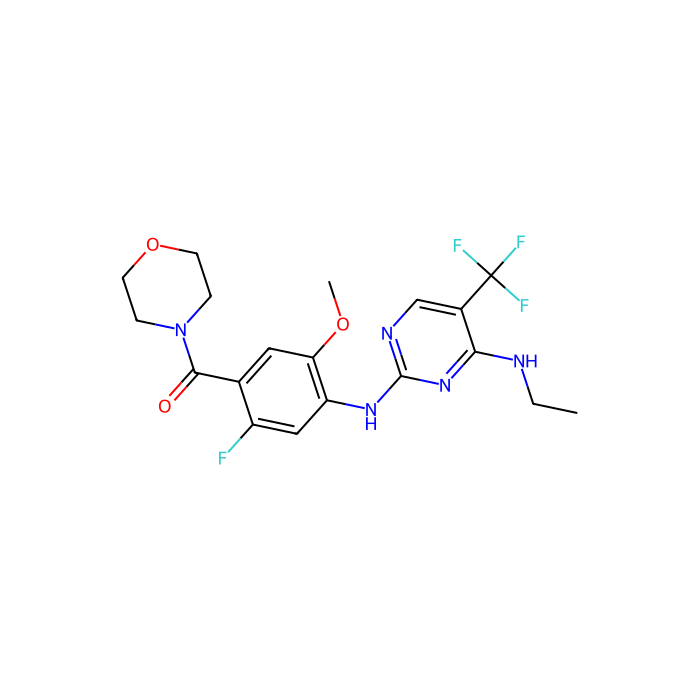
GNE7915 - Moligand™, ≥98% , Inhibitor of leucine rich repeat kinase 2;Inhibitor of TTK protein kinase, CAS No.1351761-44-8, Inhibitor of leucine rich repeat kinase 2;Inhibitor of TTK protein kinase
GNE7915 - Moligand™, ≥98% , Inhibitor of leucine rich repeat kinase 2;Inhibitor of TTK protein kinase, CAS No.1351761-44-8, Inhibitor of leucine rich repeat kinase 2;Inhibitor of TTK protein kinase
GRADE & PURITYMoligand™?Moligand™ — Aladdin's line of ligands and bioactive small molecules. Use for receptor, pathway, and binding studies needing defined small-molecule tools.≥98%
Potent and selective, brain penetrant LRRK2 inhibitor (IC 50 = 9 nM; K i = 1nM). Tested against a panel of 187 kinases only one was inhibited >50% at 100 nM. Displays moderate 5-HT2B anatagonist activity in vitro .
Storage
Store at -20°C
Shipped In
Ice chest + Ice pads
This product requires cold chain shipping. Ground and other economy services are not available.
Grade
Moligand™
Action Type
INHIBITOR
Mechanism of action
Inhibitor of leucine rich repeat kinase 2;Inhibitor of TTK protein kinase
Note
Toxic, refer to SDS for further information Need more advice on solubility, usage and handling? Please visit our frequently asked questions (FAQ) page for more details.
This compound belongs to the class of organic compounds known as 2-halobenzoic acids and derivatives. These are benzoic acids or derivatives carrying a halogen atom at the 2-position of the benzene ring.
External Descriptors
Not available
1. Djoumbou Feunang Y, Eisner R, Knox C, Chepelev L, Hastings J, Owen G, Fahy E, Steinbeck C, Subramanian S, Bolton E, Greiner R, and Wishart DS. ClassyFire: Automated Chemical Classification With A Comprehensive, Computable Taxonomy. Journal of Cheminformatics, 2016, 8:61.
Determine the necessary mass, volume, or concentration for preparing a solution.
Dilution Calculator
Determine the dilution needed to prepare a stock solution.
Reconstitution Calculator
Reviews
Customer Reviews
Application Protocols
Only protocols explicitly provided in the Product Data may be listed. None are provided for this item.
Tested applications: Not specified for this item; refer to CoA/Spec Sheet.
Recommended concentrations/dilutions: Not specified for this item; refer to CoA/Spec Sheet.
Positive controls and assay references: Not specified for this item; refer to CoA/Spec Sheet.
General note:
For designing your own protocols, use standard practices for small-molecule tool compounds (e.g., prepare concentrated DMSO stocks, maintain constant vehicle, include appropriate controls). Validate conditions empirically for your assay system.
Biological Roles
Scope: Research/in vitro context only. No medical or clinical claims.
Literature context (general, not item-specific claims):
GNE7915 is reported in the scientific literature as a small-molecule kinase inhibitor tool compound. Studies have used it to interrogate signaling cascades and phosphorylation-dependent biomarkers in cellular and biochemical assays.
Such tool compounds are valuable for dissecting target function, validating phenotypes, and benchmarking novel chemotypes in structure–activity relationship (SAR) programs. They often serve as positive controls in target engagement assays (e.g., biochemical IC50, cellular pIC50, nanoBRET/thermal shift) and can facilitate pathway mapping via phosphoproteomics.
Best practices when using bioactive tools:
Verify target engagement with orthogonal readouts (enzymatic activity, target phosphorylation, proximity assays) and assess selectivity against relevant off-target panels.
Examine concentration–response behavior and time dependence to distinguish direct target inhibition from secondary effects (e.g., transcriptional changes or cellular stress at higher concentrations).
Evaluate compound stability in assay media and potential adsorption to plastics; use low-binding consumables when working at sub-micromolar levels.
Data integrity:
Record batch/lot, exact solvent composition, and final vehicle concentration in all datasets. Include vehicle-only controls and, where applicable, inactive analog controls for mechanistic assignments.
Buffer Applications
Not a buffering reagent. This product is a bioactive small molecule supplied for research assays and screening.
Practical guidance:
Prepare working solutions in assay buffers only after first dissolving in an appropriate organic solvent (commonly DMSO) to ensure complete dissolution. Maintain constant vehicle percentage across conditions.
If precipitation is observed upon dilution into aqueous buffer, increase the proportion of co-solvent slightly, employ serial dilution in intermediate co-solvent mixtures, or include a low level of non-ionic surfactant (e.g., 0.01–0.1% Tween-20) provided it does not interfere with the assay readout.
Formulation parameters (item-specific buffer pKa ranges, buffering capacity, ionic strength) are not applicable.
Green Alternatives
Context: Green chemistry considerations for this product focus on solvent use and assay setup rather than replacement of the active itself, since it serves as a specific research tool compound.
Opportunities (general guidance):
Minimize DMSO volumes by using higher assay concentrations with smaller addition volumes and by adopting automated low-volume dispensing to limit solvent burden.
Where compatible, prefer ethanol or aqueous co-solvent systems with minimal DMSO in late dilutions to reduce worker exposure and waste hazard.
Use miniaturized assay formats (384/1536-well) to reduce total chemical consumption and waste generation.
Comparison of common stock solvents (general; not item-specific specs):
DMSO: High solvency, recyclable in principle; occupational exposure manageable; disposal as organic hazardous waste required.
Ethanol: Renewable feedstock, lower toxicity profile; lower solvency for many heteroaromatics; flammable.
PEG-400 or Captisol (cyclodextrin solutions): Improved aqueous delivery with potential reduction of organic solvents; assess biological compatibility and assay interference.
Operational green practices:
Consolidate shipments and maintain accurate inventory to reduce cold-chain transport frequency.
Employ solvent recovery for large-scale screening operations where feasible and validated for purity.
Note: No greener “substitute molecule” is applicable because the molecular structure defines biological activity; solvent and process choices drive the main green-impact levers.
Pharmaceutical Uses
Regulatory/usage status:
For research use only. Not for human or veterinary use. No compendial monograph or excipient designation is provided in the Product Data.
Laboratory and preclinical research context (general):
Bioactive reference compounds like this are commonly used as positive controls in discovery biology, as benchmarks in structure–activity relationship (SAR) campaigns, and as analytical standards for bioanalytical method development (e.g., LC–MS/MS quantitation in plasma or tissue homogenates) in preclinical research.
They may support formulation screening studies at micro-scale (e.g., solvent/co-solvent systems, cyclodextrin complexes) to understand solubility and stability constraints for in vitro and ex vivo experiments.
Manufacturing/CMC relevance:
None stated. Specifications for residual solvents, polymorph control, particle size distribution, and stability-indicating methods are Not specified for this item; refer to CoA/Spec Sheet if such attributes are critical to your research workflows.
Important note:
No therapeutic, diagnostic, or clinical application is claimed or supported by this listing. All in vivo use, if contemplated in research settings, should be justified by independent literature and governed by institutional approvals; consult the SDS and CoA for safety and material attributes.
Physical Properties
Item-specific specifications:
Appearance: Not specified for this item; refer to CoA/Spec Sheet.
Molecular Weight: Not specified for this item; refer to CoA/Spec Sheet.
Molecular Formula: Not specified for this item; refer to CoA/Spec Sheet.
Melting point (mp): Not specified for this item; refer to CoA/Spec Sheet.
Boiling point (bp): Not applicable for a non-volatile bioactive solid; specific value not specified for this item; refer to CoA/Spec Sheet.
Density: Not specified for this item; refer to CoA/Spec Sheet.
Refractive index: Not applicable for a solid; not specified for this item.
Solubility: Not specified for this item; refer to CoA/Spec Sheet.
logP/logD: Not specified for this item; refer to CoA/Spec Sheet.
pKa: Not specified for this item; refer to CoA/Spec Sheet.
General laboratory guidance (literature/good practice; not item-specific specs):
Many kinase inhibitors are sparingly soluble in aqueous media and are commonly prepared as concentrated DMSO stocks (e.g., 10–50 mM) and diluted into assay buffers to ≤0.1–0.5% v/v DMSO final.
Solubility and solid-state behavior (polymorph, amorphous vs crystalline) can influence dissolution kinetics; sonication and gentle warming (≤37 °C) of DMSO stocks may assist dissolution. Always verify chemical stability under any heating.
If aqueous use is required, co-solvent systems (DMSO→buffer), surfactants (e.g., 0.01–0.1% Tween-20), or cyclodextrins may improve apparent solubility; confirm no assay interference.
Quality & Grades
Item-specific quality information:
Grade/Purity: Moligand™ (as provided for this catalog entry)
What Moligand™ implies (general description):
Moligand™ items are research-grade small molecules intended for screening, target validation, and mechanism-of-action studies. Emphasis is placed on identity confirmation and high organic purity suitable for biochemical and cell-based assays, rather than on low-UV solvent specifications typical of HPLC-grade solvents.
Batch documentation typically includes identity verification (e.g., LC–MS and/or NMR) and an assay of purity by LC/UPLC. Exact test methods and acceptance criteria are batch-dependent.
How to use this grade effectively:
For quantitative biology/biophysics, verify purity and identity in-house against your tolerance (e.g., ≥95–98% by area) and assess counter-ions/residual solvents when necessary.
If your use requires specific attributes (water content, salt form, chiral purity, particle size), request the CoA/Spec Sheet for this batch. Absent explicit values in the Product Data, treat them as: Not specified for this item; refer to CoA/Spec Sheet.
Stabilizers/impurities:
Stabilizers, residual metals, or peroxide specifications are: Not specified for this item; refer to CoA/Spec Sheet.
Compliance note:
For research use only. Not intended for diagnostic, therapeutic, clinical, or human/animal consumption applications.
Reaction & Applications
This product is supplied as a bioactive reference compound and is not primarily intended as a synthetic reagent or solvent.
Applicable research uses (general, literature-based; not item-specific claims):
Tool compound in biochemical and cellular studies to probe kinase-driven signaling pathways. Typically used to evaluate target engagement, downstream biomarker modulation, and selectivity profiling in vitro.
Reference standard in analytical method development (e.g., LC–MS/MS quantitation in matrices) and in assay validation.
Not typically applicable:
As a reagent in stoichiometric organic transformations, catalysts, or polymerization initiators.
Practical tips (general good practice):
Prepare fresh DMSO stocks under inert atmosphere if sensitivity to hydrolysis/oxidation is suspected; aliquot and minimize freeze–thaw cycles to maintain consistency across experiments.
Confirm absence of aggregate-based inhibition or assay interference (test with detergent, redox scavengers, or orthogonal readouts) when interpreting biochemical potency data.
Reaction Conditions
Not applicable as a synthetic reagent. This product is supplied as a bioactive reference compound rather than a substrate, catalyst, or solvent.
Assay preparation conditions (general guidance; not item-specific specs):
Stock solutions: Commonly prepared in anhydrous DMSO at 10–50 mM, filtered through 0.2 µm PTFE if particulate is present. Verify chemical stability during any gentle warming used to aid dissolution.
Working solutions: Dilute into assay buffer to target concentrations while maintaining constant vehicle (typically ≤0.1–0.5% v/v DMSO). Mix thoroughly to avoid local supersaturation and precipitation.
Storage of solutions: Keep light-protected aliquots on ice during use; return unused portions promptly to −20 °C. Avoid repeated freeze–thaw.
Expected assay behaviors (general):
Potency may shift with protein source, cofactors, and ATP concentration for kinase assays; assess under conditions matching your biological question.
Non-specific binding to plastics and serum proteins can reduce free concentration; consider low-binding plastics and determine unbound fraction if quantitative pharmacology is needed.
Safety & Handling
Item-specific safety data:
GHS Classification: Not specified for this item; refer to SDS.
Signal Word: Not specified for this item; refer to SDS.
Hazard Statements (H-codes): Not specified for this item; refer to SDS.
Pictograms: Not specified for this item; refer to SDS.
General laboratory precautions (not a substitute for SDS):
Handle in a chemical fume hood with appropriate PPE: lab coat, safety glasses, and chemically resistant gloves (e.g., nitrile). Avoid inhalation of dusts and contact with skin/eyes.
Prevent exposure to strong oxidizers or acids/bases until compatibility is known. Avoid open flames and high heat during weighing or dissolution.
Use dust-minimizing techniques (antistatic measures, weigh boats with covers). Clean spills with inert absorbent; avoid aerosolization.
First aid (general): In case of contact, rinse affected area with water for ≥15 minutes and seek medical attention. If inhaled, move to fresh air. If ingested, rinse mouth; do not induce vomiting; seek medical attention. Always follow institutional protocols.
Waste disposal: Collect solutions and solids in labeled containers for organic hazardous waste. Do not discharge to drains.
Authoritative data source: Always consult the product’s SDS for definitive hazard classification, exposure controls, and transport information before use.
Solvent Selection
Applicability: As a bioactive small molecule standard, solvent selection typically concerns stock-solution preparation for biochemical or cell-based assays, not bulk reaction media.
Item-specific solubility: Not specified for this item; refer to CoA/Spec Sheet.
General/literature guidance for small-molecule inhibitors (not item-specific specs):
Primary solvent: DMSO is the default for concentrated stocks (e.g., 10–50 mM) due to strong solvating power for heteroaromatics and drug-like scaffolds.
Secondary solvents (screen if needed): DMF, NMP for difficult solids (laboratory use only); ethanol or isopropanol for less polar scaffolds; 1:1 DMSO:water or DMSO:buffer during titration to reduce precipitation.
Aqueous media: Use co-solvent approaches to keep final DMSO ≤0.1–0.5% v/v in sensitive assays. Consider adding 0.01–0.1% non-ionic surfactant to mitigate aggregation artifacts.
Avoid: Strongly protic acidic or basic media unless stability is known; oxidative conditions; prolonged light/air exposure if the scaffold contains oxidizable moieties (verify by stability screening).
Form and appearance: Not specified for this item; refer to CoA/Spec Sheet.
Reconstitution guidance (general best practice; not item-specific specs):
Solvent: Dissolve the solid in anhydrous DMSO to prepare a concentrated stock (e.g., 10–50 mM), unless your CoA specifies an alternative solvent system. If necessary, warm gently (≤37 °C) and vortex/sonicate to aid dissolution.
Filtration: If particulate persists, pass through a 0.2 µm PTFE syringe filter. Avoid aqueous filters for DMSO-rich solutions.
Aliquoting: Dispense into single-use, light-protected microtubes to minimize headspace and freeze–thaw.
Storage of solutions: Store aliquots at −20 °C or below, protected from light and moisture. Track preparation date and concentration on labels.
Stability: Solution and solid-state stability are Not specified for this item; refer to CoA/Spec Sheet. Confirm stability experimentally under your specific storage and assay conditions.
Handling notes:
Allow vials to equilibrate to room temperature in a desiccated environment before opening to avoid moisture condensation. Reseal promptly with inert gas if long-term storage is anticipated.
Research Use Note: For research use only.
Structure & Identity
Brief overview: This listing is for a bioactive small molecule tool compound supplied under Aladdin’s Moligand™ line.
Item-specific identifiers (from Product Data):
SKU: G275946
Product Name: GNE7915
CAS: 1351761-44-8
PubChem CID: 58539171
InChIKey: 414154 (as provided)
SMILES: Not specified for this item; refer to CoA/Spec Sheet.
Molecular Formula: Not specified for this item; refer to CoA/Spec Sheet.
Molecular Weight: Not specified for this item; refer to CoA/Spec Sheet.
Structural features:
Item-specific structural descriptors (functional groups, stereochemistry, ring systems): Not specified for this item; refer to CoA/Spec Sheet.
General/literature notes:
GNE7915 is reported in the research literature as a small-molecule kinase inhibitor scaffold. Detailed 2D features (heteroaromatic cores, substitution patterns, stereochemistry) should be confirmed from primary literature or the Certificate of Analysis for this batch before structure-dependent experimental design.
Practical identity guidance:
For analytical confirmation in your lab, consider orthogonal methods such as HRMS, 1H/13C NMR, and HPLC/UPLC purity profiling. Match spectra against authenticated references or vendor CoA where available.
When registering internally, cross-reference by CAS (1351761-44-8) and PubChem CID (58539171) to minimize synonym ambiguity.
Synthetic Utility
This item is a finalized small-molecule tool compound and is not primarily intended as a synthetic building block.
Use-cases that do apply (general):
Analytical reference standard for method development and validation in medicinal chemistry programs (e.g., purity tracking of analog series, stability studies, forced-degradation profiling).
Positive control in biochemical or biophysical target assays to benchmark new synthetic analogs.
Not typically applicable:
As a coupling partner, electrophile/nucleophile handle, or protecting-group reagent in routine organic synthesis. Functional group transformations, named reactions, and retrosynthetic disconnections are generally irrelevant to end-users for this molecule since its structure-specific activity is the focus.
Practical notes:
If analog synthesis is ongoing in your lab, retain this compound as a comparator in SAR. Employ parallel purification and matched analytical methods (same column, gradient, detection wavelengths) to ensure apples-to-apples comparisons across a series.
For forced-degradation studies, design stress panels (acid/base, oxidative, thermal, photolytic) to map intrinsic liabilities; this informs formulation of assay stocks and storage practices. Ensure all stress work is performed on small aliquots to protect the primary batch.
Target Specificity
Only information from Product Data may be listed here.
Target/antigen: Not specified for this item; refer to CoA/Spec Sheet.
Mechanism of action: Not specified for this item; refer to CoA/Spec Sheet.
Species reactivity/selectivity panel: Not specified for this item; refer to CoA/Spec Sheet.
Clone/isotype/epitope (if applicable): Not applicable.
Note: For research planning, consult primary literature corresponding to CAS 1351761-44-8 and PubChem CID 58539171 to understand reported biochemical selectivity. However, such literature details are not part of this product’s certified specification.
Frequently Asked Questions
What is the purity of this product?
This product is supplied at ≥98% purity (chemical assay). Lot-specific values are stated on the Certificate of Analysis.
What is Moligand??
Moligand? is one of Aladdin Scientific's premium product lines, formulated for high-purity applications across multiple workflows. Compared to standard grades in the same workflow, Moligand? products typically offer tighter specifications, more rigorous QC, and stronger lot-to-lot consistency.
How should this product be stored?
Store at ?20 °C. Freezer storage is required to maintain the specified shelf life.
How is this product shipped?
This product ships in an insulated container with ice pads. Unpack on arrival and transfer it to the storage condition stated above.
What are the CAS number, molecular formula and molecular weight?
The CAS Number is 1351761-44-8, the molecular formula is C19H21F4N5O3, and the molecular weight is 443.4 g/mol. InChIKey XCFLWTZSJYBCPF-UHFFFAOYSA-N.
What documentation is provided?
Available product documentation, including Certificates of Analysis (COA), Safety Data Sheets (SDS), and specification sheets, is shown in the product document area. Document availability and access follow the current site policy.
Need help choosing the grade?
Our grade selection guide covers purity, stabilizer status, and application suitability for all variants in our catalog.
We use cookies to ensure the website functions properly and, where permitted, to improve your experience. You can manage your preferences at any time in Settings. Learn more in our Cookie Policy.
Shall we send you a message when we have discounts available?
Remind me later
Thank you! Please check your email inbox to confirm.
Products are supplied to verified businesses, institutions, and qualified professionals for research and development use only. Not for use in humans, animals, diagnosis, or therapy.

 B2208154