GRADE & PURITYMoligand™?Moligand™ — Aladdin's line of ligands and bioactive small molecules. Use for receptor, pathway, and binding studies needing defined small-molecule tools.≥98%
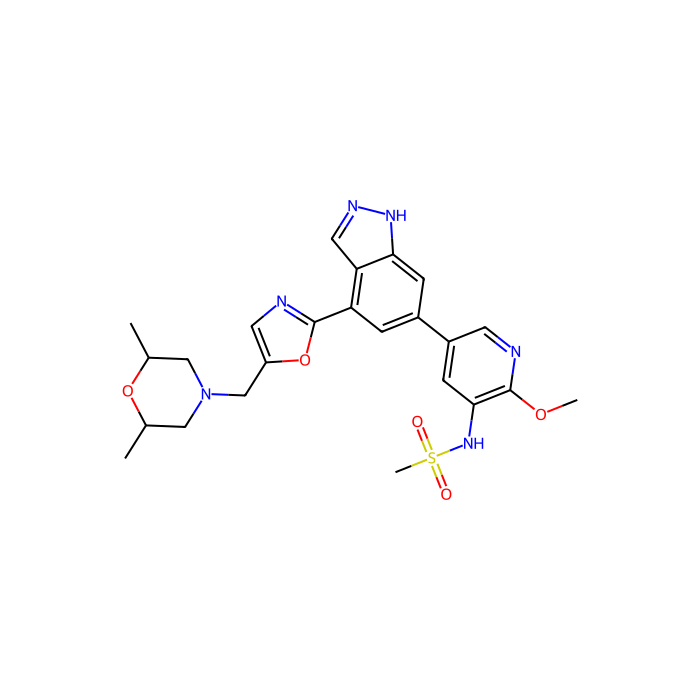
GSK2292767 is a potent and selectivePI3Kδinhibitor.
Targets
PI3Kδ
In vivo
GSK2292767 is highly selective for PI3Kδ over the closely related isoforms and is active in a disease relevant brown Norway rat acute OVA model of Th2-driven lung inflammation.
Specifications
Synonyms
N-(5-(4-(5-(((2R,6S)-2,6-Dimethylmorpholino)methyl)oxazol-2-yl)-1H-indazol-6-yl)-2-methoxypyridin-3-yl)methanesulfonamide | N-[5-[4-[5-[[(2S,6R)-2,6-Dimethylmorpholin-4-yl]methyl]-1,3-oxazol-2-yl]-1H-indazol-6-yl]-2-methoxypyridin-3-yl]methanesulfonamide | PI3Kdelta inhibitor GS2292767 | GSK2292767 | GSK-2292767 | Methanesulfonamide, N-(5 Show more
Specifications & Purity
Moligand™, ≥98%
Biochemical and Physiological Mechanisms
GSK2292767 is a potent and selective PI3Kδ inhibitor.
Storage
Store at -20°C
Shipped In
Ice chest + Ice pads
This product requires cold chain shipping. Ground and other economy services are not available.
Grade
Moligand™
Action Type
INHIBITOR
Mechanism of action
Inhibitor of phosphatidylinositol-4;5-bisphosphate 3-kinase catalytic subunit delta
This compound belongs to the class of organic compounds known as indazoles. These are compounds containing an indazole, which is structurally characterized by a pyrazole fused to a benzene.
External Descriptors
Not available
1. Djoumbou Feunang Y, Eisner R, Knox C, Chepelev L, Hastings J, Owen G, Fahy E, Steinbeck C, Subramanian S, Bolton E, Greiner R, and Wishart DS. ClassyFire: Automated Chemical Classification With A Comprehensive, Computable Taxonomy. Journal of Cheminformatics, 2016, 8:61.
Determine the necessary mass, volume, or concentration for preparing a solution.
Dilution Calculator
Determine the dilution needed to prepare a stock solution.
Reconstitution Calculator
Reviews
Customer Reviews
Application Protocols
Tested applications and recommended protocols are not provided in the Product Data for this item. No validated dilutions, assay formats, or control conditions are specified.
General, non-item-specific guidance for small-molecule ligands:
Biochemical enzyme assay: Prepare serial dilutions from a DMSO stock; keep final DMSO constant across wells. Include positive control inhibitor (if available) and vehicle control. Quantify activity via an orthogonal readout (e.g., fluorescent/absorbance/radioactivity) and fit concentration–response with appropriate models.
Binding assays (SPR/BLI/ITC): Ensure analyte solubility and absence of aggregates (dynamic light scattering optional). Use matched buffer blanks and DMSO calibration where applicable.
Cell-based assay: Confirm cytotoxicity window (e.g., CellTiter-type viability) for assay exposure. Verify target modulation via pathway biomarkers and include rescue experiments when feasible.
Please consult the SDS and CoA/Spec Sheet for any item-specific constraints, and validate protocols in your laboratory system before large-scale studies.
Biological Roles
Item-specific biological target or pathway information is not provided in this listing. No claims are made regarding mechanism of action, selectivity, or in vivo relevance.
General considerations for small-molecule research ligands (non-clinical, literature-based guidance):
Such ligands are commonly used to perturb specific signaling pathways or enzyme activities to study cellular responses, feedback regulation, and pathway crosstalk. Typical readouts include phosphorylation states, transcriptional reporter activity, metabolite levels, or phenotypic changes.
Off-target assessment is essential: employ counterscreens across kinases/enzymes/receptors relevant to your biology to detect polypharmacology. Chemoproteomics or broad panel screens (e.g., DiscoverX/KINOMEscan-like approaches) can map interaction profiles.
Physicochemical properties (pKa, logD, TPSA) influence membrane permeability, subcellular distribution, and efflux susceptibility; measure these experimentally for your lot to interpret biological data.
Time-dependent potency shifts may reflect metabolic instability or covalent interactions if electrophilic motifs are present in related probes; orthogonal validation is recommended.
Note: For definitive biological roles and primary targets associated with CAS 1254036-66-2 / CID 49783923, consult the peer-reviewed literature and database records. This product is supplied strictly for research use only.
Buffer Applications
This product is a small-molecule research ligand rather than a buffer component. No dedicated buffering applications are specified.
Practical notes for assay buffers (general guidance):
Prepare ligand working solutions by diluting DMSO stocks into biologically compatible buffers (e.g., HEPES, Tris, PBS) while maintaining consistent final DMSO across controls and treated samples.
Include 0.01–0.05% non-ionic detergent (e.g., Tween-20, Triton X-100, or Pluronic F-127) when aggregation is suspected; run detergent controls.
Control pH and ionic strength to stabilize target proteins and minimize nonspecific binding. Metal-dependent enzymes may require defined chelation/metal supplementation; match assay buffer accordingly.
Item-specific buffer recipes, pKa, or pH-dependent solubility data: Not specified for this item; refer to CoA/Spec Sheet and determine empirically for your system.
Green Alternatives
While GSK2292767 is the analyte/ligand rather than a solvent or reagent consumed in bulk, greener choices can be made around its handling and analytical workflows.
Greener solvent choices (general):
Stock solutions: If high-concentration DMSO stocks are standard, consider minimizing DMSO throughput by preparing the highest stable concentration and aliquoting to reduce waste. Where feasible, ethanol or water-cosolvent systems can reduce reliance on DMSO, provided solubility and assay tolerance are validated.
Chromatography: Favor water/MeCN with volatile buffers (ammonium formate/acetate) over non-volatile modifiers. MeCN generally has a lower environmental burden vs CH2Cl2/THF in analytical and prep workflows. Supercritical CO2 (SFC) can reduce organic solvent use in purification where applicable.
Workup and cleaning: Replace chlorinated solvents (e.g., DCM) with ethyl acetate or methyl tert-butyl ether (MTBE) where compatible. Use aqueous detergents for glassware when residues are polar and non-polymerizing.
Comparison snapshot (general):
DMSO vs DMF/NMP: DMSO is preferred from a health/environment standpoint; avoid DMF/NMP unless necessary.
MeCN vs DCM for LC: MeCN/water systems are greener and safer than DCM-containing normal-phase methods for most reversed-phase separations.
Process considerations:
Aliquoting and cold storage (-20°C) extend shelf life and minimize repeated freeze-thaw, reducing waste. Adopt microscale assays and high-density plates to cut solvent and analyte consumption.
Pharmaceutical Uses
No pharmaceutical or clinical use is claimed or supported for this item. It is supplied strictly for research use only.
General formulation context for small-molecule research ligands (non-clinical):
Preformulation studies for in vitro and ex vivo experiments may evaluate solubility, stability (hydrolytic/oxidative/photolytic), and compatibility with excipients such as cyclodextrins (e.g., HP-β-CD) or co-solvents (PEG400, ethanol) for improved aqueous delivery in assay systems.
For in vivo research models (outside the scope of this product’s intended use unless permitted by your institution), common non-clinical vehicles include aqueous buffers with co-solvents/surfactants (e.g., 5–10% DMSO, 10–40% PEG400, 1–10% Solutol/Polysorbate 80). Validate tolerability and stability independently.
Solid-form characterization (salt selection, polymorph) can influence dissolution and exposure in research contexts; however, salt form and polymorph are not specified for this item.
Pharmacopeial status and excipient role:
Not specified for this item; no compendial monographs are indicated.
Reminder: Do not use for human or veterinary applications. All work should remain within laboratory research frameworks and comply with institutional and regulatory guidelines.
Physical Properties
Item-specific specifications (Product Data):
Appearance: Not specified for this item; refer to CoA/Spec Sheet.
Molecular weight: Not specified for this item; refer to CoA/Spec Sheet.
Not specified for this item; refer to CoA/Spec Sheet for all of the following:
Melting point (MP)
Boiling point (BP)
Density
Refractive index
pKa values / isoelectric characteristics
logP/logD
UV-Vis characteristics (ε, λmax)
Solubility in common solvents (water, DMSO, MeOH, EtOH, buffers)
General guidance (literature/experience-based, not item-specific):
Small-molecule screening ligands are commonly supplied as amorphous or microcrystalline solids. Many exhibit limited aqueous solubility but dissolve well in anhydrous DMSO; 10–50 mM DMSO stock solutions are typical for HTS/biochemical assays.
If ionizable centers are present, apparent solubility may improve in buffered systems at pH values favoring ionization. Verify absence of precipitation upon dilution from DMSO into aqueous media (recommended final DMSO ≤1–2% v/v for many biochemical assays).
Record actual solubility and extinction coefficients experimentally for your specific lot, as these strongly influence assay reproducibility.
Always defer to the CoA/SDS for definitive physical parameters and lot-specific handling recommendations.
Quality & Grades
Item-specific grade (from Product Data):
Grade: Moligand™
What Moligand™ implies (general note):
Moligand™ designates a research-grade small-molecule ligand suitable for discovery biology and medicinal chemistry workflows, including target engagement assays, biochemical/biophysical screening, and SAR exploration. This grade emphasizes identity and purity control appropriate for screening and mechanism studies.
What is and is not specified for this item:
Purity assay, counter-ion/form, water/peroxide/metal residuals, and UV cutoff: Not specified for this item; refer to CoA/Spec Sheet.
Stabilizers/inhibitors: Not specified for this item; refer to CoA/Spec Sheet.
Quality considerations for users (best practice):
Verify identity by orthogonal methods (e.g., 1H/13C NMR, HRMS, LC-MS). Confirm purity by HPLC/UPLC with both UV and MS detection to uncover nonchromophoric impurities.
For screening, low background absorbance/fluorescence and well-defined purity are critical; consider pre-assay drying (if solid), and prepare fresh DMSO stocks to minimize oxidative or hydrolytic degradation.
Request lot-specific CoA for exact purity, residual solvents, and salt form; these parameters directly affect solubility, potency normalization (µM), and inter-lab reproducibility.
Compliance reminders:
For research use only. Not for human or veterinary use, diagnostic procedures, or clinical applications.
Reaction & Applications
Context: As supplied, GSK2292767 (Moligand™) is intended as a ready-to-use research ligand for biochemical/biophysical assays and screening rather than as a starting reagent for synthetic transformations.
Research applications (general, non-clinical):
Target engagement studies: thermal shift assays (DSF), differential scanning calorimetry (DSC), surface plasmon resonance (SPR), bio-layer interferometry (BLI), and isothermal titration calorimetry (ITC) to quantify binding affinity and thermodynamics.
Biochemical inhibition/activation profiling: enzyme activity assays, TR-FRET/HTRF readouts, FP anisotropy, AlphaScreen/AlphaLISA, and radioligand displacement where applicable.
Cell-based studies: pathway modulation readouts (reporter assays, phospho-signaling by Western/ELISA), phenotypic screening, and chemoproteomics (if reactive handles are present in analogs/probes).
ADME characterization: in vitro microsomal stability, solubility, permeability (PAMPA, Caco-2), and plasma protein binding to support tool compound deployment.
Assay preparation tips:
Prepare fresh DMSO stocks; filter (0.22 µm PTFE) if particulate is observed. Verify absence of precipitation upon dilution into aqueous buffers and record final DMSO percentage across all wells.
Include counter-screens for assay interference (e.g., redox cycling, aggregation via detergent sensitivity, inner-filter effects in fluorescence assays). Employ orthogonal assays to confirm mechanism.
Note: No specific biochemical target, potency, or mode-of-action is provided in this listing. Users should consult primary literature associated with the CAS/CID for target-class guidance.
Reaction Conditions
No item-specific reaction conditions are applicable because the product is supplied as a finished small-molecule ligand. However, the following practical conditions pertain to preparing solutions and running assays (general guidance):
Stock preparation: Dissolve in anhydrous DMSO to 10–50 mM if soluble; gently warm (≤37°C) and vortex/sonicate as needed. Avoid prolonged heating.
Working solutions: Dilute stock into assay buffer with vigorous mixing to minimize precipitation; maintain consistent final DMSO across all samples and controls (commonly ≤1–2% v/v for biochemical assays; verify tolerance in your system).
Light/oxygen sensitivity: If literature or pretests indicate instability, prepare solutions fresh, protect from light (amber vials), and consider inert gas overlay.
Adsorption: Hydrophobic ligands may adsorb to plastics; low-binding tubes/plates and inclusion of carrier proteins (e.g., 0.1% BSA) can mitigate losses where biologically acceptable.
Stability checks: Use LC-MS or HPLC to confirm integrity over assay time. Assess freeze–thaw stability by aliquoting stocks to single-use vials.
Expected yields, catalysts, or temperatures for chemical reactions are not applicable to this catalog item. For any synthetic use (e.g., analog preparation), consult literature protocols tailored to the verified scaffold and functional groups.
Safety & Handling
Regulatory and hazard status (Product Data):
GHS classification: Not specified for this item; refer to SDS.
Signal word: Not specified for this item; refer to SDS.
Hazard statements (H-codes): Not specified for this item; refer to SDS.
Pictograms: Not specified for this item; refer to SDS.
General laboratory safety guidance (not item-specific; follow SDS):
Handle in a chemical fume hood. Avoid inhalation of dust/aerosols and contact with skin/eyes.
Recommended PPE: lab coat, safety glasses, and appropriate chemically resistant gloves (e.g., nitrile). Consider double-gloving for prolonged handling or unknown toxicity profiles.
Avoid incompatible conditions typical for organic ligands: strong oxidizers, strong acids/bases if the scaffold is acid/base labile, and prolonged exposure to light or elevated temperature if photolabile or prone to degradation.
First aid (general): If inhaled—move to fresh air. Skin/eye contact—rinse with water for ≥15 minutes and remove contaminated clothing. If ingested—rinse mouth; seek medical attention. Always consult the SDS for authoritative instructions.
Spill/accident: Contain and collect with inert absorbent; dispose as organic laboratory waste per institutional/municipal regulations.
Waste: Treat as hazardous organic waste unless your SDS indicates otherwise. Segregate halogenated from non-halogenated solvents.
Transport and storage conditions (from Product Data):
Shipping: Ice chest + ice pads.
Storage: Store at -20°C. Protect from moisture; tightly cap to minimize uptake of atmospheric water/CO2 and solvent loss from DMSO stocks.
Solvent Selection
Item-specific solubility data are not provided; consult the CoA/Spec Sheet. The following guidance is general for small-molecule research ligands:
Primary stock solvent: DMSO is the default choice due to broad solvating ability for heteroaromatic/fragment-like to lead-like scaffolds. Prepare 10–50 mM stocks where solubility allows.
Secondary solvents: Acetonitrile (MeCN) and methanol often support analytical preparations (HPLC/UPLC). Ethanol or isopropanol may be useful for biochemical assay co-solventing.
Aqueous media: Direct dissolution in water/buffer may be limited; instead, dilute DMSO stock into buffer under vigorous mixing to avoid precipitation. Maintain final DMSO ≤1–2% v/v in sensitive biochemical assays or ≤0.1% v/v in cell-based assays where tolerated.
Polarity profile: Many discovery ligands occupy moderate polarity (cLogP ~1–4, literature-general), displaying poor water solubility but good DMSO compatibility. Adjust pH to favor ionization if functional groups are titratable.
Compatibility for analytics: For LC-UV or LC-MS, use MeCN/water or MeOH/water with 0.1% formic acid or ammonium formate/acetate buffers to improve peak shape and ionization.
Small comparison (general):
DMSO vs DMF: DMSO is preferred for bioassays (lower toxicity profile in small % v/v) and broader solubility; DMF is generally avoided in biological contexts.
MeCN vs MeOH: MeCN provides lower viscosity and stronger elution power in reversed-phase LC; MeOH may offer better solubility for some polar analytes.
Storage & Reconstitution
Item-specific conditions (from Product Data):
Storage: Store at -20°C.
Shipping: Ice chest + ice pads.
Additional best practices (general guidance; not item-specific):
Protect from moisture and light. Keep container tightly closed under inert atmosphere if feasible, especially after opening.
If supplied as a solid: Allow vial to equilibrate to room temperature in a desiccator before opening to prevent moisture condensation. Accurately weigh quickly and recap promptly.
Reconstitution: Prepare concentrated stocks in anhydrous DMSO (typical 10–50 mM if soluble). Vortex/sonicate briefly; avoid excessive heat. Filter (0.22 µm PTFE) if particulate is observed.
Aliquoting: Dispense into single-use aliquots to avoid repeated freeze–thaw. Store aliquots at -20°C (or as otherwise indicated on the CoA), ideally in amber vials. Record preparation date and concentration on each aliquot.
Stability: Item-specific shelf life, impurity profile, and freeze–thaw stability are Not specified for this item; refer to CoA/Spec Sheet. As a precaution, limit storage of DMSO solutions to weeks at -20°C and solids to months at -20°C unless CoA indicates otherwise.
Thawing/usage: Thaw on ice or at room temperature; mix thoroughly before use. Avoid multiple temperature cycles.
For authoritative guidance, always consult the lot-specific CoA and SDS.
Structure & Identity
Brief overview: GSK2292767 is listed as a small-molecule research ligand (Moligand grade). The product record does not provide a structural descriptor.
Item-specific identifiers (from Product Data):
SKU: G413879
Product name: GSK2292767
CAS: 1254036-66-2
PubChem CID: 49783923
InChIKey: Not specified for this item; refer to CoA/Spec Sheet. (Product Data lists "241892", which is not a standard InChIKey format.)
SMILES: Not specified for this item; refer to CoA/Spec Sheet.
Molecular formula: Not specified for this item; refer to CoA/Spec Sheet.
Molecular weight: Not specified for this item; refer to CoA/Spec Sheet.
Structural features (general notes):
The supplier listing does not disclose functional groups, ring systems, stereochemistry, or 2D depiction. For precise structural interpretation (e.g., heteroatom patterning, substitution, stereocenters), consult the Certificate of Analysis (CoA), Spec Sheet, or primary literature associated with the CAS/CID above.
How to describe the 2D structure (guidance):
When available, summarize the scaffold (e.g., fused/heteroaromatic core), count and placement of heteroatoms (N/O/S), halogenation, and any chiral centers. Indicate protonation sites relevant for assay buffers and potential hydrogen-bond donor/acceptor counts for rationalizing binding and solubility.
Cross-references:
Use the provided CAS or CID to retrieve the canonical SMILES/InChI and structure image from authoritative databases for internal records and modeling workflows.
Synthetic Utility
As a finished research ligand, GSK2292767 is typically used as a biological tool compound rather than a synthetic reagent. The product record does not provide functional group details, so no specific reactivity can be asserted.
General possibilities in medicinal chemistry (literature-based, not item-specific):
If analog development is intended, common late-stage diversification approaches include: Suzuki–Miyaura or Buchwald–Hartwig couplings (for aryl halide handles), amide couplings (HATU/EDC/T3P), reductive aminations, and N-alkylations/acylations to probe SAR.
Installation of solubilizing motifs (tertiary amines, sulfonamides) or heteroaromatic bioisosteres can modulate potency, selectivity, and ADME properties. Parallel synthesis with micro-scale purification (UPLC/MS) accelerates SAR cycles.
Probe derivatization: If the scaffold tolerates it, append photoaffinity or clickable handles (diazirine/azide/alkyne) via linkers at permissive positions identified by SAR to enable chemoproteomics or target-ID.
Caveats:
Without confirmed structural information for this specific item/lot, synthetic modifications should be based on verified structure from CoA/literature. Ensure unambiguous structure (NMR/HRMS) before embarking on derivatization campaigns.
In summary, view the compound primarily as a tool for biological interrogation; syntheses are typically reserved for analog generation rather than transformations of the supplied material.
Target Specificity
Item-specific target, selectivity, or binding data are not provided in the Product Data for GSK2292767.
Declared target/epitope: Not specified for this item; refer to CoA/Spec Sheet and primary literature associated with CAS 1254036-66-2 / CID 49783923.
Species reactivity or panel selectivity: Not specified for this item; refer to CoA/Spec Sheet.
Potency metrics (e.g., IC50, Ki, KD): Not specified for this item; refer to CoA/Spec Sheet.
Guidance for users:
Establish target specificity through orthogonal assays (e.g., biochemical potency, cellular target engagement, and counter-screens). Consider profiling across a relevant enzyme/receptor panel to map off-target liabilities.
For publication-grade data, include batch/lot identifiers, exact assay conditions, and reference standards to contextualize potency and selectivity claims.
Note: Aladdin provides this compound for research use only and does not represent or warrant any specific biological activity.
Frequently Asked Questions
What is the purity of this product?
This product is supplied at ≥98% purity (chemical assay). Lot-specific values are stated on the Certificate of Analysis.
What is Moligand??
Moligand? is one of Aladdin Scientific's premium product lines, formulated for high-purity applications across multiple workflows. Compared to standard grades in the same workflow, Moligand? products typically offer tighter specifications, more rigorous QC, and stronger lot-to-lot consistency.
How should this product be stored?
Store at ?20 °C. Freezer storage is required to maintain the specified shelf life.
How is this product shipped?
This product ships in an insulated container with ice pads. Unpack on arrival and transfer it to the storage condition stated above.
What are the CAS number, molecular formula and molecular weight?
The CAS Number is 1254036-66-2, the molecular formula is C24H28N6O5S, and the molecular weight is 512.58 g/mol. InChIKey NLUPPCTVKHDVIQ-GASCZTMLSA-N.
What documentation is provided?
Available product documentation, including Certificates of Analysis (COA), Safety Data Sheets (SDS), and specification sheets, is shown in the product document area. Document availability and access follow the current site policy.
Need help choosing the grade?
Our grade selection guide covers purity, stabilizer status, and application suitability for all variants in our catalog.
We use cookies to ensure the website functions properly and, where permitted, to improve your experience. You can manage your preferences at any time in Settings. Learn more in our Cookie Policy.
Shall we send you a message when we have discounts available?
Remind me later
Thank you! Please check your email inbox to confirm.
Products are supplied to verified businesses, institutions, and qualified professionals for research and development use only. Not for use in humans, animals, diagnosis, or therapy.

 H2322098