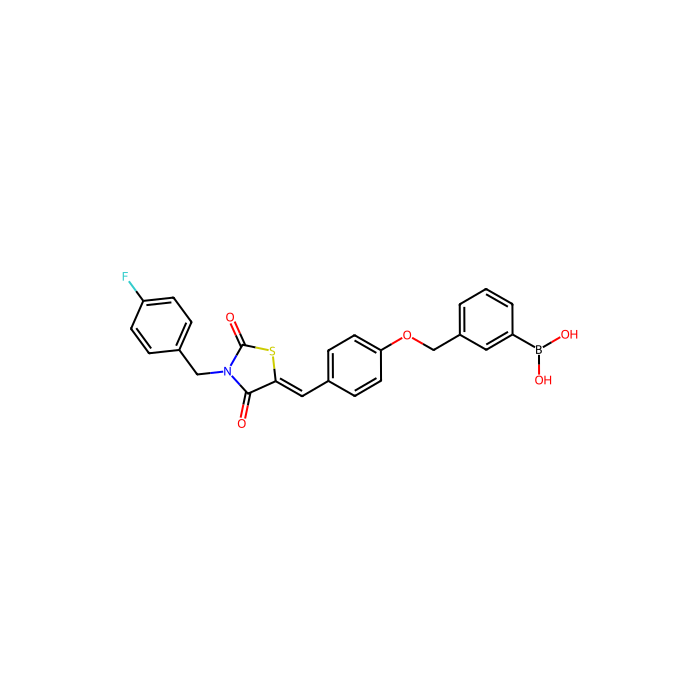
Potent and selective autotaxin inhibitor (IC50= 28 nM). Binds and inhibits autotaxin reversibly. Displays no activity against the proteasome, recombinant NPP1 or alkaline phosphatase. Inhibits ATX-mediated cell migration in an A2058 melanoma cell assay.
Storage
Store at -20°C
Shipped In
Ice chest + Ice pads
This product requires cold chain shipping. Ground and other economy services are not available.
This compound belongs to the class of organic compounds known as phenol ethers. These are aromatic compounds containing an ether group substituted with a benzene ring.
External Descriptors
Not available
1. Djoumbou Feunang Y, Eisner R, Knox C, Chepelev L, Hastings J, Owen G, Fahy E, Steinbeck C, Subramanian S, Bolton E, Greiner R, and Wishart DS. ClassyFire: Automated Chemical Classification With A Comprehensive, Computable Taxonomy. Journal of Cheminformatics, 2016, 8:61.
Solvent:DMSO, Max Conc. mg/mL: 46.33, Max Conc. mM: 100
Molecular Weight
463.300 g/mol
XLogP3
Hydrogen Bond Donor Count
2
Hydrogen Bond Acceptor Count
7
Rotatable Bond Count
7
Exact Mass
463.106 Da
Monoisotopic Mass
463.106 Da
Topological Polar Surface Area
112.000 Ų
Heavy Atom Count
33
Formal Charge
0
Complexity
722.000
Isotope Atom Count
0
Defined Atom Stereocenter Count
0
Undefined Atom Stereocenter Count
0
Defined Bond Stereocenter Count
1
Undefined Bond Stereocenter Count
0
The total count of all stereochemical bonds
1
Covalently-Bonded Unit Count
1
Solution Calculators
Molarity Calculator
Determine the necessary mass, volume, or concentration for preparing a solution.
Dilution Calculator
Determine the dilution needed to prepare a stock solution.
Reconstitution Calculator
Reviews
Customer Reviews
Application Protocols
Item-specific protocols and tested applications:
Not specified for this item; no validated applications, recommended dilutions, or positive controls are provided in the Product Data. Refer to the CoA/Spec Sheet for any lot-specific instructions.
General workflow templates (not item-specific; adapt after verifying identity and solubility):
Preparation of working solution: Thaw on ice (if frozen). If lyophilized, reconstitute in chilled buffer (e.g., PBS or HEPES) at the desired concentration. Mix gently; avoid vortexing if proteinaceous. Clarify by brief centrifugation and/or 0.22 µm filtration.
Assay setup (biochemical): Prepare a serial dilution series to span expected activity. Equilibrate all reagents to assay temperature. Include vehicle and buffer-only controls. Run in technical replicates (≥3) and include an internal standard if available.
Data quality: Track plate edge effects, evaporation, and temperature gradients. Use appropriate blanks and wavelength references for spectrophotometric assays.
Documentation:
Record buffer composition, pH, temperature, and timing for reproducibility. Archive raw data and analysis scripts.
Caution: Do not treat these general steps as validated for HA 130; they are illustrative starting points until item-specific instructions are obtained.
Biological Roles
Item-specific biological information:
Target, mechanism, and biological role: Not specified for this item; refer to CoA/Spec Sheet and primary literature associated with the exact identity of HA 130.
General considerations (not item-specific):
If HA 130 is a protein/peptide: Biological roles depend on sequence and structure (e.g., enzyme, binding domain, signaling peptide). Activity is influenced by post-translational modifications, folding state, and oligomerization. Functional assays (enzyme kinetics, receptor binding, or cellular signaling readouts) are necessary to validate activity.
If HA 130 is a small-molecule modulator: Biological roles would be defined by the specific molecular target (e.g., kinase, GPCR, ion channel). Confirm on-target engagement through orthogonal assays (biochemical potency, target engagement in cells, and selectivity profiling).
Experimental guidance:
Establish a reference standard curve or dose–response in a validated assay before deployment in complex systems.
Confirm stability under assay conditions (temperature, pH, cofactors). For proteins, monitor via SDS-PAGE, SEC, and activity assays; for small molecules, monitor by LC–MS.
Compliance note:
Research Use Only. No clinical/diagnostic claims are made or implied. Users should determine suitability for their specific application and follow institutional biosafety guidelines.
Buffer Applications
Item-specific buffer information:
Formulation, recommended reconstitution buffer, and working concentration: Not specified for this item; refer to CoA/Spec Sheet.
General buffer strategy for proteins/peptides (not item-specific):
pH control: Select buffers near the anticipated pI or activity optimum. Common systems include PBS (pH 7.2–7.4), HEPES (pH 7.0–7.6), and Tris·HCl (pH 7.4–8.0). Adjust ionic strength (e.g., 100–300 mM NaCl) to enhance solubility and minimize aggregation.
Stabilizers: Consider 5–20% glycerol for freeze–thaw protection; 0.1–5% sugars (trehalose, sucrose) for lyophilized proteins; and 0.5–2 mM DTT/TCEP for disulfide-sensitive species, if compatible.
Additives for challenging samples: 0.01–0.1% non-ionic detergents (Tween-20, Triton X-100) can reduce nonspecific adsorption; low concentrations of arginine (50–200 mM) may suppress aggregation for some proteins.
Filtration: Use 0.22 µm PES filters to remove particulates; avoid filters that bind protein (e.g., some nylon membranes) when working at low concentrations.
Practical tips:
Prepare fresh buffers with high-purity water (18 MΩ·cm) and filter/degass as needed. Equilibrate to working temperature before pH adjustment.
For assays sensitive to chelators or metals, choose buffer systems accordingly (e.g., avoid EDTA with metalloproteins; include 1 mM Mg2+ or Ca2+ where required).
Note: Without item-specific guidance, perform small-scale scouting to identify the optimal buffer, then document and standardize for reproducibility.
Green Alternatives
Context:
For protein/biologic reagents, “green chemistry” considerations focus on minimizing hazardous solvents, reducing waste, and selecting benign buffers and detergents. If HA 130 is a small molecule, solvent choice and synthetic route efficiency would be the primary levers.
Greener practice suggestions (general, not item-specific):
Solvent minimization: Prepare concentrated stock solutions to reduce total solvent volume; prefer water-based buffers over organic solvents whenever feasible.
Benign buffers: Favor PBS, HEPES, or MOPS over buffers with higher environmental persistence/toxicity; avoid azide-containing buffers if downstream biological exposure is expected.
Detergent selection: Choose readily biodegradable non-ionic detergents in the lowest effective concentration; avoid volatile organic surfactants.
Cold-chain efficiency: Align order quantities with near-term use to minimize cumulative freezer time and energy consumption.
Waste reduction: Pool compatible aqueous wastes and segregate halogenated organics; use reusable ice packs and insulated shippers where logistics allow.
Simple comparison (illustrative only):
DMSO vs aqueous buffer: DMSO offers broad solubility for hydrophobic analytes but increases EHS burden; aqueous buffers are safer but may limit solubility—consider cyclodextrins or minimal DMSO co-solvent as greener compromises.
Note: No item-specific green certifications or solvent data are provided for HA 130. Consult your EHS office for site-specific green lab practices.
Pharmaceutical Uses
Item-specific status:
No pharmacopeial designation, excipient role, or GMP status is provided for this item. Not specified for this item; refer to CoA/Spec Sheet.
General context (not item-specific; research-only):
Proteins/peptides and bioactive small molecules are frequently used in discovery research, screening, and pre-formulation studies to evaluate stability, solubility, and compatibility with dosage-form components.
Typical pre-formulation investigations include pH–solubility profiling, forced degradation studies (thermal, oxidative, photolytic), and compatibility with common excipients (e.g., sugars, amino acids, surfactants, tonicity agents). Results inform later development stages but are not substitutes for GMP-grade materials.
Important limitations:
This product is designated for Research Use Only. It is not intended for human or veterinary use, nor for diagnostics or therapeutic applications.
Do not extrapolate research-grade material performance to clinical settings. For any translational work, procure suitable grade (GMP) material and follow relevant regulatory guidance.
Documentation:
For any formulation-related research, request a detailed CoA/Spec Sheet for information on purity, residual solvents, salts, stabilizers, endotoxin (if applicable), and bioburden.
Physical Properties
Item-specific properties:
Appearance: Not specified for this item; refer to CoA/Spec Sheet.
Molecular Weight: Not specified for this item; refer to CoA/Spec Sheet.
Molecular Formula: Not specified for this item; refer to CoA/Spec Sheet.
Melting/Freezing Point: Not specified for this item; refer to CoA/Spec Sheet.
Boiling Point: Not applicable/not specified; refer to CoA/Spec Sheet.
Density: Not specified for this item; refer to CoA/Spec Sheet.
Solubility: Not specified for this item; refer to CoA/Spec Sheet.
LogP, pKa, refractive index: Not specified for this item; refer to CoA/Spec Sheet.
Context and general considerations (not item-specific):
If HA 130 is a protein/peptide, solubility typically depends on sequence (charge, hydrophobicity) and buffer composition (pH, ionic strength, additives such as salts, glycerol, or detergents). Typical working buffers include PBS (pH ~7.2–7.4) or Tris-based buffers (pH 7–8), sometimes with 5–50% glycerol to stabilize during storage.
If HA 130 is a small molecule, physical constants (mp, solubility in water/organic solvents) and spectroscopic signatures would be required for method development and QC. In absence of these data, preliminary small-scale solubility testing in water, PBS, and common biocompatible cosolvents (e.g., DMSO) is advised.
Important: Do not treat any general values as specifications. For experimental planning, obtain the CoA/Spec Sheet for exact assay conditions and any stabilizers, salts, or counterions present.
Quality & Grades
Item-specific quality information:
Grade/Purity: Not specified for this item; refer to CoA/Spec Sheet.
How to interpret grades (general guidance):
For proteins/peptides: Grades may indicate purity by HPLC (>90%, >95%), endotoxin level (EU/mg), host-cell protein/DNA carryover (for recombinant materials), or specific activity (enzymes). Stabilizers (e.g., trehalose, glycerol, BSA) may be present to enhance shelf life and should be disclosed on the CoA.
For small molecules: Grades may include research grade, analytical grade, or bioactive screening grade (with defined purity by HPLC/GC/NMR and limits for water, residual solvents, and metal contaminants). Low-UV or LC–MS grade solvents are not applicable unless supplied as a solution.
Best practices for acceptance testing (general):
Verify identity (e.g., LC–MS intact mass for proteins; 1H NMR/HRMS for small molecules), assess purity (HPLC/UPLC), and confirm absence/presence of stabilizers or salts.
For bioassays, confirm lot-to-lot consistency via functional tests (e.g., activity assay, binding ELISA, or IC50 shift in a standard cell-free assay) appropriate to the material’s intended research use.
Documentation:
Obtain the lot-specific CoA/Spec Sheet for purity, formulation, and recommended handling. Do not assume “carrier-free,” “low endotoxin,” or “cell culture suitable” unless explicitly stated for this item.
Reaction & Applications
Scope note:
Classical synthetic reaction applications (e.g., cross-couplings, Grignard, reductions) are not typically applicable to protein bioreagents. If HA 130 is instead a small-molecule tool compound, its bioassay applications would depend on its validated biological target, which is not provided here.
General laboratory applications for protein/biologic reagents (not item-specific):
Biochemical assays: enzyme kinetics, binding affinity measurements (SPR, ITC), and ELISA/Western blot calibrations.
Structural biology: preparation for crystallography, cryo-EM, or NMR (requires high purity, monodispersity, and defined buffer composition).
Interaction studies: pull-downs, co-immunoprecipitation, or affinity purification when a tag or binding motif is present.
Analytical characterization: SDS-PAGE, LC–MS intact mass, peptide mapping, and capillary electrophoresis for identity and purity.
Practical tips:
Assess solubility at multiple pH/ionic strengths; include gentle agitation and avoid foaming.
Use low-binding tubes and tips to reduce surface losses; consider carrier proteins only if compatible with downstream assays.
Filter (0.22 µm) or centrifuge to remove particulates before sensitive measurements.
Important: No application claims or target information are provided in the Product Data for HA 130. For fit-for-purpose use, verify identity, purity, and intended assay conditions using the lot-specific CoA/Spec Sheet.
Reaction Conditions
Scope and limitations:
No item-specific reaction or assay conditions are provided. Classical organic reaction conditions are unlikely to apply if HA 130 is a protein/biologic. For bioassays, conditions vary widely with target and format (e.g., ELISA vs enzyme kinetics), and must be optimized experimentally.
General guidance for bioassay conditions (not item-specific):
Temperature: Many protein assays are conducted at 4–25°C for stability or at 37°C for physiological relevance. Avoid prolonged exposure to elevated temperatures unless stability is verified.
pH and ionic strength: Maintain within the optimal activity window for the protein/target. Common ranges are pH 6.5–8.0 with 50–300 mM salt.
Additives: Include cofactors, reducing agents, or metal ions as appropriate to the biological system; avoid chelators if metal-dependent.
Timing and mixing: Pre-equilibrate reagents; use gentle mixing to prevent denaturation or foaming. Record incubation times precisely and maintain consistent agitation.
Analytical monitoring:
Assess stability and integrity over time via SDS-PAGE, SEC, or LC–MS for proteins; for small molecules, use LC–MS to monitor degradation.
Important: Because no validated protocol or reference assay is supplied for this item, all conditions above are general literature guidance and must not be treated as specifications. Consult the CoA/Spec Sheet for any lot-specific recommendations.
Safety & Handling
Item-specific safety data:
GHS Classification: Not specified for this item; refer to SDS.
Signal Word: Not specified for this item; refer to SDS.
Hazard (H) Statements: Not specified for this item; refer to SDS.
Pictograms: Not specified for this item; refer to SDS.
General laboratory precautions (not item-specific; follow your institution’s EHS policies):
Personal protective equipment: lab coat, safety glasses, and appropriate chemically resistant gloves (e.g., nitrile). Handle in a fume hood or biosafety cabinet as appropriate to the material type (protein/biologic vs small molecule).
Avoid inhalation, ingestion, and skin/eye contact. Do not pipette by mouth. Wash hands thoroughly after handling.
Incompatibilities: Without identity, avoid contact with strong oxidizers and strong acids/bases. For proteins, avoid proteases and microbial contamination; work with clean, low-binding plasticware and filtered buffers.
First-aid (overview; consult SDS): In case of skin contact, wash with soap and water. Eye exposure: rinse cautiously with water for several minutes; remove contact lenses if present and easy to do. If inhaled, move to fresh air. If ingested, rinse mouth and seek medical attention.
Spill response: Contain and absorb liquid spills with inert material; avoid aerosol generation. For solids/lyophilizates, gently dampen before picking up to minimize dust.
Waste disposal: Dispose in accordance with local regulations. For unknown compositions, treat as laboratory chemical waste; do not pour to drain without approval.
Note: The definitive authority for hazards is the product-specific SDS. Always review the SDS prior to first use.
Solvent Selection
Applicability note:
This item is listed under Proteins; solvent selection in the organic chemistry sense is generally not applicable. Instead, buffer selection and excipients govern solubility and stability.
General guidance for aqueous systems (not item-specific):
Buffer choice: PBS (pH 7.2–7.4) offers isotonicity and compatibility with many bioassays; Tris·HCl (pH 7.4–8.0) provides good pH control but is temperature sensitive (pKa ~8.1 at 25°C). For metal-sensitive proteins, HEPES (pH 6.8–8.2) is a zwitterionic alternative with low metal chelation.
Additives: Glycerol (5–50%) can enhance freeze–thaw stability; non-ionic detergents (e.g., 0.01–0.1% Tween-20) may reduce nonspecific adsorption; low levels of salt (100–300 mM NaCl) can improve solubility of basic proteins.
Organic cosolvents: If the material is a small molecule or hydrophobic peptide, DMSO may be used to prepare a concentrated stock, followed by dilution into aqueous buffer (keep final DMSO ≤0.1–1% for most bioassays). Always verify compatibility with your assay and target system.
Comparison cues (general):
PBS vs Tris: PBS is more ionic strength-stable; Tris buffers near neutrality but is temperature- and CO2-sensitive.
HEPES vs MOPS: HEPES suits physiological pH and has low UV absorbance at 280 nm; MOPS better for pH 6.5–7.9 but more UV-interfering.
Note: For this specific item, exact solvent/buffer recommendations are not specified; consult the CoA/Spec Sheet.
Temperature control: Maintain continuous cold chain. Minimize freeze–thaw cycles by preparing single-use aliquots upon first thaw. For proteinaceous materials, consider storing at -80°C for long-term stability if compatible.
Light and moisture: Protect from light if chromophores or photosensitive residues are suspected. For lyophilized material, keep tightly sealed with desiccant; allow to equilibrate to room temperature before opening to prevent condensation.
Buffering/stabilizers: If reconstitution is required and no instructions are provided, start with cold PBS or HEPES at neutral pH. Add 5–20% glycerol for stability if downstream application tolerates it. Avoid microbial contamination; use sterile, filtered buffers.
Thawing: Thaw slowly on ice. Do not heat above room temperature unless validated for the material. Mix by gentle inversion; avoid vigorous vortexing that may denature proteins.
Labeling and traceability:
Record lot number, concentration after reconstitution, buffer composition, aliquot volumes, and date of preparation. Affix labels resistant to low temperatures.
Note: Exact reconstitution solvent, target concentration, and presence of excipients are not specified for this item; consult the CoA/Spec Sheet for definitive instructions.
Structure & Identity
Brief overview: This catalog entry (HA 130) is listed under the Proteins category, but the structural identity is not provided in the Product Data. Provide a CoA/Spec Sheet or SDS for definitive identification before experimental use.
Item-specific facts (from Product Data):
SKU: H287613
Product Name: HA 130
CAS: 1229652-21-4
PubChem CID: 46911532
InChIKey: 388009 (as provided; note this does not follow the typical 27-character InChIKey format)
SMILES: Not specified for this item; refer to CoA/Spec Sheet.
Molecular Formula: Not specified for this item; refer to CoA/Spec Sheet.
Molecular Weight: Not specified for this item; refer to CoA/Spec Sheet.
Interpretive notes (general):
Without a molecular formula, sequence, or a valid InChIKey/SMILES, definitive structural features (e.g., amino acid sequence for a protein or functional groups for a small molecule) cannot be confirmed.
If HA 130 is a protein/peptide, identity is typically established by sequence, exact mass, and purity (e.g., LC–MS, HPLC). If it is a small molecule, identity relies on NMR, HRMS, and chromatographic purity.
2D structure description (general guidance):
Not available for this item. For proteins/peptides: a linear sequence of amino acids with possible tags or modifications; for small molecules: ring systems/substituents would be depicted, but none are provided here.
Synthetic Utility
Applicability note:
Classical synthetic utility (as a reagent, catalyst, or building block) is not typically applicable to protein bioreagents. If HA 130 were a small-molecule building block or catalyst, such information would be item-specific; however, no such details are provided in the Product Data.
General guidance (not item-specific):
For peptides/proteins: Utility lies in biochemical assays, binding studies, and as standards for analytical method development (e.g., LC–MS peptide mapping). They are not used as reagents in standard organic transformations.
For small molecules (if applicable): Synthetic utility would depend on functional groups and reactivity (e.g., halide for cross-coupling, carboxyl for amide coupling), none of which are specified here.
Recommendation:
Treat HA 130 as a bioassay reagent pending confirmation of identity. Use it to develop or validate analytical/biochemical assays only after verifying composition and purity via the CoA/Spec Sheet.
Note: To avoid misapplication, do not assume reactivity, protecting-group compatibility, or stability under synthetic conditions without explicit structural information.
Target Specificity
Item-specific data:
Target/antigen, binding epitope, species reactivity, clone/isotype (if antibody), and validated selectivity: Not specified for this item; refer to CoA/Spec Sheet.
General guidance (not item-specific):
If HA 130 is a protein ligand or enzyme, define specificity by measuring interactions with a panel of potential binding partners or substrates and comparing kinetics (kcat/KM) or binding constants (KD) across targets.
If HA 130 is a small-molecule probe, establish selectivity via biochemical profiling (e.g., kinase panels, receptor binding assays) and orthogonal cell-based target engagement assays.
Best practices:
Include appropriate positive and negative controls, as well as orthogonal readouts (e.g., SPR plus ITC, biochemical potency plus CETSA) to confirm on-target effects.
Note: No claims of specificity can be made for this item based solely on the current Product Data.
We use cookies to ensure the website functions properly and, where permitted, to improve your experience. You can manage your preferences at any time in Settings. Learn more in our Cookie Policy.
Shall we send you a message when we have discounts available?
Remind me later
Thank you! Please check your email inbox to confirm.
Products are supplied to verified businesses, institutions, and qualified professionals for research and development use only. Not for use in humans, animals, diagnosis, or therapy.