This compound belongs to the class of organic compounds known as long-chain fatty acids. These are fatty acids with an aliphatic tail that contains between 13 and 21 carbon atoms.
External Descriptors
Dicarboxylic acids
1. Djoumbou Feunang Y, Eisner R, Knox C, Chepelev L, Hastings J, Owen G, Fahy E, Steinbeck C, Subramanian S, Bolton E, Greiner R, and Wishart DS. ClassyFire: Automated Chemical Classification With A Comprehensive, Computable Taxonomy. Journal of Cheminformatics, 2016, 8:61.
Determine the necessary mass, volume, or concentration for preparing a solution.
Dilution Calculator
Determine the dilution needed to prepare a stock solution.
Reconstitution Calculator
Reviews
Customer Reviews
Application Protocols
Not applicable as validated bioassay protocols. This product is a small-molecule reagent rather than an antibody/kit. For practical use, see:
Reaction Conditions for synthetic procedures (esterification, amidation, reductions).
Solvent Selection for dissolution strategies.
Storage & Reconstitution for handling guidance.
If you require a specific procedure (e.g., diester preparation for GC analysis), contact Technical Support with your experimental constraints.
Biological Roles
General biochemical context (literature; no clinical claims):
Metabolic origin: Hexadecanedioic acid is an ω‑oxidation product of palmitic acid. In mammalian metabolism, ω‑oxidation (microsomal CYPs) followed by β‑oxidation in peroxisomes can generate even-chain α,ω‑dicarboxylic acids that appear transiently in plasma/urine.
Fate and transport: As a dianion at physiological pH, it exhibits increased aqueous solubility and can be transported bound to albumin or excreted as salts/conjugates. Long-chain diacids may undergo further chain-shortening via β‑oxidation to shorter diacids.
Model compound: Used as a standard in lipidomics and metabolomics for profiling ω‑oxidation fluxes and peroxisomal function after derivatization (e.g., to di‑methyl esters for GC–MS).
Supramolecular behavior: The amphiphilic nature (hydrophobic backbone, acidic termini) supports monolayer/film formation on hydrophilic surfaces in model membrane or surface-modification studies.
Enzyme interactions: Carboxylate termini can engage with acyl-CoA synthetases to form CoA thioesters in vitro, enabling studies of chain-length effects on fatty acid metabolizing enzymes.
Notes for researchers:
Poor solubility of the neutral form in aqueous buffers necessitates pH control (≥7.5) or co-solvents for biochemical assays.
For MS-based assays, derivatization (PFB esters, Me esters) can improve volatility/ionization and quantitation reproducibility.
Buffer Applications
Not a typical buffering reagent. As a long-chain α,ω‑dicarboxylic acid with pKa values around 4.7–5.6 (literature), hexadecanedioic acid is poorly soluble in water in its neutral form and offers limited buffering capacity compared to conventional systems.
If used in specialized contexts (literature guidance only):
pH range: Theoretical buffering near pH ~5.0–5.5 (between pKa1 and pKa2). Practical application is limited by solubility; forming the monosodium/disodium salt can increase solubility but results in low ionic strength and non-ideal buffer behavior.
Preparation tip: Dissolve the diacid by titration with NaOH or KOH to the desired degree of neutralization (e.g., 50–100%) while stirring and warming. Verify pH after cooling; adjust with acid/base.
Recommendation: Prefer established buffers (acetate, MES, citrate) in the pH 4–6 range. Use hexadecanedioate salts only when hydrophobic interactions or long-chain spacing are mechanistically required for the system under study.
Green Alternatives
Perspective: Hexadecanedioic acid can be handled and transformed using greener feedstocks and solvents without compromising most performance targets.
Greener sourcing (literature):
Bio-based production: ω‑oxidation of palmitic acid or microbial conversion of alkanes/fatty acids can yield hexadecanedioic acid from renewable lipids, reducing fossil carbon footprint vs petrochemical routes.
Greener processing choices:
Solvents: Replace DMF/NMP with safer alternatives when feasible.
2‑MeTHF or CPME for extractions and some esterifications (better EHS profile vs THF/Et2O).
Ethanol/i‑propanol as esterification media instead of toluene or chlorinated solvents.
Water or water/EtOH for salt-forming steps and crystallizations.
Catalysts: Use enzyme-catalyzed esterifications (lipases) under solvent-free or green solvent conditions at moderate temperatures.
Energy: Conduct melt polycondensations under vacuum with efficient heat recovery; consider reactive extrusion to minimize batch heating cycles.
Trade-offs (balanced view):
Polar aprotic replacements (e.g., Cyrene, propylene carbonate) may impact solubility/kinetics in coupling chemistry; verify compatibility.
DMF (conventional) vs Cyrene/PC (greener): similar polarity, but different stability with acid chlorides; test on small scale.
Toluene (Dean–Stark) vs 2‑MeTHF: both form azeotropes with water; 2‑MeTHF offers better EHS and renewability.
Pharmaceutical Uses
No therapeutic claims. The information below relates to formulation/manufacturing science (literature/general guidance):
Co-former/excipient concept: Dicarboxylic acids are sometimes employed as coformers in pharmaceutical cocrystals to modulate API melting point, stability, and dissolution. Hexadecanedioic acid’s long hydrophobic spacer can influence lattice packing and moisture uptake.
Salt/counterion roles: As a diacid, it can form di-salts with basic APIs in experimental solid forms; however, shorter-chain diacids (e.g., fumaric, succinic) are far more common due to better solubility and pharmacopeial precedence.
Lipid-based systems: Derivatives (esters, partial esters, or diacyl amides) of C16 diacids can act as lipophilic excipients, structuring agents, or components in self-assembled systems (e.g., organogels, SEDDS), though the parent diacid itself is seldom used directly due to limited aqueous solubility.
Analytical reference: Utilized as a reference standard (post-derivatization) in bioanalytical assays investigating ω‑oxidation or peroxisomal function.
Regulatory note: This item’s specific pharmacopoeial grade or compliance is not specified; refer to CoA/Spec Sheet and applicable pharmacopeias if a regulated grade is required.
Physical Properties
Item-specific specs: Not specified for this item; refer to CoA/Spec Sheet.
Literature/general properties (typical for hexadecanedioic acid; for guidance only):
Physical state/appearance (literature): white crystalline solid or powder.
Melting point: typically ~128–132 °C (literature; may vary with purity and crystal form).
Boiling point: not practical at ambient pressure (decomposes before boiling; distillation rarely used).
Density: reported around 1.20–1.23 g/cm³ at 20–25 °C (literature, solid).
Solubility: very low in cold water; increases in hot water only slightly. Readily soluble in polar aprotic solvents (e.g., DMF, DMSO, NMP) and hot lower alcohols; soluble in aqueous base via dianion formation; limited in nonpolar hydrocarbons.
pKa values: carboxylate pKa1 ~4.7–4.9; pKa2 ~5.3–5.6 (literature for long-chain α,ω-diacids; medium ionic strength, 25 °C).
LogP (neutral form): high (literature estimates ~3–4), reflecting the hydrophobic C16 chain; effective distribution at physiological pH depends strongly on ionization state.
Refractive index: not typically reported for solids; N/A.
Hygroscopicity: generally low; however, surface wetting and clustering can occur; forms salts easily in basic media.
Practical implications:
Dissolution is fastest by warming in polar aprotic solvent or in alcohols with a catalytic acid for esterification workflows.
For aqueous work, adjust pH > 7 to form water-soluble carboxylates.
Quality & Grades
Item-specific grade/purity: Not specified for this item; refer to CoA/Spec Sheet.
Guidance on typical quality options for this compound class (general information):
Technical/industrial grade: Suitable for polymer and materials synthesis where trace metals/UV-absorbers are not critical. May contain moisture and low-level monoacid/ester impurities; typically used after melt filtration or recrystallization.
Reagent/ACS grade: Higher assay purity (often ≥98%) with controlled residual solvents and ash; suitable for most organic synthesis and materials R&D.
High-purity/GC or LC grade: Further control of volatile impurities and low UV background; helpful when the diacid will be derivatized and analyzed by GC (as dimethyl ester) or HPLC.
Stabilizers and additives:
Long-chain diacids are generally stable without stabilizers. If supplied as a fine powder, no anti-caking agents are normally required. Any stabilizer or additive would be declared on the CoA.
Verification strategies (practical tips):
Identity: Neutralization equivalent (acid number) aligns with MW/2; FTIR with strong C=O (~1700 cm−1) and broad O–H; 1H/13C NMR in DMSO‑d6 or CDCl3 (with base).
Purity: DSC/TGA for melting behavior; GC or HPLC after esterification (e.g., MeOH/HCl) to assess trace monoacids/oligomers.
For procurement-critical specifications (water content, residual solvents, metals, UV cutoff): Not specified for this item; refer to CoA/Spec Sheet.
Polymer/oligomer synthesis: Precursor to aliphatic polyesters and polyamides. Diacid → diacid chloride (SOCl2, (COCl)2 + DMF cat.) → polyamide with diamines; or direct melt condensation with diols (Ti, Sn catalysts) to form polyesters. Long C16 spacer imparts flexibility, low T_g, and hydrophobicity.
Linker/spacer chemistry: The α,ω-diacid topology provides a 16‑carbon tether for surface modification, dendrimer growth, and bioconjugation where distance and hydrophobicity are desirable.
Reduction chemistry: LiAlH4 or BH3·THF reduces diacid to 1,16‑hexadecanediol (useful for surfactants, lubricants). Partial reduction affords ω‑hydroxy acids/esters.
Esterification/derivatization: Fischer or Steglich (DCC/DMAP) esterifications produce symmetric/asymmetric diesters for plasticizers or pro-moieties in materials.
Activation/coupling: Formation of N‑acyl imidazolides (CDI) or mixed anhydrides enables mild amide couplings with sterically hindered amines.
Analytical derivatization: Conversion to di‑methyl/ethyl esters simplifies GC quantitation of medium/long-chain diacids in complex matrices.
Practical tips:
Ensure thorough drying before activation; residual water quenches acid chlorides/carbodiimides.
For step-growth polymerizations, use azeotropic removal of condensate (Dean–Stark) or vacuum to drive equilibrium; monitor acid number to track conversion.
Control crystallinity via counterion (for salts) or by selecting ester groups; long-chain diesters can crystallize readily, aiding purification.
Reaction Conditions
General literature conditions (examples for planning; optimize locally):
Acid chloride formation: Hexadecanedioic acid (1.0 equiv) in toluene or CH2Cl2; add SOCl2 (2.5–3.0 equiv) with 0.05 equiv DMF at 0–25 °C; reflux 2–4 h until gas evolution ceases. Remove excess SOCl2 under reduced pressure; use immediately. Typical isolated conversion to diacid chloride: high (≥90%).
Amide formation from diacid chloride: Add to diamine (2.0 equiv) in dry CH2Cl2 or THF with base (Et3N, 3–4 equiv) at 0–25 °C; then warm to rt for 2–12 h. Polymerization requires high dilution control or step-growth protocols.
Fischer esterification: Reflux in MeOH or EtOH (10–20 vol) with catalytic H2SO4 or p‑TsOH (1–5 mol%) and a Dean–Stark trap if using higher alcohols/azeotropes. 6–24 h typically affords >80% diester after workup.
Steglich esterification: DCC (2.2 equiv) and DMAP (0.1 equiv) in DMF or CH2Cl2 at 0–25 °C for 12–24 h; filter DCU; purify by crystallization or chromatography.
Reduction to diol: LiAlH4 (4–5 equiv) in THF; add diacid as a slurry at 0 °C; stir 2–6 h then quench carefully; typical yields 70–90%. Alternatively, reduce diesters via catalytic hydrogenation (Raney Ni or CuCr catalysts) under H2 (50–100 bar, 120–200 °C) in continuous processes.
Salt formation/dissolution: Titrate with NaOH to pH ≥8 to dissolve as di‑sodium salt in water; useful for aqueous processing and crystallization as specific counterions.
Always confirm conditions at small scale; monitor by TLC/HPLC/acid value.
Safety & Handling
Item-specific hazard data: Not specified for this item; consult the Aladdin SDS for authoritative classification, pictograms, and H/P statements.
General safety considerations for long-chain dicarboxylic acids (literature/good practice):
GHS: Many higher aliphatic diacids are not classified as hazardous under GHS; however, dust may cause mechanical eye/respiratory irritation and skin dryness. Always defer to the specific SDS.
PPE: Wear lab coat, safety glasses, and appropriate gloves (e.g., nitrile). Avoid generating dust. Use local exhaust when weighing powders.
First aid (general guidance):
Inhalation: Move to fresh air; seek medical attention if symptoms persist.
Skin contact: Wash with soap and water; remove contaminated clothing.
Eye contact: Rinse cautiously with water for several minutes; remove contact lenses if present and easy; seek medical advice if irritation continues.
Ingestion: Rinse mouth; seek medical attention as needed.
Incompatibilities: Strong oxidizers (combustible organic), strong bases/acids can lead to salt formation or hydrolysis of derivatives; acyl chloride intermediates (if prepared) are moisture sensitive and corrosive.
Thermal hazards: Decomposes on strong heating; avoid dust accumulation near ignition sources.
Environmental: Insoluble/low mobility in water in neutral form; contain spills mechanically and collect for disposal.
Storage/handling from Product Data:
Storage: Room temperature.
Shipping: Normal.
Always consult the SDS and your institution’s safety protocols before use.
Solvent Selection
Applicability: As a solid α,ω-dicarboxylic acid, solvent choice matters for dissolution, derivatization (ester/amide), and polymerization workflows.
General solvent behavior (literature):
Polarity class: Amphiphilic functionality with dominant hydrophobic C16 chain; behaves as a hydrophobe with polar termini.
General handling guidance (literature/good practice):
Container: Store in a tightly closed, clean, dry container. A desiccator or dry cabinet helps maintain consistent mass for analytical work (acid number, titrations).
Light/air sensitivity: Stable to air and light; no special inerting required for the solid. Avoid prolonged exposure to strong UV or elevated heat to prevent slow discoloration.
Shelf life: Typically long when dry and uncontaminated; verify by melting point and acid value before critical applications.
Reconstitution/dissolution tips:
Polar aprotic solvents (DMF, DMSO, NMP): Dissolve at room temperature or with gentle warming.
Alcohols (MeOH, EtOH, iPrOH): Heat to reflux if needed; for esterification, include acid catalyst.
Aqueous media: Dissolve by titrating with NaOH/KOH to form the mono- or di-salt; adjust to target pH after dissolution.
Slurries: For heterogeneous reactions (e.g., thionyl chloride activation), a well-stirred slurry in CH2Cl2 or toluene is acceptable.
Do not return unused material to the original container. For high-purity applications, minimize headspace exposure to basic vapors that could partially neutralize surface carboxyl groups.
Research Use Only: As stated in Product Data, this item is for research use only.
Structure & Identity
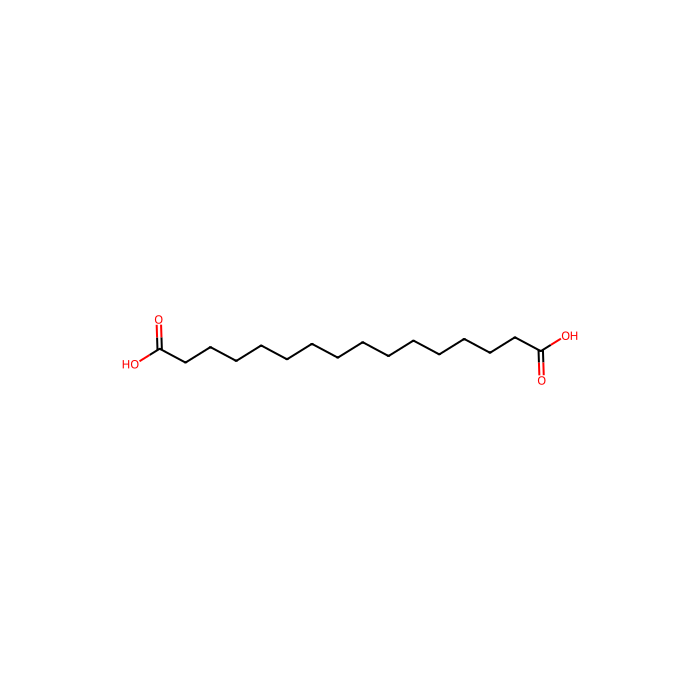
Brief overview: Hexadecanedioic acid (also known as thapsic acid; 1,16-hexadecanedioic acid) is a long-chain aliphatic α,ω-dicarboxylic acid (C16 backbone) used as a polymer/monomer building block and hydrophobic linker.
Item-specific facts (from Product Data):
CAS: 505-54-4
PubChem CID: 10459
InChIKey: 303715 (as provided)
Storage: Room temperature; shipped under normal conditions
Literature/computed identity (for reference; not item-specific specs):
Synonyms: 1,16-hexadecanedioic acid; thapsic acid
Molecular formula (literature): C16H30O4
Molecular weight (literature): ~286.41 g/mol
SMILES (literature): O=C(O)CCCCCCCCCCCCCC(=O)O
InChIKey (literature): commonly reported as WQOBZPGKQHZALJ-UHFFFAOYSA-N
Structural features (general description):
Functional groups: Two terminal carboxylic acids (–CO2H) separated by a saturated methylene chain of fourteen –CH2– units (α,ω-diacid).
No heteroatoms in the backbone besides the two carboxyl oxygens; no rings, no unsaturation, no stereocenters.
2D structure in words: HOOC–(CH2)14–COOH; linear polymethylene chain bearing a carboxyl group at each terminus. The long aliphatic segment imparts hydrophobicity; the termini provide acidity and sites for condensation (ester/amide) chemistry.
Notes:
Where identity elements are not specified for this item, consult the product CoA/Spec Sheet. The literature values above are provided to assist with planning and method development.
Synthetic Utility
Functional group leverage:
Dual carboxylic acids positioned at C‑1 and C‑16 provide two independent acyl handles for step‑growth polymerizations, crosslinking, and bifunctional coupling.
Key transformations (literature):
Activation to acid chlorides: SOCl2 or (COCl)2 (DMF catalytic) → 1,16‑bis(acyl chloride); cornerstone for amide formation with diamines and for Friedel–Crafts acylations on aromatics.
Esterifications: Fischer (ROH/H+), Steglich (DCC or EDC·HCl/DMAP), or Mitsunobu (with diols) to furnish symmetric/asymmetric diesters; useful plasticizers and pro-moieties in materials.
Reductions: LiAlH4 or BH3·THF to 1,16‑hexadecanediol; NaBH4 generally insufficient without activation. Catalytic hydrogenation of corresponding diesters offers a milder route to diols.
Couplings via CDI: Formation of N‑acyl imidazolides enables amide formation under mild, base-assisted conditions; advantageous with base-sensitive amines.
Serves as a hydrophobic, conformationally flexible spacer. Incorporation into macromolecules modulates T_g, crystallinity, and permeability.
In surface chemistry, the α,ω‑diacid builds dense carboxylate-terminated monolayers on metal oxides (via salt formation) or provides anchor points after conversion to phosphonates/silanes.
Analytical note: Convert to diesters for GC analysis; assess conversion by acid number or 1H NMR (disappearance of broad CO2H signal, emergence of ester methoxy/ethyl resonances).
Target Specificity
Not applicable. This product is a small-molecule chemical (α,ω‑dicarboxylic acid) and does not possess biological target specificity like antibodies, enzymes, or receptor ligands. For application-relevant details, refer to the Synthetic Utility and Reaction & Applications sections.
Frequently Asked Questions
How should this product be stored?
Store at room temperature.
How is this product shipped?
This product ships under standard ambient conditions. No temperature-controlled packaging is required.
What are the CAS number, molecular formula and molecular weight?
The CAS Number is 505-54-4, the molecular formula is C16H30O4, and the molecular weight is 286.41 g/mol. InChIKey QQHJDPROMQRDLA-UHFFFAOYSA-N.
What documentation is provided?
Available product documentation, including Certificates of Analysis (COA), Safety Data Sheets (SDS), and specification sheets, is shown in the product document area. Document availability and access follow the current site policy.
We use cookies to ensure the website functions properly and, where permitted, to improve your experience. You can manage your preferences at any time in Settings. Learn more in our Cookie Policy.
Shall we send you a message when we have discounts available?
Remind me later
Thank you! Please check your email inbox to confirm.
Products are supplied to verified businesses, institutions, and qualified professionals for research and development use only. Not for use in humans, animals, diagnosis, or therapy.

 K2103114