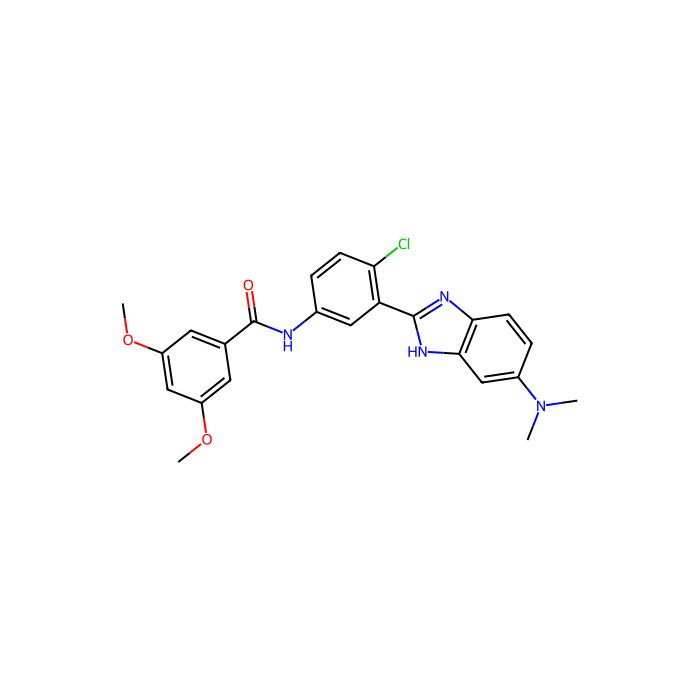
This compound belongs to the class of organic compounds known as phenylbenzimidazoles. These are compounds containing a phenylbenzimidazole skeleton, which consists of a benzimidazole moiety where its imidazole ring is attached to a phenyl group.
External Descriptors
Not available
1. Djoumbou Feunang Y, Eisner R, Knox C, Chepelev L, Hastings J, Owen G, Fahy E, Steinbeck C, Subramanian S, Bolton E, Greiner R, and Wishart DS. ClassyFire: Automated Chemical Classification With A Comprehensive, Computable Taxonomy. Journal of Cheminformatics, 2016, 8:61.
insoluble in H2O; ≥13.3 mg/mL in DMSO; ≥52.3 mg/mL in EtOH with gentle warming
Molecular Weight
450.900 g/mol
XLogP3
4.700
Hydrogen Bond Donor Count
2
Hydrogen Bond Acceptor Count
5
Rotatable Bond Count
6
Exact Mass
450.146 Da
Monoisotopic Mass
450.146 Da
Topological Polar Surface Area
79.500 Ų
Heavy Atom Count
32
Formal Charge
0
Complexity
626.000
Isotope Atom Count
0
Defined Atom Stereocenter Count
0
Undefined Atom Stereocenter Count
0
Defined Bond Stereocenter Count
0
Undefined Bond Stereocenter Count
0
The total count of all stereochemical bonds
0
Covalently-Bonded Unit Count
1
Solution Calculators
Molarity Calculator
Determine the necessary mass, volume, or concentration for preparing a solution.
Dilution Calculator
Determine the dilution needed to prepare a stock solution.
Reconstitution Calculator
Reviews
Customer Reviews
Application Protocols
No tested applications, concentrations, or protocol specifications are provided in the product data for this item.
General starting points for cell-based assays (guidance only; not item-specific):
Stock preparation: Dissolve in anhydrous DMSO to 10–50 mM; vortex and, if needed, sonicate briefly. Filter through 0.22 µm low-binding membrane if particulates persist.
Working concentrations: Typical ranges for pathway antagonists are 0.01–10 µM in cells. Establish dose–response curves (≥10 points, 3-fold serial dilutions) to determine cellular potency in your system.
Treatment: Pre-incubate 0.5–2 h before pathway stimulation; maintain constant vehicle percentage across all wells.
Controls: Include vehicle control, a known orthogonal Hh inhibitor, and a cytotoxicity readout (e.g., CellTiter, resazurin) to separate on-target effects from general toxicity.
Data quality: Use replicates (n≥3), randomize plate layout, and include inter-plate controls for normalization.
These are general guidelines. Optimize empirically for each cell line/assay. For definitive instructions, consult the literature for the specific CAS/CID and your internal SOPs.
Biological Roles
Context (general biology): The Hedgehog (Hh) pathway orchestrates embryonic development and adult tissue homeostasis. Canonically, PTCH1 represses SMO (Smoothened); binding of Hh ligands (e.g., SHH) to PTCH1 releases this repression, enabling SMO to signal to GLI transcription factors and induce Hh-responsive genes.
Role of antagonists (tool-compound perspective):
Hh-pathway antagonists are used to down-modulate the pathway in cells and model organisms. Depending on chemotype, they typically act by inhibiting SMO or blocking downstream GLI-mediated transcription (non-canonical antagonism also exists). This enables dissection of pathway dependencies, feedback regulation, and crosstalk with WNT, Notch, and TGF-β signaling.
What is known for this item:
Specific molecular target and binding mechanism: Not specified for this item; refer to CoA/primary literature corresponding to the CAS/CID and verify experimentally.
Practical deployment (general guidance):
Common assays: GLI-luciferase reporter activity, qPCR for GLI1/PTCH1 induction, immunoblot for GLI processing, and phenotypic readouts in stem/progenitor cell systems.
Controls: Pair with an orthogonal Hh-pathway inhibitor (e.g., a GLI antagonist if testing a putative SMO inhibitor, or vice versa) and include vehicle controls to deconvolute off-target effects.
Kinetics: Pre-incubation (0.5–2 h) before pathway stimulation can improve reproducibility if the compound acts upstream at membrane-level targets.
All uses are for research only; no medical or clinical claims are made or implied.
Buffer Applications
This product is not a buffering agent. However, buffers are central to its biological assay use.
General buffer guidance for bioactive small molecules:
Dilution medium: PBS, HBSS, or complete culture media (e.g., DMEM + serum) are typical recipients for DMSO-based stocks. Pre-warm buffers (25–37°C) and add stock slowly with vigorous mixing to reduce precipitation.
DMSO fraction: Maintain final DMSO at the lowest feasible level (often ≤0.1–0.5% v/v) to minimize vehicle effects. Always include matched vehicle controls.
Additives: Where solubility is marginal, 0.01–0.05% non-ionic surfactant (e.g., Tween 80) or 0.1% BSA can help maintain dispersion; verify no interference with readouts.
pH and osmolarity: Maintain physiologic pH (7.2–7.4) and compatible osmolarity for cell-based assays; avoid carbonate buffers in ambient CO2 unless controlled.
Item-specific buffer formulations, pKa, and solubility: Not specified for this item; refer to CoA/Spec Sheet and pilot solubility tests.
Green Alternatives
While this product is a bioactive tool rather than a bulk solvent or reagent, you can reduce environmental impact in its use by optimizing solvent and process choices.
Greener handling strategies (general guidance):
Prefer aqueous delivery: Use the minimal DMSO fraction that maintains solubility (often ≤0.1–0.2% v/v in the final assay) and avoid secondary organic co-solvents when possible.
Miniaturize assays: Move to 384-/1536-well formats to reduce compound and solvent consumption by 5–20× versus 96-well.
Solvent selection for cleaning/rinsing: Replace chlorinated solvents with ethanol/isopropanol or water-based detergents when compatible with the compound and equipment.
Inventory management: Prepare small, single-use aliquots to minimize freeze–thaw waste and degradation.
Illustrative comparison (general, not item-specific):
DMSO vs DMF: DMSO is typically preferred for biological stocks due to lower volatility/odor and better biocompatibility; DMF is less favored from a worker-exposure standpoint.
Ethanol vs acetonitrile for dilution: Ethanol is generally more biocompatible and greener; acetonitrile should be minimized in live-cell systems.
Waste minimization:
Consolidate organic waste streams and avoid unnecessary rinses. Validate lowest effective assay concentration to limit compound mass entering waste.
Pharmaceutical Uses
No pharmacopeial status, excipient role, or formulation specifications are provided for this item.
Research/discovery context only (no therapeutic claims):
Tool compound: Frequently used as a reference antagonist in discovery biology to probe Hedgehog-pathway involvement in cellular processes.
ADME/DMPK exploration: Where structure is available, researchers may profile solubility, permeability, metabolic stability, and protein binding as part of lead-identification campaigns. None of these parameters are specified for this item.
Reference standard: May serve as an analytical or bioassay standard in method development; confirm identity/purity with the CoA and, if necessary, with internal reference materials.
Regulatory note:
This material is labeled for research use only. It is not intended for human or veterinary use, nor for diagnostic or therapeutic applications. Any preformulation or developability studies should remain within a nonclinical research framework and adhere to institutional safety and waste-handling policies.
Physical Properties
Item-specific specs provided: none.
Appearance: Not specified for this item; refer to CoA/Spec Sheet.
Melting point (MP): Not specified for this item; refer to CoA/Spec Sheet.
Boiling point (BP): Not specified for this item; refer to CoA/Spec Sheet.
Density: Not specified for this item; refer to CoA/Spec Sheet.
LogP/logD: Not specified for this item; refer to CoA/Spec Sheet.
pKa: Not specified for this item; refer to CoA/Spec Sheet.
Refractive index/UV cutoff: Not specified for this item; refer to CoA/Spec Sheet.
Solubility: Not specified for this item; refer to CoA/Spec Sheet.
General guidance for small, hydrophobic bioactive tool compounds (literature/common practice; not item-specific):
Many Hedgehog-pathway antagonists are moderately to highly lipophilic and are typically dissolved first in anhydrous DMSO to prepare concentrated stocks (e.g., 10–50 mM), then diluted into assay buffers, maintaining final DMSO ≤0.1–0.5% v/v as tolerated by the biological system.
If precipitation occurs upon dilution, add compound to warm buffer dropwise under vortexing, or include a minimal amount of co-solvent (DMSO, ethanol) compatible with the assay. Filter-sterilization through low-protein-binding 0.22 µm membranes can help remove particulates.
Light/air sensitivity varies by scaffold; protect from strong light and minimize repeated freeze–thaw to preserve integrity.
Always rely on the SDS/CoA for authoritative physicochemical and handling details for the specific lot.
Quality & Grades
Grade/Purity: Not specified for this item; refer to CoA/Spec Sheet.
How to interpret grade/purity when provided (general guidance):
Research grade: suitable for discovery biology and routine chemical experiments; typical documentation includes HPLC/UPLC purity and MS/NMR identity checks.
High (e.g., ≥95–98%) purity: preferred for quantitative biology, target-validation studies, and SAR, reducing confounding from impurities.
Stabilizers: If present, they will be disclosed on the CoA/label; stabilizers can influence assay baselines or spectroscopic backgrounds. None are specified for this item.
UV/LC suitability: If designated as HPLC grade or LC-MS qualified, expect low non-volatile residues and minimized background; not specified for this item.
Recommended verification for this product:
Review the lot-specific CoA for assay method (e.g., HPLC conditions), purity percentage, and ID spectra. If you require a specific analytical threshold (e.g., chiral purity, residual solvent profile), communicate this before ordering so we can confirm availability.
Documentation provided by Aladdin Scientific typically includes: CoA with purity and identity data; SDS for safety; and, upon request, additional QA information where available.
Reaction & Applications
This product is sold as a bioactive research tool (small-molecule library member) rather than as a synthetic reagent. No manufacturer-provided chemical reaction applications are listed.
Relevance to research workflows (general usage):
Hedgehog pathway studies: Employed as a negative modulator in biochemical and cell-based assays to probe pathway dependence, target validation, and chemical genetics. Typical readouts include GLI-reporter activity, qPCR of Hh-responsive genes, and phenotypic markers.
Screening and SAR: Can serve as a reference/positive control antagonist when benchmarking new chemotypes or during high-content screens.
If using in chemistry workflows:
Without structure/functional-group disclosure, there are no actionable synthetic or catalytic applications to recommend. Do not assume reactivity profiles; consult the CoA/structure and primary literature before any derivatization or coupling chemistry.
Please see Biological Roles and Application Protocols (where applicable) for assay-centered guidance.
Reaction Conditions
Not applicable for this product’s primary use. No manufacturer-provided chemical reaction conditions are associated with HhAntag in this listing.
If you intend to use it in chemical reactions or conjugations:
Obtain the full structure and confirm functional-group compatibility, solvent stability, and thermal limits from the CoA and primary literature.
Pilot small-scale trials with analytical monitoring (LC-MS/HPLC) are recommended to evaluate stability under proposed conditions.
For biological experiments, refer instead to Solvent Selection, Biological Roles, and Application Protocols.
Safety & Handling
Authoritative safety data for this item are not provided in the product data and should be taken from the SDS for your received lot.
Item-specific hazard fields:
GHS classification: Not specified for this item; refer to SDS.
Signal word and H-statements: Not specified for this item; refer to SDS.
Pictograms: Not specified for this item; refer to SDS.
General laboratory precautions for small-molecule bioactives (guidance only):
PPE: lab coat, safety glasses, and suitable gloves (e.g., nitrile). Avoid inhalation and skin/eye contact. Handle powders in a fume hood to prevent dust exposure.
Avoid incompatibilities typical of organic compounds: strong oxidizers, strong acids/bases, and excessive heat. Do not autoclave organic solutions.
First aid (overview; defer to SDS): rinse eyes/skin with water for ≥15 minutes if contacted; move to fresh air after inhalation; seek medical attention as needed. If ingested, rinse mouth; do not induce vomiting unless directed by medical personnel.
Spill/accidental release: avoid dust; collect with inert absorbent, place in compatible container for disposal according to institutional and local regulations.
Waste: dispose via approved chemical waste streams; do not discharge to drains.
Special notes:
Tool compounds may exhibit potent bioactivity at low concentrations. Prevent cross-contamination, label clearly, and segregate from food/clinical areas. For definitive hazard and toxicological information, consult the SDS.
Solvent Selection
Applicability: As a bioactive small molecule, HhAntag is typically handled as a concentrated stock in an organic solvent before dilution into assay media. Compound-specific solubility is not provided; use the guidance below as general best practice.
Solvent strategy (general, literature-based for hydrophobic tool compounds):
Primary stock solvent: anhydrous DMSO is commonly used for 10–50 mM stocks due to broad solvating power and biological compatibility at low final percentages.
Secondary options: DMF or ethanol can be used for initial dissolution, but verify compatibility with your assay and plastics.
Aqueous media: dilute stocks into PBS, HBSS, or culture media slowly under agitation; keep final DMSO ≤0.1–0.5% v/v when possible. Pre-warm buffers to reduce precipitation.
Surfactant-assisted delivery: 0.01–0.05% v/v non-ionic surfactants (e.g., Tween 80 or Pluronic F-68) may help maintain dispersion in some cellular assays; confirm no pathway interference.
Practical tips:
Perform a quick solubility screen (visual + nephelometry) across a solvent panel (DMSO, MeOH, EtOH, DMF, acetonitrile) and common buffers.
Use low-binding polypropylene tubes and low-protein-binding filters to minimize adsorption losses.
For long incubations, confirm compound stability in the chosen medium by LC-MS or HPLC time-course.
Comparison (general):
DMSO: highest success rate for stocks; good biological tolerance at ≤0.5%.
Ethanol: acceptable in some enzyme assays; may affect cells at ≥0.5–1%.
Acetonitrile: strong solvent but less cell-compatible; limit to ≤0.1–0.2% where used.
General reconstitution and handling (guidance; not item-specific):
Upon receipt: Allow the sealed container to equilibrate to room temperature before opening to prevent condensation. If supplied as a solid, minimize exposure to ambient humidity.
Initial dissolution: Prepare concentrated stocks in anhydrous DMSO (e.g., 10–50 mM) unless your CoA/Spec Sheet specifies otherwise. Record exact concentration and date.
Aliquoting: Dispense single-use aliquots into low-binding tubes to avoid repeated freeze–thaw cycles. Typical aliquot volumes are 10–100 µL depending on usage frequency.
Storage of stocks: Store aliquots at -20°C (or per CoA). Protect from light if the scaffold contains chromophores; use amber vials when in doubt.
Stability checks: Periodically assess by LC-MS/HPLC for degradation, especially after >6 months or multiple freeze–thaws.
Thawing/usage: Thaw on ice or at room temperature, mix gently, and avoid vigorous aeration. Do not refreeze partially used aliquots; discard according to chemical-waste protocols.
Any item-specific reconstitution solvent, concentration limit, or stability data: Not specified for this item; refer to CoA/Spec Sheet.
Structure & Identity
Brief overview: HhAntag (SKU H126037) is supplied as a research-use small molecule listed in our small-molecule/compound library category and commonly referenced as a Hedgehog-pathway antagonist.
Item-specific identifiers (from Product Data):
CAS: 496794-70-8
PubChem CID: 9911630
InChIKey: 355370 (as provided)
SMILES: Not specified for this item; refer to CoA/Spec Sheet.
Molecular formula: Not specified for this item; refer to CoA/Spec Sheet.
Molecular weight: Not specified for this item; refer to CoA/Spec Sheet.
Structural features:
Functional groups, ring systems, and stereochemistry: Not specified for this item; refer to CoA/Spec Sheet.
2D structure description (general note):
The detailed 2D connectivity, heteroatoms, and substitution pattern are not provided in the product data. For structural confirmation (and to support analytical ID), please consult the CoA/Spec Sheet or query the cited CAS/CID in primary databases and verify against your internal QA requirements.
Best practice for identity verification in the lab:
Acquire supplier CoA and, if needed, confirm by orthogonal methods (e.g., 1H/13C NMR, HRMS, LC-MS, and HPLC/UPLC purity profile). Where target engagement studies are planned, consider validating identity/purity against a qualified reference lot to ensure assay reproducibility.
Synthetic Utility
Not typically applicable. This product is offered as a bioactive small-molecule tool rather than a synthetic building block or reagent.
Guidance if derivatization is contemplated:
Structural information (functional groups, reactive handles, stereocenters) is not provided in the product data. Do not plan synthetic modifications without first obtaining and verifying the full structure and purity profile (CoA, NMR, HRMS).
If using for probe development (e.g., biotinylation, photoaffinity tags), assess SAR to ensure modifications occur at positions tolerant to substitution and that target engagement is retained.
For most users, see Biological Roles and Application Protocols for relevant, assay-focused use.
Target Specificity
Only provide target details if explicitly supported by product data. For this listing:
Intended biological target, binding site/mode, and selectivity profile: Not specified for this item; refer to CoA/primary literature tied to CAS 496794-70-8 / CID 9911630.
General note for Hedgehog-pathway antagonists:
Common targets include Smoothened (SMO) and downstream GLI transcriptional machinery, but specificity and off-target profiles vary widely by chemotype. Always verify target engagement experimentally (e.g., CETSA/thermal shift, NanoBRET, reporter assays) and include orthogonal inhibitors as controls.
Frequently Asked Questions
What is the purity of this product?
This product is supplied at ≥98% purity (chemical assay). Lot-specific values are stated on the Certificate of Analysis.
How should this product be stored?
Store at ?20 °C. Freezer storage is required to maintain the specified shelf life.
How is this product shipped?
This product ships in an insulated container with ice pads. Unpack on arrival and transfer it to the storage condition stated above.
What are the CAS number, molecular formula and molecular weight?
The CAS Number is 496794-70-8, the molecular formula is C24H23ClN4O3, and the molecular weight is 450.92 g/mol. InChIKey UBHJFPVTEATUFS-UHFFFAOYSA-N.
What documentation is provided?
Available product documentation, including Certificates of Analysis (COA), Safety Data Sheets (SDS), and specification sheets, is shown in the product document area. Document availability and access follow the current site policy.
We use cookies to ensure the website functions properly and, where permitted, to improve your experience. You can manage your preferences at any time in Settings. Learn more in our Cookie Policy.
Shall we send you a message when we have discounts available?
Remind me later
Thank you! Please check your email inbox to confirm.
Products are supplied to verified businesses, institutions, and qualified professionals for research and development use only. Not for use in humans, animals, diagnosis, or therapy.