Determine the necessary mass, volume, or concentration for preparing a solution.
Dilution Calculator
Determine the dilution needed to prepare a stock solution.
Reconstitution Calculator
Reviews
Customer Reviews
Application Protocols
No manufacturer-tested application protocols are provided for this item. The following general, non-binding guidance reflects common practice with neutral, poorly water-soluble small molecules (literature/general):
DMSO stock preparation:
Calculate the desired stock (e.g., 50 mM). Weigh the required mass quickly in a low-humidity environment. Dissolve in anhydrous DMSO. Vortex and, if needed, warm gently (≤40 °C) to aid dissolution.
Aliquot into amber vials or microtubes to minimize freeze–thaw cycles. Store at −20 °C.
Aqueous assay dilution:
Add the DMSO stock to pre-warmed buffer while vortexing to a final DMSO content ≤0.1–1% v/v (as assay-tolerated). Inspect for precipitation; if present, increase mixing time, slightly elevate temperature, or include a small percentage of ethanol or a non-ionic surfactant if compatible.
LC-MS reference standard preparation:
Prepare 1–10 µg/mL working solutions in MeCN/H2O (1:1) with 0.1% formic acid (if MS-positive mode) freshly before use. Store short-term solutions on ice and protect from light.
Solid handling for synthesis:
For reactions sensitive to moisture, dry the solid under high vacuum over P2O5 or in a desiccator prior to use. Employ an inert atmosphere for transformations involving strong nucleophiles or reductants.
Always validate concentrations by UV or qNMR when quantitative accuracy is required. Follow your institution’s safety and waste disposal protocols.
Biological Roles
Context (literature/general biology; no clinical claims):
Natural occurrence: Hinokinin is a lignan reported from various plant sources (e.g., Cupressaceae and other families), where lignans often serve as defense metabolites and structural components influencing plant–pathogen interactions.
Chemical family features: Dibenzylbutyrolactone lignans commonly display redox-active aromatic frameworks and stabilized benzylic linkages; their methylenedioxy groups modulate electronic properties and metabolic liability.
Metabolism (general): In mammalian systems, analogous methylenedioxy aromatics can undergo oxidative O-demethylenation (yielding catechols) and subsequent phase II conjugation (glucuronidation/sulfation). The lactone can be susceptible to hydrolysis in alkaline environments or to metabolic opening via esterases (literature/general concepts).
Biophysical properties: Moderate lipophilicity and neutral charge favor membrane permeability in model systems, while limited aqueous solubility necessitates co-solvent use. The conjugated aromatic system confers measurable UV absorption for tracking in bioanalytical assays.
Research uses: As a chemical probe or reference standard in studies of lignan biosynthesis, plant chemotaxonomy, and xenobiotic metabolism. It can serve as a substrate in enzyme assays exploring oxidative demethylenation or lactone hydrolysis pathways.
Note: These roles are presented as general biochemical context drawn from lignan literature. This product is supplied strictly for research use only, as stated in the Product Data.
Buffer Applications
Hinokinin is not a buffering reagent and does not form classical buffer systems.
Practical guidance for assays (literature/general):
Use standard biological buffers (e.g., PBS, HEPES, Tris) as dictated by your assay. Pre-dissolve Hinokinin in a suitable co-solvent (commonly DMSO or ethanol), then add to the buffer with vigorous mixing to achieve the desired final concentration while keeping co-solvent content low (typically ≤0.1–1% v/v).
To mitigate precipitation in aqueous buffers, consider adding non-ionic surfactants at low levels (e.g., 0.01–0.05% Tween 80) if compatible with the assay, or increase the percentage of an organic modifier (e.g., 2–5% ethanol) within tolerance.
If your application requires a specific pH environment for stability tests (e.g., lactone hydrolysis kinetics), prepare conventional buffers spanning the target pH (citrate, phosphate, borate) and monitor compound integrity by HPLC/LC-MS over time.
Green Alternatives
Greener handling strategies for Hinokinin focus on solvent choice and process minimization (literature/general guidance):
Stock solutions: Prefer EtOH over DMSO when assay systems tolerate it (EtOH is a preferred green solvent). Use minimal DMSO percentages (≤0.1–0.5%) when necessary.
Workups and chromatography: Replace dichloromethane (DCM) with ethyl acetate (EtOAc) where solubility allows. For normal-phase flash, use heptane/EtOAc instead of hexane/DCM systems.
Reactions: Consider 2-methyltetrahydrofuran (2-MeTHF) or cyclopentyl methyl ether (CPME) as alternatives to THF/MTBE; employ MeCN or EtOAc instead of DCM when feasible. Aqueous MeOH/EtOH can be effective for lactone ring-opening/reclosing sequences.
Purification: Explore recrystallization from EtOAc/hexane or EtOAc/ethanol mixtures to reduce silica waste. If reversed-phase is needed, optimize gradients to minimize solvent volumes and switch to MeOH–water when selectivity permits.
Energy use: The compound is stable as a solid; avoid unnecessary cold-chain during short laboratory transfers. However, follow the specified -20 °C storage for long-term quality.
Illustrative comparison (literature/general):
DCM vs EtOAc: EtOAc lower toxicity, biodegradable, renewable routes available; slightly reduced solvency power versus DCM — may require higher volumes or temperature.
THF vs 2-MeTHF: 2-MeTHF is biomass-derived and less prone to peroxide issues; slightly different polarity/selectivity.
Hexane vs Heptane: Heptane is less volatile and often a safer choice with comparable chromatographic performance.
Trade-offs: Greener solvents can alter solubility and selectivity; run small-scale trials and validate analytical methods when switching media.
Pharmaceutical Uses
No excipient or pharmacopeial role is specified for this item; refer to the CoA/Spec Sheet for any regulatory notes. This product is supplied for research use only.
Reference standard: Used in analytical development and impurity profiling of plant-derived materials containing lignans. Establishes retention time, UV spectra, and MS response factors in QC methods.
Preclinical discovery chemistry: Serves as a scaffold for generating analog libraries in medicinal chemistry campaigns, enabling SAR around the dibenzylbutyrolactone core (no therapeutic claims implied).
Formulation research: Solubility and stability studies in various vehicles (co-solvent systems, cyclodextrin complexes) can be performed to understand delivery of neutral, moderately lipophilic natural products. Data inform general formulation strategies for lignan-like chemotypes.
Process development models: Reaction optimization for selective demethylenation or lactone modifications may provide tactics applicable to related natural products.
Important: Do not use in humans or clinical diagnostics. For any regulated pharmaceutical workflows, ensure materials meet appropriate compendial standards; this product is not represented as USP/EP grade unless explicitly stated (not specified for this item).
Physical Properties
Item-specific specifications (this product):
Appearance: Not specified for this item; refer to CoA/Spec Sheet.
Molecular formula: Not specified for this item; refer to CoA/Spec Sheet.
Molecular weight: Not specified for this item; refer to CoA/Spec Sheet.
Literature/general or computed values (for reference only; not product specifications):
Phase/solid-state: Organic solid at ambient conditions (literature/typical for lignans).
Melting point: Reported ~132–135 °C (literature; values may vary with purity and polymorph).
Boiling point: Not commonly reported due to thermal decomposition of lignans before boiling under atmospheric pressure (literature note).
Solubility profile: Sparingly soluble in water; soluble in polar aprotic and some protic organic solvents (e.g., DMSO, DMF, acetone, MeOH, EtOH, EtOAc) (literature/general).
LogP/cLogP: Moderate lipophilicity consistent with a dibenzylbutyrolactone bearing two benzodioxoles (typical cLogP in the ~3 range reported in cheminformatics sources; literature/computed, source-dependent).
UV-vis characteristics: Aromatic chromophores and methylenedioxy groups give UV absorption in the near-UV (e.g., 210–290 nm regions); exact maxima depend on solvent and conditions (literature/general).
pKa: No strongly ionizable centers; the lactone is neutral under physiological pH; phenolic pKa not applicable due to acetal-like methylenedioxy protection (literature/general).
Stability: Generally stable as a solid when protected from light, heat, and moisture; can undergo hydrolysis of the lactone under strong basic conditions or oxidative opening of methylenedioxy rings (literature/general).
Notes for planning experiments:
Prepare concentrated DMSO stock solutions (e.g., 10–50 mM) for biological or analytical assays; dilute into aqueous buffers with co-solvent to minimize precipitation (good laboratory practice).
Quality & Grades
Item-specific quality details:
Grade/Purity: Not specified for this item; refer to CoA/Spec Sheet.
Stabilizers/additives: Not specified for this item; refer to CoA/Spec Sheet.
Appearance and assay methods: Not specified for this item; refer to CoA/Spec Sheet.
Interpretation and expectations (general guidance for lignan standards and library compounds):
Small-molecule library compounds are commonly supplied at high chemical purity (often ≥95% by HPLC/UPLC) with identity confirmed by NMR and/or HRMS. When purity is not listed, verify by requesting the CoA and chromatogram.
If provided as a free-flowing solid, visual appearance may range from off-white to tan due to trace impurities or polymorphism; color alone is not a reliable purity indicator.
Chromatographic suitability: Researchers performing LC-UV or LC-MS profiling should check UV blank levels and mass-spectral cleanliness in the CoA. For UV assays, the methylenedioxyphenyl chromophore typically affords strong absorbance around 230–290 nm (literature note).
Residual solvents and water: If Karl Fischer (KF) or residual solvent specs are required for sensitive applications, confirm on the CoA. Do not assume water or solvent limits in the absence of stated specifications.
Impurity profile: For natural product standards, isomeric or closely related lignans can co-elute; ensure method resolution and check for known congeners (e.g., demethylenated catechols) when developing analytical methods.
Recommendation: For quantitative work (e.g., standard curves, biological SAR), request and retain the batch-specific CoA/SDS and, where necessary, perform in-house verification (qNMR or orthogonal HPLC).
Reaction & Applications
Applications (research/lab use only):
Reference standard: Used as a calibrant or identity control for lignan profiling in plant extracts and metabolomics (literature/general).
SAR/derivatization scaffold: The dibenzylbutyrolactone core allows systematic modification at the lactone (ring opening/closing) and on the aryl methylenedioxy rings (demethylenation to catechols), enabling structure–property studies (literature/general).
Analytical marker: Distinct UV and MS signatures make it suitable as a marker compound in quality control of botanical materials (literature/general).
Reactivity notes (literature/general):
Lactone chemistry: The γ-lactone can undergo base- or nucleophile-promoted ring opening to yield hydroxyacids or ester derivatives; subsequent re-lactonization provides an entry to analog series.
Methylenedioxy units: Subject to oxidative or Lewis-acid-mediated ring opening to catechols, which can be further diversified (e.g., alkylation, acylation, etherification). Selectivity and conditions must be tuned to avoid over-oxidation.
Benzylic positions: Susceptible to hydrogenolysis/oxidation under forcing conditions; careful catalyst/oxidant choice (Pd/C, MnO2, DDQ) can effect transformations without destroying the lactone.
Practical tips:
Maintain neutral to mildly acidic conditions during manipulations to preserve the lactone. Strong base promotes hydrolysis.
Protect from prolonged UV exposure; methylenedioxy motifs can photodegrade or isomerize under intense light.
For LC-MS assays, prepare fresh working solutions from concentrated DMSO stocks to minimize adsorption losses and precipitation.
Note: No medical or clinical applications are implied; usage is restricted to research and laboratory studies.
Reaction Conditions
General literature guidance for common transformations of dibenzylbutyrolactone lignans (not product specifications):
Lactone ring opening and reclosure:
Conditions: NaOMe in MeOH (0.5–1.0 M) or K2CO3/MeOH at reflux (1–6 h) to yield methyl hydroxyester; aqueous base (NaOH, 0.5–1.0 M) in MeOH/H2O for hydroxyacid. Work under inert atmosphere if sensitive functionalities are present.
Re-lactonization: Acid-catalyzed cyclization (p-TsOH in toluene or Dean–Stark; or CDI/DMAP-mediated dehydration) at 25–110 °C, 1–12 h.
Demethylenation to catechols:
Oxidative: Ceric ammonium nitrate (CAN, 1.5–3.0 equiv) in MeCN/H2O (9:1), 0–25 °C, 0.5–3 h; monitor closely to avoid over-oxidation. Alternative Lewis acids/iodonium systems are reported in lignan literature.
Follow-up: Protect catechols immediately (e.g., di-carbonate formation with triphosgene or carbonate reagents) if further steps are planned.
Hydrogenation/hydrogenolysis (benzylic tuning):
Conditions: H2 (1–3 bar) with Pd/C (5–10 wt% relative to substrate) in EtOAc, EtOH, or MeOH at 25–50 °C, 2–16 h. Check for potential lactone opening under basic impurities; pre-wash catalyst.
Oxidations at benzylic positions:
Reagents: MnO2 (activated), DDQ, or IBX in DCM/MeCN; 0–25 °C to reflux, 1–24 h. Control stoichiometry to preserve methylenedioxy groups.
Workup and analysis:
Quench oxidants with aqueous reductants (Na2S2O3) as needed; extract with EtOAc. Dry over Na2SO4 and concentrate under reduced pressure. Purify by flash (hexanes/EtOAc) or RP-HPLC. Monitor by TLC (UV-active) and LC-MS.
Expected yields: Highly condition- and substrate-dependent; small-scale scouting recommended. Literature reports for these families typically range from moderate to high yields when side reactions are controlled.
Safety & Handling
Authoritative safety classification for this specific item:
Signal word: Not specified for this item; refer to CoA/Spec Sheet and SDS.
H-statements: Not specified for this item; refer to CoA/Spec Sheet and SDS.
GHS classification: Not specified for this item; refer to CoA/Spec Sheet and SDS.
Pictograms: Not specified for this item; refer to CoA/Spec Sheet and SDS.
General safety guidance (literature/general best practice):
Hazards: Organic solids of this class may cause irritation upon contact or inhalation of dust. Avoid generating dust/aerosols. While lignans are widely studied, treat as potentially harmful if swallowed or upon skin/eye exposure. No peroxide-forming tendency is expected (no ether solvent functionality).
Personal protection: Wear suitable lab coat, nitrile gloves, and safety glasses. Use local exhaust ventilation or a fume hood when weighing, dissolving, or handling powders/solutions.
Storage incompatibilities: Avoid strong bases (risk of lactone hydrolysis), strong oxidizers (risk of aromatic oxidation/demethylenation), and prolonged exposure to light/UV (possible photodegradation of methylenedioxy motifs). Keep container tightly closed with desiccant if feasible.
First aid (overview; consult SDS): If inhaled, move to fresh air; if on skin, wash with soap and water; if in eyes, rinse cautiously with water for several minutes and seek medical attention if irritation persists; if ingested, rinse mouth and seek medical advice.
Spill/leak: Avoid dust, collect mechanically and place in suitable container. Wash spill area with appropriate solvent and detergent while observing waste regulations.
Fire-fighting: Use CO2, dry chemical, or foam. Combustion can produce CO, CO2, and irritating fumes typical of aromatic oxygenates.
Always consult the product SDS for definitive hazard, exposure limits, and emergency measures.
Solvent Selection
Hinokinin is a neutral, moderately lipophilic aromatic lactone. It is poorly soluble in water but dissolves in many organic solvents.
Good solvents: DMSO, DMF, acetone, acetonitrile, dichloromethane (DCM), ethyl acetate, methanol, ethanol, 2-propanol (solubility decreases with alcohol hydrophobicity beyond EtOH).
Limited solvents: Toluene, hexanes (solubility may be modest; can be used for crystallization or trituration).
Aqueous media: Use co-solvents or surfactants; pre-dissolve in DMSO then dilute into buffer (final DMSO often ≤0.1–1% v/v in assays).
When to choose which solvent (use-case driven):
Bioassays/stock prep: DMSO stocks (10–50 mM) for accurate pipetting and storability; dilute into aqueous buffers last to avoid precipitation.
Chromatography: Normal-phase flash often effective with hexanes/EtOAc gradients; reversed-phase prep/analytical HPLC with MeCN/H2O or MeOH/H2O (0.05–0.1% acid modifier aids peak shape), monitoring 230–290 nm.
Reactions on the scaffold: For base-sensitive lactone, prefer aprotic solvents (DCM, MeCN, THF, 2-MeTHF, EtOAc). For hydrogenation or ring-opening, alcohols (MeOH, EtOH) can be practical.
Comparison (literature/general):
DMSO vs DMF: DMSO preferred for stocks (lower volatility, better biocompatibility at low %); DMF for coupling chemistry.
DCM vs EtOAc: DCM offers higher solubility and fast evaporation; EtOAc is greener and often sufficient for workups and crystallizations.
MeCN vs MeOH for LC: MeCN may give sharper peaks and lower backpressure; MeOH offers stronger H-bonding interactions and different selectivity.
Storage & Reconstitution
Item-specific storage and shipping (per Product Data):
Storage Conditions: Store at −20 °C.
Shipped in: Ice chest + ice pads.
General storage guidance (literature/best practice for lignans):
Protect from light and moisture. Keep container tightly closed. Consider storing under inert gas (N2/Ar) if long-term storage is anticipated.
Avoid repeated freeze–thaw of the solid; dispense into small, single-use containers if frequent access is expected.
Reconstitution and working solution stability (general):
Solids: Allow vial to warm to room temperature in a desiccator before opening to prevent condensation. Reseal promptly after removing the required amount.
DMSO stocks: Prepare concentrated stocks (e.g., 10–50 mM) in anhydrous DMSO. Store at −20 °C, protected from light. Stable for weeks to a few months under these conditions; verify by LC before critical experiments.
Aqueous dilutions: Prepare immediately before use. Due to limited aqueous solubility, add organic co-solvent last while mixing. Use within the same day to minimize adsorption/degradation.
Incompatibilities and stability notes:
Strong bases can hydrolyze the lactone; avoid prolonged exposure to high-pH solutions.
Strong oxidants and prolonged UV exposure may degrade methylenedioxy groups; handle under subdued light when feasible.
For batch-specific stability, impurity profile, and retest dates, consult the CoA and SDS accompanying SKU H648559.
Structure & Identity
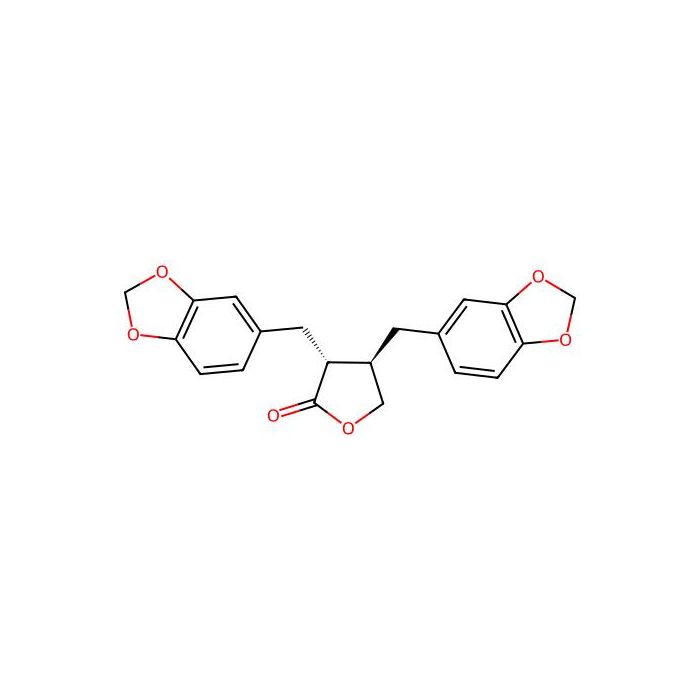
Hinokinin is a plant-derived lignan (dibenzylbutyrolactone-type) commonly encountered in natural products chemistry and small-molecule libraries.
Item-specific identifiers from Product Data:
CAS: 26543-89-5
PubChem CID: 442879
Storage: Store at -20°C (per product data)
Shipping: Ice chest + ice pads (per product data)
Not specified for this item; refer to CoA/Spec Sheet:
Molecular formula: Not specified for this item; refer to CoA/Spec Sheet.
Molecular weight: Not specified for this item; refer to CoA/Spec Sheet.
InChIKey: Not specified for this item; refer to CoA/Spec Sheet.
SMILES: Not specified for this item; refer to CoA/Spec Sheet.
Structural features (literature/general chemistry):
Core scaffold: a butyrolactone (γ-lactone) fused to a dibenzyl framework (typical of lignans).
Aromatic substitution: two 1,3-benzodioxole (methylenedioxyphenyl) rings attached to the benzylic positions of the butyrolactone side chain.
Functional groups: one cyclic ester (lactone); two acetal-like methylenedioxy moieties on the aryl rings; benzylic linkages.
Stereochemistry: Hinokinin is commonly encountered as a racemate in synthetic and isolation contexts; enantiomeric forms are discussed in the natural product literature (literature note).
2D description in words (literature):
A five-membered γ-lactone ring bears a benzylic substituent on each of two adjacent carbons; each benzyl unit terminates in a 1,3-benzodioxole ring. The two aryl rings are para-related to the benzylic carbon by an O–CH2–O bridge forming the dioxole, producing a compact, rigid, polyoxygenated aromatic lactone scaffold.
Synthetic Utility
Hinokinin provides a compact, functionally rich scaffold for derivatization (literature/general synthetic chemistry):
Key functional groups and leverage points:
γ-Lactone: Amenable to nucleophilic ring opening (alcohols, amines, water under base or catalysis) to yield hydroxyacids/esters/amides; re-lactonization under dehydrative or acid-catalyzed conditions restores the core.
Methylenedioxy aryls (1,3-benzodioxoles): Can be transformed to catechols via oxidative or Lewis-acid-mediated demethylenation, unveiling handles for O-acylation, O-alkylation, or metal-catalyzed couplings after conversion to aryl triflates.
Benzylic positions: Selective oxidation (e.g., MnO2, IBX) or reduction/hydrogenolysis (Pd/C) enables subtle tuning of electronics and lipophilicity while maintaining or modifying the lactone.
Retrosynthetic value:
As a target, hinokinin embodies the dibenzylbutyrolactone motif seen across lignans, making it a useful benchmark for testing asymmetric reductions, lactonizations, and aryl–alkyl coupling strategies.
As a starting material, it allows rapid access to catechol-containing analogs (post-demethylenation), which expand into sulfonates, carbonates, and ether libraries.
Named/typical transformations (literature):
Lactone opening with NaOMe/MeOH (reflux), followed by functionalization and acid-promoted cyclization to regenerate the lactone.
Oxidative demethylenation using reagents like ceric ammonium nitrate (CAN) or other oxidative systems to reveal catechols (conditions modulated to preserve the lactone).
Protection strategies: If catechols are formed, protect as carbonates/benzyl ethers to withstand subsequent steps.
Analytical support:
Track reactions by RP-HPLC (MeCN/H2O or MeOH/H2O, 0.1% acid), TLC in hexanes/EtOAc (strong UV response), and LC-MS for mass balance.
Target Specificity
Not applicable. This product is a small-molecule lignan, not an antibody, enzyme, or biologic. No antigen/epitope, clone, isotype, or species reactivity information applies.
For bioassay design, any interaction studies (e.g., enzyme inhibition, binding, or phenotypic responses) should be established de novo and validated under your specific assay conditions. No target specificity is claimed or provided for this item.
Frequently Asked Questions
What is the purity of this product?
This product is supplied at ≥99% purity (chemical assay). Lot-specific values are stated on the Certificate of Analysis.
How should this product be stored?
Store at ?20 °C. Freezer storage is required to maintain the specified shelf life.
How is this product shipped?
This product ships in an insulated container with ice pads. Unpack on arrival and transfer it to the storage condition stated above.
What are the CAS number, molecular formula and molecular weight?
The CAS Number is 26543-89-5, the molecular formula is C20H18O6, and the molecular weight is 354.35 g/mol.
What documentation is provided?
Available product documentation, including Certificates of Analysis (COA), Safety Data Sheets (SDS), and specification sheets, is shown in the product document area. Document availability and access follow the current site policy.
We use cookies to ensure the website functions properly and, where permitted, to improve your experience. You can manage your preferences at any time in Settings. Learn more in our Cookie Policy.
Shall we send you a message when we have discounts available?
Remind me later
Thank you! Please check your email inbox to confirm.
Products are supplied to verified businesses, institutions, and qualified professionals for research and development use only. Not for use in humans, animals, diagnosis, or therapy.