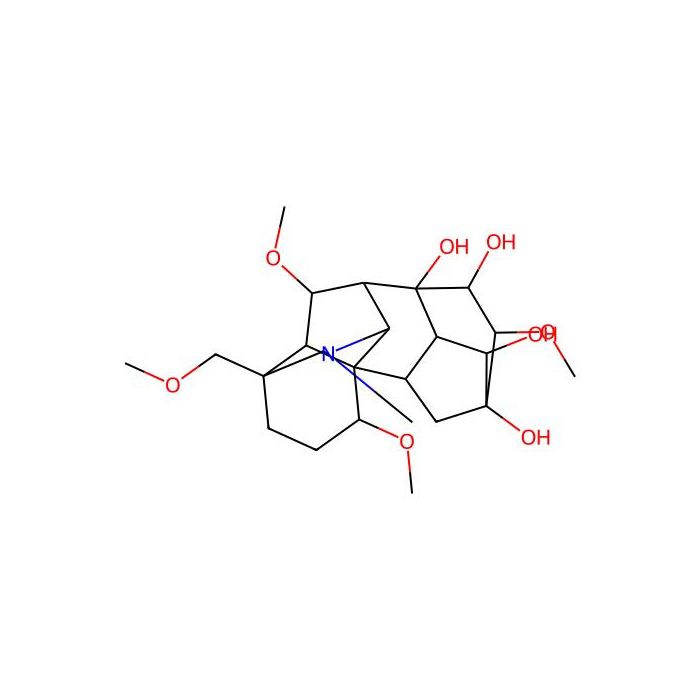
This compound belongs to the class of organic compounds known as aconitane-type diterpenoid alkaloids. These are alkaloid diterpenoids with a structure based on the hexacyclic aconitane skeleton. These compounds have no oxygen functionality at the C7 atom.
External Descriptors
Not available
1. Djoumbou Feunang Y, Eisner R, Knox C, Chepelev L, Hastings J, Owen G, Fahy E, Steinbeck C, Subramanian S, Bolton E, Greiner R, and Wishart DS. ClassyFire: Automated Chemical Classification With A Comprehensive, Computable Taxonomy. Journal of Cheminformatics, 2016, 8:61.
Determine the necessary mass, volume, or concentration for preparing a solution.
Dilution Calculator
Determine the dilution needed to prepare a stock solution.
Reconstitution Calculator
Reviews
Customer Reviews
Application Protocols
No validated, item-specific application protocols are provided. The following general procedures are commonly used for small-molecule natural products in analytical and in vitro research. Adjust to your laboratory standards.
Preparation of stock solutions:
Thaw under inert atmosphere if stored frozen. Allow vial to equilibrate to room temperature before opening to avoid moisture condensation. Prepare a 10 mM stock in anhydrous DMSO. Vortex and sonicate briefly if needed. Protect from light.
LC–MS system suitability (example, literature-based):
Column: C18, 2.1 × 50 mm, 1.7 µm. Mobile A: water + 0.1% formic acid; Mobile B: methanol + 0.1% formic acid. Gradient: 5% B to 95% B over 6 min; hold 2 min. Flow: 0.3 mL/min; 35°C. Detection: ESI+, monitor [M+H]+. Inject 1–5 µL of 0.5 µg/mL standard.
In vitro assay dosing:
Dilute DMSO stocks into assay media or buffer to achieve final DMSO ≤0.1–0.5% v/v. Pre-screen solubility/precipitation visually and by light scattering. Include vehicle controls and, where relevant, reference aconitane standards.
Stability check:
Incubate an aliquot at assay temperature for the intended duration; analyze by LC to confirm ≤5% degradation.
These are illustrative, literature-based procedures intended for research use. Validate and document any protocol per your institution’s QA/QC requirements.
Biological Roles
Literature/general context (not item specifications and not medical claims):
Source and classification: Hypaconine is described in the literature as an aconitane-type diterpenoid alkaloid occurring in Aconitum species. These alkaloids are biosynthesized via the terpenoid pathway, incorporating a polycyclic carbon scaffold and a tertiary amine.
Molecular interactions: Members of the aconitine family are known to interact with voltage-gated sodium channels in excitable tissues, typically stabilizing the open state in a site-2-like binding mode. Subtle structural changes across congeners markedly alter potency and selectivity. Specific binding constants for hypaconine should be determined experimentally; literature values vary widely and are context-dependent.
Physiological role in plants: Such alkaloids are considered chemical defenses, deterring herbivory and microbial challenge. Their accumulation can vary with species, organ, and developmental stage.
ADME considerations in research models: The tertiary amine confers pH-dependent ionization that influences membrane permeability and distribution. Polyoxygenation often yields moderate to high polarity; protein binding and P-gp interactions may be relevant in vitro. Caution is warranted when interpreting bioassay data due to potential nonspecific membrane effects at higher concentrations.
Assay implications: For in vitro studies, ensure accurate free concentration by minimizing adsorption to plastics (use low-bind consumables) and accounting for DMSO vehicle effects. Employ appropriate negative controls and, where appropriate, include known aconitane comparators to contextualize activity.
All uses are for research purposes only.
Buffer Applications
This compound is not a buffer reagent and is not typically used to prepare buffering systems. However, for analytical and biochemical assays involving hypaconine (literature/general):
Vehicle and assay buffers:
Prepare concentrated stocks in DMSO, then dilute into physiological or analytical buffers (e.g., PBS, HEPES, or Tris) ensuring the final DMSO content is generally ≤0.1–0.5% v/v to minimize solvent effects.
Slightly acidic modifiers (0.05–0.1% formic or acetic acid) in aqueous phases can help maintain the protonated form, improving solubility and chromatographic behavior.
pH considerations:
The tertiary amine will be predominantly protonated at acidic pH, improving aqueous compatibility but potentially reducing membrane permeability in cell-free systems; adjust pH to match your assay goals.
Practical notes:
Filter assay buffers (0.22 µm) and equilibrate to temperature to ensure reproducible solubility and binding measurements.
Avoid strong bases or high-pH buffers for prolonged periods, which may promote degradation of sensitive ester/ether linkages in related aconitane frameworks.
For applications requiring strict buffering capacity, select established buffers (HEPES pH 6.8–8.2; phosphate pH 5.8–8.0; acetate pH 3.6–5.6) and verify compound stability under those conditions with a small pilot study.
Green Alternatives
As a complex bio-derived alkaloid, the compound itself is not typically substituted by a “green alternative.” However, greener choices can be made in its handling, purification, and analysis. The primary levers are solvent selection and process design (literature/general):
Prefer greener solvents where feasible:
Replace dichloromethane/chloroform with ethyl acetate or 2-MeTHF for liquid–liquid extraction when partitioning behavior permits.
Use ethanol (bio-based) instead of methanol where solubility and chromatographic performance are acceptable.
In LC, prioritize water-rich mobile phases and minimize acetonitrile; methanol is generally lower-impact than acetonitrile.
Use solid-phase extraction (SPE) to decrease chlorinated solvent usage in sample cleanup.
Recover and recycle solvents where compatible with purity requirements.
Comparison (general):
DCM vs EtOAc: EtOAc is less hazardous and has a better environmental profile; may require adjusted pH to maintain partition efficiency for basic alkaloids.
ACN vs MeOH in RP-HPLC: MeOH is more benign but increases backpressure; UHPLC hardware and elevated temperature (30–40°C) can offset viscosity.
Chloroform vs 2-MeTHF: 2-MeTHF offers reduced toxicity and is bio-derived; note different polarity/hydrogen-bonding characteristics that can alter recovery.
Caveat: Ensure that any alternative maintains analyte stability and recovery; validate with small-scale trials.
Pharmaceutical Uses
No pharmacopeial or excipient status is provided for this item. It is supplied strictly for research use only and is not intended for human or veterinary applications.
Literature/general context (non-clinical, no therapeutic claims):
Natural product reference: Hypaconine, as a member of the aconitane-alkaloid class, can be used in pre-formulation studies and analytical method development to understand stability, solubility, and detection in complex matrices (e.g., herbal materials).
Analytical standards: Useful as a system suitability or identity/concentration standard in chromatographic assays monitoring Aconitum constituents during manufacturing quality control of botanical materials (non-pharmacopoeial unless otherwise documented by the user’s method).
Form considerations for lab studies: Free base versus salt form strongly impacts solubility and handling. For dissolution studies, salts (e.g., hydrochloride) typically display enhanced aqueous solubility; verify the supplied form on the CoA/label.
Stability studies: Conduct ICH-style stress tests (light, heat, humidity, oxidative) on small quantities to map degradation profiles and build stability-indicating methods; protect from light as recommended in this product’s storage instructions.
Important: Nothing herein implies suitability as an active pharmaceutical ingredient, excipient, or for any clinical use. Any formulation or manufacturing investigations must remain within non-clinical research settings and comply with institutional and regulatory requirements.
Physical Properties
Item-specific values (specifications):
Appearance: Not specified for this item; refer to CoA/Spec Sheet.
Molecular weight: Not specified for this item; refer to CoA/Spec Sheet.
Molecular formula: Not specified for this item; refer to CoA/Spec Sheet.
Melting point, boiling point, density, refractive index, pKa, logP, UV cutoff, water/metal/peroxide limits: Not specified for this item; refer to CoA/Spec Sheet.
Literature/general characteristics for aconitane-type diterpenoid alkaloids (informational, not item specifications):
Physical state: typically isolated as off-white crystalline solids or amorphous solids; often form crystalline salts with HCl or other acids.
Solubility: free bases exhibit low aqueous solubility at neutral pH, but are soluble in polar organic solvents (methanol, ethanol, acetonitrile, chloroform, dichloromethane). Protonated salts are more soluble in water and alcohols. DMSO is commonly used for analytical stock solutions (1–10 mM).
Basicity: tertiary amine with pKa typically in the 7–9 range for related aconitine-family alkaloids, enabling pH-dependent extraction/partition.
Chromatography: reverse-phase HPLC/UPLC with acidic modifiers (0.05–0.1% formic acid) provides good peak shape; expected to ionize well in ESI+ for MS detection due to the tertiary amine.
Note: The above literature values are provided for contextual planning only. For experimental work, consult the item’s CoA/Spec Sheet for definitive specifications and perform a small-scale solubility test under your lab’s conditions.
Quality & Grades
Grade/Purity: Not specified for this item; refer to CoA/Spec Sheet.
Appearance: Not specified for this item; refer to CoA/Spec Sheet.
Guidance on interpreting quality information (general):
Research-use only: This item is supplied strictly for laboratory research and development. It is not intended for human or veterinary use, diagnostics, or as a food additive.
Purity reporting: For complex natural products, purity is typically assessed by a combination of techniques (HPLC/UPLC area%, 1H/13C NMR, MS, and sometimes qNMR). Review the CoA chromatogram and spectra for confirmation of identity and homogeneity.
Counter-ions and form: Diterpenoid alkaloids can be supplied as free bases or as acid salts (e.g., hydrochloride). The salt form materially affects solubility and assay preparation. Confirm the form on the CoA/label before use.
Residual solvents/water: Complex alkaloids may retain bound or adventitious solvent/water. Karl Fischer and residual solvent results, if provided, help reconcile assay and weighings. If not specified, perform a brief drying study under vacuum at low temperature to avoid decomposition.
Stabilizers: None are listed in the Product Data. If present on the CoA, understand their analytical impact (e.g., UV background) before HPLC quantitation.
Recommendation: Prior to quantitative work (e.g., bioassay standards), confirm purity by orthogonal methods in your lab and calculate exact solution concentrations based on corrected assay (% w/w) and salt/solvate content.
Reaction & Applications
This compound is primarily employed as a reference standard, natural product probe, and analytical spike rather than as a stoichiometric reagent. Nevertheless, several application domains are relevant (literature/general):
Analytical chemistry:
LC–MS/UPLC method development for aconitane alkaloids in botanical matrices. Hypaconine can serve as a system suitability or calibration analyte for targeted quantitation.
Stability-indicating studies: Monitor degradation under light, heat, and pH stress to map hydrolytic or oxidative pathways for related alkaloids.
Chemical biology and pharmacology research (in vitro):
Tool compound for probing interactions of aconitane-type frameworks with excitable-membrane proteins. Use strictly under institutional safety review and for research use only.
Semisynthesis/derivatization:
Functional group manipulations exploiting its tertiary amine (salt formation, quaternization), alcohols/ethers (acylation, selective deprotection), and potential ester groups (hydrolysis/transesterification). These transformations allow SAR exploration and analytical tagging (e.g., dansylation for fluorescence or isotopic labeling for MS).
Chiroptical/structural studies:
Use as a standard for NMR chemical shift comparison, CD/ORD signatures, and to benchmark computational conformational analyses of rigid polycyclic amines.
Practical tips:
Work under subdued light, and avoid prolonged exposure to elevated temperature or strong base/acid unless intentional (e.g., for hydrolysis studies).
For LC–MS, prefer ESI+ with 0.05–0.1% formic acid; concentrations of 0.1–1 µg/mL are typical for MS calibration curves.
Validate identity after any derivatization by HRMS and full 1D/2D NMR.
Reaction Conditions
No item-specific reaction conditions are provided. The following general, literature-informed guidelines apply to derivatization and handling of aconitane-type alkaloids in a research setting:
Salt formation/quaternization:
Dissolve in dry acetonitrile or dichloromethane; add 1–2 equiv anhydrous HCl in dioxane (for salts) at 0–25°C. For quaternization, treat with excess MeI or EtI (2–5 equiv) in acetonitrile at room temperature to 40°C for several hours to overnight; monitor by LC–MS.
Acylation of alcohols:
Use pyridine or triethylamine as base with acyl chloride/anhydride at 0–25°C; DMAP (0.05–0.1 equiv) can accelerate. Protect from moisture and light. Work up under mild, buffered aqueous conditions to avoid amine protonation losses.
Selective oxidation:
Employ TEMPO/NaOCl or Dess–Martin periodinane at 0–25°C for secondary alcohols; closely monitor to prevent over-oxidation or cleavage of sensitive ethers.
Hydrolysis (ester cleavage where applicable):
Mild acidic (0.05–0.1 M HCl in MeOH/H2O) or basic (0.05–0.1 M Na2CO3/MeOH) conditions at 20–40°C; avoid strong base and high heat that may degrade the cage.
Analytical method conditions:
RP-UPLC: C18, 2.1 × 50 mm, 1.7 µm; water/MeOH with 0.1% formic acid, gradient 5→95% MeOH over 5–8 min; ESI+, m/z monitoring for [M+H]+. Injection concentrations of 0.1–1 µg/mL are typical.
All parameters above are general literature guidance and should be optimized experimentally for hypaconine. Validate on milligram scale before scale-up.
Safety & Handling
Item-specific hazard data from Product Data:
GHS classification: Not specified for this item; refer to SDS.
Signal word: Not specified for this item; refer to SDS.
H-statements and pictograms: Not specified for this item; refer to SDS.
General safety guidance (literature; aconitine-type alkaloids):
Toxicity: Diterpenoid aconitane alkaloids are recognized for high acute toxicity, with potent effects on excitable tissues. Handle as a highly toxic small molecule. Avoid all routes of exposure (inhalation, ingestion, skin contact, sharps injuries).
PPE: Use lab coat, double nitrile gloves (change frequently), splash goggles or face shield, and handle in a certified chemical fume hood. Consider working over spill trays and with closed containers.
Engineering controls: Conduct weighing and transfers in a ventilated enclosure; employ single-use weigh boats and antistatic precautions to minimize aerosolization of fine powders.
Incompatibilities: Strong oxidizers; strong acids/bases can alter speciation (salt formation/free base) and solubility. Avoid elevated temperatures and light which may promote hydrolysis or rearrangements of acylated congeners.
First aid (overview; defer to SDS): Move to fresh air for inhalation exposure; rinse skin/eyes with copious water for 15 minutes; seek medical attention immediately after any exposure or ingestion. Provide SDS to responders.
Waste: Collect solid and liquid waste as hazardous organic waste; decontaminate surfaces with appropriate solvent followed by detergent and water. Verify inactivation protocols with your EHS office.
Always consult the product SDS for authoritative, up-to-date hazard and response information.
Solvent Selection
Hypaconine is a basic, polyoxygenated diterpenoid alkaloid. Practical solvent guidance (literature/general):
Stock solutions for analytical/biochemical assays:
DMSO: Often the most reliable for preparing concentrated stocks (1–10 mM). Ensure complete dissolution before dilution; pre-warm gently if needed and protect from light.
Methanol or ethanol: Good for LC standards and sample prep; compatible with most reversed-phase mobile phases. Consider preparing acidified alcohol (0.1% formic or acetic acid) to stabilize the protonated form.
Water: Poor solubility expected for the free base at neutral pH; solubility increases upon acidification (formation of water-soluble salts). If the product is provided as a salt, aqueous solubility may be significantly higher.
Extraction/partitioning:
Free base partitions into moderately polar organics (CHCl3, DCM, EtOAc). Convert to the salt with dilute acid to transfer into aqueous phase; basify to re-extract the free base.
Chromatography/mobile phases:
Reversed-phase (MeOH/H2O or ACN/H2O) with 0.05–0.1% formic acid improves peak shape and MS response.
Normal-phase or HILIC can be used for orthogonal separations; avoid highly basic modifiers that cause peak tailing.
Comparison notes:
Methanol vs acetonitrile: MeOH offers stronger hydrogen-bonding solvation and can better dissolve polyoxygenated alkaloids; ACN provides lower viscosity and sharper LC peaks.
Always confirm the supplied form (free base vs salt) on the CoA to choose an appropriate solvent system.
Storage: Protect from light; Store at -20°C; Desiccated.
Shipping: Ice chest + Ice pads.
Research use note: For research use only.
Practical guidance:
Upon receipt: Keep sealed and cold. Allow the container to equilibrate to room temperature in a desiccator before opening to prevent moisture condensation on cold material.
Aliquoting: If frequent use is anticipated, prepare small, single-use aliquots (solid or concentrated DMSO solution) under dry, inert atmosphere to minimize freeze–thaw and moisture/light exposure.
Light protection: Use amber vials or wrap containers in aluminum foil. Minimize bench-top exposure during weighing and solution prep.
Reconstitution: If a solid, dissolve initially in anhydrous DMSO (e.g., to 10 mM). For aqueous applications, dilute the DMSO stock into buffer/media with vigorous mixing. If higher aqueous solubility is required and the compound is supplied as the free base, slight acidification (e.g., 0.1% formic acid) can improve compatibility; verify with a small test.
Stability: Maintain frozen stocks at -20°C or below. Avoid repeated freeze–thaw; thaw only what is needed. Inspect periodically by LC–MS/HPLC for degradation if stored >3 months.
Disposal: Follow institutional hazardous waste procedures for organic small molecules.
Always refer to the product’s CoA and SDS for definitive storage stability and handling details.
Structure & Identity
Briefly: Hypaconine is a plant-derived diterpenoid alkaloid (aconitane-type) associated with Aconitum species. It features a densely fused polycyclic cage and a tertiary amine, with multiple oxygenated substituents (ethers/alcohols/esters typical of this family), and numerous defined stereocenters (literature).
CAS: 63238-68-6 (item-specific)
PubChem CID: 76189740 (item-specific)
InChIKey: 31946 (item-specific; provided value)
SMILES: Not specified for this item; refer to CoA/Spec Sheet.
Molecular formula: Not specified for this item; refer to CoA/Spec Sheet.
Molecular weight: Not specified for this item; refer to CoA/Spec Sheet.
Structural features (literature/general):
Core: aconitane/norditerpenoid polycyclic skeleton with bridged ring system and embedded ether linkages.
Nitrogen: tertiary amine (basic center) capable of forming salts with mineral or organic acids; quaternization feasible.
Oxygenation: multiple secondary/tertiary alcohol and acetal/ether motifs are characteristic in this class; acyl groups (e.g., benzoate/acetate) may appear in congeners and influence lipophilicity and basicity.
Stereochemistry: high stereochemical density (often >8 chiral centers) with rigid, conformationally locked cage; stereochemistry critically defines bioactivity and chromatographic behavior.
2D description in words (literature): a compact, bridged polycyclic carbon framework bearing several oxygen substituents (often at bridgeheads and ring junctions) and a pendant tertiary amine; no extended aromatic systems in the aglycone (aside from possible acyl groups in derivatives).
Synthetic Utility
While not a commodity building block, hypaconine’s densely functionalized scaffold offers unique synthetic opportunities in a research context (literature/general):
Functional handles:
Tertiary amine: amenable to salt formation (HCl, TFA), quaternization (e.g., MeI, Meerwein reagents), and reductive amination-like derivatizations at adjacent positions if accessible.
Polyoxygenation: multiple secondary/tertiary alcohols and ether linkages enable selective acylation (Ac2O, benzoyl chloride), carbonate/urethanes, silylation for protection, and oxidative elaboration (e.g., TEMPO-mediated oxidations) with careful condition control.
Ester motifs (if present): hydrolysis/transesterification for generating deacylated derivatives to probe structure–activity relationships.
Retrosynthetic insights:
The rigid aconitane cage provides a platform to test late-stage functionalization methods (C–H oxidation, photoredox-mediated α-C–H to amine transformations) under mild conditions that preserve the cage.
Analytical derivatization:
Install MS/UV tags (dansyl, nitrobenzoxadiazole) on nucleophilic oxygens or via quaternization to aid trace quantification or imaging.
Stereochemical studies:
Conformational rigidity and rich stereochemistry make the molecule valuable for benchmarking NMR assignment strategies (NOESY/ROESY constraints) and computational stereochemical prediction.
Caveats:
The scaffold is sensitive; avoid strong base and high-temperature conditions that can trigger rearrangements or decomposition. Use protecting groups judiciously and confirm integrity by comprehensive NMR and HRMS after each step.
Target Specificity
No target-specific attributes (e.g., antigen/epitope, clone, isotype, species reactivity) are provided in the Product Data, and this product is not an antibody or affinity reagent. Therefore, target specificity is not applicable to this item.
For researchers exploring molecular targets in vitro, consult primary literature for binding/functional data pertinent to aconitane-type alkaloids and perform appropriate controls to distinguish specific from nonspecific effects.
We use cookies to ensure the website functions properly and, where permitted, to improve your experience. You can manage your preferences at any time in Settings. Learn more in our Cookie Policy.
Shall we send you a message when we have discounts available?
Remind me later
Thank you! Please check your email inbox to confirm.
Products are supplied to verified businesses, institutions, and qualified professionals for research and development use only. Not for use in humans, animals, diagnosis, or therapy.