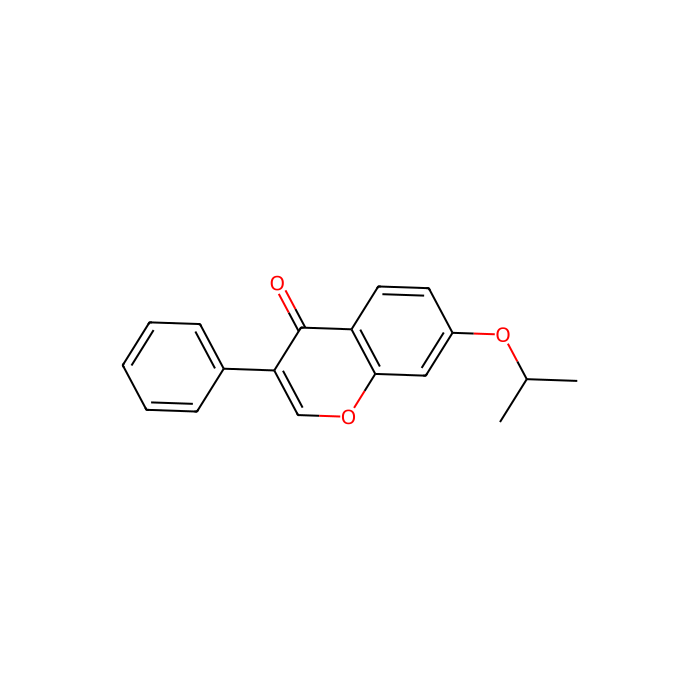
Ipriflavone - ≥98%(GC) , CAS No.35212-22-7

CAS: 35212-22-7 Cat. No.: I157461 Formula: C18H16O3 Molecular Weight: 280.32
AVAILABLE TO ORDER
GRADE & PURITY ≥98%(GC)
Synonyms
Osteofix|ipriflavone|(Ipriflavone)|Ipriflavone, INN|7-isopropyloxy-isoflavone|Osten|Ipriflavone (JP17/INN)|Osteoquine|FL113|FL-113|Ipriflavone (Osteofix)|IPRIFLAVONE [INN]|Ipriflavon|7-(1-Methylethoxy)-3-phenyl-4H-1-benzopyran-4-one|IPRIFLAVONE [WHO-DD]|IPRIFLAVONE [VANDF]|Ipriflavone [INN:JAN]|IPRIFLAVONE [MI]|Ipriflavone (JAN/INN)|Iprosten|TC-80|FL 113|7-isopropoxy-3-phenyl-chromone|7-Isopropoxyisoflavone|7-isopropoxy-isoflavone|Opera_ID_1176|Ipriflavona [INN-Spanish]|7-isopropoxy-3-phenyl-4H-chromen-4-one|IPRIFLAVONE [MART.]|3-phenyl-7-propan-2-yloxy-chromen-4-one|7-Isopropoxy-3-phenyl-4H-1-benzopyran-4-one|3-phenyl-7-propan-2-yloxychromen-4-one|Iprivone|Ipriflavona|Ostivone|Osten (TN)|Yambolap|TC 80|TN-39|Quinogin|Ipriflavonum [INN-Latin]|IPRIFLAVONE [JAN]|Osteochin|3-phenyl-7-propan-2-yloxy-1-benzopyran-4-one|4H-1-Benzopyran-4-one, 7-(1-methylethoxy)-3-phenyl-
Storage
Room temperature
Shipped In
Normal
★
Size
Germany (EU)
USA*
Price
Qty
5g
I157461-5g
—
In stock ≥10

€22.47

€33.76
Save €11.28 (33.42%)
25g
I157461-25g
—
7 In stock

€74.54

€111.85
Save €37.31 (33.36%)
100g
I157461-100g
Made to order · 8–12 wks

€235.07

€353.08
Save €118.01 (33.42%)
Enter a quantity for the sizes you want to add.

Specifications

Synonyms
Osteofix | ipriflavone | (Ipriflavone) | Ipriflavone, INN | 7-isopropyloxy-isoflavone | Osten | Ipriflavone (JP17/INN) | Osteoquine | FL113 | FL-113 | Ipriflavone (Osteofix) | IPRIFLAVONE [INN] | Ipriflavon | 7-(1-Methylethoxy)-3-phenyl-4H-1-benzopyran-4-one | IPRIFLAVONE [WHO-DD] | IPRIFLAVONE [VANDF] | Ipriflavone [INN:JAN] | IPRIFLAVON Show more
Specifications & Purity
≥98%(GC)
Biochemical and Physiological Mechanisms
Estrogenic synthetic Daidzein ( Asc 391 ) derivative. Inhibits bone resorption in vivo. Orally active.
Storage
Room temperature
Shipped In
Normal
Note
Wherever possible, you should prepare and use solutions on the same day. However, if you need to make up stock solutions in advance, we recommend that you store the solution as aliquots in tightly sealed vials at -20°C. Generally, these will be useable for up to one month. Before use, and prior to opening the vial we recommend that you allow your product to equilibrate to room temperature for at least 1 hour. Need more advice on solubility, usage and handling? Please visit our frequently asked questions (FAQ) page for more details.
Purity
≥98%(GC)
Names and Identifiers
Pubchem Sid
Pubchem Sid Url
https://pubchem.ncbi.nlm.nih.gov/substance/488179789
Canonical Smiles
CC(C)OC1=CC2=C(C=C1)C(=O)C(=CO2)C3=CC=CC=C3
IUPAC Name
3-phenyl-7-propan-2-yloxychromen-4-one
InChIKey
SFBODOKJTYAUCM-UHFFFAOYSA-N
INCHI
1S/C18H16O3/c1-12(2)21-14-8-9-15-17(10-14)20-11-16(18(15)19)13-6-4-3-5-7-13/h3-12H,1-2H3
Isomeric SMILES
CC(C)OC1=CC2=C(C=C1)C(=O)C(=CO2)C3=CC=CC=C3
WGK Germany
2
RTECS
DJ3100500
Molecular Weight
280.32
Reaxy-Rn
4754346
Reaxys-RN_link_address
https://www.reaxys.com/reaxys/secured/hopinto.do?context=S&query=IDE.XRN=4754346&ln=

Advanced Data

Taxonomic Classification

Taxonomy Tree

KingdomOrganic compounds
SuperclassPhenylpropanoids and polyketides
ClassIsoflavonoids
SubclassIsoflav-2-enes
Intermediate Tree Nodes Not available
Direct ParentIsoflavones
Alternative Parents Chromones  Pyranones and derivatives  Alkyl aryl ethers  Benzene and substituted derivatives  Heteroaromatic compounds  Oxacyclic compounds  Organic oxides  Hydrocarbon derivatives  
Molecular FrameworkAromatic heteropolycyclic compounds
Substituents Isoflavone - Chromone - Benzopyran - 1-benzopyran - Alkyl aryl ether - Pyranone - Monocyclic benzene moiety - Pyran - Benzenoid - Heteroaromatic compound - Oxacycle - Ether - Organoheterocyclic compound - Organooxygen compound - Hydrocarbon derivative - Organic oxide - Organic oxygen compound - Aromatic heteropolycyclic compound
DescriptionThis compound belongs to the class of organic compounds known as isoflavones. These are polycyclic compounds containing a 2-isoflavene skeleton which bears a ketone group at the C4 carbon atom.
External Descriptors aromatic ether - isoflavones
3D Structure
Interactive Chemical Structure Model


Associated Targets(Human)
STAT1 Tchem Signal transducer and activator of transcription 1-alpha/beta (1 Activities)
Activity TypeActivity Value -log(M)Mechanism of ActionActivity ReferencePublications (PubMed IDs)
PDE5A Tclin Phosphodiesterase 5A (5113 Activities)
Activity TypeRelationActivity valueUnitsAction TypeJournalPubMed IddoiAssay Aladdin ID
EGFR Tclin Epidermal growth factor receptor erbB1 (33727 Activities)
Activity TypeRelationActivity valueUnitsAction TypeJournalPubMed IddoiAssay Aladdin ID
F2 Tclin Thrombin (11687 Activities)
Activity TypeRelationActivity valueUnitsAction TypeJournalPubMed IddoiAssay Aladdin ID
CA2 Tclin Carbonic anhydrase II (17698 Activities)
Activity TypeRelationActivity valueUnitsAction TypeJournalPubMed IddoiAssay Aladdin ID
ESR1 Tclin Estrogen receptor alpha (17718 Activities)
Activity TypeRelationActivity valueUnitsAction TypeJournalPubMed IddoiAssay Aladdin ID
HMGCR Tclin HMG-CoA reductase (2475 Activities)
Activity TypeRelationActivity valueUnitsAction TypeJournalPubMed IddoiAssay Aladdin ID
NR3C1 Tclin Glucocorticoid receptor (14987 Activities)
Activity TypeRelationActivity valueUnitsAction TypeJournalPubMed IddoiAssay Aladdin ID
INSR Tclin Insulin receptor (5558 Activities)
Activity TypeRelationActivity valueUnitsAction TypeJournalPubMed IddoiAssay Aladdin ID
PGR Tclin Progesterone receptor (8562 Activities)
Activity TypeRelationActivity valueUnitsAction TypeJournalPubMed IddoiAssay Aladdin ID
ADRB2 Tclin Beta-2 adrenergic receptor (11824 Activities)
Activity TypeRelationActivity valueUnitsAction TypeJournalPubMed IddoiAssay Aladdin ID
CHRM2 Tclin Muscarinic acetylcholine receptor M2 (10671 Activities)
Activity TypeRelationActivity valueUnitsAction TypeJournalPubMed IddoiAssay Aladdin ID
ADRB1 Tclin Beta-1 adrenergic receptor (6630 Activities)
Activity TypeRelationActivity valueUnitsAction TypeJournalPubMed IddoiAssay Aladdin ID
HTR1A Tclin Serotonin 1a (5-HT1a) receptor (14969 Activities)
Activity TypeRelationActivity valueUnitsAction TypeJournalPubMed IddoiAssay Aladdin ID
ADRA2A Tclin Alpha-2a adrenergic receptor (9450 Activities)
Activity TypeRelationActivity valueUnitsAction TypeJournalPubMed IddoiAssay Aladdin ID
AR Tclin Androgen Receptor (11781 Activities)
Activity TypeRelationActivity valueUnitsAction TypeJournalPubMed IddoiAssay Aladdin ID
CHRM1 Tclin Muscarinic acetylcholine receptor M1 (12690 Activities)
Activity TypeRelationActivity valueUnitsAction TypeJournalPubMed IddoiAssay Aladdin ID
ACE Tclin Angiotensin-converting enzyme (1423 Activities)
Activity TypeRelationActivity valueUnitsAction TypeJournalPubMed IddoiAssay Aladdin ID
DRD2 Tclin Dopamine D2 receptor (23596 Activities)
Activity TypeRelationActivity valueUnitsAction TypeJournalPubMed IddoiAssay Aladdin ID
GABRA1 Tclin GABA receptor alpha-1 subunit (399 Activities)
Activity TypeRelationActivity valueUnitsAction TypeJournalPubMed IddoiAssay Aladdin ID
MAOA Tclin Monoamine oxidase A (11911 Activities)
Activity TypeRelationActivity valueUnitsAction TypeJournalPubMed IddoiAssay Aladdin ID
CNR1 Tclin Cannabinoid CB1 receptor (20913 Activities)
Activity TypeRelationActivity valueUnitsAction TypeJournalPubMed IddoiAssay Aladdin ID
DRD1 Tclin Dopamine D1 receptor (9720 Activities)
Activity TypeRelationActivity valueUnitsAction TypeJournalPubMed IddoiAssay Aladdin ID
DRD4 Tchem Dopamine D4 receptor (7907 Activities)
Activity TypeRelationActivity valueUnitsAction TypeJournalPubMed IddoiAssay Aladdin ID
ACHE Tclin Acetylcholinesterase (18204 Activities)
Activity TypeRelationActivity valueUnitsAction TypeJournalPubMed IddoiAssay Aladdin ID
PTGS1 Tclin Cyclooxygenase-1 (9233 Activities)
Activity TypeRelationActivity valueUnitsAction TypeJournalPubMed IddoiAssay Aladdin ID
SLC6A2 Tclin Norepinephrine transporter (10102 Activities)
Activity TypeRelationActivity valueUnitsAction TypeJournalPubMed IddoiAssay Aladdin ID
HRH2 Tclin Histamine H2 receptor (5428 Activities)
Activity TypeRelationActivity valueUnitsAction TypeJournalPubMed IddoiAssay Aladdin ID
ADRA1D Tclin Alpha-1d adrenergic receptor (4171 Activities)
Activity TypeRelationActivity valueUnitsAction TypeJournalPubMed IddoiAssay Aladdin ID
HTR1B Tclin Serotonin 1b (5-HT1b) receptor (2801 Activities)
Activity TypeRelationActivity valueUnitsAction TypeJournalPubMed IddoiAssay Aladdin ID
HTR2A Tclin Serotonin 2a (5-HT2a) receptor (14758 Activities)
Activity TypeRelationActivity valueUnitsAction TypeJournalPubMed IddoiAssay Aladdin ID
HTR2C Tclin Serotonin 2c (5-HT2c) receptor (11471 Activities)
Activity TypeRelationActivity valueUnitsAction TypeJournalPubMed IddoiAssay Aladdin ID
AVPR2 Tclin Vasopressin V2 receptor (2912 Activities)
Activity TypeRelationActivity valueUnitsAction TypeJournalPubMed IddoiAssay Aladdin ID
ADORA1 Tclin Adenosine A1 receptor (17603 Activities)
Activity TypeRelationActivity valueUnitsAction TypeJournalPubMed IddoiAssay Aladdin ID
AGTR1 Tclin Type-1 angiotensin II receptor (5176 Activities)
Activity TypeRelationActivity valueUnitsAction TypeJournalPubMed IddoiAssay Aladdin ID
CALCR Tclin Calcitonin receptor (2215 Activities)
Activity TypeRelationActivity valueUnitsAction TypeJournalPubMed IddoiAssay Aladdin ID
SLC6A4 Tclin Serotonin transporter (12625 Activities)
Activity TypeRelationActivity valueUnitsAction TypeJournalPubMed IddoiAssay Aladdin ID
ADRA1A Tclin Alpha-1a adrenergic receptor (8359 Activities)
Activity TypeRelationActivity valueUnitsAction TypeJournalPubMed IddoiAssay Aladdin ID
PTGS2 Tclin Cyclooxygenase-2 (13999 Activities)
Activity TypeRelationActivity valueUnitsAction TypeJournalPubMed IddoiAssay Aladdin ID
HRH1 Tclin Histamine H1 receptor (7573 Activities)
Activity TypeRelationActivity valueUnitsAction TypeJournalPubMed IddoiAssay Aladdin ID
ADRA1B Tclin Alpha-1b adrenergic receptor (2912 Activities)
Activity TypeRelationActivity valueUnitsAction TypeJournalPubMed IddoiAssay Aladdin ID
OPRM1 Tclin Mu opioid receptor (19785 Activities)
Activity TypeRelationActivity valueUnitsAction TypeJournalPubMed IddoiAssay Aladdin ID
DRD3 Tclin Dopamine D3 receptor (14368 Activities)
Activity TypeRelationActivity valueUnitsAction TypeJournalPubMed IddoiAssay Aladdin ID
AVPR1A Tclin Vasopressin V1a receptor (5412 Activities)
Activity TypeRelationActivity valueUnitsAction TypeJournalPubMed IddoiAssay Aladdin ID
OPRD1 Tclin Delta opioid receptor (15096 Activities)
Activity TypeRelationActivity valueUnitsAction TypeJournalPubMed IddoiAssay Aladdin ID
OPRK1 Tclin Kappa opioid receptor (16155 Activities)
Activity TypeRelationActivity valueUnitsAction TypeJournalPubMed IddoiAssay Aladdin ID
HTR3A Tclin Serotonin 3a (5-HT3a) receptor (3366 Activities)
Activity TypeRelationActivity valueUnitsAction TypeJournalPubMed IddoiAssay Aladdin ID
SLC6A3 Tclin Dopamine transporter (10535 Activities)
Activity TypeRelationActivity valueUnitsAction TypeJournalPubMed IddoiAssay Aladdin ID
PTH1R Tclin Parathyroid hormone receptor (47172 Activities)
Activity TypeRelationActivity valueUnitsAction TypeJournalPubMed IddoiAssay Aladdin ID
GRIN1 Tclin Glutamate (NMDA) receptor subunit zeta 1 (122 Activities)
Activity TypeRelationActivity valueUnitsAction TypeJournalPubMed IddoiAssay Aladdin ID
KCNH2 Tclin HERG (29587 Activities)
Activity TypeRelationActivity valueUnitsAction TypeJournalPubMed IddoiAssay Aladdin ID
Associated Targets(non-human)
Agtr2 Angiotensin II type 2 (AT-2) receptor (803 Activities)
Activity TypeRelationActivity valueUnitsAction TypeJournalPubMed IddoiAssay Aladdin ID
Mc4r Melanocortin receptor 4 (1205 Activities)
Activity TypeRelationActivity valueUnitsAction TypeJournalPubMed IddoiAssay Aladdin ID
Ltc4s Leukotriene C4 synthase (1 Activities)
Activity TypeRelationActivity valueUnitsAction TypeJournalPubMed IddoiAssay Aladdin ID
Sigmar1 Sigma opioid receptor (160 Activities)
Activity TypeRelationActivity valueUnitsAction TypeJournalPubMed IddoiAssay Aladdin ID
Npy1r Neuropeptide Y receptor type 1 (8 Activities)
Activity TypeRelationActivity valueUnitsAction TypeJournalPubMed IddoiAssay Aladdin ID
Cckar Cholecystokinin A receptor (90 Activities)
Activity TypeRelationActivity valueUnitsAction TypeJournalPubMed IddoiAssay Aladdin ID
Pde4d Phosphodiesterase 4D (4 Activities)
Activity TypeRelationActivity valueUnitsAction TypeJournalPubMed IddoiAssay Aladdin ID
Nos2 Nitric oxide synthase, inducible (3573 Activities)
Activity TypeRelationActivity valueUnitsAction TypeJournalPubMed IddoiAssay Aladdin ID
Mapk1 MAP kinase ERK2 (650 Activities)
Activity TypeRelationActivity valueUnitsAction TypeJournalPubMed IddoiAssay Aladdin ID
Hdac6 Histone deacetylase 6 (222 Activities)
Activity TypeRelationActivity valueUnitsAction TypeJournalPubMed IddoiAssay Aladdin ID
Mmp9 Matrix metalloproteinase 9 (38 Activities)
Activity TypeRelationActivity valueUnitsAction TypeJournalPubMed IddoiAssay Aladdin ID
Alpl Alkaline phosphatase tissue-nonspecific (94 Activities)
Activity TypeRelationActivity valueUnitsAction TypeJournalPubMed IddoiAssay Aladdin ID
Pseudomonas aeruginosa (123386 Activities)
Activity TypeRelationActivity valueUnitsAction TypeJournalPubMed IddoiAssay Aladdin ID
Klebsiella pneumoniae (43867 Activities)
Activity TypeRelationActivity valueUnitsAction TypeJournalPubMed IddoiAssay Aladdin ID
Staphylococcus aureus (210822 Activities)
Activity TypeRelationActivity valueUnitsAction TypeJournalPubMed IddoiAssay Aladdin ID
Acinetobacter baumannii (41033 Activities)
Activity TypeRelationActivity valueUnitsAction TypeJournalPubMed IddoiAssay Aladdin ID
Escherichia coli (133304 Activities)
Activity TypeRelationActivity valueUnitsAction TypeJournalPubMed IddoiAssay Aladdin ID
Saccharomyces cerevisiae (19171 Activities)
Activity TypeRelationActivity valueUnitsAction TypeJournalPubMed IddoiAssay Aladdin ID
Plasmodium falciparum (966862 Activities)
Activity TypeRelationActivity valueUnitsAction TypeJournalPubMed IddoiAssay Aladdin ID
Cryptococcus neoformans (21258 Activities)
Activity TypeRelationActivity valueUnitsAction TypeJournalPubMed IddoiAssay Aladdin ID
Candida albicans (78123 Activities)
Activity TypeRelationActivity valueUnitsAction TypeJournalPubMed IddoiAssay Aladdin ID
Giardia intestinalis (1290 Activities)
Activity TypeRelationActivity valueUnitsAction TypeJournalPubMed IddoiAssay Aladdin ID
Rattus norvegicus (775804 Activities)
Activity TypeRelationActivity valueUnitsAction TypeJournalPubMed IddoiAssay Aladdin ID
RAW264.7 (28094 Activities)
Activity TypeRelationActivity valueUnitsAction TypeJournalPubMed IddoiAssay Aladdin ID
Luciferin 4-monooxygenase (66902 Activities)
Activity TypeRelationActivity valueUnitsAction TypeJournalPubMed IddoiAssay Aladdin ID
rep Replicase polyprotein 1ab (378 Activities)
Activity TypeRelationActivity valueUnitsAction TypeJournalPubMed IddoiAssay Aladdin ID
Bone (344 Activities)
Activity TypeRelationActivity valueUnitsAction TypeJournalPubMed IddoiAssay Aladdin ID
Mapt Microtubule-associated protein tau (6 Activities)
Activity TypeRelationActivity valueUnitsAction TypeJournalPubMed IddoiAssay Aladdin ID
Nfe2l2 Nuclear factor erythroid 2-related factor 2 (214 Activities)
Activity TypeRelationActivity valueUnitsAction TypeJournalPubMed IddoiAssay Aladdin ID
Rorc Nuclear receptor ROR-gamma (89407 Activities)
Activity TypeRelationActivity valueUnitsAction TypeJournalPubMed IddoiAssay Aladdin ID
Glra2 Glycine receptor (1745 Activities)
Activity TypeRelationActivity valueUnitsAction TypeJournalPubMed IddoiAssay Aladdin ID
MC3T3-E1 (421 Activities)
Activity TypeRelationActivity valueUnitsAction TypeJournalPubMed IddoiAssay Aladdin ID
Mechanisms of Action
Certificates (CoA,COO,BSE/TSE and Analysis Chart)
C of A & Other Certificates(BSE/TSE, COO):
Analytical Chart:

Find and download the COA for your product by matching the lot number on the packaging.

5 results found

Lot NumberCertificate TypeDateItem
I1817028I1817028Certificate of AnalysisApr 15, 2026 I157461
I1817027I1817027Certificate of AnalysisApr 15, 2026 I157461
F1801087F1801087Certificate of AnalysisJan 27, 2026 I157461
D2315452D2315452Certificate of AnalysisJul 18, 2022 I157461
D2315451D2315451Certificate of AnalysisApr 22, 2022 I157461
Chemical and Physical Properties
Melt Point(°C)117 °C
Molecular Weight280.300 g/mol
XLogP34.000
Hydrogen Bond Donor Count0
Hydrogen Bond Acceptor Count3
Rotatable Bond Count3
Exact Mass280.11 Da
Monoisotopic Mass280.11 Da
Topological Polar Surface Area35.500 Ų
Heavy Atom Count21
Formal Charge0
Complexity407.000
Isotope Atom Count0
Defined Atom Stereocenter Count0
Undefined Atom Stereocenter Count0
Defined Bond Stereocenter Count0
Undefined Bond Stereocenter Count0
The total count of all stereochemical bonds0
Covalently-Bonded Unit Count1
Citations of This Product
Solution Calculators
Reviews

Customer Reviews

Application Protocols

Not applicable as standardized bioassay/antibody protocols.

General laboratory usage suggestions (for small molecules):

  • Stock solutions: Prepare 10–100 mM stocks in dry DMSO or ethanol. Filter-sterilize (0.22 µm PTFE) if sterility is required.
  • Working concentrations: For biochemical or cell-free assays, typical final DMSO ≤0.1–1% v/v; empirically determine solubility limits.
  • Analytical method development: Start with reverse-phase HPLC using ACN/H2O (0.1% formic acid), gradient 10–90% ACN over 10–20 min; detect at 260–340 nm. Confirm identity by LC–MS.

For any specific assay or protocol, validate conditions with your own controls and consult primary literature.

Biological Roles

Item-specific biological/clinical claims are not provided and are not made by Aladdin Scientific. The following are general, literature-based notes about isoflavone chemistry relevant to research use only.

  • Isoflavone class
    • Isoflavones are plant-derived polyphenolic scaffolds; ipriflavone is a synthetic ether derivative lacking free phenolic OH at position 7 due to O-isopropyl protection.
    • The conjugated chromenone core can interact with proteins and membranes via π–π and hydrophobic interactions; hydrogen-bond acceptors are provided by the carbonyl and ether oxygens.
  • Assay utility
    • Used as a tool compound/negative control in assays exploring structure–activity relationships of flavonoids where free phenolic OH groups are important for activity (ipriflavone lacks these at the 7-position).
  • Metabolic considerations (in vitro, literature)
    • Ether cleavage (O-dealkylation) can occur enzymatically or chemically, generating corresponding phenols under certain conditions; these pathways are often modeled in microsomal or chemical stability studies.

No claims are made regarding biological efficacy, safety, or therapeutic use. For any work involving cells or enzymes, determine solubility limits, vehicle effects (e.g., final DMSO ≤0.1–1%), and assess compound stability in the relevant medium.

Buffer Applications

Not typically applicable. Ipriflavone is a neutral, poorly water-soluble small molecule and is not used as a buffering agent.

Practical tip: When preparing aqueous assay solutions, dissolve ipriflavone first in a miscible organic solvent (e.g., DMSO or ethanol) to make a concentrated stock, then dilute into the desired buffer (e.g., PBS, HEPES) with vigorous mixing to the final vehicle percentage tolerated by the system. Consider using surfactants (Tween-80, Pluronic F-127) if acceptable to your assay to improve dispersion.

Green Alternatives

As a solid substrate, ipriflavone itself is not typically replaced; however, greener process choices can be made for its handling and transformations.

  • Solvent selection (greener options vs conventional)
    • Prefer ethanol, 2-MeTHF, ethyl acetate, or propylene carbonate over chlorinated solvents where feasible.
    • Use water/ethanol mixtures for recrystallizations instead of acetone/MeOH when solubility allows.

Comparison (general guidance):

  • Ethanol vs DMF/DMSO
    • Pros: renewable, lower toxicity, easier solvent recovery.
    • Cons: lower solubility for ipriflavone; may require heating or co-solvents.
  • 2-MeTHF vs THF
    • Pros: bio-derived, lower peroxide hazard, higher boiling point.
    • Cons: different polarity can affect reaction rates/selectivity; need reoptimization.
  • Ethyl acetate vs dichloromethane
    • Pros: lower environmental impact, readily biodegradable.
    • Cons: higher boiling point; may slow extractions/evaporation.

Process intensification

  • Use microscale screening to minimize solvent and reagent use.
  • Apply flow chemistry for hazardous steps (e.g., halogenations, strong Lewis acids) to improve safety and reduce waste.

Note: Choose greener alternatives consistent with reaction compatibility and desired selectivity; verify performance experimentally.

Pharmaceutical Uses

No excipient or pharmacopeial status is specified for this item. Aladdin Scientific supplies ipriflavone strictly for research and laboratory use only.

General formulation-related notes (literature/general; not product claims):

  • Due to low aqueous solubility, ipriflavone has been explored in research settings for solid dispersion, inclusion complex (e.g., cyclodextrin), and nanoparticulate formulations to enhance dissolution for in vitro studies.
  • For pre-formulation screening, consider:
    • Solubility profiling across pH 1–8 with and without co-solvents.
    • Stability in common vehicles (PEG 400, ethanol, Cremophor EL, polysorbates).
    • Light and oxidative stability assessments given the conjugated chromophore.

No therapeutic or clinical use is endorsed or implied.

Physical Properties

Item-specific specifications (this lot): Not specified for this item; refer to CoA/Spec Sheet.

Literature and general reference values (for context only; not product specifications):

  • Appearance: typically an off-white to pale yellow crystalline solid (literature)
  • Melting point: ~173–175 °C (literature)
  • Boiling point: not commonly reported; decomposes before boiling under ambient pressure (literature)
  • Density: not well established; solid (literature)
  • Solubility: practically insoluble in water; soluble in organic solvents such as DMSO, DMF, acetone, ethyl acetate, ethanol; sparingly soluble in methanol (literature)
  • LogP (octanol/water): estimated ~3–4 (literature/computational predictions)
  • pKa: neutral compound; no strongly ionizable groups in physiological pH range (literature)
  • UV-Vis: strong π→π* absorption in the near-UV; typical λmax for isoflavones ~250–280 nm and ~300–350 nm depending on solvent (literature)
  • Stability: stable under ambient lab conditions; sensitive to strong bases/acids that can promote ring opening or ether cleavage (general)

Notes

  • Use the product-specific CoA for definitive quality attributes (mp range, purity, residual solvents, etc.).
  • For quantitative spectroscopic work, determine extinction coefficients in the solvent of interest.
Quality & Grades
  • Item-specific grade/purity: Not specified for this item; refer to CoA/Spec Sheet.
  • What grade implies (general guidance):
    • Research/chemical grade ipriflavone is typically suitable for synthetic chemistry, analytical standards, and assay development. Higher grades (e.g., HPLC grade standard) emphasize impurities profiling, tight melting range, and low residual solvents for quantitative work.
  • Stabilizers: None typically required for solid ipriflavone; it is generally stable. If a stabilizer were present, it would be listed on the CoA and should be considered during assay development (e.g., for LC/MS background or UV absorbance).
  • Documentation: For chromatography or bioassay applications, request or consult the CoA for certificate parameters such as identity confirmation (1H NMR/LC-MS), purity by HPLC, and residual solvent content.
  • Batch-to-batch considerations: Isoflavones can exhibit polymorphism; verify a consistent melting range and HPLC profile if your application is sensitive to solid-state form.
Reaction & Applications

Applications relevant to ipriflavone’s isoflavone scaffold (general, literature-based):

  • Reference standard and probe
    • Used as a reference compound in analytical methods development (HPLC/LC–MS) for isoflavone profiling and stability studies due to distinct UV chromophores.
  • Scaffold for derivatization
    • The isoflavone core (chromen-4-one) supports electrophilic aromatic substitution on the phenyl ring and nucleophilic additions across the enone under specific conditions.
    • The 7-O-isopropyl ether can undergo selective O-dealkylation (e.g., with BBr3, AlCl3, or HBr/acetic acid) to access 7-hydroxyisoflavone, enabling subsequent O-alkylation or O-acylation.
  • Cross-coupling and C–H functionalization
    • Halogenation of the B-ring (literature procedures) enables Suzuki or Buchwald–Hartwig couplings to elaborate the aryl substituent pattern.
  • Photophysics and supramolecular chemistry
    • The conjugated system shows solvatochromic UV absorption; useful in studying π–π interactions and host–guest binding in inclusion complexes (e.g., cyclodextrins; literature).
  • Practical tips
    • Protect the ether moiety under strongly acidic/basic conditions to avoid cleavage or rearrangement.
    • For metal-catalyzed steps, pre-dry substrate and solvents; trace water can reduce yields in enone chemistry.
    • Monitor by HPLC-UV at ~260–340 nm and LC–MS (ESI+) for convenient tracking.

Manufacturer Applications: Not provided in the Product Data; the above are common literature uses for the isoflavone class and ipriflavone specifically.

Reaction Conditions

General literature guidance for common transformations of the ipriflavone scaffold (not product specifications):

  • O-Deisopropylation (to 7-hydroxyisoflavone)
    • Reagents: BBr3 (1–3 eq) in dry DCM at −78 to 0 °C, then warm to RT; or AlCl3 in toluene at reflux; or HBr/AcOH under reflux.
    • Times: 1–12 h depending on conditions and scale.
    • Workup: Quench carefully with MeOH/water; extract with EtOAc; neutralize.
    • Yields: often 60–90% (literature ranges) with careful control to avoid overbromination.
  • Electrophilic halogenation of aryl ring
    • Reagents: NBS/NCS under radical or electrophilic conditions; solvent: AcOH/DMF/CHCl3; 0–25 °C.
    • Use directing/protecting strategies to control regioselectivity.
  • Hydrogenation of the enone
    • Catalyst: Pd/C (5–10 wt%), solvent: EtOH or EtOAc; H2 1–3 atm; RT–50 °C; 2–8 h.
    • Monitor by TLC/HPLC; avoid over-reduction of aromatic rings by moderating pressure/temperature.
  • Cross-coupling (after aryl halogenation)
    • Suzuki: Pd(PPh3)4 (1–3 mol%), base: K2CO3, solvent: dioxane/H2O or 2-MeTHF/H2O, 60–90 °C, 2–16 h.
    • Buchwald–Hartwig (for aryl amination): Pd catalyst with dialkylbiaryl phosphine ligands; base: NaOtBu; toluene or dioxane, 80–110 °C.

Always conduct small-scale optimization; the electron-rich ether and conjugated enone can influence catalyst choice and reaction rates.

Safety & Handling

Item-specific GHS details: Not specified for this item; refer to the SDS.

General safety considerations for isoflavone ethers (literature/general):

  • Expected hazards: Typically low acute toxicity; may cause eye/skin irritation or respiratory irritation if dust is generated. Handle as a nuisance dust.
  • PPE: Use lab coat, safety glasses, and appropriate gloves (e.g., nitrile). Avoid inhalation of dust; handle in a fume hood if dusting or when preparing solutions.
  • Incompatibilities: Strong bases or strong acids (risk of hydrolysis/ether cleavage), strong oxidizers (risk of oxidative degradation).
  • Handling tips:
    • Minimize dust generation; weigh in a draft-free balance enclosure when possible.
    • Prepare stock solutions in dry, oxygen-free solvents if long-term stability in solution is required.
  • First-aid (overview; consult SDS for details):
    • Inhalation: move to fresh air; seek medical attention if symptoms persist.
    • Skin/eye contact: rinse with water for at least 15 minutes; remove contaminated clothing.
    • Ingestion: rinse mouth; seek medical attention.
  • Fire safety: Organic solid; combustible. Use CO2, dry chemical, or foam. Avoid water jet on bulk powders.

Always consult the product SDS for authoritative hazard classification, H-statements/P-statements, and response measures.

Solvent Selection

Ipriflavone is a neutral, moderately lipophilic aromatic ketone/ether with an extended conjugated system.

  • Polarity/miscibility (general):
    • Poorly soluble in water; higher solubility in moderately polar aprotic and polar protic organic solvents.
    • Good choices: DMSO, DMF, acetone, ethyl acetate, acetonitrile, ethanol; to a lesser extent methanol and isopropanol (literature).
    • For nonpolar media, use a co-solvent strategy (e.g., DMSO stock diluted into buffer with surfactant) if biological assays require aqueous vehicles.
  • Practical selection by use case:
    • Analytical (HPLC/UPLC): ACN/water or MeOH/water with 0.1% formic acid for UV/ESI-MS detection; expect strong absorbance 250–350 nm.
    • Synthetic transformations: Dry, oxygen-free toluene, THF, MeCN, or DMF depending on reaction (e.g., O-dealkylation, cross-coupling on the aryl ring).
    • Crystallization: Ethanol/ethyl acetate or ethanol/water mixtures are often effective; optimize by small-scale screening.
  • Small comparison (general):
    • DMSO: highest solubility; best for concentrated stocks (10–100 mM) for screening.
    • Ethanol/MeOH: convenient, volatile; good for prep and recrystallization.
    • ACN/EtOAc: useful for normal-phase and reverse-phase sample prep.

Note: Determine exact solubility empirically under your conditions; literature values vary with temperature and solid form.

Storage & Reconstitution
  • Item-specific storage: Room temperature (per Product Data). Ship at ambient conditions.
  • Long-term stability (general): Store tightly closed in a desiccator, protected from light and moisture. Avoid prolonged exposure to strong UV.
  • Reconstitution/solution preparation (general):
    • Prepare concentrates in dry DMSO, DMF, ethanol, or acetone. For aqueous use, dilute the organic stock into buffer with vigorous mixing.
    • Typical stock levels: 10–100 mM in DMSO; verify solubility at intended concentration.
    • If sterile solutions are required, filter through 0.22 µm PTFE or PES. Avoid cellulose ester filters with strong organic solvents.
  • Freeze–thaw guidance: Solid form tolerates ambient storage; for solutions, aliquot and store at −20 °C or −80 °C to avoid repeated freeze–thaw. Check for precipitation/crystallization upon thawing; warm gently and vortex to redissolve.
  • Stability in solution: Assess by HPLC over time; ipriflavone can slowly degrade under strongly basic/acidic conditions or upon prolonged light exposure.

For definitive storage limits and re-test intervals, consult the item’s CoA/Spec Sheet.

Structure & Identity

Ipriflavone is a synthetic isoflavone ether widely used as a small-molecule reference standard and scaffold in organic and medicinal chemistry research.

  • Item-specific (from Product Data)
    • SKU: I157461
    • CAS: 35212-22-7
    • PubChem CID: 3747
    • InChIKey: 334302 (as provided)
    • Storage: Room temperature; Shipped at ambient conditions
    • Research Use: For research use only
  • Literature identifiers and composition (for reference; not item-specific specs)
    • Common name: 7-Isopropoxyisoflavone (ipriflavone)
    • Molecular formula (literature): C18H16O3
    • Molecular weight (literature): ~280.32 g/mol
    • Structural class: Isoflavone (chromen-4-one) core bearing an isopropoxy substituent at the 7-position and a phenyl at C-2
    • Typical SMILES (literature): CC(C)OC1=CC2=CC(=O)OC=C2C(=O)C3=CC=CC=C31 [representative; consult databases for authoritative form]
  • 2D structural description (general)
    • Tricyclic isoflavone scaffold: a benzopyran-4-one (chromenone) fused ring system with a pendant phenyl at C-2.
    • An isopropoxy group (–O–CH(CH3)2) is para/ortho-related on the A-ring at the 7-position relative to the heterocycle oxygen.
    • Planar, conjugated π-system spanning both aromatic rings and the enone of the chromenone.
Synthetic Utility

Ipriflavone is a useful protected isoflavone intermediate and analytical standard.

  • Functional group handles
    • Enone (α,β-unsaturated carbonyl) in the chromenone enables conjugate additions under controlled conditions; however, the aromatic stabilization reduces intrinsic electrophilicity compared with simple chalcones.
    • Aryl ether at C-7 serves as a removable protecting group; BBr3 or other Lewis acids can effect O-deisopropylation to regenerate the phenol.
    • Two aryl rings offer sites for electrophilic aromatic substitution subsequent to selective halogenation/metalation (e.g., directed ortho-lithiation after appropriate protecting strategies).
  • Retrosynthetic value
    • Access to ipriflavone commonly proceeds via cyclization of 2′-hydroxyacetophenone derivatives with substituted benzaldehydes (Baker–Venkataraman rearrangement/Allan–Robinson cyclization) followed by O-alkylation.
  • Derivatization pathways
    • O-alkyl/O-acyl libraries from the 7-phenol (post-deprotection).
    • C–C couplings on pre-halogenated aryl positions (Suzuki, Sonogashira).
    • Hydrogenation of the enone to dihydro derivatives for SAR comparisons (literature).

Use ipriflavone as a stable, bench-friendly starting point for generating 7-substituted isoflavone analogs.

Target Specificity

Not applicable. This product is a small-molecule chemical, not a biological macromolecule or antibody. No antigen/epitope or species reactivity applies.

Shall we send you a message when we have discounts available?

Remind me later

Thank you! Please check your email inbox to confirm.

Oops! Notifications are disabled.