
Determine the necessary mass, volume, or concentration for preparing a solution.
| Activity Type | Relation | Activity value | Units | Action Type | Journal | PubMed Id | doi | Assay Aladdin ID |
|---|
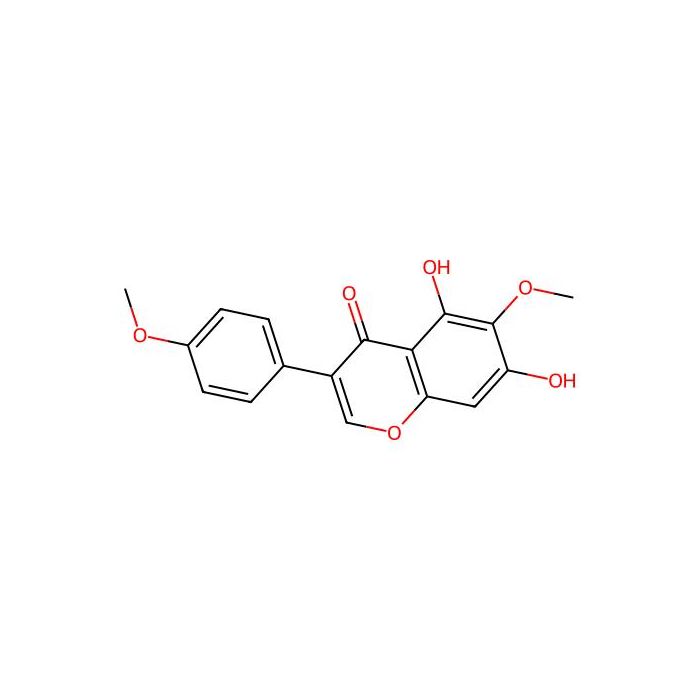
Irisolidone is a major isoflavone found in Pueraria lobata flowers. Irisolidone exhibits potent hepatoprotective activity. Irisolidone shows the high efficacy for volume-regulated anion channels (VRAC) blockade (IC 50 =9.8 μM) .
In Vitro
Irisolidone, an isoflavone metabolite, represses JC virus gene expression via inhibition of Sp1 binding in human glial cells. Irisolidone can inhibit endothelial cell proliferation. MCE has not independently confirmed the accuracy of these methods. They are for reference only.
Form:Solid
Taxonomy Tree
| Kingdom | Organic compounds |
|---|---|
| Superclass | Phenylpropanoids and polyketides |
| Class | Isoflavonoids |
| Subclass | O-methylated isoflavonoids |
| Intermediate Tree Nodes | 4'-O-methylated isoflavonoids |
| Direct Parent | 4'-O-methylisoflavones |
| Alternative Parents | Isoflavones Hydroxyisoflavonoids Chromones Phenoxy compounds Methoxybenzenes Anisoles Pyranones and derivatives Alkyl aryl ethers 1-hydroxy-4-unsubstituted benzenoids 1-hydroxy-2-unsubstituted benzenoids Vinylogous acids Heteroaromatic compounds Oxacyclic compounds Organic oxides Hydrocarbon derivatives |
| Molecular Framework | Aromatic heteropolycyclic compounds |
| Substituents | 4p-o-methylisoflavone - Isoflavone - Hydroxyisoflavonoid - Chromone - Benzopyran - 1-benzopyran - Anisole - Phenoxy compound - Phenol ether - Methoxybenzene - 1-hydroxy-4-unsubstituted benzenoid - 1-hydroxy-2-unsubstituted benzenoid - Pyranone - Alkyl aryl ether - Monocyclic benzene moiety - Benzenoid - Pyran - Vinylogous acid - Heteroaromatic compound - Ether - Organoheterocyclic compound - Oxacycle - Organooxygen compound - Organic oxygen compound - Hydrocarbon derivative - Organic oxide - Aromatic heteropolycyclic compound |
| Description | This compound belongs to the class of organic compounds known as 4'-o-methylisoflavones. These are isoflavones with methoxy groups attached to the C4' atom of the isoflavone backbone. |
| External Descriptors | Isoflavonoids |
| Activity Type | Relation | Activity value | Units | Action Type | Journal | PubMed Id | doi | Assay Aladdin ID |
|---|
| Solubility | DMSO : 100 mg/mL (318.18 mM; Need ultrasonic) |
|---|---|
| Molecular Weight | 314.290 g/mol |
| XLogP3 | 3.000 |
| Hydrogen Bond Donor Count | 2 |
| Hydrogen Bond Acceptor Count | 6 |
| Rotatable Bond Count | 3 |
| Exact Mass | 314.079 Da |
| Monoisotopic Mass | 314.079 Da |
| Topological Polar Surface Area | 85.200 Ų |
| Heavy Atom Count | 23 |
| Formal Charge | 0 |
| Complexity | 468.000 |
| Isotope Atom Count | 0 |
| Defined Atom Stereocenter Count | 0 |
| Undefined Atom Stereocenter Count | 0 |
| Defined Bond Stereocenter Count | 0 |
| Undefined Bond Stereocenter Count | 0 |
| The total count of all stereochemical bonds | 0 |
| Covalently-Bonded Unit Count | 1 |
No tested applications or dilutions are provided in the Product Data. The following general, research-use-only protocols are commonly applied to small-molecule reference standards like isoflavones; verify and optimize for your system.
These are generic templates intended to help initiate method development. Adjust solvent composition, concentrations, and detection parameters to your compound’s verified properties and instrument constraints.
No item-specific biological data are provided. The following context is general for the isoflavone class (literature-based); do not construe as clinical or therapeutic information.
Important: Aladdin Scientific supplies this item strictly for research use only, as indicated in the Product Data. No medical or clinical claims are made or implied.
This compound is not a buffer reagent and does not constitute a defined buffering system.
For buffer preparation guidance, refer to general buffer preparation resources; this product itself is not intended to prepare buffers.
As a solid small molecule, the main environmental lever is solvent choice for handling, synthesis, and analysis rather than the compound itself. The following are literature-based, general recommendations for isoflavone handling and derivatization; optimize for your workflow.
Illustrative comparison (general):
Note: Always balance “green” choices against analytical/synthetic performance requirements and compound stability.
No pharmacopeial status, excipient role, or GMP-related information is provided for this item. Aladdin Scientific supplies this compound strictly for research use only.
Research/formulation context (non-clinical, literature-based):
Note: Do not use this product in drug substances, drug products, clinical trials, or diagnostic procedures. For regulated applications, request detailed CoA, impurity profile, and stability data; this listing does not specify those attributes.
Item-specific physicochemical specifications were not provided in the Product Data. The following notes distinguish item-specific gaps from general literature context.
Important: For experimental planning, obtain the CoA/SDS for definitive physical constants and solution stability data specific to SKU I650962.
Interpretation and implications (general guidance for small-molecule reference compounds):
Recommendation: Contact Aladdin Scientific support with your SKU and desired application (e.g., analytical standard, screening) to ensure the supplied grade meets your performance and regulatory needs.
Manufacturer Applications: Not specifically stated in Product Data. Irisolidone (isoflavone class) is commonly used in research as:
Synthetic/analytical applications (literature/general):
Practical tips:
No item-specific reaction condition data are provided. The following are general, literature-based guidelines for manipulating isoflavone scaffolds and preparing analytical solutions; adapt to your system and confirm experimentally.
These conditions are illustrative and should be validated for irisolidone’s exact substitution pattern.
Safety information specific to this SKU was not provided. Use prudent laboratory precautions and consult the SDS for authoritative guidance.
General laboratory precautions for small-molecule phenolic isoflavones (literature-based):
Always defer to the product-specific SDS and institutional EHS policies for final safety measures.
Irisolidone is an isoflavone-type small molecule. Item-specific solubility was not provided; the following solvent guidance is literature-based for the isoflavone class. Verify experimentally for this item/lot.
Quick comparison (literature-based):
Tip: Filter stock solutions (0.22 µm PTFE) to remove particulates prior to analytical injections.
Reconstitution and handling (general best practices for small-molecule solids):
Always consult the lot-specific CoA/SDS for definitive stability and handling guidance.
Brief overview: Irisolidone is widely cited in the literature as a plant-derived isoflavone. Item-specific identifiers from the current listing are incomplete; key structural descriptors below are provided with appropriate caveats.
Structural features (general, literature-based for the isoflavone class; confirm for this item):
2D structure in words (general isoflavone motif):
While irisolidone is typically employed as a reference/assay compound rather than a synthetic intermediate, its isoflavone scaffold offers useful reactivity in derivatization (general, literature-based):
Note: Verify the exact substitution pattern of irisolidone from the CoA before planning selective transformations (regiochemistry dictates reactivity and protecting-group strategy).
Not applicable. This product is a small organic molecule, not a biological affinity reagent (e.g., antibody, enzyme, or ligand with validated target selectivity provided). No target, epitope, or species reactivity information is supplied in the Product Data.
For discovery research, any putative molecular targets should be established empirically using appropriate biochemical/biophysical assays; Aladdin Scientific provides no target-specific claims for this item.