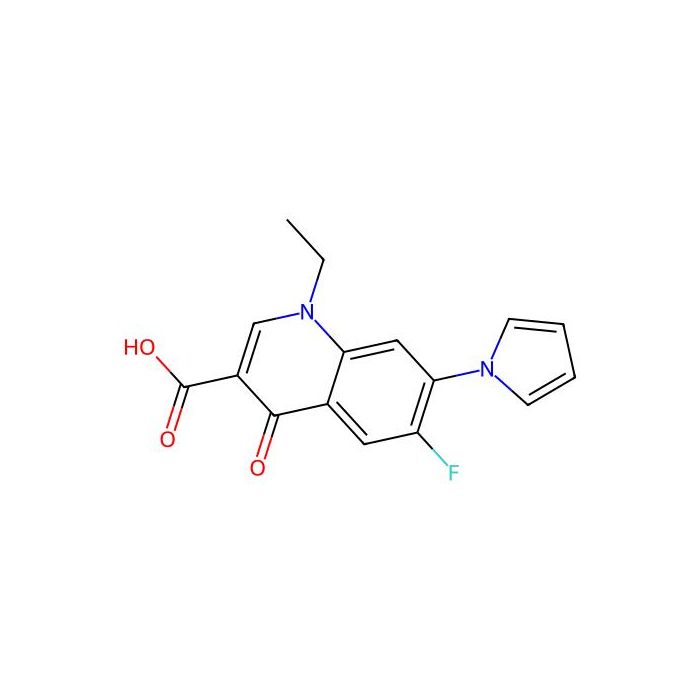
Irloxacin (Pirfloxacin) is a quinolone antibacterial agent. Irloxacin shows greater activity with an acid pH. Irloxacin has a good in vitro antimicrobial spectrum against both gram-positive and gram-negative bacteria. Orally active.
Specifications
Specifications & Purity
10mM in DMSO
Biochemical and Physiological Mechanisms
Irloxacin (Pirfloxacin) is a quinolone antibacterial agent. Irloxacin shows greater activity with an acid pH. Irloxacin has a good in vitro antimicrobial spectrum against both gram-positive and gram-negative bacteria. Orally active.
Storage
Store at -80°C
Shipped In
Dry ice packs + Cold packs
This product requires cold chain shipping. Ground and other economy services are not available.
Names and Identifiers
Isomeric SMILES
CCN1C=C(C(=O)C2=CC(=C(C=C21)N3C=CC=C3)F)C(=O)O
PubChem CID
65828
Molecular Weight
300.28
Advanced Data
Certificates (CoA,COO,BSE/TSE and Analysis Chart)
C of A & Other Certificates(BSE/TSE, COO):
Analytical Chart:
Solution Calculators
Molarity Calculator
Determine the necessary mass, volume, or concentration for preparing a solution.
Dilution Calculator
Determine the dilution needed to prepare a stock solution.
Reconstitution Calculator
Reviews
Customer Reviews
Application Protocols
No validated, item-specific application protocols were provided in the Product Data.
General guidance for small-molecule screening and biochemical assays:
Stock preparation: Dissolve in anhydrous DMSO to 10–50 mM. Vortex and, if needed, sonicate briefly. Pass through a 0.22 µm PTFE filter for particulate removal.
Aliquoting: Dispense single-use aliquots (e.g., 10–50 µL) into light-protective microvials or plates; store frozen to prevent repeated freeze–thaw.
Working solutions: Dilute into assay buffer with careful control of final DMSO (commonly ≤0.1–1% v/v). Add DMSO stocks last with thorough mixing to minimize precipitation.
Controls: Include vehicle controls and, where appropriate, a known fluoroquinolone as a positive control to verify assay performance.
Analytics: Verify concentration by UV–Vis or LC–MS where possible; note that quinolones absorb strongly in the UV (typically 250–300 nm range; literature) which can aid quantification.
For cell-free enzymology or binding assays, pre-screen solubility and nonspecific binding to plastics; use low-bind consumables as needed.
Biological Roles
General (literature) context for the fluoroquinolone class to which Irloxacin belongs:
Primary biochemical targets: bacterial DNA gyrase (GyrA/GyrB) and topoisomerase IV (ParC/ParE), type II topoisomerases critical for DNA supercoiling and segregation. Quinolones intercalate and stabilize the cleavage complex, inhibiting religation and disrupting DNA processing in bacteria.
Structure–activity relationships (SAR):
C6 fluorine increases DNA gyrase affinity and broadens spectrum compared to earlier quinolones.
C7 amine/aza-heterocycles modulate penetration and efflux susceptibility in Gram-negative organisms.
N1 substituents can tune potency and pharmacokinetic properties.
Resistance mechanisms (biochemical): target-site mutations in gyrA/parC QRDR regions, decreased outer-membrane permeability, and efflux pump upregulation.
Use in research: probe molecule for studying topoisomerase-mediated DNA cleavage, for mapping binding pockets via biochemical assays, and as a reference control in microbiology method development.
Note: The above roles are provided for biochemical understanding only. This product is supplied strictly for research use; no clinical or diagnostic use is intended or implied.
Buffer Applications
Irloxacin is not a buffering reagent and is not typically used to prepare laboratory buffer systems. For studies requiring Irloxacin in solution:
Prepare in a compatible assay buffer (e.g., phosphate- or HEPES-based) with minimal DMSO co-solvent. Adjust pH modestly during stock preparation to ensure complete dissolution, then readjust to assay pH.
Verify that the buffer ionic strength and divalent cations (e.g., Mg2+, Ca2+) do not promote precipitation or unintended chelation effects sometimes observed with quinolones (literature caution).
For actual buffer-making guidance, please refer to dedicated buffering agents (phosphate, HEPES, Tris, etc.).
Green Alternatives
Because Irloxacin is typically handled as research stocks rather than as a reaction solvent or bulk reagent, “green alternatives” primarily concern solvent choice for dissolution and processing.
Greener handling options (general guidance):
Prefer aqueous vehicles with minimal co-solvent when feasible. Adjust pH slightly (e.g., ≤0.1% HCl or NaOH) to aid dissolution, then buffer to target pH. This reduces reliance on dipolar aprotics.
If an organic co-solvent is required, consider ethanol or propylene glycol as more benign alternatives to DMF/NMP, provided solubility and assay compatibility are acceptable.
Keep DMSO concentrations as low as assay tolerance allows (often ≤0.1–1% v/v in final wells) to minimize environmental and biological confounders.
Illustrative comparison (general):
DMSO: high solubility, widely compatible; moderate environmental concern; difficult to remove from aqueous waste streams.
Ethanol: renewable feedstocks available; lower toxicity; may not fully dissolve high loads of amphoteric APIs without pH adjustment.
Water (pH-adjusted): greenest option; requires careful pH control to prevent precipitation during dilution.
Process tips:
Use small-volume, high-concentration master stocks and aliquot to reduce waste.
Employ closed, LC–MS compatible vialing to extend shelf life and limit evaporative losses.
Pharmaceutical Uses
No therapeutic or clinical claims are made for this material. In a laboratory/manufacturing context, Irloxacin may be utilized as follows (non-clinical):
Analytical reference material for method development and validation (HPLC/UPLC, LC–MS, dissolution testing) in support of research on fluoroquinolone chemotypes.
System-suitability standard in chromatographic fingerprinting or impurity profiling of related substances during medicinal chemistry programs.
Spiking standard for recovery studies in sample preparation workflows (e.g., SPE, protein precipitation) to benchmark extraction efficiency.
Regulatory/compendial status: Not specified for this item; refer to CoA/Spec Sheet. If compendial reference standards are required, procure pharmacopeial RS from the appropriate authority.
Physical Properties
Item-specific physical constants were not provided in the Product Data.
Appearance: Not specified for this item; refer to CoA/Spec Sheet.
Melting point, boiling point, density, refractive index: Not specified for this item; refer to CoA/Spec Sheet.
General/literature expectations for fluoroquinolones (for context only):
Ionization: Typically amphoteric with a carboxylate pKa(acid) ~5–6 and a basic amine pKa(base) ~7.5–9 (literature), leading to zwitterionic forms near neutral pH.
LogP/logD: Neutral core is moderately lipophilic (logP often ~0.5–2), but logD at pH 7.4 is reduced due to ionization (literature ranges; substance-specific value not provided here).
Solubility: Often sparingly soluble in pure water at neutral pH; solubility increases under acidic (protonated amine) or basic (carboxylate) conditions. Readily soluble in DMSO; mixed aqueous-organic vehicles (e.g., water with minimal NaOH/HCl adjustment or co-solvent) are commonly used (literature).
Note: For method development or formulation studies, determine exact pKa, logD, and aqueous solubility for this specific lot/compound experimentally or consult the CoA/Spec Sheet and SDS.
Quality & Grades
Grade/Purity: Not specified for this item; refer to CoA/Spec Sheet.
Context for this research product:
Small-molecule library compounds are typically supplied at high chemical purity suitable for screening, hit validation, and method development. Verified identity (e.g., by NMR/LC–MS) and purity by HPLC are commonly documented on the CoA.
If UV-based analytics are anticipated, low-UV-absorbing residual solvents and well-resolved chromatographic profiles are preferred; consult the certificate for details.
Stabilizers: None stated in the Product Data. If present for certain lots, stabilizers will be listed on the CoA; consider their potential impact on bioassays and analytics.
What to check on receipt (best practice):
Confirm identity by LC–MS and purity by HPLC against the provided CoA.
Verify counter-ion/tautomeric state if relevant (fluoroquinolones may exhibit different salt forms or hydrates). If the salt/hydrate form is not specified, treat as free base/free acid form and characterize accordingly.
Document lot-specific water content and residual solvent content if they are critical for your application.
Reaction & Applications
This product is supplied as a finished small molecule for research use (e.g., screening, target engagement studies, analytical method development). It is not typically used as a reagent/solvent. Nevertheless, the fluoroquinolone scaffold offers handles for derivatization in medicinal chemistry and chemical biology.
Research applications (non-clinical):
Tool compound for studying bacterial type II topoisomerase biochemistry (DNA gyrase and topoisomerase IV) in purified-enzyme or cell-free systems (literature context; no therapeutic claims).
Positive control in assay development for quinolone-binding studies (fluorescence polarization, SPR, thermal shift) and for benchmarking chromatographic methods.
Derivatization chemistry (general for quinolones):
C3 carboxyl activation (acid chlorides, mixed anhydrides, HATU/EDC) to form esters/amides for probe design or prodrug analogs.
N1 functionalization via alkylation or acylation under basic conditions, respecting regioselectivity of the quinolinone nitrogen.
C7 amine/aza-heterocycle substitutions by SNAr or nucleophilic displacement on suitably activated intermediates during scaffold synthesis; late-stage diversification can be achieved on certain analogs.
Conjugation: installation of linkers (e.g., PEGylated amides/ureas) for affinity matrices or pull-down probes.
Practical tips:
Maintain anhydrous conditions during coupling steps; control pH during aqueous workups to preserve the quinolinone core.
Protect from strong UV/light during prolonged manipulations to limit photodegradation observed with some fluoroquinolones (literature).
Reaction Conditions
This product is not commonly used as a reagent in named reactions; however, if you undertake derivatization or conjugation (general literature guidance):
Amide formation at C3 carboxyl:
Typical conditions: HATU (1.1–1.5 eq) or EDC·HCl (1.2–2 eq) with HOBt/HOAt or Oxyma in DMF or DCM/DMF, base (DIPEA 2–4 eq), 0–25°C, 1–16 h. Monitor by LC–MS. Expected isolated yields for clean couplings: 50–85% (substrate dependent).
Esterification:
DIC/DMAP in DCM or carbonyldiimidazole (CDI) activation in DMF; 0–25°C, 2–12 h.
N1-alkylation:
Mild base (K2CO3, Cs2CO3) in DMF/acetone, alkyl halide (1.2–2 eq), 0–40°C; minimize O-alkylation by solvent/base choice and stoichiometry.
Conjugation to tags (e.g., PEG, dyes):
Use NHS esters or click-compatible linkers; maintain pH 7.5–8.5 in aqueous-organic media to preserve quinolone integrity.
General cautions:
Light sensitivity has been reported for some fluoroquinolones; perform sensitive steps under subdued light.
Avoid prolonged strong base (>pH 10) or high temperatures that can compromise the C3–C4 pharmacophore.
All conditions are provided as general literature guidance; optimize on small scale for Irloxacin specifically.
Safety & Handling
Hazard classification was not provided in the Product Data. Handle as a research chemical with appropriate caution.
GHS classification, signal word, pictograms, and H-statements: Not specified for this item; refer to SDS.
Recommended PPE: laboratory coat, nitrile gloves, and safety glasses; use a certified chemical fume hood when weighing, dissolving, or transferring fine powders.
Avoid: inhalation of dust/aerosols; skin/eye contact; environmental release. Prevent cross-contamination of screening libraries.
Storage incompatibilities: Strong oxidizers and strong acids/bases may degrade quinolone cores or amine substituents; avoid prolonged exposure to light and moisture (general best practice for heteroaromatics).
First aid (general overview; defer to SDS):
Inhalation: move to fresh air; seek medical advice if symptoms persist.
Skin/eye contact: rinse with water for at least 15 minutes; remove contaminated clothing; seek medical advice if irritation persists.
Ingestion: rinse mouth; do not induce vomiting; seek medical attention.
Waste: Collect solutions/solids in appropriately labeled organic waste per institutional and regulatory guidance.
Always consult the SDS for authoritative safety, toxicological, and ecological information before use.
Solvent Selection
Irloxacin (fluoroquinolone class) is amphoteric and typically handled as DMSO stocks for screening.
Polarity and ionization: Coexisting acidic (carboxyl) and basic (amine) sites favor zwitterionic forms near neutral pH; unionized fractions increase in certain pH ranges. This governs aqueous solubility and membrane partitioning.
Primary solvents for stocks: DMSO (excellent), DMF (good). For aqueous work, prepare acidified (e.g., ≤0.1% HCl) or basified (≤0.1% NaOH) solutions to enhance dissolution, then back-titrate to target pH if necessary (general guidance).
Miscibility profile: DMSO and DMF are fully miscible with water; gradual dilution minimizes precipitation when transitioning to aqueous buffers.
Avoid: Neat nonpolar solvents (hexanes, toluene) which give negligible solubility; strong alkaline/acidic conditions for prolonged periods may cause degradation.
Comparison (general):
DMSO: highest solvating power; widely used for 10–50 mM library stocks; strong UV absorbance <270 nm may interfere in some assays.
DMF/NMP: alternative high-boiling polar aprotics; consider toxicity and downstream removal.
Aqueous buffers (pH-adjusted): greener but require careful pH control to avoid precipitation; suitable for immediate use rather than long-term storage.
Storage & Reconstitution
Storage conditions (from Product Data): Store at -80°C.
Solvents: Use anhydrous DMSO to prepare concentrated master stocks (e.g., 10–50 mM). If aqueous stocks are required, dissolve first in a small volume of DMSO, then dilute with pH-adjusted buffer to mitigate precipitation.
Aliquoting: Prepare single-use aliquots in amber vials or 96/384-well plates; minimize headspace to limit oxidation and moisture ingress.
Freeze–thaw: Avoid repeated freeze–thaw cycles; thaw on ice, mix gently, and promptly refreeze unused aliquots.
Light/moisture: Protect from light and humidity; store in sealed containers with desiccant when possible.
Stability notes:
Lot-specific stability, water content, and exact shelf life at -80°C are Not specified for this item; refer to CoA/Spec Sheet and SDS.
Before critical experiments, confirm integrity by LC–MS/HPLC after storage to ensure no degradation or precipitation has occurred.
Structure & Identity
Irloxacin is a member of the fluoroquinolone chemotype, supplied here for research screening and chemical biology use.
SKU: I656135
CAS: 91524-15-1
PubChem CID: 65828 (literature)
Molecular formula: Not specified for this item; refer to CoA/Spec Sheet.
Molecular weight: Not specified for this item; refer to CoA/Spec Sheet.
SMILES: Not specified for this item; refer to CoA/Spec Sheet.
InChIKey: Not specified for this item; refer to CoA/Spec Sheet.
Structural features (general, literature):
Fluoroquinolone core bearing a 4-oxo-3-carboxyquinoline scaffold with a characteristic C6–F substituent.
Typically N1-alkyl/aryl substitution and a C7 nitrogen heterocycle (often piperazinyl or related) that imparts amphoteric behavior and Gram-negative activity profile.
A bicyclic quinoline ring system fused from a benzene and pyridone ring; F on the benzene portion, a carboxyl at C3, a carbonyl at C4, an N1 substituent extending from the pyridone nitrogen, and a C7 amino/aza-heterocycle pendant on the quinoline ring.
Synthetic Utility
Although supplied as a finished screening compound, the fluoroquinolone scaffold offers several synthetic entry points for probe or analog synthesis (general guidance):
Carboxyl group (C3):
Coupling to amines (EDC/HATU/DIC) to form amides; carbodiimide-mediated esterifications for pro-moieties.
Conversion to activated esters (NHS, PFP) enabling downstream bioconjugation.
Quinolone nitrogen (N1):
Alkylation or acylation under controlled basic conditions; N-selectivity vs O-alkylation requires careful base/solvent choice.
C7 amine/aza-heterocycle:
Diversification via nucleophilic substitution on appropriately activated precursors; late-stage modifications can tune physicochemical and target interactions.
Photoreactive and clickable probes:
Installation of diazirines/azides through amide linkers at C3 or N1 to enable photoaffinity labeling and chemoproteomics of topoisomerase complexes (literature practice).
Strategic considerations:
Maintain the C3–C4 diketo–acid motif essential for topoisomerase binding; modifications here strongly affect activity.
Control stereoelectronic environment at C7 to manage efflux and permeability properties.
Protect from strong base or prolonged heating that may trigger decarboxylation or ring transformations in the quinolinone core.
Target Specificity
This section is primarily applicable to biological macromolecules (e.g., antibodies, enzymes). Irloxacin is a small-molecule research compound; no item-specific target-binding data were provided.
Target, epitope, clone/isotype, species reactivity: Not applicable to this product type.
General (literature) context: Fluoroquinolones interact with bacterial type II topoisomerases (DNA gyrase, topoisomerase IV). For quantitative affinity/selectivity data specific to Irloxacin, consult primary literature or generate assay-specific KD/IC50 values under your conditions.
Frequently Asked Questions
How should this product be stored?
Store at ?80 °C. Ultra-low temperature storage is required to maintain the specified shelf life.
How is this product shipped?
This product ships frozen with dry ice and cold packs. Unpack on arrival and transfer it to the storage condition stated above; handle dry ice with insulated gloves in a ventilated area.
What are the CAS number, molecular formula and molecular weight?
The CAS Number is 91524-15-1, the molecular formula is C16H13FN2O3, and the molecular weight is 300.28 g/mol.
What documentation is provided?
Available product documentation, including Certificates of Analysis (COA), Safety Data Sheets (SDS), and specification sheets, is shown in the product document area. Document availability and access follow the current site policy.
We use cookies to ensure the website functions properly and, where permitted, to improve your experience. You can manage your preferences at any time in Settings. Learn more in our Cookie Policy.
Shall we send you a message when we have discounts available?
Remind me later
Thank you! Please check your email inbox to confirm.
Products are supplied to verified businesses, institutions, and qualified professionals for research and development use only. Not for use in humans, animals, diagnosis, or therapy.