GRADE & PURITYMoligand™?Moligand™ — Aladdin's line of ligands and bioactive small molecules. Use for receptor, pathway, and binding studies needing defined small-molecule tools.10mM in DMSO
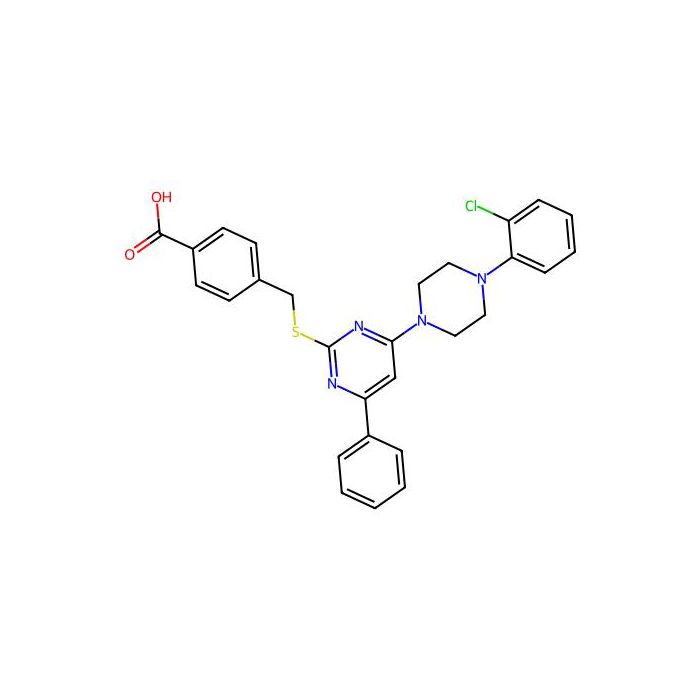
J14 is a reversible sulfiredoxin inhibitor with an IC 50 of 8.1 μM. J14 induces oxidative stress (intracellular ROS accumulation) by inhibiting sulfiredoxin , leading to cytotoxicity and cancer cell death
In Vitro
J14 (0-100 μM; 0-96 hours; A549 cells) treatment inhibits the growth of A549 cells in a concentration- and a time- dependent manner, and its half inhibitory concentration for the growth of A549 cells was 15.7 μM. ?\nJ14 (20 μM; 48-72 hours; A549 cells) treatment causes not only the release of cytochrome c into the cytosol, but also the activation of caspase-3 and caspase-9. J14 induces oxidative damage to mitochondria, resulting in caspase-mediated apoptosis. ?\nJ14 treatment significantly increases the accumulation of sulfinic peroxiredoxins and intracellular ROS. Excess accumulation of intracellular ROS causes oxidative damage, leading to cell death. J14 significantly induces cell death in A549 cells in a time-dependent manner, resulting in approximately 40% cell death in 96 hours. ?\nJ14 induces oxidative mitochondrial damage and apoptosis. MCE has not independently confirmed the accuracy of these methods. They are for reference only. Cell Viability AssayCell Line: A549 cells Concentration: 0-100 μM Incubation Time: 0 hour, 24 hours, 48 hours, 72 hours, 96 hours Result: Inhibited the growth of A549 cells in a concentration- and a time- dependent manner. Western Blot AnalysisCell Line: A549 cells Concentration: 20 μM Incubation Time: 48 hours, 72 hours Result: Caused not only the release of cytochrome c into the cytosol, but also the activation of caspase-3 and caspase-9.
In Vivo
J14 (50 mg/kg; intraperitoneal injection; daily; for 16 days; BALB/c nude female mice) treatment significantly reduces the average tumor volume. The masses and weights of the primary tumors excised from the J14-treated mice are significantly lower compared with those of the control mice . MCE has not independently confirmed the accuracy of these methods. They are for reference only. Animal Model: Six-week-old BALB/c nude female mice injected with A549 cells Dosage: 50 mg/kg Administration: Intraperitoneal injection; daily; for 16 days Result: Significantly reduced the growth of human lung tumor without acute toxicity.
IC50& Target:IC50: 8.1 μM (Sulfiredoxin),ROS
Specifications
Specifications & Purity
Moligand™,10mM in DMSO
Biochemical and Physiological Mechanisms
J14 is a reversible sulfiredoxin inhibitor with an IC 50 of 8.1 μM. J14 induces oxidative stress (intracellular ROS accumulation) by inhibiting sulfiredoxin , leading to cytotoxicity and cancer cell death.
Storage
Store at -80°C
Shipped In
Dry ice packs + Cold packs
This product requires cold chain shipping. Ground and other economy services are not available.
Determine the necessary mass, volume, or concentration for preparing a solution.
Dilution Calculator
Determine the dilution needed to prepare a stock solution.
Reconstitution Calculator
Reviews
Customer Reviews
Application Protocols
No vendor-validated biological or analytical protocols are specified for J14. The following are general, non-item-specific starting points:
Biochemical enzyme assay (96/384-well):
Prepare 10 mM DMSO stock; generate a 10-point 3-fold dilution series in DMSO.
Add to assay buffer to achieve 0.5–1% final DMSO across all wells; include vehicle controls.
Readout: fluorescence/absorbance/luminescence per enzyme system; confirm linearity and absence of interference.
SPR binding screen:
Filter compound solutions (0.2 μm PTFE). Match running buffer DMSO to sample DMSO within ±0.1%.
Use multi-concentration injections; assess for bulk shifts and nonspecific binding.
Cell viability counter-screen:
Dose cells with a concentration range maintaining ≤0.1–0.5% DMSO.
Evaluate cytotoxicity with orthogonal methods (e.g., resazurin and nuclei count).
All protocols must be optimized locally. No claims are made about performance of J14 in these applications. For any item-specific recommendations, consult the CoA/Spec Sheet.
Biological Roles
No biological target, pathway, or mode of action is disclosed for J14 in this listing. As a Moligand™ screening compound, it should be treated as an investigational chemical probe candidate.
General considerations for discovery compounds (not item-specific claims):
Potential roles span enzyme inhibition/activation, receptor/ion-channel modulation, PPI perturbation, or pathway biasing, depending on structure and context.
Early profiling may include: broad panel biochemical assays, off-target safety counterscreens (e.g., hERG binding, CYP inhibition) strictly for research insight; no clinical interpretation.
Mechanistic deconvolution options: chemoproteomics (affinity capture with an appropriately derivatized analogue), CETSA/thermal profiling, CRISPRi/a modifier screens, and transcriptomic/proteomic signatures to infer pathways.
Best practices:
Establish a vehicle control matrix and DMSO tolerance curve for your assay.
Assess solubility, stability, and permeability in the relevant biological matrix prior to large-scale studies.
Confirm concentration–response behavior and evaluate potential assay interference (fluorescent/colored compounds, redox cycling, metal chelation, or aggregation) with orthogonal readouts.
Note: All uses are for laboratory research only. No biological effect or therapeutic implication is asserted for this specific item.
Buffer Applications
J14 is not a buffer reagent. However, appropriate buffer systems are critical for reliable screening with small molecules.
Practical guidance (general, assay-focused):
Enzymatic assays: Use buffers with sufficient capacity at the enzyme’s optimal pH (e.g., HEPES pH 7.4–7.5, Tris pH 7.5–8.0, phosphate pH 6.5–7.5). Maintain ionic strength (50–150 mM NaCl) to reduce nonspecific interactions.
Aggregation control: Include 0.01–0.05% nonionic detergent (Tween-20, Triton X-100, or Pluronic F-127) if compatible; verify against enzyme activity.
Binding assays (SPR/MST/FP): Filter and degas buffers (0.22 μm). Add 0.005–0.05% surfactant and 1–2% DMSO to match analyte solvent and reduce bulk refractive index shifts (SPR).
Cell assays: Use standard culture media with DMSO ≤0.1–0.5% v/v where possible. Consider serum protein binding and compound adsorption to plastics.
Recipes and pH ranges above are general literature guidance and must be validated for your specific assay. No item-specific buffer formulation is provided for J14.
Green Alternatives
Green chemistry considerations are generally less applicable to a single screening compound used at milligram or sub‑milligram scales; the main impact areas are solvent choice and waste minimization.
Prefer aqueous buffers and lower DMSO percentages where assay-tolerated.
For analytical workflows, ethanol can sometimes substitute for acetonitrile/methanol in sample prep if compatible with detection and solubility requirements.
Minimize repeated freeze–thaw cycles by aliquoting to reduce compound waste and re-synthesis demand.
Trade-offs (general):
DMSO vs bio-based solvents: DMSO remains the most reliable stock solvent for diverse chemotypes. While bio-based alternatives (e.g., 2-MeTHF) are greener for synthesis, they are seldom appropriate for biological assays and may be immiscible with water.
Aqueous-first approaches reduce solvent use but may limit achievable concentrations or stability for hydrophobic molecules.
Recommendation:
Implement microscale assay formats (384/1536-well) and acoustic dispensing to reduce solvent and compound consumption without compromising data quality.
Item-specific greener substitutes are not applicable because the structure and functional use as a reagent are not defined in this listing.
Pharmaceutical Uses
This product is supplied strictly for research use and is not intended for human or veterinary use, diagnostic procedures, or as an excipient.
Context for discovery workflows (general, non-clinical):
Compounds like J14 can be employed as tool candidates in pre-formulation research (e.g., solubility screens, stability assessments) and in vitro ADME method development to understand structure–property relationships. These activities are exploratory and not for clinical application.
If advancement is contemplated, additional controls are typically required: polymorph/solid-form assessment, salt screening, impurity profiling, and comprehensive analytical characterization under applicable quality systems. None of these are specified for this item.
No pharmacopeia status, dosage form suitability, or clinical formulation role is provided or implied for this compound.
Physical Properties
Item-specific physicochemical data are not disclosed in this catalog entry.
Appearance: Not specified for this item; refer to CoA/Spec Sheet.
Melting point / Boiling point: Not specified for this item; refer to CoA/Spec Sheet.
Density / Refractive index: Not specified for this item; refer to CoA/Spec Sheet.
Solubility: Not specified for this item; refer to CoA/Spec Sheet. (General practice for library compounds is dissolution in anhydrous DMSO to prepare concentrated stocks.)
logP / pKa: Not specified for this item; refer to CoA/Spec Sheet.
General guidance (literature/practice, not item-specific):
For small-molecule screening compounds, initial dissolution in DMSO (≥99.9%, anhydrous) at 10–50 mM is common, followed by dilution into aqueous assay buffers containing 0.1–2% DMSO as tolerated by the assay system.
If hydrophobic, co‑solvent systems (DMSO:water, DMSO:buffer, or DMSO:PEG400:water) can improve handling; if ionizable, dissolution at a pH favoring ionization may improve apparent solubility.
Always verify compound integrity and solution concentration by orthogonal methods (HPLC/UV, LC–MS) before critical assays, especially after storage at low temperature.
Moligand™ compounds are intended for discovery workflows (HTS, fragment/ligand screening, biochemical/biophysical assays). Identity confirmation (e.g., LC–MS, NMR) and purity assessment are typically provided on a per-lot Certificate of Analysis.
This listing does not disclose numeric purity, residual solvent, water, or metal specifications. For lot-specific values and release tests, consult the CoA/Spec Sheet.
Implications for use:
Screening-grade materials are suitable for primary and secondary assays, mechanistic studies, and early SAR. For lead optimization or in vivo enabling studies, teams may request additional QC (e.g., chiral purity, low residual solvent, solid-form control) as needed.
If your assays are UV-sensitive or require mass-balance closure, request data on UV cutoff/blank absorbance and volatile content for your lot.
Recommendations:
Verify concentration by HPLC/UV or quantitative NMR when preparing master stocks for critical experiments.
Record lot number in ELN. If reproducibility issues arise, re‑test purity and identity under your lab’s methods.
If a stabilizer is present or if salt/form is relevant, this will be stated on the CoA; none are specified in this listing.
Reaction & Applications
This product is positioned as a discovery ligand/small‑molecule for screening, not as a synthetic reagent. Accordingly, “reaction chemistry” use cases are limited. The following focuses on research applications typical for Moligand™ compounds:
Primary/secondary screening: Suitable for biochemical enzyme assays, binding assays (fluorescence polarization, TR-FRET, AlphaScreen), and biophysical methods (DSF, MST, SPR), pending solubility and fluorescence characteristics confirmed by your team.
Orthogonal target engagement: Apply CETSA/thermal shift in lysates or intact cells where compatible with DMSO and compound permeability.
Cell-based phenotypic assays: Evaluate pathway modulation, imaging-based phenotypes, or reporter activity after confirming cytotoxicity windows and DMSO tolerance.
SAR exploration: Use J14 as a reference point in matched molecular pair or analogue-by-catalog campaigns to rapidly explore substituent effects once structure is disclosed internally.
Analytical characterization in-house: LC–MS for intact mass and stability; HPLC/UPLC for purity and carryover; NMR for structural confirmation if the structure is shared with your lab.
Practical tips:
Confirm absence of assay interference (autofluorescence, inner filter effects, colloidal aggregation). Employ detergent controls and light-protection if aromatic chromophores are suspected.
Titrate DMSO vehicle controls matching the highest compound concentration.
For colloid detection, consider dynamic light scattering or detergent-sensitive IC50 shifts as part of triage.
No specific named reactions or synthetic transformations are provided for this item.
Reaction Conditions
Not applicable as a reagent: J14 is not provided for use in chemical synthesis under defined reaction conditions. No named reactions, catalysts, or stoichiometries are specified for this item.
Assay handling conditions (general, research practice):
Stock preparation: Dissolve in anhydrous DMSO (typical screening stocks 10–50 mM). Vortex and, if needed, sonicate briefly. Filter (PTFE, 0.2 μm) for SPR or LC–MS.
Assay dosing: Prepare serial dilutions in DMSO, then dilute into assay buffer to the required final concentration keeping DMSO constant across wells (commonly 0.1–1.0% v/v).
Stability checks: Assess freeze–thaw stability over intended cycles; monitor by LC–MS/HPLC. Protect from light if aromatic chromophores are suspected.
Adsorption mitigation: Use low-bind plastics or glass vials for hydrophobic compounds; pre-condition tips/vials with low-% DMSO.
These recommendations are general and must be validated in your assay context. No item-specific conditions are claimed.
Safety & Handling
Safety data specific to J14 are not provided in this listing.
GHS classification / pictograms / H-statements / signal word: Not specified for this item; refer to SDS.
Primary hazards: Unknown; handle as a potentially harmful laboratory chemical. Avoid inhalation, ingestion, and skin/eye contact.
PPE: Lab coat, safety glasses, and appropriate chemical-resistant gloves (e.g., nitrile). Use in a fume hood when weighing or handling powders/solutions that may aerosolize.
General first aid: In case of skin/eye contact, rinse with water for at least 15 minutes; remove contaminated clothing. If inhaled, move to fresh air. If ingested or in case of any exposure concerns, seek medical attention. Defer to SDS for authoritative instructions.
Incompatibilities: Unknown; store separately from strong oxidizers and strong acids/bases as a precaution. Avoid exposure to heat, light, and moisture to preserve integrity.
Spill response: Absorb liquid spills with inert material (vermiculite, absorbent pads). Collect solids with minimal dust generation. Dispose according to institutional hazardous waste protocols.
Waste: Treat as organic laboratory chemical waste unless otherwise specified by SDS/CoA.
Always consult the product SDS for definitive hazard information and institution-specific EHS guidance before use.
Solvent Selection
Because the detailed structure is not disclosed, solvent choice should follow best practices for small‑molecule library members.
Primary stock solvent: DMSO (anhydrous) is the default for discovery compounds due to broad solvating ability and assay compatibility at 0.1–2% final DMSO.
Aqueous compatibility: Dilute DMSO stocks into assay buffer just prior to use. Pre-wet plastic tips/vials with low-% DMSO to minimize adsorption of lipophilic compounds.
Alternative solvents (if needed):
Mixed systems: DMSO:water or DMSO:buffer.
Co-solvents: acetonitrile, ethanol, methanol for analytical injections; PEG400 or cyclodextrin vehicles for solubilization screening (research only).
Polarity considerations: Without structural data, assume a range of polarity; run a small solubility screen (e.g., DMSO, MeOH, ACN, buffer pH 6–8 with 0.01–0.05% surfactant such as Tween-20 if assay-tolerated).
Protein-binding mitigation: Include small amounts of bovine serum albumin (BSA) only if compatible with the assay; verify no interference.
Quick comparison (general):
DMSO: maximal solvency, good stability; may affect some enzymes/cells above 1–2%.
ACN/MeOH: useful for LC–MS/HPLC and analytical dilutions; less suitable for biological assays at high %.
Aqueous buffers: best for final assay; consider pH to favor compound ionization if appropriate.
Storage & Reconstitution
Storage conditions (as provided): Store at −80°C.
Shipping: Shipped on dry ice packs + cold packs to maintain low temperature.
Long-term stability: Not specified for this item; refer to CoA/Spec Sheet.
Reconstitution (general guidance for small-molecule library members):
Allow vials to equilibrate to room temperature in a desiccated environment before opening to minimize moisture condensation.
Dissolve in anhydrous DMSO to prepare a concentrated stock (e.g., 10–50 mM as assay permits). Record exact mass and final volume to calculate concentration.
If particulate persists, warm gently (≤37°C) and vortex/sonicate briefly; avoid prolonged heating.
Filter solutions for biophysical assays if required (0.2 μm PTFE) and protect from light if chromophoric.
Aliquoting and freeze–thaw:
Dispense single-use aliquots (e.g., 10–50 μL) in low-bind tubes; store at −80°C in sealed, moisture-protected secondary containment.
Avoid repeated freeze–thaw cycles. Thaw on ice or at room temperature, use immediately, and discard leftovers according to lab policy.
Stability in solution, hygroscopicity, and light sensitivity are not specified for this item; confirm empirically or consult the CoA/Spec Sheet. Research use only.
Structure & Identity
Brief overview: J14 (SKU J656865) is supplied as a Moligand™ small‑molecule library member for discovery and screening workflows. Structural identifiers are intentionally limited in this catalog entry.
Product name: J14
SKU: J656865
CAS: 1043854-13-2
PubChem CID: 45987688
Molecular formula: Not specified for this item; refer to CoA/Spec Sheet.
Molecular weight: Not specified for this item; refer to CoA/Spec Sheet.
SMILES: Not specified for this item; refer to CoA/Spec Sheet.
InChIKey: Not specified for this item; refer to CoA/Spec Sheet.
Structural features (general): Not disclosed in this listing. As a Moligand™ library compound, J14 is expected to fall within typical drug‑like chemical space (e.g., heteroatom-containing, aromatic/aliphatic balance), but compound‑specific functional groups, ring systems, and stereochemical elements are not provided here.
Notes on representation:
2D description cannot be provided without the disclosed structure. If you require exact atom connectivity and stereochemistry, please request the current CoA/Spec Sheet or structure file (SDF/molfile) under applicable confidentiality terms.
When preparing cheminformatics entries (ELN/LIMS), use the identifiers above and link to internal documentation once structure is released to your project team.
Synthetic Utility
J14 is offered as a screening ligand/small molecule rather than a building block or reagent. Without a disclosed structure, synthetic transformations and retrosynthetic roles cannot be specified.
General notes (not item-specific):
If a structure becomes available and contains common synthetic handles (e.g., aryl halide, carboxylate, amine), diversification could be achieved via cross-coupling, amide coupling, reductive amination, or SNAr for analogue generation.
For SAR expansion, maintain a reference batch of J14 as the parent comparator while synthesizing analogues to probe electronic, steric, and lipophilicity effects.
For isotopic or tagged derivatives (e.g., biotin/alkyne handles) used in chemoproteomics, design linkers to minimize perturbation of key pharmacophores identified through modelling or SAR.
Because no functional groups are disclosed here, treat J14 as a terminal probe until additional structural data are provided via CoA or separate disclosure.
Target Specificity
No target, enzyme, receptor, or pathway specificity is provided for J14 in this listing.
Item-specific data such as Ki/IC50, selectivity panels, species reactivity, or off-target profiles are not disclosed.
If your project requires target annotation, consider running a primary panel relevant to your biology area (e.g., kinase, GPCR, protease, ion channel) followed by orthogonal confirmation.
For any available target-binding data that may exist for your lot, please request the CoA/Spec Sheet or associated project documentation. Absent such data, J14 should be treated as an unannotated small molecule for exploratory research only.
Frequently Asked Questions
What is Moligand??
Moligand? is one of Aladdin Scientific's premium product lines, formulated for high-purity applications across multiple workflows. Compared to standard grades in the same workflow, Moligand? products typically offer tighter specifications, more rigorous QC, and stronger lot-to-lot consistency.
How should this product be stored?
Store at ?80 °C. Ultra-low temperature storage is required to maintain the specified shelf life.
How is this product shipped?
This product ships frozen with dry ice and cold packs. Unpack on arrival and transfer it to the storage condition stated above; handle dry ice with insulated gloves in a ventilated area.
What are the CAS number, molecular formula and molecular weight?
The CAS Number is 1043854-13-2, the molecular formula is C28H25ClN4O2S, and the molecular weight is 517.04 g/mol.
What documentation is provided?
Available product documentation, including Certificates of Analysis (COA), Safety Data Sheets (SDS), and specification sheets, is shown in the product document area. Document availability and access follow the current site policy.
Need help choosing the grade?
Our grade selection guide covers purity, stabilizer status, and application suitability for all variants in our catalog.
We use cookies to ensure the website functions properly and, where permitted, to improve your experience. You can manage your preferences at any time in Settings. Learn more in our Cookie Policy.
Shall we send you a message when we have discounts available?
Remind me later
Thank you! Please check your email inbox to confirm.
Products are supplied to verified businesses, institutions, and qualified professionals for research and development use only. Not for use in humans, animals, diagnosis, or therapy.