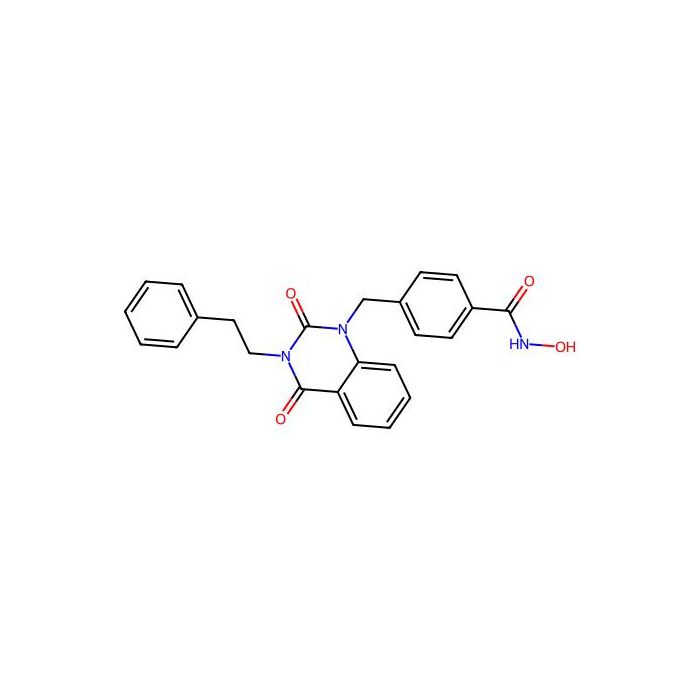
J22352 - ≥98% , CAS No.2252395-44-9

CAS: 2252395-44-9 Cat. No.: J651816 Formula: C24H21N3O4 Molecular Weight: 415.44 PubChem CID: 138377601
AVAILABLE TO ORDER
GRADE & PURITY ≥98%
Storage
Store at -20°C
Shipped In
Ice chest + Ice pads
★
Size
Germany (EU)
USA*
Price
Qty
5mg
J651816-5mg
Made to order · 8–12 wks
€209.04
10mg
J651816-10mg
Made to order · 8–12 wks
€330.52
50mg
J651816-50mg
Made to order · 8–12 wks
€955.29
100mg
J651816-100mg
Made to order · 8–12 wks
€1,632.13
Enter a quantity for the sizes you want to add.

Overview

J22352 is a PROTAC (proteolysis-targeting chimeras)-like and highly selective HDAC6 inhibitor with an IC 50 value of 4.7 nM. J22352 promotes HDAC6 degradation and induces anticancer effects by inhibiting autophagy and eliciting the antitumor immune response in glioblastoma cancers, and leading to the restoration of host antitumor activity by reducing the immunosuppressive activity of PD-L1

In Vitro

J22352 (0.1-20 μM; 72 hours) decreases U87MG cell viability in a dose-dependent manner. J22352 (10 μM; 24 hours) shows a dose-dependent decrease in HDAC6 protein abundance. MCE has not independently confirmed the accuracy of these methods. They are for reference only. Cell Viability AssayCell Line: U87MG cells Concentration: 0.1 μM; 0.5 μM; 1μM; 2.5 μM; 5 μM; 10 μM; 20 μM Incubation Time: 72 hours Result: A dose-dependent decrease on U87MG cell proliferation. Western Blot AnalysisCell Line: U87MG cells Concentration: 10 μM Incubation Time: 24 hours Result: A dose-dependent decrease in aberrant overexpression of HDAC6 in glioblastoma.

In Vivo

J22352 (10 mg/kg; given i.p. per day for 14 days in male nude mice) results in a >80% tumor growth inhibition (TGI) rate. J22352 is well tolerated in mice . MCE has not independently confirmed the accuracy of these methods. They are for reference only. Animal Model: Male nude mice (BALB/cAnN.Cg-Foxnlnu/CrlNarl, 4-6 weeks old) Dosage: 10 mg/kg Administration: Given i.p.; per day for 14 days Result: Marked anti-tumor effects and well tolerated in mice.

Form:Solid

IC50& Target:HDAC6 4.7 nM (IC 50 )

Specifications

Specifications & Purity
≥98%
Biochemical and Physiological Mechanisms
J22352 is a PROTAC (proteolysis-targeting chimeras)-like and highly selective HDAC6 inhibitor with an IC 50 value of 4.7 nM. J22352 promotes HDAC6 degradation and induces anticancer effects by inhibiting autophagy and eliciting the antitumor immune respon
Storage
Store at -20°C
Shipped In
Ice chest + Ice pads
This product requires cold chain shipping. Ground and other economy services are not available.
Action Type
INHIBITOR
Purity
≥98%
Names and Identifiers
SMILES
C1=CC=C(C=C1)CCN2C(=O)C3=CC=CC=C3N(C2=O)CC4=CC=C(C=C4)C(=O)NO
IUPAC Name
4-[[2,4-dioxo-3-(2-phenylethyl)quinazolin-1-yl]methyl]-N-hydroxybenzamide
InChIKey
JBJIKUXUKSADFV-UHFFFAOYSA-N
InChI
1S/C24H21N3O4/c28-22(25-31)19-12-10-18(11-13-19)16-27-21-9-5-4-8-20(21)23(29)26(24(27)30)15-14-17-6-2-1-3-7-17/h1-13,31H,14-16H2,(H,25,28)
Isomeric SMILES
C1=CC=C(C=C1)CCN2C(=O)C3=CC=CC=C3N(C2=O)CC4=CC=C(C=C4)C(=O)NO
PubChem CID
138377601
Molecular Weight
415.44

Advanced Data

Taxonomic Classification

Taxonomy Tree

KingdomOrganic compounds
SuperclassOrganoheterocyclic compounds
ClassDiazanaphthalenes
SubclassBenzodiazines
Intermediate Tree Nodes Not available
Direct ParentQuinazolines
Alternative Parents Benzoic acids and derivatives  Benzoyl derivatives  Pyrimidones  Vinylogous amides  Heteroaromatic compounds  Ureas  Lactams  Carboxylic acids and derivatives  Azacyclic compounds  Organopnictogen compounds  Organooxygen compounds  Organonitrogen compounds  Organic oxides  Hydrocarbon derivatives  
Molecular FrameworkAromatic heteropolycyclic compounds
Substituents Quinazoline - Benzoic acid or derivatives - Benzoyl - Pyrimidone - Benzenoid - Pyrimidine - Monocyclic benzene moiety - Heteroaromatic compound - Vinylogous amide - Urea - Carbonic acid derivative - Lactam - Azacycle - Carboxylic acid derivative - Organic nitrogen compound - Organic oxygen compound - Organopnictogen compound - Organic oxide - Hydrocarbon derivative - Organooxygen compound - Organonitrogen compound - Aromatic heteropolycyclic compound
DescriptionThis compound belongs to the class of organic compounds known as quinazolines. These are compounds containing a quinazoline moiety, which is made up of two fused six-member aromatic rings, a benzene ring and a pyrimidine ring.
External Descriptors Not available
3D Structure
Interactive Chemical Structure Model


Associated Targets(Human)
HDAC6 Tclin Histone deacetylase 6 (4 Activities)
Activity TypeActivity Value -log(M)Mechanism of ActionActivity ReferencePublications (PubMed IDs)
HDAC8 Tclin Histone deacetylase 8 (1 Activities)
Activity TypeActivity Value -log(M)Mechanism of ActionActivity ReferencePublications (PubMed IDs)
HDAC8 Tclin Histone deacetylase 8 (4516 Activities)
Activity TypeRelationActivity valueUnitsAction TypeJournalPubMed IddoiAssay Aladdin ID
HDAC11 Tclin Histone deacetylase 11 (967 Activities)
Activity TypeRelationActivity valueUnitsAction TypeJournalPubMed IddoiAssay Aladdin ID
A549 (127892 Activities)
Activity TypeRelationActivity valueUnitsAction TypeJournalPubMed IddoiAssay Aladdin ID
Associated Targets(non-human)
Hdac1 Histone deacetylase 1 (93 Activities)
Activity TypeRelationActivity valueUnitsAction TypeJournalPubMed IddoiAssay Aladdin ID
Hdac6 Histone deacetylase 6 (222 Activities)
Activity TypeRelationActivity valueUnitsAction TypeJournalPubMed IddoiAssay Aladdin ID
Lewis lung carcinoma cell line (1243 Activities)
Activity TypeRelationActivity valueUnitsAction TypeJournalPubMed IddoiAssay Aladdin ID
Mechanisms of Action
Certificates (CoA,COO,BSE/TSE and Analysis Chart)
C of A & Other Certificates(BSE/TSE, COO):
Analytical Chart:
Chemical and Physical Properties
SolubilityDMSO : 125 mg/mL (300.89 mM; Need ultrasonic)
Solution Calculators
Reviews

Customer Reviews

Application Protocols

No validated application protocols are provided for this item.

  • Item-specific

    • Tested applications, recommended dilutions, and positive controls: Not specified for this item; refer to CoA/Spec Sheet.
  • General guidance (not item-specific)

    • Stock preparation: Dissolve in DMSO to a convenient concentration (e.g., 10–50 mM), vortex/sonicate, and filter if needed (0.2 µm PTFE for organic solutions).
    • Assay use: Maintain constant final DMSO (≤0.5–1% v/v typical). Include vehicle controls and, where available, orthogonal assay formats to confirm activity.
    • Plate handling: Use low-binding labware for hydrophobic compounds; minimize edge effects with controlled incubation and humidity.
  • Documentation

    • Record lot number, stock concentration, solvent, and preparation date. Replace working solutions regularly to avoid degradation artifacts.
Biological Roles
  • Item-specific

    • No target, pathway, or mechanism information is provided for J22352. Biological function, if any, is not specified for this item; refer to internal screening results and literature.
  • General context (not item-specific)

    • Small molecules in discovery libraries may act on a diverse set of targets (enzymes, receptors, ion channels) through noncovalent or covalent mechanisms. Activity is contingent on structure, physicochemical properties, and assay context.
    • Early characterization typically includes: permeability (e.g., PAMPA/MDCK), metabolic stability (microsomes/S9/hepatocytes), plasma protein binding, and solubility across assay-relevant pH values.
    • Counter-screening against nuisance mechanisms (redox cycling, metal chelation, aggregation) is recommended to de-risk false positives. Detergent-supplemented assays and light/detergent controls may help identify aggregators or photosensitive chemotypes.
    • If a putative target emerges, corroborate with orthogonal assays (biophysics, CETSA), dose–response curves, time-dependence, and where feasible, structure–activity relationships.
  • Documentation

    • Capture exact solvent composition, plate map, and handling conditions in ELNs; subtle differences in DMSO content or precipitation can confound biological readouts.
  • Disclaimer

    • For research use only. Not for human or animal use. No clinical or therapeutic claims are made or implied.
Buffer Applications

This product is not described as a buffering reagent, and no acid/base constants are provided.

  • Item-specific

    • pKa(s) and buffering range: Not specified for this item; refer to CoA/Spec Sheet.
  • Guidance

    • If solutions are prepared for biological assays, use established buffer systems (e.g., phosphate, HEPES, MOPS, Tris) appropriate to assay pH and temperature. Dissolve the compound separately (often in DMSO), then dilute into the buffer while keeping organic co-solvent low and constant across samples.
    • Monitor for precipitation upon dilution; a short solubility scout across pH 6–8 and ionic strengths can prevent assay variability.
  • Conclusion

    • Buffer formulation is generally not applicable to this compound beyond serving as a vehicle for delivery into assays.
Green Alternatives

Without structural information, solvent/process choices for J22352 cannot be prescribed. The following general guidance supports greener decision-making during dissolution, purification, or assay setup (literature-based; not item-specific):

  • Preferable dissolution/co-solvents (when compatible)

    • Ethanol, isopropanol, propylene carbonate, and water/co-solvent systems over DMF or dichloromethane when solubility permits.
    • Replace acetonitrile with ethanol/water or methanol/water in LC methods where chromatographic performance is acceptable.
  • Greener process solvents vs common incumbents (general comparison)

    • 2-MeTHF or CPME vs THF/diethyl ether: lower peroxide tendency, improved safety profile, partially bio-based; note differing polarity and water miscibility.
    • Ethyl acetate vs dichloromethane/chloroform: lower toxicity and environmental impact; check partition efficiency.
    • Cyclopentyl methyl ether (CPME) vs toluene: reduced emissions and often favorable workup; ensure reaction compatibility.
  • Practical tradeoffs

    • DMSO is widely used for screening stocks but is not readily biodegradable and can carry compounds across membranes; minimize assay %DMSO and consider PEG-400 or aqueous cyclodextrins if compatible with biology and stability.
    • Verify compound stability in greener media; hydrolysis/oxidation risk may increase in aqueous or alcoholic systems.
  • Item-specific note

    • No green-alternative mandate or restriction is specified for this item; consult your EHS and process chemistry teams for case-by-case selection.
Pharmaceutical Uses

No pharmacopeial status, excipient role, or manufacturing use is specified for this item.

  • Item-specific

    • Regulatory/compendial listing: Not specified for this item; refer to CoA/Spec Sheet.
    • Intended use: For research use only (as stated). Not for human or veterinary use.
  • General considerations (not item-specific)

    • In preclinical discovery, small molecules are often formulated for in vivo studies using vehicles such as PEG-400, Captisol, cremophor-free micelles, or aqueous buffers with co-solvents. Selection depends on solubility, stability, and route of administration. Such uses require full characterization, which is not provided here.
    • For analytical QC, reference standards demand well-defined purity, counterion/solvate content, and stability; if using this material as a reference, independently verify these parameters.
  • Disclaimer

    • No therapeutic or clinical claims are made. This product is sold strictly for laboratory research.
Physical Properties

Item-specific specifications are not provided for this listing. Do not assume properties; confirm via CoA/SDS or primary databases.

  • Item-specific

    • Appearance: Not specified for this item; refer to CoA/Spec Sheet.
    • Melting point: Not specified for this item; refer to CoA/Spec Sheet.
    • Boiling point: Not specified for this item; refer to CoA/Spec Sheet.
    • Density: Not specified for this item; refer to CoA/Spec Sheet.
    • Solubility: Not specified for this item; refer to CoA/Spec Sheet.
    • LogP/logD: Not specified for this item; refer to CoA/Spec Sheet.
    • Refractive index: Not applicable (typically for liquids) / Not specified for this item; refer to CoA/Spec Sheet.
    • pKa(s): Not specified for this item; refer to CoA/Spec Sheet.
    • UV/Vis characteristics: Not specified for this item; refer to CoA/Spec Sheet.
  • Literature/general guidance (not item-specific)

    • For unknown solids in discovery libraries, practical solubility is often first screened in DMSO (e.g., 10–50 mM stock), with subsequent dilution into assay buffers containing co-solvent (0.1–1% DMSO). Verify compound stability against hydrolysis/oxidation before extended aqueous exposure.
    • If the PubChem CID record provides predicted properties (cLogP, TPSA, HBD/HBA), use them to anticipate aqueous solubility, permeability, and formulation approach. Treat predictions as guidance, not specifications.
Quality & Grades
  • Item-specific (from Product Data)

    • Grade/Purity: Not specified for this item; refer to CoA/Spec Sheet.
    • Stabilizers/inhibitors: Not specified for this item; refer to CoA/Spec Sheet.
  • How to interpret grades (general, not item-specific)

    • Screening/library grade: Suitable for hit-finding and early SAR where ultra-trace impurities are less critical than for regulated contexts; typically supplied with identity confirmation (e.g., 1H NMR/LC–MS) and a purity threshold (often ≥90–95% by HPLC). Verify actual threshold on the CoA.
    • Analytical/HPLC grade (for solvents): Emphasizes low UV background and particulate; not applicable unless this listing is a solvent (structure unknown here).
    • Reagent/ACS grade: Conforms to consensus specifications for common reagents; applicability depends on compound class and standards availability.
  • Identity and purity confirmation (recommended practice)

    • Request CoA with: chromatographic purity method and wavelength, residual solvent profile, water content (if relevant), and spectral data (NMR, HRMS).
    • For critical studies, independently verify by orthogonal methods (e.g., qNMR, HRMS, and LC at multiple wavelengths) and confirm counterion/solvate state where applicable.
  • Lot-to-lot continuity

    • Document lot numbers in ELNs. For biological assays, re-bridge control curves when switching lots, especially if purity or salt form differs.
Reaction & Applications
  • Item-specific

    • Manufacturer application text: Not provided in the Product Data for this item.
    • As listed, J22352 is part of a “small molecule and compound library” category. No reaction-specific role is claimed for this product.
  • General applications for library compounds (not item-specific)

    • Primary/secondary screening: Evaluate activity in biochemical or cell-based assays for hit identification. Maintain consistent DMSO content across wells to minimize solvent artifacts.
    • SAR exploration: Use as a reference chemotype in matched-pair comparisons to define structure–activity relationships and prioritize analog synthesis.
    • Profiling: Test across counter-screens for selectivity, off-target liability, and interference (e.g., redox, aggregators). Employ PAINS/REOS filters thoughtfully and validate with orthogonal assays.
    • Mechanistic studies: If chemical probes/affinity handles are available or can be appended, use for target engagement assays (CETSA, DARTS) or chemoproteomics. Confirm that any derivatization preserves the parent’s core features.
    • Analytical standard: Where identity and purity are confirmed, may serve as a reference for LC–MS retention and MS/MS libraries in discovery workflows.
  • Practical considerations

    • Prepare fresh working solutions; avoid repeated freeze–thaw by aliquoting DMSO stocks.
    • Assess compound stability in assay buffer (pH, redox, light sensitivity) before long incubations.
    • Record exact lot, concentration, and solvent composition in ELN for reproducibility.
  • Note

    • No specific synthetic or named-reaction role is asserted for this item due to absent structural information.
Reaction Conditions

No reaction conditions are provided or implied for this product.

  • Item-specific

    • Named reactions, catalysts, or optimal conditions: Not specified for this item; refer to CoA/Spec Sheet.
  • General note (not item-specific)

    • If the compound is to be modified, choose conditions orthogonal to any potentially labile motifs (e.g., avoid strong base with ester/halide-sensitive scaffolds; protect nucleophiles during electrophilic substitutions). Conduct micro-scale scouting (temperature, solvent, base/acid, time) and monitor by LC–MS.
  • Analytical control

    • Verify identity and purity by LC at multiple wavelengths and MS; use reference spectra if available. Evaluate stability under proposed conditions before committing to scale.
Safety & Handling

Safety details in this listing are incomplete; handle as a research chemical of unknown hazard profile.

  • Item-specific (from Product Data)

    • GHS signal word / pictograms / hazard statements: Not specified for this item; refer to SDS.
    • GHS classification: Not specified for this item; refer to SDS.
    • Storage: Store at −20°C.
    • Shipping: Ice chest + ice pads.
  • General laboratory precautions (not item-specific; defer to SDS)

    • PPE: Lab coat, safety glasses or chemical splash goggles, and appropriate chemically resistant gloves (e.g., nitrile). Use in a fume hood to avoid inhalation of dusts/vapors/aerosols.
    • Avoid contact with skin and eyes; prevent inhalation and ingestion. Wash hands thoroughly after handling.
    • Incompatibilities: Unknown for this item. As a precaution, avoid strong oxidizers, strong acids/bases, and reducing agents until compatibility is verified.
    • Peroxide formation/instability: Unknown. If an ether/allylic/benzylic solvent-like material is later identified, assess peroxide risk and test periodically.
    • First aid (overview): If inhaled—move to fresh air. Skin/eye contact—rinse with water for at least 15 minutes; remove contaminated clothing. If swallowed—rinse mouth; seek medical advice. Always consult the SDS for definitive guidance.
    • Spill response: Contain and collect with inert absorbent. Avoid dust generation. Dispose per institutional and local regulations.
  • Documentation

    • Request and review the SDS and CoA prior to first use. Treat all unknowns as potentially harmful until hazards are characterized.
Solvent Selection

Because the structure and polarity are not specified, adopt a rational solubility and compatibility screening workflow.

  • General solvent strategy (not item-specific)

    • Start with DMSO to prepare a concentrated primary stock (e.g., 10–50 mM), then dilute into assay media to ≤0.5–1% DMSO v/v.
    • If DMSO is unsuitable (reactivity, assay interference), screen: DMF, methanol, ethanol, isopropanol, acetonitrile, acetone. For aqueous systems, evaluate co-solvent systems (5–20% organic) or inclusion of cyclodextrins/surfactants.
    • For scale-up or processing, consider greener selections (2-MeTHF, ethyl acetate, CPME, propylene carbonate) where compatible.
  • Miscibility/polarity references (literature values; not item-specific)

    • Polar aprotic: DMSO (ε ~47), DMF (ε ~38), MeCN (ε ~36).
    • Protic: MeOH (ε ~33), EtOH (ε ~25).
    • Moderately polar ethers/esters: EtOAc (ε ~6), 2-MeTHF (ε ~7).
  • Practical tips

    • Warm gently (≤40 °C) and sonicate to aid dissolution; avoid prolonged heating.
    • Filter solutions (0.2 µm) for cell-based assays to remove particulates.
    • Check for precipitation upon dilution into aqueous buffers; maintain minimal organic content needed to keep the compound in solution.
  • Item-specific note

    • Solvent recommendations specific to J22352 are not specified for this item; refer to CoA/Spec Sheet and perform a small-scale solubility screen.
Storage & Reconstitution
  • Item-specific (from Product Data)

    • Storage temperature: Store at −20°C.
    • Shipping: Ice chest + ice pads.
  • General handling and reconstitution (not item-specific)

    • Upon receipt: Allow the container to equilibrate to room temperature in a desiccator before opening to prevent moisture condensation.
    • Solid materials: If supplied as a solid or powder, briefly centrifuge before opening to collect contents. For reconstitution, DMSO is a common primary solvent for small molecules; prepare concentrated stocks (e.g., 10–50 mM) based on molecular weight once confirmed. If aqueous solubility is anticipated, test in water or buffer incrementally, possibly with co-solvent.
    • Liquids/oils: If supplied as an oil or viscous liquid, dispense by weight using a positive displacement pipette. Consider preparing gravimetric stock solutions to reduce error.
    • Aliquoting: Divide reconstituted stock into single-use aliquots to avoid repeated freeze–thaw. Store aliquots at −20°C or below, protected from light if the compound is chromophoric.
    • Stability: Solution and solid-state stability are not specified for this item; refer to CoA/Spec Sheet. As a precaution, limit freeze–thaw cycles, exclude moisture/air where feasible (use inert gas backfill), and avoid prolonged exposure to elevated temperatures.
    • Documentation: Record concentration, solvent, pH (if aqueous), preparation date, and storage conditions. Label clearly with lot number for traceability.
  • Note

    • For research use only.
Structure & Identity

Brief overview: This entry is a cataloged small-molecule/library compound. Key identifiers are provided, but detailed structural descriptors are not included here.

  • Item-specific (from Product Data)

    • SKU: J651816
    • Product Name (catalog alias): J22352
    • CAS: 2252395-44-9
    • PubChem CID: 138377601
    • InChIKey: 155887 (as provided; format appears non-standard/truncated — verify against CoA/SDS)
    • SMILES: Not specified for this item; refer to CoA/Spec Sheet.
    • Molecular formula: Not specified for this item; refer to CoA/Spec Sheet.
    • Molecular weight: Not specified for this item; refer to CoA/Spec Sheet.
  • Literature/general notes (not item-specific)

    • Without a SMILES/InChI or IUPAC name, specific functional groups, ring systems, or stereochemistry cannot be enumerated.
    • PubChem CID typically links to computed properties (formula, exact mass, canonical SMILES); consult PubChem for CID 138377601 to retrieve full structural descriptors for your records.
  • 2D structure description

    • Not available from the provided data. Once the canonical SMILES/InChI is confirmed, a concise description of heteroatoms, ring topology, substitution pattern, and stereocenters can be documented for method files and ELNs.
Synthetic Utility

Synthetic applications cannot be detailed without structural information.

  • Item-specific

    • Functional groups/reactivity: Not specified for this item; refer to CoA/Spec Sheet.
  • General guidance for library compounds (not item-specific)

    • If the structure presents orthogonal handles (e.g., aryl halide, nitrile, boronate, alkyne, amine, acid), diversification can proceed via cross-coupling, reductive amination, amide coupling, or cycloaddition. Confirm presence of such motifs from the structure prior to planning transformations.
    • For salt/solvate forms, account for counterions in stoichiometry and workup planning. Free-basing or salt formation may aid purification and handling.
  • Recommendation

    • Retrieve the canonical SMILES/InChI from the CoA or PubChem (CID 138377601) and build a retrosynthetic map before considering derivatization or scale-up.
Target Specificity
  • Item-specific

    • No target, epitope, or selectivity profile is provided for this item.
  • Applicability

    • This section is typically relevant to biologics/antibodies or well-characterized chemical probes. For an unannotated small-molecule library member, target specificity is not established here.
  • Recommendation

    • Determine any target engagement through your own screening and follow-up studies (biochemical/biophysical assays, CETSA, chemoproteomics). Document results in your ELN for future reference.

Frequently Asked Questions

What is the purity of this product?
This product is supplied at ≥98% purity (chemical assay). Lot-specific values are stated on the Certificate of Analysis.
How should this product be stored?
Store at ?20 °C. Freezer storage is required to maintain the specified shelf life.
How is this product shipped?
This product ships in an insulated container with ice pads. Unpack on arrival and transfer it to the storage condition stated above.
What are the CAS number, molecular formula and molecular weight?
The CAS Number is 2252395-44-9, the molecular formula is C24H21N3O4, and the molecular weight is 415.44 g/mol. InChIKey JBJIKUXUKSADFV-UHFFFAOYSA-N.
What documentation is provided?
Available product documentation, including Certificates of Analysis (COA), Safety Data Sheets (SDS), and specification sheets, is shown in the product document area. Document availability and access follow the current site policy.

Shall we send you a message when we have discounts available?

Remind me later

Thank you! Please check your email inbox to confirm.

Oops! Notifications are disabled.