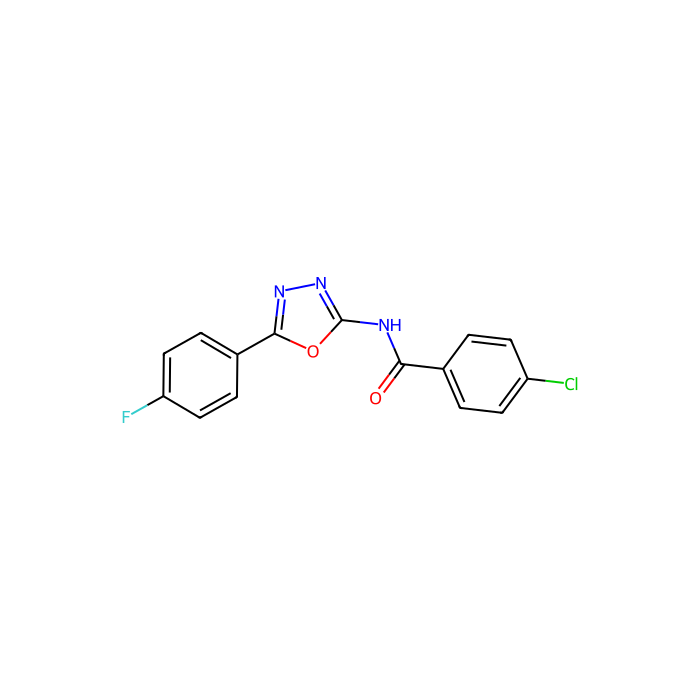
This compound belongs to the class of organic compounds known as 4-halobenzoic acids and derivatives. These are benzoic acids or derivatives carrying a halogen atom at the 4-position of the benzene ring.
External Descriptors
Not available
1. Djoumbou Feunang Y, Eisner R, Knox C, Chepelev L, Hastings J, Owen G, Fahy E, Steinbeck C, Subramanian S, Bolton E, Greiner R, and Wishart DS. ClassyFire: Automated Chemical Classification With A Comprehensive, Computable Taxonomy. Journal of Cheminformatics, 2016, 8:61.
Determine the necessary mass, volume, or concentration for preparing a solution.
Dilution Calculator
Determine the dilution needed to prepare a stock solution.
Reconstitution Calculator
Reviews
Customer Reviews
Application Protocols
No vendor-tested application protocols or dilution recommendations are provided for this item.
General-use protocol (research-only; adapt to your system):
Stock solution: Dissolve compound in anhydrous DMSO to 10–50 mM. Aliquot into low-binding tubes and store at −20°C or below.
Plate setup: For cell-based or biochemical assays, add compound last to achieve the desired final concentration and ≤1% v/v DMSO. Include vehicle controls and, where possible, positive/negative pathway controls.
Incubation: Follow timing relevant to the assay (e.g., 15–60 min preincubation for enzyme/reporter assays, or multi-hour exposure for growth/translation studies). Optimize empirically.
Readout: Use orthogonal methods (e.g., luminescence/fluorescence plus absorbance or LC-based endpoints) to mitigate assay interference.
Data handling: Record exact vehicle %, lot number, and storage history to support reproducibility.
These steps are offered as general guidance only; develop and validate a fit-for-purpose SOP for your laboratory.
Biological Roles
Context from literature (for scientific background; not an item-specific claim):
KKL-35 is reported as a small-molecule tool compound used to interrogate bacterial protein synthesis quality-control pathways, notably processes involved in ribosome rescue/quality control. Researchers employ it to probe translation-associated stress responses and evaluate pathway dependencies in bacterial systems. Verify the exact molecular target and species applicability from primary publications before experimental use.
Practical notes for biological studies (general):
Prepare DMSO stocks and perform preliminary concentration–response experiments to determine working ranges and potential cytotoxicity in the organism or cell-free system under study.
Include appropriate orthogonal assays (e.g., reporter assays, growth kinetics in defined media, or in vitro translation systems) to confirm on-pathway effects versus off-target interference.
Consider efflux and permeability: uptake in bacterial cells can be affected by membrane composition and efflux pumps; use isogenic strains or efflux inhibitors as controls when relevant.
Protein binding and media composition (serum, albumin, divalent cations) may shift apparent potency; standardize conditions across replicates.
No clinical or diagnostic use is intended or permitted. This product is provided strictly for laboratory research.
Buffer Applications
This item is a small-molecule screening compound, not a buffering agent. Consequently, classical buffer system guidance (pH range/capacity recipes) is not applicable.
Practical notes:
When diluting from DMSO stocks into aqueous buffers (e.g., PBS, HEPES, MOPS), maintain a consistent final co-solvent percentage to control for vehicle effects.
Pre-warm and mix thoroughly to minimize precipitation; consider adding a small amount of surfactant only if compatible with the assay and after control testing.
For pH control in assays, use established buffers appropriate to your biological system; the compound itself does not function as a pH buffer.
Green Alternatives
As a discrete bioactive small molecule used at micromolar concentrations, traditional “green solvent replacement” frameworks apply mainly to its handling/assay solvents rather than to the compound itself.
Greener handling considerations (general):
Prefer aqueous assay media with minimal organic co-solvent (≤0.5–1% DMSO) where activity permits.
If organic solvent is required, consider ethanol or propylene glycol for biocompatible contexts when consistent with solubility and assay readouts. Be aware of volatility and potential assay interference.
For synthetic modification or scale-up preparation (if undertaken in-house), evaluate greener solvent choices (e.g., 2-MeTHF, CPME, EtOAc) and avoid chlorinated solvents when feasible.
Ethanol: Renewable, low toxicity; volatility can simplify removal but may affect assay equilibrium.
DMF: Powerful solvent but reproductive toxin; avoid in biological assays when possible.
Waste minimization:
Use miniaturized assay formats (384/1536-well) and automated liquid handling to reduce solvent consumption and compound use.
Consolidate compatible organic wastes and follow institutional disposal procedures.
Pharmaceutical Uses
No pharmacopeial status, excipient role, or manufacturing/formulation uses are provided for this item.
Regulatory/compendial listing: Not specified for this item; refer to CoA/Spec Sheet.
Formulation role: This product is sold for research use only and is not intended for human or veterinary use, clinical diagnostics, or as a drug substance/excipient.
If formulating for research studies (non-clinical only):
Typical approach is a DMSO stock diluted into appropriate in vitro assay media. For in vivo research in model organisms (if permitted by your institution), vehicle choices often include aqueous buffers with limited co-solvent and PEG/surfactant systems; determine compatibility and stability empirically and follow institutional approvals.
Do not use in any therapeutic or diagnostic application.
Physical Properties
Item-specific physicochemical specifications were not provided in the Product Data. Do not treat external/literature values as specifications for this lot; verify on the CoA/Spec Sheet before method development.
Appearance: Not specified for this item; refer to CoA/Spec Sheet.
Molecular weight: Not specified for this item; refer to CoA/Spec Sheet.
Melting point: Not specified for this item; refer to CoA/Spec Sheet. (measure on first use if critical)
Boiling point: Not specified for this item; refer to CoA/Spec Sheet.
Density: Not specified for this item; refer to CoA/Spec Sheet.
Refractive index: Not applicable (solid) or not specified; refer to CoA/Spec Sheet.
pKa/logP: Not specified for this item; refer to CoA/Spec Sheet.
Solubility: Not specified for this item; refer to CoA/Spec Sheet.
General guidance (literature/practice, non-specification):
Screening probes of this class are commonly dissolved in anhydrous DMSO to prepare 10–50 mM stocks, then diluted into aqueous buffers with ≤1% v/v DMSO final. Assess solubility by small-scale titration and visual inspection for precipitation.
If lyophilized, allow vial to warm in a desiccator to ambient temperature before opening to avoid moisture condensation.
Record exact lot-specific purity, water content, and residual solvents from the CoA for method validation and reporting.
Quality & Grades
Item-specific grade/purity were not provided in the Product Data.
Grade/Purity: Not specified for this item; refer to CoA/Spec Sheet.
Guidance on interpreting grades (general):
Screening compound/library grade typically emphasizes identity confirmation (e.g., LC/MS, 1H NMR) and sufficient purity for biochemical assays (often ≥95% by LC unless otherwise noted). UV–vis backgrounds and trace metals are generally not specified unless designated as HPLC grade solvents or ICP standards.
When a specific purity (e.g., HPLC ≥98%) is stated on a CoA, it refers to area% by a defined chromatographic method; method parameters and detection wavelength matter—review them before comparing lots or across vendors.
Stabilizers/salt forms: If the compound is delivered as a salt (e.g., HCl, TFA) or with an antioxidant, this will be noted on the CoA. Such forms affect molecular weight and solubility; adjust stock preparations accordingly.
Documentation: Retain CoA and any spectral data with your ELN entry. If regulatory filings or high-throughput screening (HTS) QC are planned, request additional characterization (water by KF, residual solvent by GC, enantiopurity if chiral).
Recommendation: Verify lot-specific identity, purity, and counterion prior to quantitative biology or medicinal chemistry workflows.
Reaction & Applications
This product is supplied as a bioactive screening compound rather than a general synthetic reagent. As such, it is not typically used as a stoichiometric reagent or catalyst in preparative organic synthesis.
Research applications (general, literature-based):
KKL-35 has been described in the literature as a chemical probe for studying bacterial translation quality control pathways. Users employ it in biochemical/cellular assays to interrogate bacterial protein synthesis stress responses. Verify the exact target and mechanism relevant to your study via primary references. (literature/general; not a product specification)
Assay considerations:
Prepare concentrated DMSO stocks (e.g., 10–50 mM), store frozen, and minimize freeze–thaw cycles. Validate activity with positive/negative controls relevant to the biological pathway of interest.
For HTS or chemogenomic profiling, document plate map, vehicle percentage, and incubation times; include counter-screens to exclude nonspecific assay interference (e.g., redox cycling, aggregation).
Not typically applicable:
Named organic reactions (e.g., cross-coupling, reductions) are not relevant to routine use of this screening compound. If you plan derivatization or SAR, consult medicinal chemistry literature for scaffold-appropriate transformations once the exact structure is confirmed.
Reaction Conditions
No named chemical reactions or standardized synthetic conditions apply to the routine use of this compound, as it is supplied for biological screening rather than as a reagent.
General handling conditions for assay preparation (non-synthetic):
Stock preparation: Dissolve in anhydrous DMSO to 10–50 mM; vortex and sonicate briefly if needed. Verify clarity and absence of particulates.
Working solutions: Dilute into assay buffer or culture medium to the desired concentration, maintaining a fixed vehicle percentage (commonly 0.1–1% v/v DMSO). Mix thoroughly to avoid local supersaturation.
Temperature: Prepare and handle at ambient temperature unless stability studies indicate otherwise. Avoid prolonged exposure to elevated temperatures and direct light until stability is known.
Stability checks: For multi-day studies, assess stability by LC or assay signal drift over time; aliquot stocks to minimize freeze–thaw cycles.
If performing any chemical transformations on this scaffold, conditions must be selected based on the confirmed functional groups from the CoA/literature; no universal reaction guidance can be given without structural details.
Safety & Handling
Hazard classification for this specific item is not provided in the Product Data. Always consult the product SDS for authoritative safety information.
GHS classification: Not specified for this item; refer to SDS.
Signal word / H-statements / pictograms: Not specified for this item; refer to SDS.
General laboratory precautions (good practice):
Handle in a fume hood; avoid inhalation, ingestion, and skin/eye contact. Wear appropriate PPE: lab coat, safety glasses or goggles, and chemically resistant gloves (e.g., nitrile).
Avoid dust formation and aerosolization if supplied as a solid. For DMSO solutions, prevent skin contact as DMSO can enhance dermal absorption of solutes.
Incompatibilities: Until specific functional groups are confirmed, avoid strong oxidizers and strong acids/bases. Do not mix with unknown reactive reagents.
First aid overview: In case of skin contact, wash with soap and water; eye exposure, rinse cautiously with water for several minutes; inhalation, move to fresh air; ingestion, rinse mouth. Seek medical attention in all cases and provide the SDS to responders.
Spill response: Contain with inert absorbent, avoid generating dust, and collect for disposal as organic laboratory waste per institutional and local regulations.
Thermal hazards: No item-specific decomposition profile provided; avoid heating above necessary temperatures and keep away from ignition sources if formulated in flammable solvents.
Note: For research use only.
Solvent Selection
No item-specific solubility or polarity data are provided. The guidance below reflects common practice for small-molecule screening compounds and should be verified empirically.
Primary stock solvent: Anhydrous DMSO is typically preferred due to broad solvating power and assay compatibility at ≤1% v/v.
Alternative organic solvents: DMF or ethanol can be used when compatible with downstream assays. For water-sensitive scaffolds, maintain strictly anhydrous conditions.
Aqueous buffers: Direct dissolution into water or PBS is generally discouraged unless high aqueous solubility is confirmed; otherwise, prepare a DMSO concentrate and dilute into buffer with vigorous mixing to avoid precipitation.
Co-solvent strategies: If precipitation occurs upon dilution, include 0.1–1% DMSO or ethanol in the final assay medium. Add compound stock last, with rapid mixing.
Comparison (general):
DMSO vs ethanol: DMSO offers higher solubility for polar/heteroaromatic scaffolds; ethanol can be preferable for hydrophobic materials in cell-free systems with volatility advantages.
DMF: Similar solvency to DMSO but less favored in live-cell assays; use primarily for chemistry or enzyme assays tolerant to DMF.
Practical tips:
Filter sterilization is rarely necessary for small-molecule stocks; if required, use low-binding PTFE filters and confirm no adsorption.
Record final solvent fractions in assay records to control for vehicle effects.
Storage & Reconstitution
Item-specific storage conditions are provided; reconstitution advice is general and should be verified with the CoA/Spec Sheet.
Storage (as supplied): Store at −20°C. Protect from moisture and light. Maintain in the original, tightly closed container. (item-specific)
Shipping: Shipped in an ice chest with ice pads to preserve stability in transit. (item-specific)
Reconstitution: Not specified for this item; refer to CoA/Spec Sheet.
General reconstitution guidance (non-specification):
For solid material: Allow vial to equilibrate to room temperature in a desiccator before opening. Dissolve in anhydrous DMSO to prepare a 10–50 mM stock. If insoluble, warm gently to 30–40°C and/or sonicate briefly. Record the exact concentration gravimetrically or by UV if chromophore permits.
For solutions: Inspect for precipitation or discoloration; if observed, test by LC before use.
Aliquoting: Divide stock into single-use aliquots to minimize freeze–thaw. Store aliquots at −20°C or −80°C as appropriate; avoid repeated thawing.
Stability: In the absence of item-specific data, avoid storage >6–12 months without re-qualifying by LC–MS or activity assay. Protect from repeated light exposure.
Always label with compound name, SKU (K413519), lot number, concentration, solvent, and date of preparation. For research use only.
Structure & Identity
A small-molecule research compound supplied for screening and chemical biology applications. Item-specific identifiers are limited in the Product Data; key structure fields are therefore left unspecified here and should be confirmed from the item’s CoA/Spec Sheet.
CAS: 865285-29-6 (item-specific)
PubChem CID: 4128171 (item-specific)
InChIKey: Not specified for this item; refer to CoA/Spec Sheet. (Product Data lists an incomplete token)
SMILES: Not specified for this item; refer to CoA/Spec Sheet.
Molecular formula: Not specified for this item; refer to CoA/Spec Sheet.
Molecular weight: Not specified for this item; refer to CoA/Spec Sheet.
Structural features (general, literature context):
KKL-35 is referenced in the chemical biology literature as a small-molecule probe used in antibacterial mechanism studies. Specific ring systems/functional groups vary by reported structure; consult primary references and the supplied CoA for definitive identity. (literature/general)
2D structure description (general):
Without an item-specific structure, a reliable textual description of substituents, heteroatoms, and stereochemistry cannot be provided. Users should verify the exact scaffold (including any salt form) from analytical documentation prior to use.
Notes:
If you require structural confirmation, request NMR/HRMS/LC data with the shipment or consult the CoA/Spec Sheet associated with SKU K413519.
Synthetic Utility
This product is offered as a bioactive small molecule rather than a synthetic building block; therefore, it is not typically employed as a reagent or intermediate in organic synthesis.
Guidance if derivatization is planned (general):
Once the exact scaffold is confirmed from CoA and primary literature, standard medicinal chemistry tactics (e.g., substituent scans, isosteric replacements, solubilizing side chains) can be applied to explore SAR.
Protecting-group strategies, cross-couplings, or late-stage functionalizations should be matched to the actual functional groups present in the confirmed structure; without those details, prescriptive methods are inappropriate.
Document analytical methods (LC–MS, NMR, HRMS) and establish impurity profiles if preparing analogs for SAR.
In summary, treat this compound primarily as a probe for biological experiments rather than as a general-purpose synthetic reagent.
Target Specificity
This section typically applies to biologics (e.g., antibodies) where antigen/epitope specificity is defined. For this small-molecule product, no item-specific target binding data are provided in the Product Data.
Target/Pathway: Not specified for this item; refer to CoA/Spec Sheet and primary literature relevant to KKL-35.
Species reactivity: Not applicable.
Clone/isotype: Not applicable.
Researchers should consult peer-reviewed sources for pathway hypotheses and then verify activity in their specific biological system with appropriate controls.
We use cookies to ensure the website functions properly and, where permitted, to improve your experience. You can manage your preferences at any time in Settings. Learn more in our Cookie Policy.
Shall we send you a message when we have discounts available?
Remind me later
Thank you! Please check your email inbox to confirm.
Products are supplied to verified businesses, institutions, and qualified professionals for research and development use only. Not for use in humans, animals, diagnosis, or therapy.

 G2216478