GRADE & PURITYMoligand™?Moligand™ — Aladdin's line of ligands and bioactive small molecules. Use for receptor, pathway, and binding studies needing defined small-molecule tools.≥98 atom%,≥98%
Determine the necessary mass, volume, or concentration for preparing a solution.
Dilution Calculator
Determine the dilution needed to prepare a stock solution.
Reconstitution Calculator
Reviews
Customer Reviews
Application Protocols
No item-specific tested applications or protocols are provided for this product. Refer to your laboratory SOPs and the primary literature for:
13C NMR acquisition of carbohydrates (anomeric carbon observation and decoupling schemes).
LC–MS sample preparation for sugars (HILIC/ion chromatography) and isotopologue analysis.
GC–MS oxime–TMS derivatization workflows for monosaccharides.
For any procedural details (concentrations, times, instrument settings), consult method-appropriate references and validate in-house.
Biological Roles
Context (literature/general)
Glucose is a central carbohydrate in metabolism; however, most organisms utilize D-glucose preferentially. L-glucose is not broadly metabolized in standard mammalian pathways but is valuable as a chiral control and to probe noncanonical uptake or enzyme specificity. The [1-13C] label enables position-resolved tracing when metabolism does occur (e.g., in certain microbes or engineered systems).
Applications in biochemistry
Transport specificity: Evaluate stereoselectivity of glucose transporters and kinases by comparing uptake/turnover of L- vs D-glucose under identical conditions.
Enzyme discrimination: Test substrate scope of isomerases, mutarotases, and oxidases that may accept L-glucose; 13C at C-1 simplifies monitoring of anomeric carbon transformations.
Negative control in fluxomics: Labeled L-glucose can serve as a control to reveal non-specific incorporation or background labeling in complex matrices.
Detection modalities
13C NMR: Direct observation of the anomeric carbon provides clean readouts of chemical environment, anomer ratios (α/β), and reaction progress in enzyme assays.
MS-based metabolomics: Tracks M+1 isotopologues in derivatized sugars or downstream products if catabolism occurs; helps quantify adventitious pathways.
Practical notes
Mutarotation influences the population of α/β anomers; control temperature and time post-dissolution before measurement.
For cell-based studies, confirm whether the model system possesses L-glucose transport/catabolic capacity; otherwise expect minimal incorporation (useful for background controls).
Buffer Applications
This product is a neutral carbohydrate and is not used as a buffering agent. For aqueous work, dissolve in the buffer system appropriate to your assay (e.g., PBS, HEPES, or ammonium formate for LC–MS). When buffer selection matters, prioritize:
Ionic strength and pH compatible with your biological/enzyme system.
Volatile buffers (ammonium acetate/formate) for MS-based analytics.
No item-specific buffer recipes are provided; refer to your method SOPs.
Green Alternatives
Intrinsic greenness (literature/general)
Glucose is a benign, renewable, biodegradable carbohydrate. The 13C label is non-radioactive and poses minimal environmental burden compared to radiotracers (e.g., 14C), reducing waste management complexity.
Alternative tracers and trade-offs (literature/general)
U-13C6-glucose: Maximizes isotopic signal across all carbons; excellent for comprehensive fluxomics, but cost is higher and data deconvolution can be more complex.
Position-specific 13C (e.g., [2-13C], [3-13C]): Offers pathway-selective insight with simpler spectra; requires careful experimental design to avoid blind spots.
2H- or 15N-labeled nutrients (e.g., D2O, 15NH4+): Useful for complementary pathways; however, deuterium has kinetic isotope effects and exchangeability concerns.
Sustainability considerations
Aqueous media as solvent minimize VOC emissions; avoid chlorinated solvents by favoring water-based analytics (HILIC, IC) or derivatization only when GC–MS is essential.
Use recyclable glass vials and minimize single-use plastic in sample prep; opt for miniaturized assays to reduce material footprint.
Comparison (general)
L-[1-13C]glucose vs U-13C6-glucose
Signal distribution: single intense 13C resonance at C-1 vs distributed across all carbons.
Data complexity: simpler isotopomer patterns vs complex multiplets/couplings.
Cost: typically lower vs higher per mole of 13C incorporated.
Environmental impact: comparable; both are non-radioactive and aqueous-compatible.
Pharmaceutical Uses
No therapeutic or clinical claims are made for this product. In formulation science and process development (research use only), isotope-labeled sugars can serve as:
Tracing excipient fate in bioprocess models or stability studies (literature/general), differentiating carryover or degradation pathways by MS without affecting bioactivity.
Chiral controls in analytical release tests that distinguish D- vs L-glucose.
Note: L-glucose is not commonly used as an excipient. Any application in regulated products would require separate qualification; this listing is intended strictly for research use.
Physical Properties
Item-specific (Product Data)
Appearance: Not specified for this item; refer to CoA/Spec Sheet.
Molecular Formula: Not specified for this item; refer to CoA/Spec Sheet.
Molecular Weight: Not specified for this item; refer to CoA/Spec Sheet.
Literature/general (for L-glucose/13C isotopologue; reference values, not specifications)
Physical state: crystalline solid (carbohydrate). 13C enrichment does not materially alter bulk properties.
Melting point: typical for anhydrous glucose ~146–150 °C (decomp., literature; hydrate/solvate forms vary).
Solubility: very soluble in water (hundreds of g/L at RT); soluble in methanol; sparingly soluble in ethanol; insoluble in nonpolar solvents.
pKa: polyol; no strongly ionizable groups under neutral conditions; behaves as a neutral polyhydroxy compound.
LogP (octanol/water): ~−3 to −3.2 (literature estimates for glucose; highly hydrophilic).
Optical rotation: L-glucose exhibits rotation opposite in sign to D-glucose of comparable magnitude (value depends on solvent, temperature, wavelength, and anomer ratio).
Density: ~1.5–1.6 g/cm³ for crystalline carbohydrates (general range; form-dependent).
Hygroscopicity: carbohydrates can be mildly hygroscopic; tendency depends on crystalline form and RH.
UV absorbance: lacks strong chromophores above 220 nm; detection typically by RI, ELSD, or derivatization for HPLC.
Notes: Values above are provided for scientific context only and are not the specifications of this catalog item.
Quality & Grades
Item-specific (Product Data)
Grade: Moligand™
Purity/assay and analytical limits: Not specified for this item; refer to CoA/Spec Sheet.
Stabilizers/additives: Not specified for this item; refer to CoA/Spec Sheet.
What Moligand™ implies (general)
Moligand™ items are positioned for small-molecule and compound library work, fragment screening, and ligand discovery. For an isotope-labeled metabolite, this typically emphasizes consistency suitable for biochemical assays, NMR/MS tracing, and screening contexts. Exact assay/purity thresholds and residual solvent/metal specifications must be confirmed on the CoA.
Identity and isotopic quality considerations (general best practice)
Isotopic enrichment: For 13C tracers, users often verify fractional enrichment at the labeled position by quantitative 13C NMR or HRMS (M+1 isotopologue abundance). Enrichment level is not specified for this item; refer to CoA.
Anomeric composition: Glucose exists as α/β anomers in equilibrium; HPLC or NMR may show two sets of signals. This is normal and does not indicate impurity.
Typical QC techniques: 1H/13C NMR, HRMS (ESI), HPLC/IC, water content by KF, and microbial bioburden (for bioassay use). Item-specific values are not provided here.
When to request additional documentation
For quantitative fluxomics or calibration standards, request CoA with isotopic enrichment, chemical purity, residual solvents, water content, and trace inorganic contaminants as applicable to your method validation requirements.
Reaction & Applications
This compound is primarily used as a stable-isotope tracer rather than as a synthetic reagent.
Isotopic tracing (literature/general)
13C metabolic flux analysis (MFA/SIRM): L-[1-13C]glucose specifically probes pathways that can metabolize L-glucose (e.g., noncanonical uptake routes, certain microbial systems, or engineered models). The C-1 label tracks decarboxylation steps producing 13CO2 or redistribution of 13C into downstream metabolites.
NMR/MS readouts: 13C NMR detects anomeric carbon labeling; LC–MS/MS or GC–MS measures M+1 isotopologues in sugar phosphates and organic acids after derivatization.
Analytical calibration
Serves as an internal standard or recovery standard in chiroselective assays that differentiate L- and D-glucose, aiding quantification and method validation without clinical interpretation.
Chemical reactivity context (general)
The aldehyde at C-1 (in open-chain form) can undergo oxime/hydrazone formation—useful for immobilization or tagging, but consider potential isotope exchange or scrambling if the carbonyl participates in exchange reactions. Under basic or heated conditions, enolization/isomerization (Lobry de Bruyn–Alberda van Ekenstein) can occur, affecting label position.
Practical tips
Minimize prolonged exposure to high pH or elevated temperatures to preserve isotopic integrity at C-1.
For quantitative work, prepare fresh aqueous solutions and record time/temperature to control mutarotation/anomer ratios, which subtly influence NMR integrals and chromatographic behavior.
Reaction Conditions
Because L-[1-13C]glucose is typically used as a tracer/analyte rather than a reagent, “reaction conditions” are best framed as assay/derivatization conditions (literature/general):
NMR measurements
Solvent: D2O (preferred) or DMSO-d6.
Concentration: 10–100 mM typical for 13C-detected experiments; lower for 1H with 13C decoupling.
Temperature: 20–30 °C; allow 30–60 min post-dissolution for mutarotation equilibration before acquisition.
GC–MS derivatization (example workflow)
Methoximation: Dissolve sample in anhydrous pyridine with methoxyamine·HCl (10–20 mg/mL), 60–90 min at 60 °C.
Silylation: Add MSTFA (with 1% TMCS) and incubate 30–60 min at 60 °C; inject on nonpolar column. Monitor M+1 isotopologues.
Enzyme assays
Solvent: Aqueous buffer (e.g., 50 mM phosphate or HEPES), pH 7.0–7.5.
Substrate levels: 0.1–10 mM range depending on enzyme turnover and detection sensitivity.
Temperature: 25–37 °C; avoid extremes that accelerate isomerization.
Cell culture labeling (where applicable)
Medium supplementation: Replace or supplement carbohydrate source with L-[1-13C]glucose at typical sugar concentrations used for the model system; confirm cell line or organism can utilize L-glucose if isotopic incorporation is desired.
These are general literature-style parameters provided for planning purposes; optimize to your specific system. They are not specifications for this catalog item.
Safety & Handling
Item-specific (Product Data)
GHS Classification: Not specified for this item; refer to SDS.
Signal Word: Not specified for this item; refer to SDS.
Hazard statements (H-codes): Not specified for this item; refer to SDS.
Pictograms: Not specified for this item; refer to SDS.
Storage: Protect from light; store at room temperature (per listing). Keep container tightly closed; avoid high humidity.
General safety considerations (literature/general)
Expected hazard profile: Simple carbohydrates are generally of low acute toxicity; nonetheless, handle as a laboratory chemical. Avoid inhalation of dust and contact with eyes/skin. No peroxide formation hazards.
PPE: lab coat, safety glasses, and appropriate gloves (e.g., nitrile). Use dust control (weighing boat in fume hood) to minimize airborne particulates.
Incompatibilities: Strong oxidizers (e.g., nitric acid), strong dehydrating agents, and strong bases under heating (may cause caramelization/degradation). Avoid contact with reactive carbonyl reagents if isotopic integrity at C-1 must be preserved.
First aid (overview; consult SDS): If inhaled—move to fresh air. Skin/eye contact—rinse with water for several minutes; remove contaminated clothing. If ingested in lab setting—rinse mouth, seek medical advice if symptoms persist.
Fire safety: Combustible organic solid; use water spray, CO2, dry chemical, or foam. Thermal decomposition may produce CO/CO2 and caramelization products.
Always consult the product’s SDS for authoritative safety, exposure limits, and emergency procedures.
Solvent Selection
Polarity and miscibility (literature/general)
Strongly hydrophilic neutral polyol; highly soluble in water; miscible up to high concentrations (>1 M commonly achievable at RT). Limited solubility in lower alcohols (MeOH > EtOH >> iPrOH); negligible in aprotic nonpolars (DCM, toluene, hexanes).
For NMR: D2O is preferred (excellent solubility; shows characteristic 13C signal at the anomeric carbon). For nonaqueous NMR, DMSO-d6 dissolves glucose well but alters mutarotation kinetics and chemical shifts.
Selection guidance by application
LC-based analytics: Aqueous mobile phases (HILIC or amino columns) are typical; for sample prep, water or water:MeOH 50:50 works well. Add 0.1% formic acid or ammonium formate for MS if needed.
GC–MS: Derivatize (e.g., methoximation followed by silylation, MOX-TMS) to achieve volatility; use anhydrous pyridine for oximation and MSTFA/BSTFA for silylation.
Biochemical assays/cell culture: Prepare sterile aqueous stocks (PBS or culture media) to desired molarity; filter-sterilize (0.22 μm) if sterility is required.
Quick comparison (literature/general)
Water: best for biological and analytical work; maximizes isotopic fidelity; compatible with 13C NMR.
DMSO: enables high-concentration stocks but may not be compatible with all bioassays; can complicate interpretation in metabolic studies.
Alcohols: limited utility due to moderate solubility and potential for acetal formation under acidic conditions.
Storage & Reconstitution
Item-specific (Product Data)
Storage conditions: Protect from light; Room temperature. Shipped under normal conditions.
General guidance (literature/best practice; not item-specific specifications)
Solid material: Keep tightly capped in a desiccator or low-humidity environment to prevent moisture uptake and caking. Protect from strong light during long-term storage.
Reconstitution: Dissolve in high-purity water (or assay buffer) to the required molarity. Common working stocks are 0.1–1.0 M. Mix gently until fully dissolved.
Sterility: For biological assays, filter-sterilize through 0.22 μm PTFE/PES syringe filters into sterile vials.
Aliquoting: Prepare single-use aliquots to minimize headspace and repeated opening. Label with concentration, solvent, and preparation date.
Storage of solutions: Aqueous solutions are typically stored refrigerated (2–8 °C) for short-term use; for maximum isotopic integrity, prepare fresh as needed. Avoid repeated freeze–thaw cycles.
Light protection: Use amber vials or foil-wrapped containers for solutions if extended exposure is expected.
Documentation: Record anomeric ratio (optional, by NMR) and pH at preparation when experiments are sensitive to these variables.
Always defer to the CoA/SDS for item-specific stability, solubility limits, and shelf-life information.
Structure & Identity
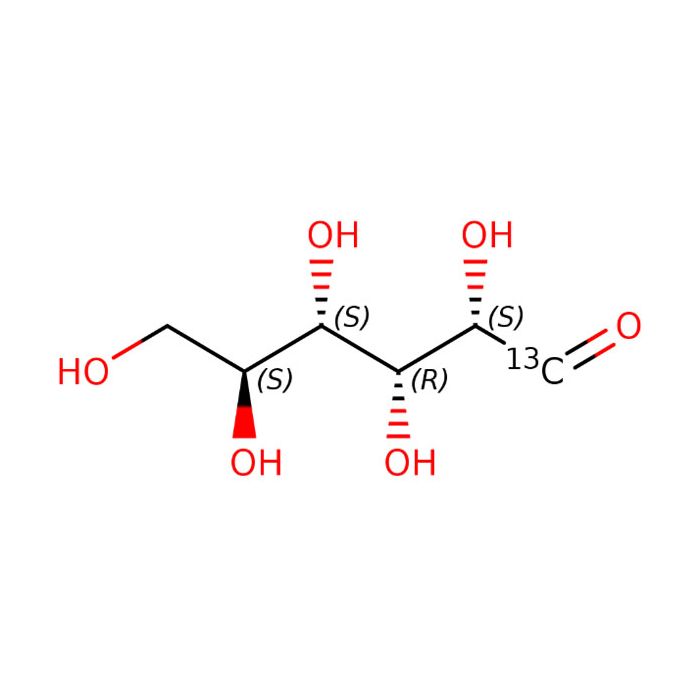
A stable-isotope–labeled hexose for tracer studies and analytics; L-[1-13C]glucose is the L enantiomer of glucose bearing a single 13C at the anomeric (C-1) position.
Item-specific (Product Data)
SKU: L354520
Product name: L-[1-13C]glucose
CAS: 478519-02-7
CID: 90472761
InChIKey: 405806 (as provided)
Grade: Moligand™
Storage: Protected from light; Room temperature
Shipped in: Normal
Structure description (literature/general)
Core scaffold: aldohexose (open-chain form: an aldehyde at C-1; predominant cyclic forms: L-glucopyranose and L-glucofuranose). Multiple hydroxyl groups (five secondary alcohols + one primary at C-6).
Stereochemistry: L series; four defined stereocenters (C-2, C-3, C-4, C-5) with configurations opposite to D-glucose; anomeric center (C-1) interconverts between α- and β-anomers in solution (mutarotation).
Isotopic label: 13C (≈1.1% natural abundance) is enriched specifically at C-1, enabling positional 13C tracing in metabolism and distinct 13C NMR chemical shifts for the anomeric carbon.
Formula and identifiers (literature/computed; not item-specific)
Empirical formula (unlabeled): C6H12O6. For 1×13C isotopologue: 13C1C5H12O6 (often written as C6H12O6 with one 13C at C-1).
Average molecular weight (L-[1-13C]glucose): ~181.16 g/mol (computed: 180.156 g/mol for C6H12O6 + 1.00335 for one 13C).
SMILES/InChI: Not specified for this item; refer to CoA/Spec Sheet.
2D structure in words: A six-membered pyranose ring with the anomeric carbon (C-1, 13C-labeled) bonded to a ring oxygen and a hydroxyl (α or β), a primary CH2OH at C-6, and four vicinal secondary alcohols at C-2–C-5 in the L-gluco configuration.
Synthetic Utility
Although not a mainstream building block for total synthesis, L-[1-13C]glucose offers distinctive utility in synthesis-adjacent contexts (literature/general):
Isotopic probe for mechanism studies: Track incorporation and fate of the anomeric carbon in carbohydrate transformations (e.g., glycosylation, oxidations to uronic acids, or isomerizations). 13C labeling allows unambiguous assignment of intermediates via 13C NMR.
Chiral auxiliary/source: The L series provides a complementary chiral pool to D-sugars. Protection–deprotection and selective functionalizations can yield labeled chiral synthons (e.g., 13C-labeled glyceraldehyde or sugar-derived lactones) while retaining position-specific 13C at the anomeric-derived carbon.
Surface/bioconjugation chemistry: Oxime/hydrazone ligation at C-1 (after transient ring opening) affords labeled conjugates for materials or glycobiology, with the 13C tag enabling site-specific spectroscopic verification.
Calibration standards: Use as a position-labeled standard to validate 13C NMR quantitation, DEPT editing, and 2D correlation assignments in carbohydrate chemistry.
Practical notes
Maintain mild conditions (neutral pH, ambient temperature) during transformations that engage the anomeric center to minimize label scrambling via enolization or retro-aldol pathways.
Document anomeric ratio before/after steps; it will affect coupling patterns and chemical shifts in 13C/1H NMR.
Target Specificity
Not applicable. This product is a small-molecule carbohydrate (not an antibody or targeted biologic), and no target/epitope specificity data are provided for this item.
Frequently Asked Questions
What is the purity of this product?
This product is isotopically enriched to ≥98 atom% the labelled isotope. Isotopic enrichment is a separate specification from chemical purity — a labelled compound has both. This product is supplied at ≥98% purity (chemical assay). Lot-specific values are stated on the Certificate of Analysis.
What is Moligand??
Moligand? is one of Aladdin Scientific's premium product lines, formulated for high-purity applications across multiple workflows. Compared to standard grades in the same workflow, Moligand? products typically offer tighter specifications, more rigorous QC, and stronger lot-to-lot consistency.
How should this product be stored?
Store at room temperature, protected from light. The material is light-sensitive — keep it in its original opaque or amber container.
How is this product shipped?
This product ships under standard ambient conditions. No temperature-controlled packaging is required.
What are the CAS number, molecular formula and molecular weight?
The CAS Number is 478519-02-7, the molecular formula is C513CH12O6, and the molecular weight is 181.15 g/mol. InChIKey WQZGKKKJIJFFOK-WIZIAPGRSA-N.
What documentation is provided?
Available product documentation, including Certificates of Analysis (COA), Safety Data Sheets (SDS), and specification sheets, is shown in the product document area. Document availability and access follow the current site policy.
Need help choosing the grade?
Our grade selection guide covers purity, stabilizer status, and application suitability for all variants in our catalog.
We use cookies to ensure the website functions properly and, where permitted, to improve your experience. You can manage your preferences at any time in Settings. Learn more in our Cookie Policy.
Shall we send you a message when we have discounts available?
Remind me later
Thank you! Please check your email inbox to confirm.
Products are supplied to verified businesses, institutions, and qualified professionals for research and development use only. Not for use in humans, animals, diagnosis, or therapy.

 F2616385