L-Ascorbyl palmitate (Asc-6P) is used along with other fatty acid ascorbates such as L-ascorbyl oleate and L-ascorbyl linoleate to protect cells and membranes from oxidative damage. Fatty acid ascorbate molecules have increased solubility in non-polar (lipophilic) environments. It is applied as humectants and emollients.
L-Ascorbyl palmitate (Asc-6P) is used along with other fatty acid ascorbates such as L-ascorbyl oleate and L-ascorbyl linoleate to protect cells and membranes from oxidative damage. Fatty acid ascorbate molecules have increased solubility in non-polar (lipophilic) environments.
This compound belongs to the class of organic compounds known as fatty acid esters. These are carboxylic ester derivatives of a fatty acid.
External Descriptors
Not available
1. Djoumbou Feunang Y, Eisner R, Knox C, Chepelev L, Hastings J, Owen G, Fahy E, Steinbeck C, Subramanian S, Bolton E, Greiner R, and Wishart DS. ClassyFire: Automated Chemical Classification With A Comprehensive, Computable Taxonomy. Journal of Cheminformatics, 2016, 8:61.
Determine the necessary mass, volume, or concentration for preparing a solution.
Dilution Calculator
Determine the dilution needed to prepare a stock solution.
Reconstitution Calculator
Reviews
Customer Reviews
Application Protocols
No assay-validated protocols (e.g., WB, IHC, IF, FC) are applicable to this small-molecule antioxidant, and none are provided in the Product Data.
General research-use preparation examples (literature/practice; adjust to your system)
Stock in ethanol: Prepare a concentrated stock (e.g., 50–200 mg/mL) in absolute ethanol under low light. Store aliquots tightly capped; use within a defined period based on your stability study.
Lipid incorporation: Pre-dissolve the weighed solid in a minimal volume of ethanol or ethyl acetate. Add to the oil phase with stirring at 30–40 °C until clear, then remove any volatile solvent under reduced pressure or nitrogen sweep.
Analytical sample: Dissolve in acetonitrile or MeOH for HPLC; filter (0.45 µm PTFE) before injection. Include internal standards if quantifying oxidation products.
Controls and benchmarking
Include blank (no antioxidant) and positive controls (e.g., α-tocopherol) in oxidation assays to contextualize efficacy.
Track peroxide value or volatile oxidation markers (e.g., hexanal) in accelerated tests to optimize concentration.
All procedures must be validated in-house; these are illustrative, literature-informed approaches for research only.
Biological Roles
General biochemical context (literature)
Ascorbyl palmitate is an esterified, lipophilic form of L-ascorbic acid that can partition into membranes and lipid droplets. In biological and model systems, it functions primarily as a chain-breaking antioxidant, scavenging lipid peroxyl radicals and helping to terminate lipid peroxidation cascades.
Enzymatic or chemical hydrolysis can release L-ascorbic acid and palmitate; the ascorbate anion participates in classical redox cycles (ascorbate/dehydroascorbate) interfacing with glutathione and NADPH-dependent reductases in biological settings (literature).
Due to its amphiphilicity, ascorbyl palmitate localizes at oil–water interfaces in emulsions or membrane surfaces, which can be advantageous for protecting polyunsaturated lipids in liposomes and microsomal preparations.
Experimental usage (research only)
Employed in studies of oxidative stress, lipid oxidation kinetics, and antioxidant synergies (e.g., with tocopherols) in biomimetic systems.
Used to probe how antioxidant partitioning impacts efficacy in heterogeneous systems, aiding in model development for food, cosmetic, or delivery matrices.
Limitations and considerations
Compared with free ascorbic acid, the ester displays reduced aqueous reactivity but improved persistence in hydrophobic compartments; hydrolysis rate and localization determine net activity.
Avoid extrapolating in vitro antioxidant behavior to physiological or clinical outcomes; kinetics and metabolism differ substantially across systems.
All information here reflects general biochemical knowledge, not item-specific claims.
Buffer Applications
Ascorbyl palmitate is not a conventional buffering agent.
Not typically applicable
It lacks appropriate acid–base equilibria in aqueous solution due to its poor water solubility and esterification, and it is not used to control pH in common laboratory buffers.
Practical guidance
For antioxidant needs in buffered systems, consider water-soluble alternatives (e.g., L-ascorbic acid, sodium ascorbate) and pair with appropriate buffers (e.g., phosphate, citrate) chosen for pH and compatibility with metal chelators. Reserve ascorbyl palmitate for lipid phases or emulsified systems where interfacial antioxidant action is desired.
Green Alternatives
Selection of antioxidants and solvents impacts environmental and safety profiles. For lipophilic antioxidant roles, consider the following trade-offs (literature/general):
Alternative antioxidants (functionally similar)
L-Ascorbic acid or sodium ascorbate: greener and water-soluble, but ineffective in nonpolar matrices; better for aqueous systems.
2,5-Di-tert-butylhydroquinone (TBHQ), BHA/BHT: effective lipid antioxidants but carry more stringent hazard and regulatory concerns.
Tocopherols (vitamin E): bio-derived and oil-soluble; excellent in nonpolar phases, often synergistic with ascorbyl palmitate.
Greener solvent choices for processing
Prefer bio-based or lower-toxicity solvents when feasible: ethanol (bioethanol) and ethyl acetate over chlorinated solvents.
For enzymatic syntheses or processing, consider 2-MeTHF or CPME vs THF/MTBE, balancing peroxidation and safety.
Comparative snapshot (general)
Ascorbyl palmitate vs L-ascorbic acid: improved performance in oils at the expense of biodegradation rate and water solubility; both are based on an ascorbate core.
Ascorbyl palmitate vs tocopherol: AP offers interfacial activity; tocopherol is highly oil-soluble. Combining can reduce required total antioxidant loading.
Practical sustainability tips
Use minimal effective dosage verified by accelerated oxidation tests (e.g., Rancimat, Schaal oven).
Employ nitrogen blanketing and light-opaque packaging to reduce additive load.
Choose renewable solvents and implement solvent recovery where applicable.
Note: These are general green-chemistry considerations; selection should be justified by data for your specific system.
Pharmaceutical Uses
No therapeutic claims are made. The following describes formulation roles in research and development contexts (literature/general):
Excipient role
Functions as a lipid-phase antioxidant/stabilizer in prototype formulations, including oil-based solutions, emulsions, semisolids, and polymer matrices, to mitigate oxidative degradation of sensitive actives or excipients.
Amphiphilic character allows interfacial activity in emulsions, complementing tocopherols for broader protection.
Development considerations
Compatibility: generally compatible with oils, waxes, fatty alcohols, and many esters; assess interactions with amines, strong acids/bases, and metal ions that may catalyze oxidation or hydrolysis.
Processing: typically incorporated by pre-dissolving in a volatile, compatible solvent (e.g., ethanol, ethyl acetate) or by melting/solubilizing directly into the oil phase under gentle heat.
Analytical control: assay by HPLC with UV detection; monitor related substances such as dehydroascorbyl palmitate, free ascorbic acid, and palmitic acid.
Regulatory notes (general, non-binding)
Ascorbyl palmitate is recognized in various compendial and industrial contexts as an antioxidant excipient; however, for any regulated use, source-specific documentation, pharmacopeial compliance, and impurity profiles must be verified for the particular lot. This product is for research use only per the Product Data.
Always confirm suitability and specifications with the vendor’s CoA/Spec Sheet for your application.
Physical Properties
Item-specific physicochemical specifications have not been provided. Consult the product CoA/Spec Sheet for lot-specific values.
Item-specific
Appearance: Not specified for this item; refer to CoA/Spec Sheet.
Molecular Formula: Not specified for this item; refer to CoA/Spec Sheet.
Molecular Weight: Not specified for this item; refer to CoA/Spec Sheet.
Literature/general reference values (non-binding, for planning only)
Molecular formula (literature): C22H38O7
Molecular weight (literature): ~414.53 g/mol
Physical form: typically a white to off-white solid or powder (literature)
Melting point: ~107–117 °C (literature; may vary with polymorph and purity)
Boiling point: Not applicable; decomposes before boiling (literature)
Solubility profile: practically insoluble in water; soluble in ethanol, isopropanol, acetone, ethyl acetate, chloroform, and miscible with lipids/oils (literature)
Partitioning: lipophilic ester; markedly higher hydrophobicity than L-ascorbic acid (literature)
pKa: not typically assigned for the ester; the enediol acidity is attenuated relative to ascorbic acid due to esterification (qualitative, literature)
Refractive index/density: Not widely standardized for the solid; check vendor documentation for specific lots.
Practical notes (general)
Exhibits light/air sensitivity over long exposures due to ascorbate redox chemistry; stability is improved versus free ascorbic acid in non-aqueous media (literature).
Wetting agents or mild warming (≤40 °C) can aid dissolution in viscous oils during formulation (general practice).
Quality & Grades
Item-specific quality information
Grade/Purity: Not specified for this item; refer to CoA/Spec Sheet.
Stabilizers/Antioxidants: Not specified for this item; refer to CoA/Spec Sheet.
Context and implications (general guidance for ascorbyl palmitate)
Typical research grades include “reagent grade” or “purified grade” solids suitable for formulation and analytical development. Where specified, “low peroxide” or “low acid value” specs may be relevant to oxidative stability in lipid systems; absent explicit data for this item, verify on the CoA.
For chromatographic or stability-indicating analysis, materials described as “HPLC grade” (for solvents) or “>98% purity” (for solids) indicate lower UV-active impurities. This listing does not state such claims; confirm by CoA.
Residual solvents, free palmitic acid content, and isomeric purity (6-O-monoester vs mixed esters) can influence performance in lipid matrices; request specification sheets if these attributes are critical to your application.
Practical tips
If using as an antioxidant in sensitive matrices, screen incoming lots by HPLC/UV to quantify free ascorbic acid and palmitic acid.
For regulatory or GMP-adjacent research, seek a specification that defines identification (IR/NMR), assay by HPLC, limits on related substances, loss on drying, and residual solvents.
Note: In the absence of stated grade/purity in the Product Data, all performance-critical parameters should be verified experimentally and via the vendor’s CoA for this SKU.
Reaction & Applications
Research/manufacturer application context
Application details were not provided in the Product Data. Ascorbyl palmitate is widely used in research as a lipid-phase antioxidant and radical scavenger in oils, emulsions, liposomes, and polymer matrices (literature). It serves as a lipophilic delivery form of ascorbate for systems where water solubility is limiting.
Antioxidant chemistry (literature)
Chain-breaking antioxidant: donates hydrogen from the enediol system to quench peroxyl radicals, interrupting autoxidation propagation.
Synergism: regenerates oxidized tocopheroxyl radicals back to tocopherol under certain conditions, extending lipid stability.
Interface activity: its amphiphilicity enables localization at oil–water interfaces of emulsions, improving protection versus purely hydrophobic antioxidants.
Practical formulation tips (general)
Pre-dissolve in a small amount of ethanol or ethyl acetate, then blend into oils; gentle heating (≤40 °C) enhances incorporation without accelerating degradation.
Limit exposure to strong bases/acids during processing to avoid ester hydrolysis; maintain low water activity in nonaqueous systems.
Combine with chelators (e.g., EDTA) and oxygen-control strategies (nitrogen headspace) for maximal oxidative stability in model systems.
Analytical considerations
Monitor by HPLC-UV or LC–MS; typical methods separate ascorbyl palmitate, dehydroascorbyl palmitate, free ascorbic acid, and palmitic acid (literature).
Oxidation markers (peroxides, hexanal in lipid studies) can quantify protective effects.
Note: All uses are for research and laboratory applications only.
Reaction Conditions
General literature conditions relevant to ascorbyl palmitate synthesis and manipulation (non-binding, for planning):
Chemical acylation (formation)
Reagents: palmitoyl chloride or palmitic anhydride.
Base and solvent: pyridine or triethylamine in dry acetone, THF, or dichloromethane; catalytic DMAP can enhance acylation at 6-OH.
Temperature/time: 0–25 °C, 1–12 h depending on reagent; protect from moisture and light.
Workup: aqueous quench, extraction, and purification by crystallization or silica gel (using minimal polar eluents to avoid degradation).
Media: solvent-free systems, ionic liquids, or organic solvents such as tert-butanol, acetone, or 2-MeTHF.
Water activity control: molecular sieves or low aw support high conversions and selectivity for 6-OH.
Temperatures: 35–60 °C; reaction times from several hours to days.
Hydrolysis (deprotection)
Base-catalyzed: Na2CO3/MeOH–H2O or mild NaOH; keep temperature low and monitor to prevent lactone opening.
Enzymatic: lipase-mediated in buffered media for selective ester cleavage.
Stability considerations
Avoid prolonged exposure to strong acids/bases and high temperatures; enediol is oxidation-sensitive. Conduct reactions under inert atmosphere and subdued light when feasible.
Report actual conditions, yields, and impurity profiles according to your own experimental data; these values vary with scale and setup.
Safety & Handling
Product safety status (item-specific):
GHS Classification: Not specified for this item; refer to SDS.
Signal Word: Not specified for this item; refer to SDS.
Hazard (H-) Statements: Not specified for this item; refer to SDS.
Pictograms: Not specified for this item; refer to SDS.
General laboratory handling (literature/practice)
Avoid dust generation and inhalation; handle solid in a well-ventilated area or fume hood when weighing.
Prevent prolonged exposure to air, heat, and light which can accelerate oxidative degradation of the ascorbate moiety.
Use appropriate PPE: lab coat, safety glasses, and suitable gloves (e.g., nitrile). For large-scale transfers, consider dust mask/respirator per institutional risk assessment.
Incompatibilities: strong oxidizers can degrade ascorbyl esters; strong bases/acids can catalyze hydrolysis/transesterification.
First-aid overview (defer to SDS for authoritative guidance)
Eye contact: Rinse cautiously with water for several minutes; remove contact lenses if present and easy to do. Seek medical attention if irritation persists.
Skin contact: Wash with soap and water; remove contaminated clothing.
Inhalation: Move to fresh air; seek medical advice if symptoms occur.
Ingestion: Rinse mouth; do not induce vomiting; obtain medical advice if unwell.
Fire and spill response (general)
Combustible organic solid. Use water spray, dry chemical, CO2, or foam for small fires. For spills, avoid dust, collect mechanically, and dispose per local regulations.
Always consult the product SDS for definitive hazard and response information for this SKU.
Solvent Selection
Ascorbyl palmitate is a lipophilic ester; solvent choice centers on dissolving the hydrophobic chain while preserving ascorbate integrity.
Polarity/miscibility (literature)
Water: practically insoluble.
Alcohols: soluble in ethanol and isopropanol; solubility improves with warming and water exclusion.
Esters/ketones: soluble in ethyl acetate and acetone; useful for coatings and rapid solvent removal.
Chlorinated/ether solvents: soluble in chloroform and MTBE; choose with care regarding safety/green profiles.
Oils/lipids: readily miscible with triglyceride oils, medium-chain triglycerides (MCT), squalane, and other nonpolar lipids; ideal for lipid-phase antioxidant studies.
Selection guidance
For stock solutions: absolute ethanol or ethyl acetate provide fast dissolution and easy removal. Protect from moisture to minimize hydrolysis.
For lipid formulations: incorporate directly into warmed oil (30–40 °C) with mild stirring; pre-wetting with a small volume of ethanol can accelerate dispersion.
For analytical sample prep: dissolve in acetonitrile/MeOH mixtures for HPLC; add acid scavengers only if compatible with the method.
Comparison (general)
Versus L-ascorbic acid: far better solubility in nonpolar media, enabling membrane-phase antioxidant studies.
Versus tocopherol: ascorbyl palmitate is more polar and can bridge interfaces; pairing with tocopherol can yield synergistic antioxidant effects in emulsions (literature observation).
Always validate solvent selection against the requirements of downstream assays and stability constraints.
Storage & Reconstitution
Item-specific logistics
Storage Conditions: Room temperature (per Product Data).
Shipped In: Normal (per Product Data).
Research Use Note: For research use only (per Product Data).
General storage recommendations (literature/practice; not overriding item-specific guidance)
Keep container tightly closed in a dry place; limit exposure to air and humidity to reduce hydrolysis/oxidation.
Protect from light where possible (amber container or secondary light protection) due to ascorbate’s photosensitivity.
For long-term storage after opening, consider storing under inert gas headspace (e.g., nitrogen) and using desiccant packs.
Reconstitution and handling (general)
Prepare concentrated stocks in absolute ethanol or ethyl acetate immediately before use. Alternatively, dissolve directly into the oil phase of your formulation with mild warming (30–40 °C) and stirring.
Avoid aqueous media unless intentional hydrolysis is desired; the ester is poorly water soluble and may hydrolyze under acidic/basic conditions.
If sterile solutions are required for specific research workflows, dissolve in a compatible solvent and sterile-filter through a 0.22–0.45 µm PTFE membrane; verify solvent compatibility with downstream systems.
Always refer to the product’s CoA/Spec Sheet and SDS for lot-specific stability and handling instructions, and establish in-house retest/expiry dating based on your storage environment.
Structure & Identity
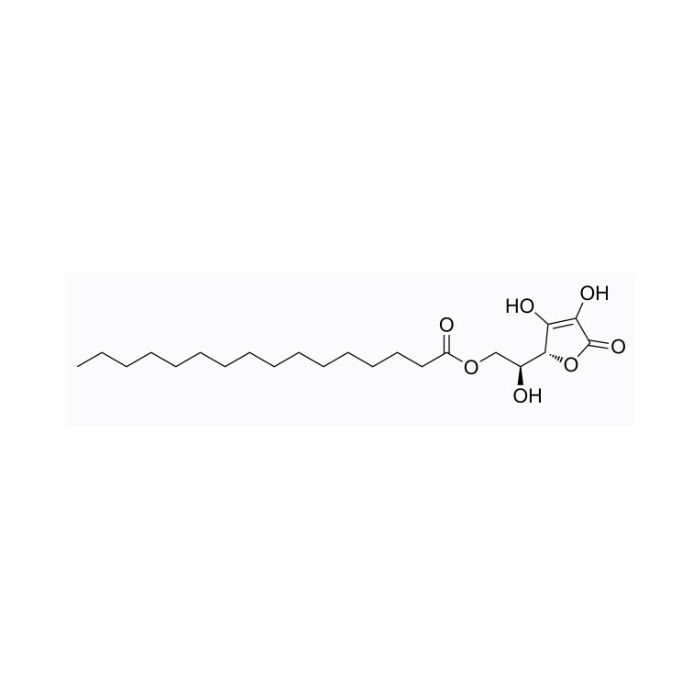
L-Ascorbic acid 6-palmitate (ascorbyl palmitate) is the lipophilic 6-O-monoester of L-ascorbic acid with palmitic acid.
Item-specific identifiers (Product Data)
SKU: A104524
CAS: 137-66-6
CID: 54680660
InChIKey: 291934 (as provided)
SMILES: Not specified for this item; refer to CoA/Spec Sheet.
Literature/computed identifiers (for reference; not item specifications)
Common name: Ascorbyl palmitate; L-ascorbic acid 6-hexadecanoate
Molecular formula (literature): C22H38O7
Molecular weight (literature): ~414.53 g/mol
Example SMILES (literature): CCCCCCCCCCCCCCCC(=O)O[C@@H]1C(=O)OC(C(O)=C1O)O
Structural features (general description)
Core scaffold: L-ascorbate (enediol lactone, 5-membered γ-lactone ring) bearing a conjugated enediol system (vicinal diol/ene-diol) responsible for redox activity.
Ester functionality: A single long-chain fatty acyl ester (palmitate, C16:0) at the primary 6-OH of ascorbic acid; no additional acylation at the 2- or 3- positions in the monoester.
Stereochemistry: Retains the native L-ascorbic acid stereochemistry at C4 (configurationally defined center); the palmitate chain is achiral.
2D description: A five-membered lactone ring with two adjacent hydroxyls and an enolizable double bond; a primary alkoxy substituent extends via an ester linkage to a linear C16 saturated alkyl chain.
Category context
Category Path: 全部 / 可售 / 生命科学
Note: Identity values not explicitly provided under Product Data should be confirmed against the product’s CoA/Spec Sheet for this specific lot.
Synthetic Utility
Although primarily an antioxidant excipient, ascorbyl palmitate has modest synthetic utility in research settings (literature/general):
Functional group features
Enediol lactone capable of redox transformations (ascorbate ↔ dehydroascorbate) and nucleophilic addition in specialized conditions.
Primary fatty acyl ester at the 6-O position: susceptible to hydrolysis (acid/base or enzymatic) and transesterification.
Transformations and uses
Hydrolysis to L-ascorbic acid and palmitic acid for tracer or partitioning studies where reversible protection of the 6-OH is desired.
Transesterification/acyl exchange to generate alternative ascorbyl monoesters using lipase catalysis in organic media or ionic liquids, enabling libraries of lipophilic ascorbate esters.
Oxidation to dehydroascorbyl palmitate for probing redox cycles and stability in nonaqueous environments.
Retrosynthetic perspective
Typically derived from L-ascorbic acid and palmitic acid derivatives (acid chloride/anhydride) under mild conditions or via enzymatic acylation, leveraging selectivity for the primary 6-OH.
Practical notes
Maintain low water activity to suppress premature hydrolysis.
Avoid strong bases that can induce lactone opening; employ neutral to mildly acidic or enzymatic conditions for selective transformations.
These utilities support method development and structure–property studies rather than bulk synthesis applications.
Target Specificity
This product is a small-molecule antioxidant, not a biological affinity reagent. Target specificity parameters such as antigen, epitope, species reactivity, clone, or isotype do not apply.
Not applicable
No antibodies, enzymes, or receptor-targeted ligands are described in the Product Data for this SKU.
For application-relevant details, refer instead to Reaction & Applications, Synthetic Utility, and Solvent Selection.
Frequently Asked Questions
What is the purity of this product?
This product is supplied at ≥99% purity (chemical assay). Lot-specific values are stated on the Certificate of Analysis.
How should this product be stored?
Store at room temperature.
How is this product shipped?
This product ships under standard ambient conditions. No temperature-controlled packaging is required.
What are the CAS number, molecular formula and molecular weight?
The CAS Number is 137-66-6, the molecular formula is C22H38O7, and the molecular weight is 414.53 g/mol. InChIKey QAQJMLQRFWZOBN-LAUBAEHRSA-N.
What documentation is provided?
Available product documentation, including Certificates of Analysis (COA), Safety Data Sheets (SDS), and specification sheets, is shown in the product document area. Document availability and access follow the current site policy.
We use cookies to ensure the website functions properly and, where permitted, to improve your experience. You can manage your preferences at any time in Settings. Learn more in our Cookie Policy.
Shall we send you a message when we have discounts available?
Remind me later
Thank you! Please check your email inbox to confirm.
Products are supplied to verified businesses, institutions, and qualified professionals for research and development use only. Not for use in humans, animals, diagnosis, or therapy.

 E2626300