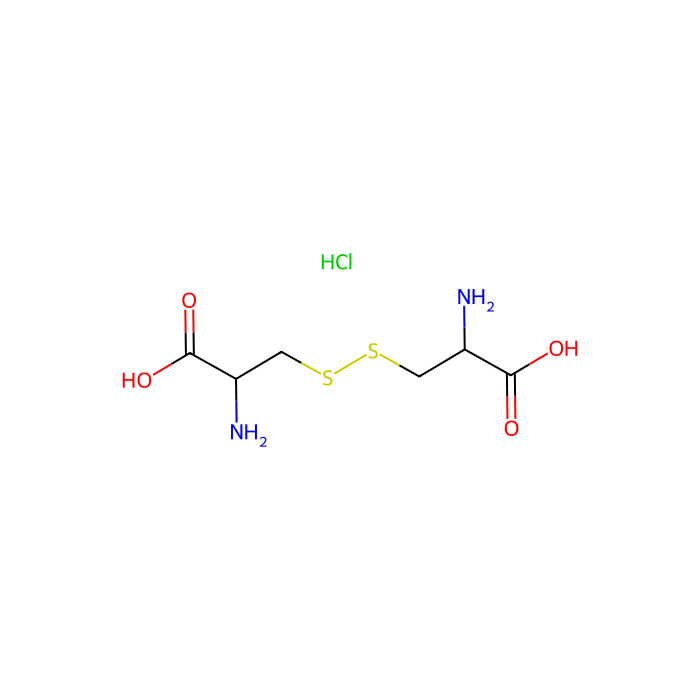
Determine the necessary mass, volume, or concentration for preparing a solution.
Taxonomy Tree
| Kingdom | Organic compounds |
|---|---|
| Superclass | Organic acids and derivatives |
| Class | Carboxylic acids and derivatives |
| Subclass | Amino acids, peptides, and analogues |
| Intermediate Tree Nodes | Amino acids and derivatives - Alpha amino acids and derivatives - Cysteine and derivatives |
| Direct Parent | L-cysteine-S-conjugates |
| Alternative Parents | L-alpha-amino acids Dicarboxylic acids and derivatives Dialkyldisulfides Amino acids Sulfenyl compounds Carboxylic acids Organopnictogen compounds Organic oxides Monoalkylamines Hydrochlorides Hydrocarbon derivatives Carbonyl compounds |
| Molecular Framework | Aliphatic acyclic compounds |
| Substituents | L-cysteine-s-conjugate - L-alpha-amino acid - Alpha-amino acid - Dicarboxylic acid or derivatives - Amino acid - Dialkyldisulfide - Organic disulfide - Sulfenyl compound - Carboxylic acid - Organic nitrogen compound - Organic oxygen compound - Organopnictogen compound - Organic oxide - Hydrocarbon derivative - Hydrochloride - Primary amine - Organosulfur compound - Organooxygen compound - Organonitrogen compound - Primary aliphatic amine - Carbonyl group - Amine - Aliphatic acyclic compound |
| Description | This compound belongs to the class of organic compounds known as l-cysteine-s-conjugates. These are compounds containing L-cysteine where the thio-group is conjugated. |
| External Descriptors | Not available |
Find and download the COA for your product by matching the lot number on the packaging.
| Lot Number | Certificate Type | Date | Item |
|---|---|---|---|
| Certificate of Analysis | Nov 03, 2023 | C298727 |
| Sensitivity | Hygroscopic |
|---|---|
| Molecular Weight | 276.8 |
| XLogP3 | |
| Hydrogen Bond Donor Count | 5 |
| Hydrogen Bond Acceptor Count | 8 |
| Rotatable Bond Count | 7 |
| Exact Mass | 276.001 Da |
| Monoisotopic Mass | 276.001 Da |
| Topological Polar Surface Area | 177.000 Ų |
| Heavy Atom Count | 15 |
| Formal Charge | 0 |
| Complexity | 192.000 |
| Isotope Atom Count | 0 |
| Defined Atom Stereocenter Count | 2 |
| Undefined Atom Stereocenter Count | 0 |
| Defined Bond Stereocenter Count | 0 |
| Undefined Bond Stereocenter Count | 0 |
| The total count of all stereochemical bonds | 0 |
| Covalently-Bonded Unit Count | 2 |
No vendor-validated application protocols are provided for this specific lot. Typical research workflows using L-cystine standards include:
Because concentration, solvent, and stabilizers are Not specified for this item; refer to CoA/Spec Sheet for exact preparation and dilution instructions. Always follow your laboratory’s validated SOPs.
Content below provides general biochemical context for L-cystine; it is not specific to this item’s composition.
Note: This product is for research use only and not for clinical or diagnostic procedures. For lot-specific concentration, matrix, and stability of the supplied solution, refer to the CoA/Spec Sheet.
L-cystine hydrochloride solutions are not commonly used as primary buffering agents. While amino acids can contribute to ionic strength and weak buffering near their pKa values, cystine’s functional groups and disulfide character make it an uncommon choice for buffer formulation.
For any composition- or pH-related details of this specific solution, Not specified for this item; refer to CoA/Spec Sheet.
For analytical standards, “green” considerations focus on solvent systems, packaging, and workflow efficiency rather than replacing the analyte itself.
Comparison (general considerations):
Trade-offs:
Always consult the CoA/Spec Sheet for the supplied matrix to align green choices with method compatibility.
No therapeutic or clinical claims are made. The following relates to research and quality-control contexts only.
Regulatory status and pharmacopeial references for this exact item are Not specified for this item; refer to CoA/Spec Sheet. If pharmacopeial traceability is required (e.g., to USP/EP monographs), verify suitability and documentation with your QA procedures.
Item-specific physical data for this solution (concentration, solvent, density, pH, refractive index) are Not specified for this item; refer to CoA/Spec Sheet.
Literature values for the related solid L-cystine salts (for context only, not specifications):
Solution behavior and handling insights (general):
For assay setup, prepare calibrators and dilutions using the same solvent matrix noted on the CoA/Spec Sheet to minimize matrix effects.
What this means for this item:
Practical notes:
As an analytical standard solution, the primary application is in quantitative analysis rather than synthesis. Common research and analytical uses include:
Practical tips:
Note: Always use the lot-specific concentration from the CoA to calculate calibrator levels.
General literature guidance on reactions involving cystine/cysteine redox chemistry (context for method development; not specifications for this product):
Solvent systems: water or water/organic (ACN/MeOH) with volatile acids (formic/acetic) for LC–MS; buffered aqueous phases for ion-exchange.
Always validate conditions with small-scale tests using aliquots of the standard; refer to the CoA for the exact matrix to ensure compatibility.
GHS classification, pictograms, signal word, and H-statements are Not specified for this item; refer to the product SDS for authoritative safety information.
General laboratory safety guidance for amino-acid salt solutions and disulfide-containing standards:
Waste: dispose in accordance with institutional and local regulations; aqueous amino-acid solutions are typically collected as non-halogenated aqueous waste unless contaminated with hazardous reagents.
This product is supplied as a solution; the exact solvent matrix is Not specified for this item; refer to CoA/Spec Sheet. The following guidance is general for L-cystine hydrochloride and amino-acid standards:
Comparison (general):
Best practices for solution standards:
Reconstitution: Not applicable (supplied as a solution). For preparing working calibrators, perform volumetric or gravimetric dilutions using the diluent recommended in your analytical method and consistent with the supplied matrix (see CoA/Spec Sheet).
A ready-to-use analytical standard solution of the disulfide amino acid L-cystine in its hydrochloride salt form. Item-specific identifiers provided below; where missing, consult the CoA.
Structural features (general, literature-based description of L-cystine·2HCl):
Computed/literature identifiers for context (not specifications for this lot):
Note: This product is a solution; exact concentration, solvent matrix, and counterion state for this specific item are Not specified for this item; refer to CoA/Spec Sheet.
While this product is supplied as an analytical standard solution rather than a reagent, the chemistry of L-cystine (disulfide of L-cysteine) underpins several synthetic concepts (general, literature-based context):
Caveat: Because this is an analytical standard solution with unspecified concentration and matrix, it is not typically employed as a stoichiometric reagent. Where synthetic use is intended, solid-grade reagents with known counterion forms and water content are preferred. For this item’s exact composition, Not specified for this item; refer to CoA/Spec Sheet.
Not applicable. This product is a chemical analytical standard solution, not an antibody or biological targeting reagent. No antigen/epitope specificity, clone information, or species reactivity applies.
Our grade selection guide covers purity, stabilizer status, and application suitability for all variants in our catalog.
View Analytical standard grade guide →