Levcromakalim - Moligand™, 10 mM in DMSO , CAS No.94535-50-9

CAS: 94535-50-9 Cat. No.: L1496959 Formula: C16H18N2O3 Molecular Weight: 286.33
AVAILABLE TO ORDER
GRADE & PURITY Moligand™ ? Moligand™ — Aladdin's line of ligands and bioactive small molecules. Use for receptor, pathway, and binding studies needing defined small-molecule tools. 10 mM in DMSO
Storage
Store at -80°C
Shipped In
Dry ice packs + Cold packs
★
Size
Germany (EU)
USA*
Price
Qty
1ml
L1496959-1ml
Made to order · 8–12 wks
€146.56
Enter a quantity for the sizes you want to add.
🧪

Why this grade

Moligand™, 10 mM in DMSO Moligand™ for sensitive chromatographic and analytical workflows requiring minimal baseline interference.

🌡

Storage & shipping

Store at -80°C Ships Dry ice packs + Cold packs Check lot-specific COA for exact specifications.

📋

Quality documents

SDS, COA, datasheet, and spec sheet available for download. Lot-specific COA accessible via lot number lookup.

📚

Literature proof

Cited in 0 peer-reviewed publications across chromatography, organic synthesis, and cross-coupling reactions.

Overview

Levcromakalim ((-)-Cromakalim) is an ATP-sensitive K + channel (K ATP ) activator.

Specifications

Specifications & Purity
Moligand™, 10 mM in DMSO
Storage
Store at -80°C
Shipped In
Dry ice packs + Cold packs
This product requires cold chain shipping. Ground and other economy services are not available.
Grade
Moligand™
Names and Identifiers
Isomeric SMILES CC1([C@H]([C@@H](C2=C(O1)C=CC(=C2)C#N)N3CCCC3=O)O)C
Molecular Weight 286.33
Reaxy-Rn 8781733
Reaxys-RN_link_address https://www.reaxys.com/reaxys/secured/hopinto.do?context=S&query=IDE.XRN=8781733&ln=

Documentation

📋 Safety Data Sheet (SDS)

Comprehensive hazard, handling, storage, and regulatory compliance document.

Download SDS →

✅ Certificate of Analysis (COA)

Lot-specific quality data. Enter your lot number to retrieve the exact COA.

Look up COA →

📊 Datasheet

Quick-reference summary of product specifications and applications.

View datasheet →

🔬 Specification Sheet

Full quality attributes and acceptance criteria for this grade.

View spec sheet →

Advanced Data

Certificates(CoA,COO,BSE/TSE and Analysis Chart)
C of A & Other Certificates(BSE/TSE, COO):
Analytical Chart:
Solution Calculators
Reviews

Customer Reviews

Application Protocols

The following protocols are literature-informed, general examples for using levcromakalim as a research tool. They are not item-specific validations; optimize for your system.

  1. Preparing stock solutions
  • Dissolve in anhydrous DMSO to 10–50 mM. Vortex and, if necessary, gently warm (<40°C) or sonicate briefly. Aliquot into low-adsorption tubes, flush with inert gas if available, and store at −80°C. Avoid repeated freeze–thaw.
  1. Cell-based membrane potential assay (e.g., voltage-sensitive dye)
  • Plate cells expressing KATP channels (e.g., Kir6.x/SURx) 18–24 h prior.
  • Prepare working solutions by diluting DMSO stock into assay buffer to 0.03–30 µM, keeping final DMSO ≤0.1–0.5% v/v.
  • Load membrane potential dye per manufacturer’s instructions. Equilibrate cells, then add levcromakalim and monitor fluorescence kinetics. Include vehicle control and a KATP blocker (e.g., glibenclamide) to confirm on-target response.
  1. Patch-clamp (whole-cell) positive control
  • Use internal and external solutions appropriate for K+ currents. After establishing whole-cell mode, apply cumulative concentrations (e.g., 0.1, 0.3, 1, 3, 10 µM) to build a concentration–response curve.
  • Verify reversibility/antagonism by perfusing a sulfonylurea blocker.
  1. Vascular ring myography (ex vivo)
  • Precontract rings with a vasoconstrictor; apply increasing concentrations of levcromakalim (e.g., 0.01–10 µM) and record relaxation. Confirm specificity with a KATP antagonist.

Always include vehicle controls, replicate wells/rings/cells, and appropriate statistical analysis.

Biological Roles

Levcromakalim is widely used as a research tool compound to activate ATP-sensitive potassium (KATP) channels.

Mechanistic context (literature/general):

  • Target: KATP channels formed by inward-rectifier subunits (Kir6.x) and sulfonylurea receptor regulatory subunits (SURx). Levcromakalim interacts with SUR-containing channels to promote channel opening, leading to K+ efflux and membrane hyperpolarization.
  • Subtype preferences: Literature reports indicate higher efficacy on SUR2-containing channels (e.g., SUR2A/SUR2B with Kir6.1/6.2) relative to SUR1-containing assemblies; exact potency depends on subunit composition, species, and experimental conditions.
  • Functional consequences: Hyperpolarization reduces voltage-dependent Ca2+ entry and can modulate vascular smooth muscle tone, neuronal excitability, and pancreatic/islet electrophysiology in model systems.

Research utilities:

  • Positive control agonist in patch-clamp and membrane potential assays to validate KATP function and pharmacology.
  • Tool for dissecting signaling pathways influenced by cellular energetics (ATP/ADP ratios), since KATP channels integrate metabolic state with excitability.
  • Benchmark molecule for structure–activity relationship (SAR) studies of potassium channel openers.

Notes and caveats:

  • Enantioselective activity is reported; confirm the stereochemical designation and optical purity on the CoA for quantitative studies.
  • Off-target effects at high micromolar concentrations can occur; include pharmacological controls such as sulfonylurea antagonists (e.g., glibenclamide) to demonstrate on-target action.

All uses are for research and laboratory investigations only.

Buffer Applications

This compound is not a buffering agent and is not used to prepare pH buffer systems. Consequently, there are no standard buffer recipes or buffering ranges associated with levcromakalim.

Practical note:

  • When dosing into buffered physiological media, prepare concentrated DMSO stocks and dilute immediately before use. Maintain constant vehicle concentration across controls and treatments to preserve buffer performance and assay comparability.
Green Alternatives

This product is a targeted bioactive small molecule used as a probe/ligand rather than a process solvent or general-purpose reagent. As such, conventional “green alternative” comparisons (e.g., replacing a solvent with a greener one) are not typically applicable.

Sustainability-oriented handling suggestions (general):

  • Use minimal effective quantities for screening and profiling to reduce chemical waste.
  • Prepare concentrated stocks to limit the volume of organic solvent used in dilutions; consolidate assays to minimize freeze–thaw cycles and disposal.
  • Prefer DMSO over more hazardous dipolar aprotic solvents when compatible with your assay, and keep final vehicle percentages low.
  • Segregate organic waste streams to facilitate compliant disposal and potential solvent recovery at institutional scale.

If you are exploring greener paradigms for ion-channel assays:

  • Consider assay formats that reduce dye load or utilize label-free readouts, which can decrease auxiliary reagent waste.
  • Microplate miniaturization (e.g., 384–1536 wells) significantly reduces per-data-point solvent and compound consumption.

No item-specific environmental metrics (biodegradability, aquatic toxicity, E-factor contributions) are provided; consult your institutional EHS for best practices.

Pharmaceutical Uses

This product is supplied strictly for research use. It is not intended for human or veterinary use, nor for clinical or diagnostic applications.

Laboratory/formulation contexts (research only):

  • Analytical reference: may be used as a research reference compound for method development (e.g., LC–MS/MS) to quantify exposure in in vitro ADME or transport studies.
  • In vitro dosing: typically dosed from DMSO stocks into physiological buffers or cell culture media for mechanistic studies of KATP modulation.

Regulatory/pharmacopeial status:

  • No pharmacopeial monograph or excipient designation is provided for this item.

Handling and documentation:

  • For quantitative work, confirm identity and assay on the CoA and document storage conditions and lot numbers in study records.
  • If preparing dose formulations for preclinical in vitro studies, validate homogeneity and stability in the chosen vehicle across the intended time frame.

No therapeutic claims are made or implied for this product; it is provided solely for laboratory research.

Physical Properties

Item-specific physicochemical specifications have not been provided for this catalog entry.

  • Appearance: Not specified for this item; refer to CoA/Spec Sheet.
  • Molecular Weight: Not specified for this item; refer to CoA/Spec Sheet.
  • Molecular Formula: Not specified for this item; refer to CoA/Spec Sheet.
  • Melting point, boiling point, density, refractive index, UV/Vis cutoff, water content, residual solvents, metal content: Not specified for this item; refer to CoA/Spec Sheet.

Literature/general notes (for context only; not specifications of this item):

  • Small-molecule KATP openers of the cromakalim class are typically crystalline solids with limited aqueous solubility and good solubility in polar aprotic organic solvents (e.g., DMSO) commonly used for stock solutions in bioassays.
  • Stock solutions are often prepared at 10–50 mM in anhydrous DMSO and diluted into buffered media immediately prior to use to minimize precipitation.

Solubility guidance (practical, general):

  • DMSO: generally soluble (commonly used vehicle for screening solutions).
  • Ethanol/MeOH: variable; co-solvent systems may assist dissolution.
  • Aqueous buffers: limited intrinsic solubility; use DMSO cosolvent (typically ≤0.1–0.5% v/v final) with surfactant if needed.

Important: Treat all numerical physicochemical values as unknown for this specific item unless they appear on the CoA or the product Specification Sheet.

Quality & Grades
  • Grade/Purity: Moligand™ (vendor-specific research/screening grade).

What Moligand™ generally signifies (context):

  • Intended use: small-molecule ligand for screening, target engagement studies, and chemical biology research.
  • Typical quality controls for such grades may include orthogonal identity confirmation (e.g., 1H NMR, LC–MS) and chromatographic purity assessment. However, the exact tests and acceptance criteria for this item are not provided here.

Item-specific notes:

  • Assay/purity, stabilizers, residual solvent limits, and spectral data: Not specified for this item; refer to CoA/Spec Sheet.
  • UV characteristics for analytical detection (HPLC/UPLC), and any salt form information (free base vs. salt): Not specified for this item; refer to CoA/Spec Sheet.

Implications for users:

  • For bioassay and screening use, verify identity and purity on receipt (e.g., check CoA; optionally confirm by LC–MS/NMR if your application is sensitive to minor impurities or stereochemistry).
  • If your workflows require defined salt form or enantiopurity, confirm these details with the CoA. Levcromakalim’s biological activity is enantioselective in literature, so stereochemical integrity can be important for consistent results.

Documentation:

  • Request and retain the Certificate of Analysis/Specification Sheet for lot-specific purity, identity tests, and handling notes.
  • For regulated work or quantitative analysis, consider obtaining a reference standard with documented assay and uncertainty, if needed.
Reaction & Applications

Chemical reaction use: This molecule is not typically employed as a reagent, catalyst, or solvent in synthetic transformations. Accordingly, there are no standard named-reaction roles where levcromakalim functions as a reactant.

Research applications (literature/general, chemistry-adjacent):

  • Small-molecule probe: widely used as a reference ATP-sensitive potassium (KATP) channel opener to modulate membrane potential in electrophysiology, myography, and high-throughput screening assays.
  • Use in SAR benchmarking: the levo-enantiomer provides a standard of activity against SUR-containing KATP channel assemblies for comparing analogue series.
  • Calibration control: serves as a positive control in assays where hyperpolarization or vasorelaxation readouts are measured indirectly (e.g., Tl+ flux assays, voltage-sensitive dyes), with a matching KATP blocker (e.g., glibenclamide) as a negative control.

Practical laboratory tips (general):

  • Prepare concentrated DMSO stocks and avoid repeated freeze–thaw; aliquot to minimize degradation risk.
  • Validate concentration-response behavior in your system; potencies can vary with expression of SUR/Kir subunits, temperature, and membrane potential.
  • Include vehicle controls and a KATP antagonist to confirm on-target effects.

Note: For users seeking information on chemical reactivity or building-block applications, this compound is not a common synthon; see “Biological Roles,” “Target Specificity,” and “Application Protocols” for the most relevant content.

Reaction Conditions

Not typically applicable: levcromakalim is not a standard reagent for chemical reactions. There are no canonical reaction conditions where it functions as a substrate, catalyst, or solvent.

Assay preparation conditions (literature/general) relevant to its use as a probe:

  • Stock solutions: commonly 10–50 mM in anhydrous DMSO; filter-sterilize if required by the assay and compatible with the compound’s stability.
  • Working concentrations: in vitro studies often explore 0.03–30 µM; optimal ranges depend on cell type, channel subunit composition, temperature, and endpoint sensitivity.
  • Controls: pair with a KATP blocker (e.g., glibenclamide) to confirm on-target effects; include vehicle controls matching the final DMSO percentage.
  • Incubation: equilibration typically occurs within minutes; monitor for precipitation upon dilution into aqueous media, especially at the upper end of test ranges.

These conditions are provided as general literature-informed guidance for biological testing and are not item-specific specifications. Validate and optimize for your assay system.

Safety & Handling

Safety data specific to this item are not provided in the Product Data.

  • GHS Classification: Not specified for this item; refer to SDS.
  • Signal Word / Hazard Statements / Pictograms: Not specified for this item; refer to SDS.

General laboratory safety guidance (not a substitute for the SDS):

  • Personal protective equipment: wear appropriate lab coat, safety glasses, and chemical-resistant gloves. Handle powders/solids in a fume hood to avoid inhalation of dust or aerosols.
  • Avoid ingestion, inhalation, and skin/eye contact. Use in well-ventilated areas and avoid creating dust. Wash hands thoroughly after handling.
  • Incompatibilities: avoid strong oxidizers and strong acids/bases until specific compatibility data are confirmed. Do not mix with unknown reagents.
  • First aid (overview): in case of skin contact, wash with soap and water; for eye contact, rinse cautiously with water for several minutes and seek medical attention; if inhaled, move to fresh air; if ingested, rinse mouth. Always follow institutional protocols and consult SDS.
  • Waste disposal: dispose of unused material and contaminated consumables as organic hazardous waste in accordance with local regulations.

Storage and transport per Product Data:

  • Storage: Store at −80°C.
  • Shipping: Shipped on dry ice packs + cold packs to maintain low temperature.

Always consult the Safety Data Sheet (SDS) for authoritative hazard classification, exposure controls, and emergency measures prior to use.

Solvent Selection

Levcromakalim is a neutral, hydrophobic small molecule with heteroatoms that confer moderate polarity but generally poor intrinsic water solubility. For laboratory use it is usually formulated as concentrated stocks in organic solvents.

Practical solvent guidance (general/literature-informed):

  • Primary vehicle: DMSO is the preferred solvent for preparing concentrated stocks (e.g., 10–50 mM), owing to high solvating power and compatibility with bioassays in low final percentages.
  • Alternative vehicles: DMF or ethanol may dissolve the compound; however, DMF is less desirable in biological systems, and ethanol may limit achievable stock concentration.
  • Aqueous buffers: direct dissolution is typically limited. Use aqueous dilution from a DMSO stock immediately before use; gentle warming and vortexing/sonication can help.
  • Co-solvent systems: for higher aqueous working concentrations, consider DMSO (0.1–0.5% v/v final) plus small amounts of non-ionic surfactant (e.g., Tween-80 at very low concentrations) where biocompatible.

Selection considerations:

  • If optical readouts are used, ensure vehicle controls match final DMSO percentage; maintain ≤0.1–0.5% v/v DMSO when sensitive cell types are involved.
  • For long incubations or in vivo-like models, verify precipitation risk by visual inspection or light scattering after dilution into the final medium.

Note: No item-specific solubility limits or solvent impurities are provided; consult the CoA/Spec Sheet and validate in your system.

Storage & Reconstitution

Item-specific conditions (from Product Data):

  • Storage: Store at −80°C.
  • Shipped In: Dry ice packs + Cold packs.

General handling and reconstitution (practical guidance):

  • Upon receipt: keep frozen. If long-term storage is anticipated, minimize time at ambient temperature. Record lot number and receipt date.
  • Aliquoting: if supplied as a solid, equilibrate the sealed container to room temperature before opening to avoid condensation. If supplied in solution, maintain on dry ice or in a −80°C rack during aliquoting.
  • Reconstitution solvent: anhydrous DMSO is commonly used to prepare concentrated stocks (e.g., 10–50 mM). Filter-sterilize if required and if compatible.
  • Light/moisture: protect from moisture uptake and prolonged light exposure; store aliquots in amber or foil-wrapped containers if feasible.
  • Freeze–thaw: avoid repeated cycles. Dispense single-use aliquots to preserve integrity.
  • Short-term working storage: thawed DMSO stocks can be kept on ice during use; return unused aliquots to −80°C promptly. For refrigerated storage between uses, validate chemical stability empirically.

Specifications not provided:

  • Assay/purity, water content, residual solvents, stabilizers, salt form, and exact solubility: Not specified for this item; refer to CoA/Spec Sheet.

For research use only. Consult the CoA and SDS for lot-specific guidance and safety before use.

Structure & Identity

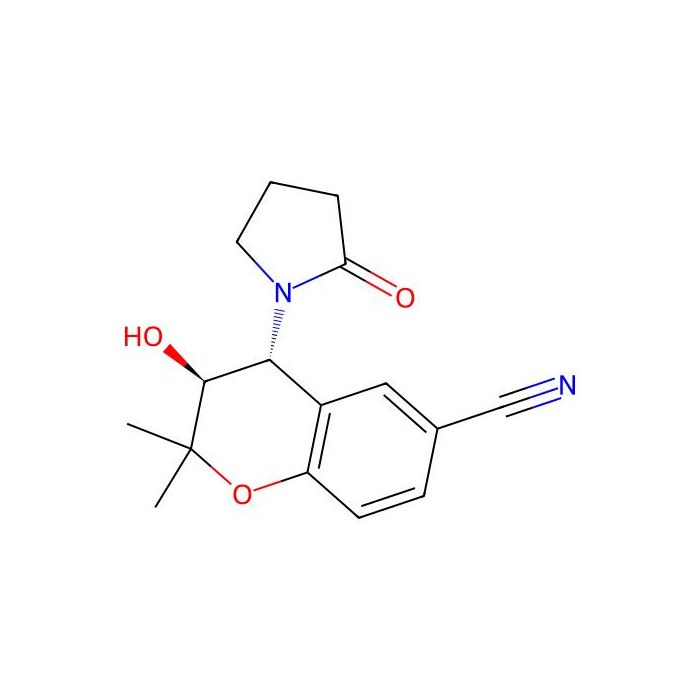
Brief overview: Levcromakalim is the levo-enantiomer of cromakalim, a small-molecule potassium channel opener widely used as a research tool for ATP-sensitive K+ (KATP) channels.

  • SKU: L1496959
  • Product Name: Levcromakalim
  • CAS: 94535-50-9
  • PubChem CID: 93504 (literature)
  • Molecular Formula: Not specified for this item; refer to CoA/Spec Sheet.
  • Molecular Weight: Not specified for this item; refer to CoA/Spec Sheet.
  • SMILES: Not specified for this item; refer to CoA/Spec Sheet.
  • InChIKey: Not specified for this item; refer to CoA/Spec Sheet.

Structural features (literature/general):

  • Chiral small molecule; levcromakalim corresponds to the (–) enantiomer of cromakalim and has two stereocenters on a chroman (2H-1-benzopyran) ring system bearing a bicyclic core.
  • Contains a chroman (benzopyran) scaffold with a gem-dimethyl substitution at C-2, a cyano substituent on the aromatic ring, and an N-linked 2-pyrrolidinone (lactam) moiety at the saturated ring position.
  • Functional groups: cyano (–C≡N), lactam (imide-like amide in a 5-membered ring), ether within the chroman ring, and tertiary carbon centers.
  • 2D description in words: a benzopyran fused ring with a saturated C3–C4 bond; the 4-position bears an N-linked 2-oxopyrrolidinyl substituent, the 2-position is gem-dimethyl, and the aryl ring carries a nitrile substituent. The stereochemistry at the saturated ring defines the levo enantiomer.

Note: Exact identifiers (SMILES/InChIKey) and elemental composition for this catalog item are not specified here; consult the item’s CoA/Spec Sheet for definitive identity data.

Synthetic Utility

Levcromakalim is a finished bioactive small molecule and is not commonly used as a synthetic reagent, catalyst, or intermediate.

Context (general):

  • Structural class: chroman-based KATP channel opener bearing a cyano group and an N-linked 2-pyrrolidinone. While informative for medicinal chemistry design, the molecule itself is not deployed as a building block in routine synthesis because late-stage modifications would compromise the parent scaffold or stereochemistry.
  • Reference compound: In synthesis-driven projects, levcromakalim often serves as a benchmark for biological activity to guide SAR around the chroman core rather than as a synthon.

If your objective is chemical synthesis:

  • Consider starting from simpler chroman or benzopyran intermediates and introducing the cyano and lactam substituents through stepwise functionalization, preserving stereochemistry at the saturated ring centers.
  • Enantioselective synthesis or chiral resolution is generally required to access the levo enantiomer with high enantiomeric excess.

For practical purposes, users should consult the “Biological Roles,” “Target Specificity,” and “Application Protocols” tabs for the most relevant information on using this product in research.

Target Specificity

Item-specific target validation data are not provided; the following reflects literature/general knowledge of the molecule’s pharmacology.

Primary target class:

  • ATP-sensitive potassium (KATP) channels composed of Kir6.x pore-forming subunits and SUR regulatory subunits.

Selectivity notes (literature/general):

  • Preference toward SUR2-containing KATP channels (e.g., SUR2A/SUR2B with Kir6.1 or Kir6.2) is commonly reported, with lower activity at SUR1-containing pancreatic channels; exact selectivity ratios vary by assay system and species.
  • Antagonism by sulfonylureas (e.g., glibenclamide) and other KATP blockers is used to confirm target-mediated effects.

Assay considerations:

  • Channel expression levels, membrane potential, intracellular nucleotides (ATP/ADP), Mg2+, and phospholipid environment strongly influence apparent potency and efficacy.
  • When profiling specificity, include panels of ion channels and transporters to assess potential off-target interactions at higher concentrations.

Note: No lot-specific binding constants, EC50/IC50 values, or target panels are provided for this item. For quantitative claims, generate data under your experimental conditions and consult primary literature.

Need help choosing the grade?

Our grade selection guide covers purity, stabilizer status, and application suitability for all variants in our catalog.

View Moligand™ grade guide →

Shall we send you a message when we have discounts available?

Remind me later

Thank you! Please check your email inbox to confirm.

Oops! Notifications are disabled.