
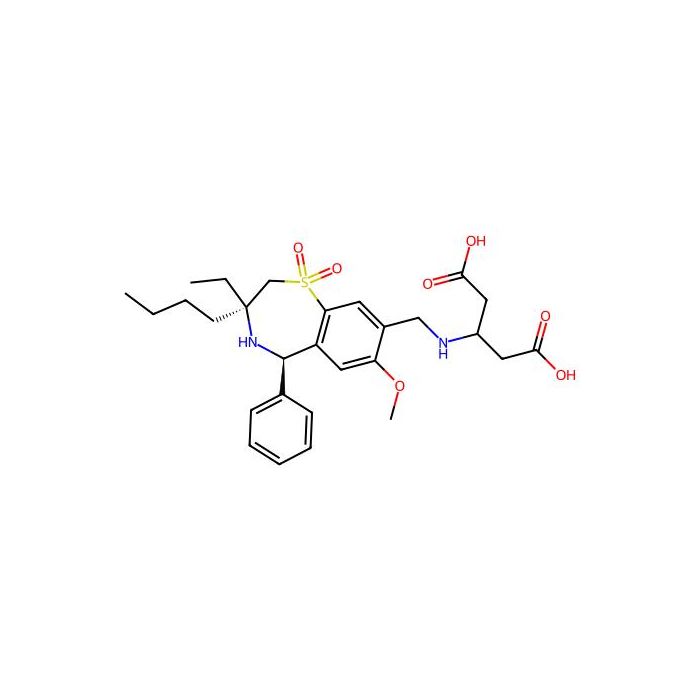
Determine the necessary mass, volume, or concentration for preparing a solution.
| Activity Type | Activity Value -log(M) | Mechanism of Action | Activity Reference | Publications (PubMed IDs) |
|---|
Linerixibat (GSK2330672) is a highly potent, nonabsorbable and orally active apical sodium-dependent bile acid transporter (ASBT) inhibitor with an IC 50 of 42 nM human ASBT . Linerixibat can be used as lipid-lowering agent. Linerixibat has the potential for type 2 diabetes and Primary Biliary Cholangitis treatment
In Vitro
The zwitterionic, nonhygroscopic, crystalline salt form of Linerixibat (Compound 56) shows good aqueous solubility at pH 7.4 (>7 mg/mL), excellent thermal stability, and did not generate reactive or humanspecific metabolite, characteristics. MCE has not independently confirmed the accuracy of these methods. They are for reference only.
In Vivo
Linerixibat (GSK2330672; 0.05-10 mg/kg; oral gavage; twice daily; for 14 days; male ZDF rat) treatment lowers glucose in an animal model of type 2 diabetes . MCE has not independently confirmed the accuracy of these methods. They are for reference only. Animal Model: Male Zucker Diabetic Fatty (ZDF) rat Dosage: 0.05 mg/kg, 0.1 mg/kg, 0.5 mg/kg, 1 mg/kg, 5 mg/kg, 10 mg/kg Administration: Oral gavage; twice daily; for 14 days Result: Led to a 1.30-1.64% reduction in hemoglobin A1c (HbA1c), a greater than 50% reduction in nonfasted plasma glucose to below 200 mg/dL, and statistically significant higher plasma insulin.
Form:Solid
IC50& Target:IC50: 42 nM (Apical sodium-dependent bile acid transporter (ASBT))
Taxonomy Tree
| Kingdom | Organic compounds |
|---|---|
| Superclass | Organoheterocyclic compounds |
| Class | Benzothiazepines |
| Subclass | Not available |
| Intermediate Tree Nodes | Not available |
| Direct Parent | Benzothiazepines |
| Alternative Parents | Anisoles Aralkylamines Amino fatty acids Alkyl aryl ethers Dicarboxylic acids and derivatives Benzene and substituted derivatives Sulfones Amino acids Dialkylamines Carboxylic acids Azacyclic compounds Organic oxides Hydrocarbon derivatives Carbonyl compounds |
| Molecular Framework | Aromatic heteropolycyclic compounds |
| Substituents | Benzothiazepine - Anisole - Phenol ether - Alkyl aryl ether - Amino fatty acid - Aralkylamine - Monocyclic benzene moiety - Dicarboxylic acid or derivatives - Benzenoid - Fatty acyl - Sulfone - Amino acid or derivatives - Amino acid - Azacycle - Secondary amine - Carboxylic acid derivative - Carboxylic acid - Secondary aliphatic amine - Ether - Carbonyl group - Organooxygen compound - Organic nitrogen compound - Organic oxygen compound - Hydrocarbon derivative - Organic oxide - Amine - Organonitrogen compound - Aromatic heteropolycyclic compound |
| Description | This compound belongs to the class of organic compounds known as benzothiazepines. These are organic compounds containing a benzene fused to a thiazepine ring (a seven-membered ring with a nitrogen atom and a sulfur atom replacing two carbon atoms). |
| External Descriptors | Not available |
| Activity Type | Activity Value -log(M) | Mechanism of Action | Activity Reference | Publications (PubMed IDs) |
|---|
| Activity Type | Relation | Activity value | Units | Action Type | Journal | PubMed Id | doi | Assay Aladdin ID |
|---|
| Activity Type | Relation | Activity value | Units | Action Type | Journal | PubMed Id | doi | Assay Aladdin ID |
|---|
| Activity Type | Relation | Activity value | Units | Action Type | Journal | PubMed Id | doi | Assay Aladdin ID |
|---|
| Activity Type | Relation | Activity value | Units | Action Type | Journal | PubMed Id | doi | Assay Aladdin ID |
|---|
| Activity Type | Relation | Activity value | Units | Action Type | Journal | PubMed Id | doi | Assay Aladdin ID |
|---|
| Activity Type | Relation | Activity value | Units | Action Type | Journal | PubMed Id | doi | Assay Aladdin ID |
|---|
| Activity Type | Relation | Activity value | Units | Action Type | Journal | PubMed Id | doi | Assay Aladdin ID |
|---|
| Activity Type | Relation | Activity value | Units | Action Type | Journal | PubMed Id | doi | Assay Aladdin ID |
|---|
| Activity Type | Relation | Activity value | Units | Action Type | Journal | PubMed Id | doi | Assay Aladdin ID |
|---|
| Activity Type | Relation | Activity value | Units | Action Type | Journal | PubMed Id | doi | Assay Aladdin ID |
|---|
| Solubility | DMSO : 50 mg/mL (91.46 mM; Need ultrasonic) |
|---|---|
| Molecular Weight | 546.7 |
| XLogP3 | -1.600 |
| Hydrogen Bond Donor Count | 4 |
| Hydrogen Bond Acceptor Count | 9 |
| Rotatable Bond Count | 13 |
| Exact Mass | 546.24 Da |
| Monoisotopic Mass | 546.24 Da |
| Topological Polar Surface Area | 150.000 Ų |
| Heavy Atom Count | 38 |
| Formal Charge | 0 |
| Complexity | 870.000 |
| Isotope Atom Count | 0 |
| Defined Atom Stereocenter Count | 2 |
| Undefined Atom Stereocenter Count | 0 |
| Defined Bond Stereocenter Count | 0 |
| Undefined Bond Stereocenter Count | 0 |
| The total count of all stereochemical bonds | 0 |
| Covalently-Bonded Unit Count | 1 |
No item-specific, validated protocols are provided for this listing.
General protocols (for transporter inhibitor assessment):
Controls and QC:
Note: Adapt parameters (substrate concentration, incubation times) to ensure linear kinetics under your specific assay conditions.
General, literature-level context: Linerixibat is widely described as a potent, selective small-molecule inhibitor targeting the ileal bile acid transporter (IBAT/ASBT; SLC10A2). It serves as a chemical probe for bile acid reabsorption processes in the distal ileum.
Biochemical and pathway relevance (no clinical claims):
Note: Specific potency, selectivity panels, and ADME parameters for this item are not provided here and should be taken from primary literature or the lot-specific CoA where available. Use strictly for research in vitro/in vivo laboratory models as per institutional approvals.
This product is not a buffering agent. However, appropriate buffer systems are essential for transporter and uptake assays employing this small-molecule tool.
Assay-buffer guidance (general):
Practical recipes (examples, adjust as needed):
Note: No item-specific pKa or solubility data are provided; empirically verify pH-dependent solubility and adsorption in your specific buffer system.
As a bioactive small molecule, the main environmental considerations relate to solvent choice and waste minimization during assay preparation and analytical QC.
Greener solvent strategies (general guidance):
Illustrative comparison (general):
Operational practices:
Note: No greener “alternative compound” is proposed here; selection of a different chemical probe should be based on your biological hypothesis and selectivity requirements.
For research use only. Not for human or veterinary use, formulation, or diagnostics.
Context (no therapeutic claims):
Documentation:
Note: This listing provides no claims regarding suitability for clinical manufacturing, human administration, or diagnostic use.
Item-specific physicochemical data are not provided in the Product Data for this listing.
Practical handling guidance (general, for small-molecule screening tools):
Note: Where exact numerical values are required for method validation or regulatory documentation, please obtain the lot-specific Certificate of Analysis (CoA) and/or detailed Specification Sheet.
Context for small-molecule research compounds:
Recommendations:
This product is primarily a bioactive small-molecule tool (library compound) rather than a synthetic reagent. Accordingly, it is not typically used as a solvent or stoichiometric/catalytic reagent in organic synthesis.
Research applications (general for transporter inhibitors):
Assay implementation tips:
Not typically applicable. Linerixibat is supplied as a research-use bioactive small molecule, not as a reagent or catalyst for chemical synthesis.
If adapting for probe synthesis or analytical derivatization (general guidance only):
Because the exact functional groups are not specified in this listing, all conditions must be developed empirically after consulting definitive structural references. For routine use, prioritize the sections on Solvent Selection, Biological Roles, and Storage & Reconstitution.
Hazard classification details are not specified in the Product Data and may vary by lot. Handle as a laboratory chemical of unknown hazard profile.
Always consult the Safety Data Sheet (SDS) accompanying your lot for authoritative hazard and response information.
No item-specific solubility data are provided. The following guidance reflects common practice for hydrophobic, drug-like small molecules used in biological assays.
Comparison (general):
Practical tip: Perform a mini-solubility screen (DMSO vs DMF; 10–50 mM) and monitor by UHPLC after 24 h at room temperature to confirm absence of precipitation or degradation.
Reconstitution (general guidance for small molecules; verify solubility experimentally):
Handling tips:
Note: Any item-specific parameters (water content, exact solubility, stabilizers) are not specified for this item; refer to the CoA/Spec Sheet and SDS for definitive guidance.
Linerixibat (SKU: L648859) is a research-use small-molecule tool compound listed in our small-molecule and compound library category.
Structural features (general, literature-level):
Identity and traceability:
This product is a final bioactive small molecule and is not commonly employed as a synthetic building block.
If used in chemistry method development (general considerations):
Note: Functional group-specific reactivity (e.g., amide coupling, halide cross-coupling) cannot be specified here because the Product Data do not include a structure/SMILES. Refer to peer-reviewed sources for detailed synthetic derivatization routes and reactivity.
Item-specific target data are not provided in the Product Data.
General, literature-level context:
Recommendations:
Note: Do not infer quantitative potency or selectivity from this listing; consult peer-reviewed literature and validate experimentally.