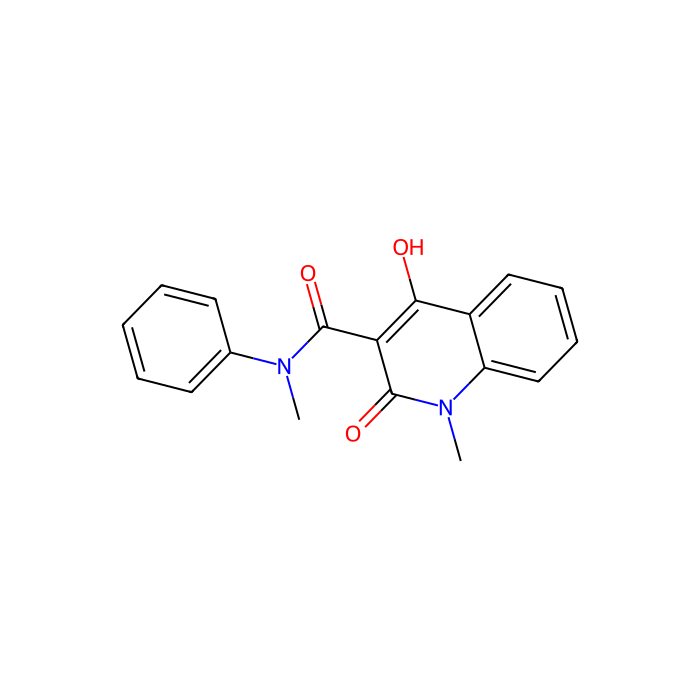
Linomide - ≥96%(HPLC) , CAS No.84088-42-6

CAS: 84088-42-6 Cat. No.: L157755 Formula: C18H16N2O3 Molecular Weight: 308.34 EC Number: 635-913-9
AVAILABLE TO ORDER
GRADE & PURITY ≥96%(HPLC)
Synonyms
ROQUINIMEX|4-hydroxy-N,1-dimethyl-2-oxo-N-phenyl-3-quinolinecarboxamide|Roquinimex [USAN:INN]|N-methyl-N-phenyl-1,2-dihydro-4-hydroxy-1-methyl-2-oxo-quinoline-3-carboxamide|ROQUINIMEX [MART.]|diethoxymethoxy ethane|4-hydroxy-N,1-dimethyl-2-oxo-N-phenyl-1,2-dihydroquinoline-3-carboxamide|Roquinimexum [Latin]|Roquinimex(Linomide)|FCF89|Linomide|ROQUINIMEX [USAN]|1,2-Dihydro-4-hydroxy-N,1-dimethyl-2-oxo-3-quinolinecarboxanilide|N-phenyl-N-methyl-1,2-dihydro-4-hydroxy-1-methyl-2-oxo-quinoline-3-carboxamide|ROQUINIMEX [INN]|ROQUINIMEX [WHO-DD]|FCF 89|LS 2616|PNU-212616|3-Quinolinecarboxamide, 1,2-dihydro-4-hydroxy-N,1-dimethyl-2-oxo-N-phenyl|ROQUINIMEX [MI]|Roquinimexum|ABR 21261|LS2616;FCF89|1,2-Dihydro-4-hydroxy-N,N-dimethyl-2-oxo-N-phenyl-3-quinolinecarboxamide|Roquinimex (USAN/INN)
Storage
Room temperature
Shipped In
Normal
★
Size
Germany (EU)
USA*
Price
Qty
10mg
L157755-10mg
—
8 In stock

€24.21

€36.36
Save €12.15 (33.41%)
50mg
L157755-50mg
—
3 In stock

€88.42

€132.68
Save €44.25 (33.36%)
Enter a quantity for the sizes you want to add.

Overview

Linomide is a quinoline derivative immunostimulant which increases NK cell activity and macrophage cytotoxicity; inhibits angiogenesis and reduces the secretion of TNF alpha.

Specifications

Synonyms
ROQUINIMEX | 4-hydroxy-N,1-dimethyl-2-oxo-N-phenyl-3-quinolinecarboxamide | Roquinimex [USAN:INN] | N-methyl-N-phenyl-1,2-dihydro-4-hydroxy-1-methyl-2-oxo-quinoline-3-carboxamide | ROQUINIMEX [MART.] | diethoxymethoxy ethane | 4-hydroxy-N,1-dimethyl-2-oxo-N-phenyl-1,2-dihydroquinoline-3-carboxamide | Roquinimexum [Latin] | Roquinimex(Lino Show more
Specifications & Purity
≥96%(HPLC)
Biochemical and Physiological Mechanisms
Immunomodulator with stimulatory and antitumor properties. Inhibitsin vivoapoptosis of T cells and inhibits angiogenesis in ratsin vivo.
Storage
Room temperature
Shipped In
Normal
Purity
≥96%(HPLC)
Names and Identifiers
Pubchem Sid
Pubchem Sid Url
https://pubchem.ncbi.nlm.nih.gov/substance/504771340
Canonical Smiles
CN1C2=CC=CC=C2C(=C(C1=O)C(=O)N(C)C3=CC=CC=C3)O
IUPAC Name
4-hydroxy-N,1-dimethyl-2-oxo-N-phenylquinoline-3-carboxamide
InChIKey
SGOOQMRIPALTEL-UHFFFAOYSA-N
INCHI
1S/C18H16N2O3/c1-19(12-8-4-3-5-9-12)17(22)15-16(21)13-10-6-7-11-14(13)20(2)18(15)23/h3-11,21H,1-2H3
Isomeric SMILES
CN1C2=CC=CC=C2C(=C(C1=O)C(=O)N(C)C3=CC=CC=C3)O
Molecular Weight
308.34
Reaxy-Rn
8566168
Reaxys-RN_link_address
https://www.reaxys.com/reaxys/secured/hopinto.do?context=S&query=IDE.XRN=8566168&ln=

Advanced Data

Taxonomic Classification

Taxonomy Tree

KingdomOrganic compounds
SuperclassBenzenoids
ClassBenzene and substituted derivatives
SubclassAnilides
Intermediate Tree Nodes Not available
Direct ParentAromatic anilides
Alternative Parents Quinoline-3-carboxamides  Hydroquinolones  Hydroxyquinolines  Hydroquinolines  Pyridinecarboxylic acids and derivatives  Hydroxypyridines  Pyridinones  Tertiary carboxylic acid amides  Vinylogous acids  Vinylogous amides  Heteroaromatic compounds  Lactams  Azacyclic compounds  Organooxygen compounds  Organonitrogen compounds  Organic oxides  Hydrocarbon derivatives  Organopnictogen compounds  
Molecular FrameworkAromatic heteropolycyclic compounds
Substituents Aromatic anilide - Quinoline-3-carboxamide - Dihydroquinolone - Hydroxyquinoline - Dihydroquinoline - Quinoline - Pyridine carboxylic acid or derivatives - Hydroxypyridine - Pyridinone - Pyridine - Heteroaromatic compound - Tertiary carboxylic acid amide - Vinylogous acid - Vinylogous amide - Lactam - Carboxamide group - Azacycle - Carboxylic acid derivative - Organoheterocyclic compound - Hydrocarbon derivative - Organic oxide - Organooxygen compound - Organonitrogen compound - Organopnictogen compound - Organic oxygen compound - Organic nitrogen compound - Aromatic heteropolycyclic compound
DescriptionThis compound belongs to the class of organic compounds known as aromatic anilides. These are aromatic compounds containing an anilide group in which the carboxamide group is substituted with an aromatic group. They have the general structure RNC(=O)R', where R= benzene, and R = aryl group.
External Descriptors Not available
3D Structure
Interactive Chemical Structure Model


Associated Targets(Human)
PGR Tclin Progesterone receptor (8562 Activities)
Activity TypeRelationActivity valueUnitsAction TypeJournalPubMed IddoiAssay Aladdin ID
ADRB1 Tclin Beta-1 adrenergic receptor (6630 Activities)
Activity TypeRelationActivity valueUnitsAction TypeJournalPubMed IddoiAssay Aladdin ID
CHRM1 Tclin Muscarinic acetylcholine receptor M1 (12690 Activities)
Activity TypeRelationActivity valueUnitsAction TypeJournalPubMed IddoiAssay Aladdin ID
DRD2 Tclin Dopamine D2 receptor (23596 Activities)
Activity TypeRelationActivity valueUnitsAction TypeJournalPubMed IddoiAssay Aladdin ID
MAOA Tclin Monoamine oxidase A (11911 Activities)
Activity TypeRelationActivity valueUnitsAction TypeJournalPubMed IddoiAssay Aladdin ID
PTGS1 Tclin Cyclooxygenase-1 (9233 Activities)
Activity TypeRelationActivity valueUnitsAction TypeJournalPubMed IddoiAssay Aladdin ID
SLC6A2 Tclin Norepinephrine transporter (10102 Activities)
Activity TypeRelationActivity valueUnitsAction TypeJournalPubMed IddoiAssay Aladdin ID
HTR2A Tclin Serotonin 2a (5-HT2a) receptor (14758 Activities)
Activity TypeRelationActivity valueUnitsAction TypeJournalPubMed IddoiAssay Aladdin ID
ADRA1A Tclin Alpha-1a adrenergic receptor (8359 Activities)
Activity TypeRelationActivity valueUnitsAction TypeJournalPubMed IddoiAssay Aladdin ID
HRH1 Tclin Histamine H1 receptor (7573 Activities)
Activity TypeRelationActivity valueUnitsAction TypeJournalPubMed IddoiAssay Aladdin ID
SLC6A3 Tclin Dopamine transporter (10535 Activities)
Activity TypeRelationActivity valueUnitsAction TypeJournalPubMed IddoiAssay Aladdin ID
PDE3A Tclin Phosphodiesterase 3A (3309 Activities)
Activity TypeRelationActivity valueUnitsAction TypeJournalPubMed IddoiAssay Aladdin ID
TNF Tclin TNF-alpha (1897 Activities)
Activity TypeRelationActivity valueUnitsAction TypeJournalPubMed IddoiAssay Aladdin ID
ADRA2C Tclin Alpha-2c adrenergic receptor (4876 Activities)
Activity TypeRelationActivity valueUnitsAction TypeJournalPubMed IddoiAssay Aladdin ID
ADORA2A Tclin Adenosine A2a receptor (16305 Activities)
Activity TypeRelationActivity valueUnitsAction TypeJournalPubMed IddoiAssay Aladdin ID
ADORA3 Tchem Adenosine A3 receptor (15931 Activities)
Activity TypeRelationActivity valueUnitsAction TypeJournalPubMed IddoiAssay Aladdin ID
CHRNA4 Tclin Neuronal acetylcholine receptor protein alpha-4 subunit (1265 Activities)
Activity TypeRelationActivity valueUnitsAction TypeJournalPubMed IddoiAssay Aladdin ID
MC3R Tchem Melanocortin receptor 3 (5659 Activities)
Activity TypeRelationActivity valueUnitsAction TypeJournalPubMed IddoiAssay Aladdin ID
CYP2D6 Tclin Cytochrome P450 2D6 (33882 Activities)
Activity TypeRelationActivity valueUnitsAction TypeJournalPubMed IddoiAssay Aladdin ID
NR1I2 Tchem Pregnane X receptor (6667 Activities)
Activity TypeRelationActivity valueUnitsAction TypeJournalPubMed IddoiAssay Aladdin ID
CYP1A2 Tchem Cytochrome P450 1A2 (26471 Activities)
Activity TypeRelationActivity valueUnitsAction TypeJournalPubMed IddoiAssay Aladdin ID
CYP2C9 Tchem Cytochrome P450 2C9 (32119 Activities)
Activity TypeRelationActivity valueUnitsAction TypeJournalPubMed IddoiAssay Aladdin ID
CYP2C19 Tchem Cytochrome P450 2C19 (29246 Activities)
Activity TypeRelationActivity valueUnitsAction TypeJournalPubMed IddoiAssay Aladdin ID
CYP3A4 Tclin Cytochrome P450 3A4 (53859 Activities)
Activity TypeRelationActivity valueUnitsAction TypeJournalPubMed IddoiAssay Aladdin ID
Homo sapiens (32628 Activities)
Activity TypeRelationActivity valueUnitsAction TypeJournalPubMed IddoiAssay Aladdin ID
PC-3 (62116 Activities)
Activity TypeRelationActivity valueUnitsAction TypeJournalPubMed IddoiAssay Aladdin ID
HUVEC (11049 Activities)
Activity TypeRelationActivity valueUnitsAction TypeJournalPubMed IddoiAssay Aladdin ID
ABCC2 Tchem Canalicular multispecific organic anion transporter 1 (1191 Activities)
Activity TypeRelationActivity valueUnitsAction TypeJournalPubMed IddoiAssay Aladdin ID
ABCB11 Tchem Bile salt export pump (2311 Activities)
Activity TypeRelationActivity valueUnitsAction TypeJournalPubMed IddoiAssay Aladdin ID
ABCC3 Tbio Canalicular multispecific organic anion transporter 2 (718 Activities)
Activity TypeRelationActivity valueUnitsAction TypeJournalPubMed IddoiAssay Aladdin ID
ABCC4 Tchem Multidrug resistance-associated protein 4 (785 Activities)
Activity TypeRelationActivity valueUnitsAction TypeJournalPubMed IddoiAssay Aladdin ID
MEN1 Tchem Menin/Histone-lysine N-methyltransferase MLL (48157 Activities)
Activity TypeRelationActivity valueUnitsAction TypeJournalPubMed IddoiAssay Aladdin ID
Associated Targets(non-human)
Pde4d Phosphodiesterase 4D (4 Activities)
Activity TypeRelationActivity valueUnitsAction TypeJournalPubMed IddoiAssay Aladdin ID
Hdac6 Histone deacetylase 6 (222 Activities)
Activity TypeRelationActivity valueUnitsAction TypeJournalPubMed IddoiAssay Aladdin ID
Mus musculus (284745 Activities)
Activity TypeRelationActivity valueUnitsAction TypeJournalPubMed IddoiAssay Aladdin ID
Luciferin 4-monooxygenase (66902 Activities)
Activity TypeRelationActivity valueUnitsAction TypeJournalPubMed IddoiAssay Aladdin ID
rep Replicase polyprotein 1ab (378 Activities)
Activity TypeRelationActivity valueUnitsAction TypeJournalPubMed IddoiAssay Aladdin ID
Mechanisms of Action
Certificates (CoA,COO,BSE/TSE and Analysis Chart)
C of A & Other Certificates(BSE/TSE, COO):
Analytical Chart:

Find and download the COA for your product by matching the lot number on the packaging.

2 results found

Lot NumberCertificate TypeDateItem
L2212221L2212221Certificate of AnalysisSep 07, 2026 L157755
C2023230C2023230Certificate of AnalysisJan 17, 2024 L157755
Chemical and Physical Properties
SolubilitySolvent:1.1eq. NaOH, Max Conc. mg/mL: 30.83, Max Conc. mM: 100
Melt Point(°C)204 °C(dec.)
Molecular Weight308.300 g/mol
XLogP32.700
Hydrogen Bond Donor Count1
Hydrogen Bond Acceptor Count3
Rotatable Bond Count2
Exact Mass308.116 Da
Monoisotopic Mass308.116 Da
Topological Polar Surface Area60.900 Ų
Heavy Atom Count23
Formal Charge0
Complexity522.000
Isotope Atom Count0
Defined Atom Stereocenter Count0
Undefined Atom Stereocenter Count0
Defined Bond Stereocenter Count0
Undefined Bond Stereocenter Count0
The total count of all stereochemical bonds0
Covalently-Bonded Unit Count1
Solution Calculators
Reviews

Customer Reviews

Application Protocols

No tested applications or protocols are provided for this item.

General starting points (to be optimized by the end user):

  • Stock solution preparation: Dissolve the compound in anhydrous DMSO to prepare a concentrated stock (e.g., 10–50 mM), filter if needed (0.22 µm PTFE), and aliquot.
  • Cell-based assays: Dilute the DMSO stock into prewarmed media to the desired final concentration, keeping DMSO ≤0.1–0.5% v/v where possible. Include vehicle controls and a cytotoxicity counter-screen.
  • Biochemical assays: Prepare assay buffer with suitable cofactors and include low percentages of organic cosolvent if required for solubility. Confirm that the compound does not precipitate upon mixing.
  • Storage of working solutions: Short-term store at 2–8°C protected from light; discard if turbidity, precipitation, or color change is observed. Long-term storage recommendations depend on stability data—verify with the CoA.

All parameters above are general guidance only; validate for your specific system.

Biological Roles

Item-specific target and mode-of-action details are not provided in the Product Data and should be confirmed from the CoA and primary literature.

General, literature-level context:

  • Linomide is described in the research literature as a small molecule employed in immunology and inflammation studies as a tool compound. It has been used to probe immune-related pathways and to benchmark responses in cell-based and biochemical assays. Exact molecular targets, binding constants, and pathway annotations for this catalog item are not specified here and should be verified from authoritative sources before experimental design.
  • Typical research uses include: evaluating concentration–response relationships, studying cytokine or chemokine profiles in immune cell models, and exploring structure–activity relationships in related chemical series. Ensure vehicle controls are run to differentiate compound effects from solvent artifacts.

Best practices for biological evaluation:

  • Prepare well-characterized stock solutions, confirm stability under assay conditions (temperature, light exposure, plastic adsorption), and quantify carryover in serial dilutions.
  • Include orthogonal readouts (e.g., viability and pathway-specific markers) to rule out nonspecific effects.

Note: No clinical or diagnostic use is intended or implied. This product is supplied strictly for research use only.

Buffer Applications

This product is a small-molecule bioactive and is not itself a buffering agent. Therefore, conventional buffer-system guidance (pKa, buffer capacity, recipe tables) does not apply.

Practical note:

  • When using Linomide in biochemical or cell-based assays, select an appropriate buffer (e.g., PBS, HEPES, Tris) based on your biology. Validate that the compound remains soluble upon dilution into the chosen buffer and that the buffer components do not interfere with your assay readouts.
Green Alternatives

This listing is a discrete small-molecule bioactive rather than a process solvent or commonly used auxiliary, so the concept of a direct “green alternative” does not directly apply.

Greener handling considerations for dissolution and formulation (general guidance):

  • Prefer water-miscible, lower-toxicity cosolvents where feasible (e.g., ethanol or propylene glycol) instead of higher-hazard solvents. Confirm assay compatibility first.
  • Use minimal DMSO percentages in biological assays (≤0.1–0.5% v/v when possible) to limit solvent-related effects.
  • Explore aqueous vehicles with cyclodextrins (e.g., HP-β-CD) or surfactants (Polysorbate 80) to reduce organic solvent usage.
  • Implement microscale workflows to minimize chemical consumption and waste.

Small comparison (general vehicles):

  • DMSO: excellent solvency; moderate environmental/health profile; readily recyclable in some lab settings.
  • Ethanol: renewable feedstock; higher volatility; good safety profile at low assay levels.
  • PEG400/propylene glycol: low volatility; good solvency for hydrophobic actives; can complicate LC–MS and cleaning; viscosity considerations.

Waste and EHS:

  • Collect solvent wastes separately by class (halogen-free organics, aqueous-organic). Avoid flushing concentrated organic stocks to drain. Follow institutional green-chemistry guidance for solvent selection and disposal.
Pharmaceutical Uses

No pharmacopeial status, excipient role, or formulation grade is specified for this item; refer to the CoA/Spec Sheet. This product is supplied strictly for research use only and is not intended for human or veterinary use.

Research and pre-formulation context (general guidance):

  • As a reference small molecule, Linomide may be used in formulation feasibility studies at research scale (e.g., screening solvent/cosolvent systems, assessing stability in simulated biological media). Any such activities should remain within non-clinical research settings.
  • If analytical reference standards are required, establish traceability via internal or external certified materials and document the analytical methods (e.g., HPLC assay, LC–MS purity) used to qualify working standards.

Compatibility and vehicles:

  • Evaluate solubility and stability in common vehicles such as DMSO, ethanol/water, or PEG-based systems before proceeding to biological testing. Confirm no precipitation occurs at the final working concentrations.

Regulatory note:

  • No claims are made regarding GMP compliance, compendial monographs, or suitability for clinical manufacturing.
Physical Properties

Item-specific physicochemical specifications have not been provided in the Product Data.

  • Appearance: Not specified for this item; refer to CoA/Spec Sheet.
  • Melting point (MP): Not specified for this item; refer to CoA/Spec Sheet.
  • Boiling point (BP): Not applicable/Not typically reported for non-volatile solids; otherwise, not specified for this item.
  • Density: Not specified for this item; refer to CoA/Spec Sheet.
  • Solubility: Not specified for this item; refer to CoA/Spec Sheet.
  • LogP/logD: Not specified for this item; refer to CoA/Spec Sheet.
  • pKa: Not specified for this item; refer to CoA/Spec Sheet.
  • Refractive index: Not applicable for solids; otherwise, not specified for this item.

Practical considerations (general, literature-level guidance):

  • Small-molecule bioactives are commonly dissolved in DMSO for biological assays, then diluted into aqueous media with surfactant or cosolvent. Verify solubility experimentally before preparing concentrated stocks.
  • If poor aqueous solubility is encountered, typical cosolvent systems include DMSO–water, ethanol–water, or PEG400–saline; compatibility must be confirmed for the intended assay.
  • For analytical characterization, confirm identity/purity by orthogonal methods (e.g., HPLC-UV or LC–MS, and NMR, as applicable) using conditions optimized after consulting the CoA/Spec Sheet.
Quality & Grades
  • Grade/Purity: Not specified for this item; refer to CoA/Spec Sheet.

Interpretation and best practices:

  • For small-molecule bioactive tools, catalog entries are often provided at a purity suitable for discovery research (commonly ≥95% by HPLC), but the definitive acceptance criteria (assay, residual solvents, water, and impurity profile) must be taken from the product-specific CoA.
  • UV cutoff, residual metal content, and stabilizers: Not specified for this item; refer to CoA/Spec Sheet. If low UV background is important (e.g., HPLC quantitation at short wavelengths), verify the UV profile and use HPLC-grade eluents.
  • Batch-to-batch verification: Confirm identity and purity by an orthogonal technique upon receipt if your workflow is sensitive to trace impurities (e.g., bioassays, SAR studies). Request and retain spectral data (HPLC chromatogram, LC–MS, NMR) corresponding to the lot shipped.
  • If the item includes any stabilizer or form (salt vs. free base), this will be stated on the CoA/label. Absence of such a note does not guarantee absence; always verify before long-term studies.
Reaction & Applications

This product is positioned as a life-science research small molecule rather than a synthetic reagent. No manufacturer reaction-use claims are provided.

Research application contexts (general, literature-level):

  • Linomide has been employed as a reference small molecule in immunology-related research. Typical uses include in vitro or ex vivo studies where a defined small-molecule modulator is evaluated for its effects on cellular readouts. Specific pathways/targets for this catalog item are not specified here; consult the primary literature and SDS/CoA.
  • HTS/Assay development: Commonly prepared as concentrated DMSO stocks (e.g., 10–50 mM), then diluted into assay buffer or media. Adsorption to plastics and precipitation on dilution should be evaluated during method development.

Analytical applications:

  • Method development for quantitation in complex matrices (cell lysate, media) often uses LC–MS/MS with stable-isotope internal standards where available; retention and ionization are strongly dependent on the actual structure—verify with the CoA.

Note: If your intent is chemical synthesis using this item as a building block, this product is not typically selected for such use. See the “Synthetic Utility” section for a brief discussion and consider purchasing the corresponding intermediates where available.

Reaction Conditions

No manufacturer-provided reaction conditions are associated with this product, as it is positioned as a life-science research small molecule rather than a synthetic reagent.

General guidance if analytical or derivatization work is performed:

  • LC–MS: Start with water/acetonitrile or water/methanol gradients containing 0.1% formic acid or ammonium formate (2–10 mM). Optimize based on ionization and retention behavior observed for the confirmed structure.
  • NMR: Use d6-DMSO or CD3OD to improve solubility; adjust temperature (25–50°C) if needed to sharpen signals. Reference residual solvent peaks accordingly.
  • Stability checks: Evaluate solution stability at intended temperatures and under light exposure; perform time-course HPLC to detect degradation.

Note: Any synthesis or transformation work should be based on the verified chemical structure from the CoA/Spec Sheet. Absent that, no specific named-reaction conditions can be responsibly recommended.

Safety & Handling

GHS and hazard details are not provided for this listing. Always consult the product-specific SDS before use.

  • GHS classification: Not specified for this item; refer to SDS.
  • Signal word / H-statements / Pictograms: Not specified for this item; refer to SDS.

General laboratory safety guidance (not a substitute for the SDS):

  • PPE: Wear a lab coat, safety glasses, and appropriate chemical-resistant gloves. Avoid inhalation of dust/aerosols and skin contact.
  • Engineering controls: Handle in a fume hood or well-ventilated area; avoid generating dust. Use containment when weighing to limit airborne particulates.
  • Hygiene: Wash hands thoroughly after handling. Do not eat, drink, or smoke in the work area.
  • Incompatibilities: Absent specific data, segregate from strong oxidizers, strong acids/bases, and reactive reducing agents. Verify storage compatibility from SDS.
  • First aid (overview):
    • Inhalation: Move to fresh air, monitor breathing; seek medical attention as needed.
    • Skin/eye contact: Rinse with water for at least 15 minutes; remove contaminated clothing; seek medical attention if irritation persists.
    • Ingestion: Rinse mouth; do not induce vomiting unless directed by medical personnel; seek medical attention.
  • Spill response: Avoid dust formation; collect with inert absorbent, place in appropriate waste container, and ventilate area.
  • Waste: Dispose of in accordance with institutional and local regulations for organic laboratory chemicals.
Solvent Selection

Item-specific solubility parameters are not provided; choose solvents empirically guided by your application.

General guidance for small-molecule bioactives:

  • Primary stock solvent: DMSO is typically preferred due to broad solubilizing power and compatibility with biological assays at low final percentages (≤0.1–1% v/v). Verify that the compound remains in solution upon aqueous dilution.
  • Alternative cosolvents: Ethanol, methanol, acetonitrile, or PEG400 can be used depending on assay constraints. Evaluate cytotoxicity of the vehicle in cell-based systems.
  • Aqueous vehicles: Use surfactant-assisted media (e.g., 0.5–1% Tween 80 or Pluronic F-68) or buffer with modest organic content to suppress precipitation.

Comparison snapshot (general):

  • DMSO: highest solvency; good freezer stability; may affect some enzymatic assays at >1%.
  • Ethanol: volatile; acceptable in many biochemical assays at low %; can denature proteins at higher %.
  • PEG400: low volatility; improves apparent solubility; viscosity can complicate pipetting and LC–MS.

Analytical compatibility:

  • For LC–MS, favor acetonitrile/water with volatile buffers (e.g., formic acid, ammonium formate). Flush systems thoroughly when using PEG-containing samples.
  • For NMR, use d6-DMSO or CD3OD if solubility is limited; reference and suppress residual solvent peaks accordingly.
Storage & Reconstitution
  • Storage conditions (as provided): Room temperature.
  • Shipped in: Normal conditions.
  • Appearance: Not specified for this item; refer to CoA/Spec Sheet.

General reconstitution guidance (to be validated by the user):

  • Recommended stock solvent: Anhydrous DMSO is commonly suitable for small-molecule bioactives. Begin with a small test to confirm solubility and stability.
  • Typical stock concentrations: 10–50 mM in DMSO (optimize based on solubility and intended assay window). Filter through a 0.22 µm PTFE syringe filter if particulate is present.
  • Aliquoting: Dispense single-use aliquots in low-bind microtubes to avoid repeated freeze–thaw cycles and adsorption losses.
  • Working solution preparation: Dilute stocks into buffer or media immediately before use. Ensure the final vehicle content (e.g., DMSO) is within acceptable limits for your system.

Stability precautions (general):

  • Protect from excessive heat, moisture, and light during storage and handling. Keep container tightly closed and use desiccant if hygroscopicity is suspected.
  • For extended storage of DMSO stocks, many labs keep aliquots at −20 to −80°C; verify stability experimentally (periodic HPLC check) and consult the CoA for any item-specific guidance.

Research use only: Not for human or veterinary use.

Structure & Identity

Overview for SKU L157755 (Linomide). Item-specific identifiers provided are limited; consult the CoA/SDS for definitive structural data.

  • Product name: Linomide
  • Synonyms: Not specified for this item; refer to CoA/Spec Sheet. (Note: Linomide is commonly known in literature as a small-molecule immunology research tool compound.)
  • CAS: 84088-42-6
  • SKU: L157755
  • InChIKey: Not specified for this item; refer to CoA/Spec Sheet. (The value in Product Data is incomplete.)
  • SMILES: Not specified for this item; refer to CoA/Spec Sheet.
  • Molecular formula: Not specified for this item; refer to CoA/Spec Sheet.
  • Molecular weight: Not specified for this item; refer to CoA/Spec Sheet.

Structural features (general, literature-level notes):

  • Linomide is described in the research literature as a small organic molecule used in immunology studies. Detailed functional-group annotations (e.g., heteroaromatic ring systems, amide functionality) should be confirmed against the CoA/Spec Sheet for this catalog item.

2D structure description (generic guidance):

  • Without an item-specific structure string (SMILES/InChI), a precise 2D description cannot be provided here. Users should verify the ring system(s), heteroatom count, and stereochemical features directly from the official specification documents prior to method development or spectral confirmation.
Synthetic Utility

This product is supplied as a finished small-molecule research tool and is not typically used as a synthetic building block. Item-specific functional groups and protected handles are not provided in the Product Data; consult the CoA if you plan derivatization.

General considerations if chemical modification is contemplated in a research setting:

  • Confirm the exact structure (SMILES/InChI) and identify sites amenable to derivatization (e.g., aryl positions, amide nitrogen) based on the verified structure from the CoA.
  • If generating analogs for SAR, consider robust cross-coupling or amide-coupling tactics as appropriate to the confirmed scaffold, and develop orthogonal analytical methods (HPLC/LC–MS/NMR) to qualify products.
  • For bioconjugation or probe development (e.g., affinity tags, fluorophores), plan linkers that minimize perturbation of the pharmacophore and validate biological activity post-conjugation.

If your program primarily needs synthetic intermediates or diversification handles, sourcing the corresponding precursor scaffolds may be more efficient than modifying this finished material.

Target Specificity

No target, enzyme/receptor specificity, or binding data are provided for this catalog item.

  • Target/Pathway: Not specified for this item; refer to CoA/Spec Sheet and primary literature.
  • Species reactivity: Not specified for this item.
  • Assay-validated readouts: Not specified for this item.

Use case note:

  • If using Linomide as a tool compound, define the intended biological readouts a priori and include appropriate positive/negative controls to infer target engagement indirectly when direct binding data are not available.

Shall we send you a message when we have discounts available?

Remind me later

Thank you! Please check your email inbox to confirm.

Oops! Notifications are disabled.