Determine the necessary mass, volume, or concentration for preparing a solution.
Dilution Calculator
Determine the dilution needed to prepare a stock solution.
Reconstitution Calculator
Reviews
Customer Reviews
Application Protocols
No assay/application protocols (e.g., WB, IHC, IF, FC) apply to this reagent. For synthetic use, follow air‑free handling protocols:
Prepare oven‑dried glassware; assemble under N2/Ar.
Cool solvent/electrophile bath to target temperature (e.g., −78 °C).
Transfer the cuprate solution by cannula/syringe into the reaction flask.
Add electrophile slowly while maintaining temperature.
Monitor by TLC/GC; quench cautiously; perform cyanide‑appropriate waste treatment.
For item‑specific concentration and solvent, refer to the CoA/Spec Sheet.
Biological Roles
This product is an organometallic synthesis reagent and has no direct biological role or function. It is not intended for biological assays, cell culture, or in vivo use. For research use only.
General context (for chemists planning downstream applications): 2‑Thienyl substitution is common in bioactive small‑molecule libraries and materials, but the cyanocuprate reagent itself is a preparative tool used upstream in chemical synthesis, not a biological modulator.
Buffer Applications
Not typically applicable. Lithium 2‑thienylcyanocuprate solution is an air‑/moisture‑sensitive organometallic reagent and is incompatible with aqueous buffers. For aqueous/biochemical work, consider downstream handling of isolated, neutral organic products rather than the reagent itself.
Green Alternatives
Objective assessment of greener strategies when installing a 2‑thienyl group (literature/general):
Pros: aqueous‑tolerant, milder, broad functional group compatibility; scalable with minimal air‑sensitive handling.
Cons: restricted primarily to aryl–aryl/alkenyl couplings (not direct 1,4‑additions); requires Pd catalyst and base; boronate synthesis may add steps.
Negishi/Kumada couplings (thienylzinc or thienylmagnesium):
Pros: effective for Csp2–Csp2 bond formation.
Cons: air‑sensitive reagents; Grignards are less chemoselective, more moisture sensitive than cyanocuprates; not suited to conjugate additions without modification.
Organoboron 1,4‑addition (copper‑catalyzed):
Pros: lower toxicity profile vs cyanide‑containing cuprates; often proceeds in greener solvents (MeOH/H2O mixtures reported for some systems).
Cons: may require catalyst/ligand development; reactivity toward heteroaryl transfer can be substrate‑dependent.
Photoredox/nickel dual catalysis using thienyl sulfonium or diazonium precursors:
Pros: mild conditions, potential for late‑stage functionalization.
Cons: specialized catalysts and light sources; scope and scalability still evolving.
Comparison snapshot (general):
Cyanocuprate (this product): excels at 1,4‑additions and ketone formation from acid chlorides; requires strict exclusion of air/moisture; cyanide handling considerations.
Boron pathways: greener waste profile, excellent cross‑coupling, but limited for direct 1,4‑thienylation.
Selection guidance: choose cyanocuprate when conjugate addition chemoselectivity or acylation to ketones is the key driver; prefer boron or zinc routes for classical aryl–aryl couplings in greener media.
Pharmaceutical Uses
No direct pharmaceutical or clinical use. This reagent is intended for research and process development in synthetic chemistry.
General formulation context (not specific to this item): Organocuprate reagents may be used in the synthesis of pharmaceutical intermediates (e.g., installing 2‑thienyl motifs), but they are not excipients and have no compendial monograph use as formulated components. Any use in GMP settings would require internal qualification and control around cyanide and copper residues in intermediates per regulatory guidance.
Physical Properties
Item-specific physical property data (solution solvent, concentration, appearance, and exact physicochemical constants) are not provided for this catalog entry.
Appearance: Not specified for this item; refer to CoA/Spec Sheet.
Concentration/solvent: Not specified for this item; refer to CoA/Spec Sheet.
Molecular weight (formula weight of the exact solvated complex): Not specified for this item; refer to CoA/Spec Sheet.
Density, refractive index, UV cutoff: Not specified for this item; refer to CoA/Spec Sheet.
Water/peroxide/metal impurity limits: Not specified for this item; refer to CoA/Spec Sheet.
General/literature notes for cyanocuprate solutions (context, not item-specific specifications):
Typical solvents: ethereal media (e.g., THF, diethyl ether, DME) or hydrocarbon/ether mixtures (literature). Cyanocuprates often display enhanced stability versus dialkylcuprates.
Temperature stability: commonly handled between −78 °C and ambient depending on substrate/reactivity (literature). Many preparations and additions are run at −78 to 0 °C to control selectivity.
Solubility behavior: organocuprates are generally miscible with coordinating ethers; they are decomposed by protic solvents and react with water and oxygen (literature).
Because this product is explicitly a “solution,” definitive physical constants (bp/mp) are governed by the carrier solvent and concentration, which are not specified here. Always consult the product CoA/SDS for exact composition and handling parameters.
Quality & Grades
Grade/Purity: Not specified for this item; refer to CoA/Spec Sheet.
Appearance and concentration: Not specified for this item; refer to CoA/Spec Sheet.
Interpretive guidance (general, for cyanocuprate solutions):
Solution reagents are commonly supplied in rigorously dried ether or hydrocarbon/ether blends. The effective reactivity depends on the active cuprate concentration, aggregation state, and solvent coordination.
If designated as “anhydrous” or “air‑sensitive” on the CoA, expect packaging under inert gas with septum‑sealed bottles suitable for syringe/cannula transfer.
Trace impurities (water, peroxides, halides) can suppress nucleophilic transfer and reduce yields/selectivity in conjugate additions and acylations. Verify water content or titrate active base where applicable.
For chromatography‑sensitive applications (e.g., low‑level functionalization), low UV background and metal content may be relevant; consult CoA for any UV cutoff/metal limits (not specified for this item).
Research use note: For research use only. Not for human or veterinary applications.
Recommendation: Before critical syntheses, perform a small‑scale test addition to benchmark reagent activity under your exact conditions. Record solvent, temperature, and equivalents used for reproducibility across lots.
Reaction & Applications
Lithium 2‑thienylcyanocuprate, a higher‑order cyanocuprate RCu(CN)Li, is a selective nucleophilic 2‑thienyl transfer reagent with broad utility in C–C bond formation (literature/general). Typical applications include:
Conjugate (1,4) addition to α,β‑unsaturated carbonyls: delivers 2‑thienyl at the β‑position with good chemoselectivity; compatible with enones, enoates, and enals. Enolates generated can be trapped (e.g., with silyl electrophiles) to form β‑thienyl derivatives.
Acylation to give ketones: reaction with acid chlorides affords aryl(heteroaryl) ketones; cyanocuprates often minimize over‑addition relative to Grignards.
Allylic substitution: SN2′ addition to allylic halides/acetates furnishing branched 2‑thienylated products under Cu catalysis/stoichiometry.
Aryl/heteroaryl iodide coupling under cuprate conditions: thienyl transfer to activated aryl halides under carefully optimized conditions (literature).
Heteroaryl installation in medicinal scaffolds: 2‑thienyl is a privileged motif in materials and discovery chemistry; cyanocuprates provide complementary reactivity to Pd‑catalyzed cross‑couplings, especially in conjugate additions where boron/zinc reagents may be less effective.
Practical notes:
Temperature control (−78 to 0 °C) tunes selectivity and suppresses side reactions.
Order of addition matters: add the electrophile to the cuprate at low temperature; slow addition improves control.
Proton sources, oxygen, and acids quench the reagent. Maintain rigorously anhydrous, oxygen‑free conditions.
Workup: quench at low temperature (e.g., MeOH or i‑PrOH, then aqueous NH4Cl) and avoid acidifying any cyanide‑containing residues; manage waste per local regulations.
Reaction Conditions
General literature guidance for lithium cyanocuprates; adjust to your substrate and consult the primary literature. Item‑specific solvent/concentration is not provided for this product.
Atmosphere: rigorously dry N2 or Ar; dry glassware.
Temperature: −78 to 0 °C for conjugate additions; −78 to −20 °C for acylations to suppress over‑reaction; 0 to ambient for some allylic substitutions (monitor closely).
Solvents: THF, diethyl ether, DME, or mixtures with toluene/hexanes. Strictly avoid protic solvents.
Stoichiometry: 1.1–1.5 equiv of cuprate vs electrophile is common; increase equivalents for less reactive substrates (literature).
Order of addition: cool cuprate solution, then add electrophile slowly. Maintain temperature to control exotherm.
Additives: TMSCl or TMSOTf to trap enolates after 1,4‑addition; Lewis acids (e.g., BF3·OEt2) have been used in specific systems to enhance rates/selectivity (evaluate compatibility).
Times: 0.5–4 h for many 1,4 additions at −78 to −20 °C; monitor by TLC/GC.
Quench/workup: at reaction temperature, add i‑PrOH or MeOH dropwise; warm to 0–25 °C; add saturated NH4Cl. Keep conditions basic if cyanide is present in waste streams; treat per institutional guidelines.
Yields (literature ranges): conjugate additions and acylations often 60–90% depending on substrate and conditions.
Analytical control: titrate active species where possible; run a small‑scale model reaction to benchmark reactivity of the specific lot/solution.
Safety & Handling
Authoritative safety information is provided in the SDS. The following are general best practices for organocuprate cyanide complexes and air/moisture‑sensitive solutions.
Item-specific hazard data (GHS class, pictograms, H‑statements): Not specified for this item; refer to SDS.
General precautions (literature/industry practice):
Reactivity hazards: organocuprates react vigorously with moisture, oxygen, and strong acids. Acidification of cyanocuprates can release HCN; strictly avoid contact with acids and handle under inert atmosphere.
Atmosphere/exclusion: work under dry nitrogen or argon using air‑free techniques (Schlenk or glovebox). Glassware should be oven‑dried and cooled under inert gas.
PPE: chemical splash goggles, nitrile gloves, lab coat; use a face shield for transfers. Conduct all work in a fume hood.
Incompatibilities: water, alcohols, acids, oxidizers, and electrophiles that may quench the reagent. Avoid contact with halogenating agents unless intentionally used in synthesis.
Thermal considerations: additions often run at low temperature; avoid uncontrolled warming which can accelerate decomposition.
Spill/Quench (general guidance): small residues are commonly destroyed by slow, controlled quench at low temperature with isopropanol followed by water, then aqueous ammonium chloride; for cyanide‑bearing systems, ensure alkaline conditions and cyanide‑appropriate waste treatment. Follow institutional protocols.
First aid (overview): exposure management per SDS; in general, remove contaminated clothing, rinse skin/eyes with water for ≥15 min, seek medical attention.
Storage per Product Data: store at room temperature; keep tightly closed under inert gas and away from moisture and acids. Shipments: Normal.
Solvent Selection
This product is supplied as a solution; the carrier solvent is not specified for this item. The following guidance covers solvent environments typically used with lithium cyanocuprates in synthesis (literature/general):
Preferred media: coordinating ethers such as THF, diethyl ether, or DME promote solubility and controlled reactivity. Hydrocarbon cosolvents (toluene, hexanes) are sometimes blended to tune polarity and temperature range.
Polarity profile: organocuprate reactions benefit from moderately polar, aprotic conditions; dielectric constants of common choices: THF (~7.6), diethyl ether (~4.3), toluene (~2.4) (literature).
Substrate pairing:
1,4‑Additions to enones/enals: THF or ether at −78 to 0 °C.
Acylation of acid chlorides to ketones: toluene/THF at −78 to −20 °C to limit overreaction.
Allylic substitutions (SN2′): etheric solvents often improve regioselectivity.
Additives: TMSCl or TMSOTf can activate certain transfers; HMPA (now discouraged) historically increased rates/selectivity.
Moisture sensitivity: strictly exclude protic solvents and water.
Small solvent comparison (literature/general):
THF: best balance of solubility and control; broad substrate scope.
Diethyl ether: high selectivity; lower boiling point improves cryogenic work.
Toluene: lowers polarity; can reduce side reactions with sensitive electrophiles.
If the carrier solvent in this catalog item differs from your reaction medium, consider cannula‑transferring into the desired anhydrous solvent at low temperature under inert gas.
Storage & Reconstitution
Storage conditions (from Product Data):
Storage: Room temperature.
Shipped: Normal.
Additional handling guidance (general for cyanocuprate solutions):
Keep tightly sealed under inert atmosphere; protect from moisture, oxygen, and acids. Store in original septum‑sealed bottle; minimize headspace exchanges.
Do not refrigerate or freeze unless recommended on the CoA; some solutions can precipitate salts or change aggregation state on cooling.
Inspect before use: if the solution shows phase separation, precipitation, or discoloration, perform a small‑scale test reaction to confirm activity.
Reconstitution: Not applicable (supplied as a ready‑to‑use solution). If concentration adjustment is necessary, dilute under inert gas with a dry, compatible solvent (e.g., anhydrous THF or ether) at low temperature.
Stability: Not specified for this item; refer to CoA/Spec Sheet for shelf‑life and recommended retest intervals.
Note: For research use only. Always consult the SDS for definitive safety and disposal instructions, especially concerning cyanide‑containing waste.
Structure & Identity
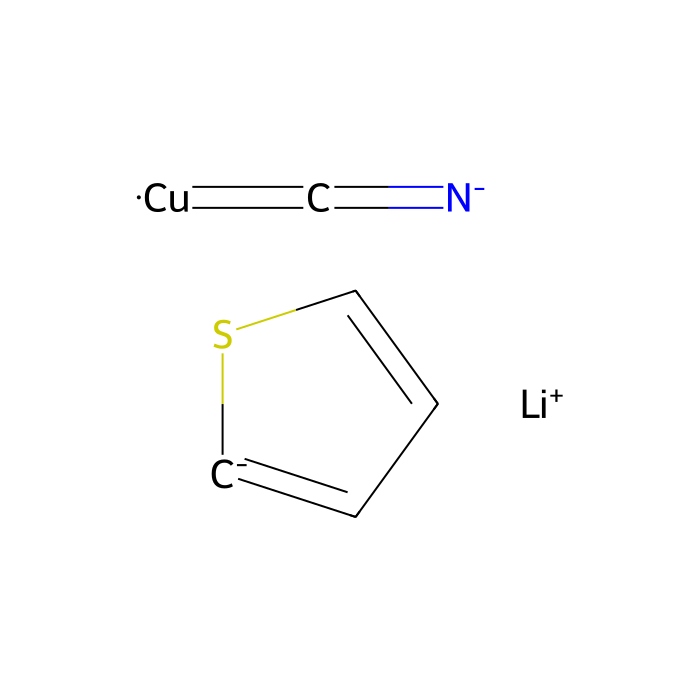
Brief description: Lithium 2-thienylcyanocuprate is a higher-order, mixed cyanocuprate reagent of the general type RCu(CN)Li, where R = 2‑thienyl (a five‑membered sulfur heteroaryl). It is supplied as a solution.
Connectivity (typical for cyanocuprates): R–Cu–CN with Li+ as counterion; aggregation and solvent coordination (e.g., THF/ether) are common in solution (literature).
Ring system: Thiophene (aromatic 5‑membered ring containing sulfur) substituted at the 2‑position, which directs nucleophilic transfer as a 2‑thienyl unit.
Stereochemistry: None intrinsic; reactions can create stereocenters under chiral ligation/auxiliaries (literature).
2D structure in words (general): a thiophene ring bearing the organometallic bond at C‑2 (alpha to sulfur) bound to copper; copper is further bound to cyanide, with lithium balancing charge and often coordinated by ether solvent molecules in solution.
Synthetic Utility
Key functional elements and reactivity (literature/general):
Higher-order cyanocuprate RCu(CN)Li featuring a 2‑thienyl nucleophile capable of selective C–C bond formation.
Chemoselectivity: compared with Grignards and organolithiums, cyanocuprates favor 1,4‑addition to Michael acceptors and controlled acylation of acid chlorides to give ketones with reduced over‑addition.
Heteroaryl transfer: 2‑thienyl transfer proceeds efficiently to enones and acid chlorides; allylic SN2′ processes are also well documented.
Functional group tolerance: carbonyls (esters, amides, nitriles) are generally tolerated when not directly targeted as electrophiles; halides and protic groups should be masked. Sensitive nitro or strongly electron‑deficient aromatics may undergo side reactions.
Retrosynthetic value: provides a convergent route to β‑thienyl carbonyls, 2‑thienyl ketones, and allylic thienylates. Complements cross‑coupling by enabling conjugate additions inaccessible to Suzuki conditions.
Typical transformations enabled:
β‑Thienylation of enones followed by enolate trapping (e.g., silylation or alkylation) to build complexity in one pot.
Acylation with acid chlorides to furnish 2‑thienyl aryl/alkyl ketones.
Construction of branched allylic 2‑thienyl motifs via SN2′ displacement under copper conditions.
Tip: employ low temperatures and slow electrophile addition; consider additives (e.g., TMSCl) to capture enolates or steer selectivity when appropriate.
Target Specificity
Not applicable. This product is a small‑molecule organometallic reagent, not a biological targeting agent, antibody, or probe. No antigen/epitope specificity is relevant.
We use cookies to ensure the website functions properly and, where permitted, to improve your experience. You can manage your preferences at any time in Settings. Learn more in our Cookie Policy.
Shall we send you a message when we have discounts available?
Remind me later
Thank you! Please check your email inbox to confirm.
Products are supplied to verified businesses, institutions, and qualified professionals for research and development use only. Not for use in humans, animals, diagnosis, or therapy.