
Determine the necessary mass, volume, or concentration for preparing a solution.
| Activity Type | Activity Value -log(M) | Mechanism of Action | Activity Reference | Publications (PubMed IDs) |
|---|
Moligand™, 10mM in DMSO Moligand™ for sensitive chromatographic and analytical workflows requiring minimal baseline interference.
Store at -80°C Ships Dry ice packs + Cold packs Check lot-specific COA for exact specifications.
SDS, COA, datasheet, and spec sheet available for download. Lot-specific COA accessible via lot number lookup.
Cited in 39 peer-reviewed publications across chromatography, organic synthesis, and cross-coupling reactions.
Information
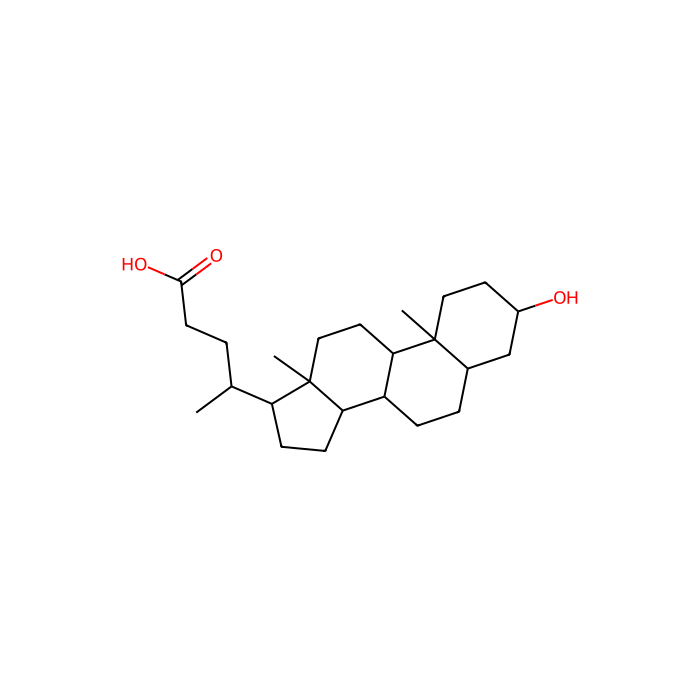
Lithocholic acid Lithocholic acid is a toxic secondary bile acid, causes intrahepatic cholestasis, has tumor-promoting activity, its toxic effect can be protected after it activates the vitamin D receptor , PXR and FXR .
In vitro
Lithocholic acid (LCA) is a hydrophobic secondary bile acid that is primarily formed in the intestine by the bacterial 7α-dehydroxylation of chenodeoxycholic acid. LCA causes intrahepatic cholestasis (cessation or impairment of bile flow). LCA activates PXR (pregnane X receptor), and the LCA-induced severe liver damage can be protected by the activation of PXR. LCA is a ligand for farnesoid X receptor (FXR) with EC50 of 3.8 μM. LCA directly binds VDR (vitamin D receptor) with Ki of 29μM, activates VDR (vitamin D receptor) 30 μM, with much more sensitivity than the other nuclear receptors (eg. PXR, FXR), and its toxic effect is thus protected. LCA has tumor-promoting activity, inhibits mammalian DNA Polymerase β with IC50 of 15 μM.
In vivo
Administration of LCA and its conjugates to rodents causes intrahepatic cholestasis,a pathogenic state characterized by decreased bile flow and the accumulation of bile constituents in the liver and blood. In DMH (dimethyldydrazine)-induced murine carcinogenesis model, LCA suppresses apoptosis almost completely in premalignant colon. LCA activates VDR, induces expression in vivo of CYP3A, a cytochrome P450 enzyme that detoxifies LCA in the liver and intestine.
Cell Data
cell lines:
Concentrations:~30 μM
Incubation Time:Incubation Time:
Powder Purity:≥100%
Comprehensive hazard, handling, storage, and regulatory compliance document.
Download SDS →Lot-specific quality data. Enter your lot number to retrieve the exact COA.
Look up COA →Full quality attributes and acceptance criteria for this grade.
View spec sheet →| Activity Type | Activity Value -log(M) | Mechanism of Action | Activity Reference | Publications (PubMed IDs) |
|---|
| Activity Type | Activity Value -log(M) | Mechanism of Action | Activity Reference | Publications (PubMed IDs) |
|---|
| Activity Type | Activity Value -log(M) | Mechanism of Action | Activity Reference | Publications (PubMed IDs) |
|---|
| Activity Type | Activity Value -log(M) | Mechanism of Action | Activity Reference | Publications (PubMed IDs) |
|---|
Find and download the COA for your product by matching the lot number on the packaging.
| Lot Number | Certificate Type | Date | Item |
|---|---|---|---|
 G2402018 G2402018 | Certificate of Analysis | May 13, 2026 | L408630 |
| Solubility | Solubility (25°C) In vitro |
|---|---|
| Specific Rotation[α] | 35.5° |
| Melt Point(°C) | 183-188°C |
Our grade selection guide covers purity, stabilizer status, and application suitability for all variants in our catalog.
View Moligand™ grade guide →