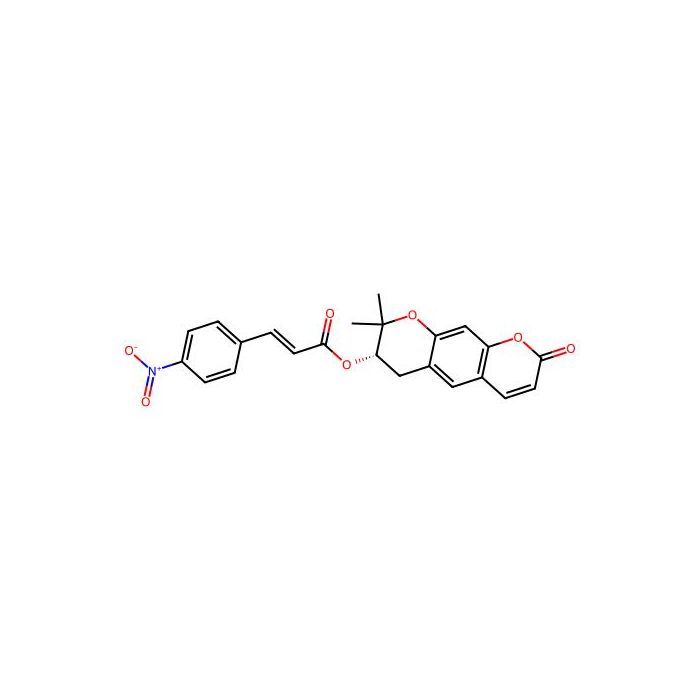
≥98% for sensitive chromatographic and analytical workflows requiring minimal baseline interference.
🌡
Storage & shipping
Store at -20°C Ships Ice chest + Ice pads Check lot-specific COA for exact specifications.
📋
Quality documents
SDS, COA, datasheet, and spec sheet available for download. Lot-specific COA accessible via lot number lookup.
📚
Literature proof
Cited in 0 peer-reviewed publications across chromatography, organic synthesis, and cross-coupling reactions.
Overview
LKY-047, a Decursin derivative, is a potent and selective reversible competitive cytochrome P45022J2 (CYP2J2) inhibitor with an IC 50 of 1.7 μM. LKY-047 is inactive against other human P450s, such as CYPs 1A2, 2A6, 2B6, 2C8, 2C9, 2C19, 2D6, 2E1, and 3A
In Vitro
LKY-047 is a strong competitive inhibitor of CYP2J2-mediated astemizole O-demethylase and terfenadine hydroxylase activity, with K i values of 0.96 μM and 2.61 μM, respectively. LKY-047 also acted as an uncompetitive inhibitor of CYP2J2-mediated ebastine hydroxylation with a K i value of 3.61 μM. At 20 μM LKY-047 concentration, approximately 20-fold greater than the Ki value, LKY-047 is found to inhibit CYP2J2 by 85.3%, and only slightly affecting the enzyme activities of the other P450s tested. LKY-047 weakly inhibits CYP2D6 enzyme activity (37.2%) at 20 μM concentration. MCE has not independently confirmed the accuracy of these methods. They are for reference only.
Form:Solid
IC50& Target:CYP2J2 1.7 μM (IC 50 )
Specifications
Specifications & Purity
≥98%
Biochemical and Physiological Mechanisms
LKY-047, a Decursin derivative, is a potent and selective reversible competitive cytochrome P45022J2 (CYP2J2) inhibitor with an IC 50 of 1.7 μM. LKY-047 is inactive against other human P450s, such as CYPs 1A2, 2A6, 2B6, 2C8, 2C9, 2C19, 2D6, 2E1, and 3A [1
Storage
Store at -20°C
Shipped In
Ice chest + Ice pads
This product requires cold chain shipping. Ground and other economy services are not available.
Action Type
INHIBITOR
Purity
≥98%
Names and Identifiers
Molecular Weight
421.40
Documentation
📋 Safety Data Sheet (SDS)
Comprehensive hazard, handling, storage, and regulatory compliance document.
DMSO : 16.67 mg/mL (39.56 mM; ultrasonic and warming and heat to 60°C)
Solution Calculators
Molarity Calculator
Determine the necessary mass, volume, or concentration for preparing a solution.
Dilution Calculator
Determine the dilution needed to prepare a stock solution.
Reconstitution Calculator
Reviews
Customer Reviews
Application Protocols
No tested application protocols are provided for this item in the product data.
Please refer to your internal SOPs and assay-specific method development. If available, consult the CoA/Spec Sheet for any lot-specific handling notes. This section intentionally avoids generalized protocols because only product-verified applications should be listed here.
Biological Roles
Item-specific biological role and target information are not provided for LKY-047.
General considerations (not item-specific claims)
As a member of a small-molecule/compound library, LKY-047 is intended for research use in probing biological systems, identifying hits, and initiating structure–activity relationship (SAR) studies. Any biological role is context-dependent and must be established experimentally within the user’s assay system.
Without a disclosed structure or annotated target, no endogenous function can be inferred. Users should consult primary literature by CAS (1954681-29-8) or product CoA for any known target associations, binding data, or biochemical pathway annotations if available.
For cell-based assays, confirm cytotoxicity and nonspecific effects at the working concentration range using orthogonal readouts (e.g., cell viability dyes, impedance, or off-target counterscreens) before drawing mechanistic conclusions.
For biophysical characterization, techniques such as DSF/TSA, MST, ITC, or SPR can be employed to evaluate binding under carefully controlled buffer conditions and carrier solvent levels.
Buffer Applications
This product is not a buffering agent and does not constitute a defined buffer system.
Practical notes for dosing small molecules into buffers (general guidance)
Prepare concentrated DMSO stocks and dilute into assay buffer with vigorous mixing to a final carrier of 0.1–1% v/v DMSO. Verify absence of precipitation by visual inspection and, if critical, by light scattering or filtration.
Common assay buffers: HEPES (pH 7.0–7.5), PBS, or Tris (pH 7.4–8.0), optionally with 0.01–0.05% nonionic surfactant (Tween 20/80 or Pluronic F-127) to aid solubilization of hydrophobic scaffolds.
For metal-sensitive targets or when chelation artifacts are a concern, minimize EDTA and test alternate buffers (e.g., MOPS, PIPES) as appropriate.
Filter-sterilize working solutions when used in cell culture, and always include a vehicle control (same buffer and DMSO percentage).
Green Alternatives
When preparing solutions or running assays with small-molecule library compounds, solvent choice is the main lever for greener practice. The information below is general guidance (not item-specific):
Prefer greener carriers: DMSO and ethanol often balance solvency with safer environmental profiles compared to DMF/NMP. Limit the final assay carrier to ≤1% v/v when possible.
Avoid problematic solvents: DMF, NMP, dichloromethane, and acetonitrile carry higher EHS burdens. Use only when necessary, in small volumes, with proper capture and waste segregation.
Minimize waste: Prepare only the quantity of stock needed for the current campaign; aliquot to extend shelf-life and reduce disposals from freeze–thaw degradation.
Comparison (general)
DMSO: broad solvency; favorable safety relative to DMF/NMP; readily recyclable by distillation at scale.
Ethanol/i‑PrOH: renewable feedstocks available; low toxicity; may limit solubility for lipophilic compounds.
2-MeTHF/CPME: greener ethers for synthetic steps (if derivatization is pursued); less relevant for aqueous assay dosing.
Operational tips
Implement microscale assays (384/1536-well) to reduce solvent volumes.
Use sealed plates and humidified incubators to curb evaporative losses and rework.
Capture high-boiling polar aprotics (e.g., DMSO) for dedicated waste streams to facilitate responsible disposal/recycling.
Pharmaceutical Uses
Item-specific pharmacopeial status or formulation roles are not provided for LKY-047. No medical or clinical use is intended or implied; for research use only.
General context (not item-specific claims)
In early discovery, library compounds like LKY-047 may be evaluated in preformulation screens to understand solubility class, stability in biorelevant media, and compatibility with common excipients. These activities are exploratory and do not constitute approved pharmaceutical use.
If moving toward developability assessments, determine: thermodynamic/kinetic solubility (aqueous and biorelevant media), pKa (if ionizable), lipophilicity (logD7.4), and solid-form state (XRPD/DSC/TGA). Any enabling formulation concepts (e.g., cosolvents, amorphous dispersions, salts) must be based on the actual structure and ionization behavior as reported on the CoA.
There is no known pharmacopeial monograph or established excipient role for this item as supplied.
Physical Properties
Item-specific values
Appearance: Not specified for this item; refer to CoA/Spec Sheet.
Melting point (MP): Not specified for this item; refer to CoA/Spec Sheet.
Boiling point (BP): Not specified for this item; refer to CoA/Spec Sheet.
Density: Not specified for this item; refer to CoA/Spec Sheet.
Refractive index: Not applicable to solids; if liquid, not specified for this item.
Solubility: Not specified for this item; refer to CoA/Spec Sheet.
logP/logD, pKa: Not specified for this item; refer to CoA/Spec Sheet.
General guidance (literature/practice, not item-specific specs)
Screening compounds are frequently supplied as off-white to light-yellow solids or films and are commonly reconstituted in DMSO to 10–50 mM stocks for plate-based assays.
If solubility is unknown, perform a mini-solubility screen: DMSO → DMF → ethanol/methanol → aqueous buffer with 0.5–2% DMSO or mild surfactant (e.g., 0.01–0.05% Tween 80). Start at small scale (100–500 µL) and inspect for clarity and precipitation after 1–24 h.
Hygroscopicity and polymorphism can affect weigh accuracy and reconstitution; equilibrate vial to room temperature in a desiccated environment before opening to minimize moisture condensation on cold solids.
If UV-Vis characterization is needed for concentration by absorbance, acquire a spectrum of a DMSO solution to locate λmax and determine an empirical ε in your solvent system, as literature values are unavailable for this item.
Quality & Grades
Item-specific information
Grade/Purity: Not specified for this item; refer to CoA/Spec Sheet.
How to interpret typical documentation for library compounds (general guidance)
CoA/Spec Sheet commonly includes: purity by HPLC/UPLC (area %), identity confirmation (LC–MS, HRMS, and/or 1H NMR), residual solvents, and water content (Karl Fischer) when applicable. Review these before critical experiments.
If an inhibitor/ligand is used for quantitative biology, prefer lots with ≥95% HPLC purity and single, well-defined identity data (exact mass, isotope pattern, retention time).
UV transparency and low metal content are sometimes relevant for biochemical assays and analytical detection. If not stated in the CoA, perform a quick in-house check or request additional documentation when needed.
Batch-to-batch considerations: Library members can show variable counter-ions/salt forms if ionic. Confirm salt/tautomeric form and report concentration as free base/acid equivalents when calculating dosing.
Stabilizers: If a stabilizer or antioxidant is present, it will be declared on the CoA. Absence of such a note generally implies neat material; verify prior to sensitive assays (e.g., enzyme kinetics or cell-based readouts).
Reaction & Applications
This product is offered as a screening/collection compound rather than a general-purpose reagent. Accordingly, its primary applications are in discovery biology and analytical workflows. The following guidance is general and not item-specific:
Discovery and screening
Use as a test article in biochemical, biophysical, or cell-based assays to explore target modulation. Prepare concentrated DMSO stocks (e.g., 10–50 mM) and dose across serial dilutions to map concentration–response behavior.
Plate handling: Employ low-bind plastics or glass vials/plates for hydrophobic compounds. Minimize DMSO evaporation by using sealed plates and controlled humidity.
Controls: Include vehicle controls (matching DMSO %) and positive/negative reference controls suitable for the assay readout.
Analytical applications
Use as a reference standard for method development (LC–MS/MS, HPLC/UPLC) once identity/purity are confirmed by CoA. Establish retention time windows and ion transitions empirically.
Stability considerations
Assess bench stability by short-term isothermal studies (e.g., 24–72 h at room temperature and 4 °C in assay media) and long-term stability at –20 °C. Monitor by LC–MS/HPLC for degradation or precipitation.
Note: Because the structure and functional groups are not provided, no recommendations are made for specific synthetic reactions or derivatizations. For medicinal chemistry follow-up (SAR), consult the structure on the CoA and tailor conditions to the scaffold’s reactivity.
Reaction Conditions
No reaction conditions are provided for this product, and it is not generally intended for use as a chemical reagent.
General notes (not item-specific)
If derivatization or analogue synthesis is pursued after disclosure of the structure, select conditions compatible with the functional groups present and the compound’s stability profile. For example, base-sensitive motifs require mild coupling protocols; oxidation-prone motifs benefit from inert atmosphere and antioxidant additives.
Conduct preliminary stability scouting under prospective reaction conditions (e.g., 25–80 °C, varied pH, air vs inert) and monitor by LC–MS/HPLC to avoid degradation.
Purification choices (normal-phase silica, reverse-phase chromatography, crystallization) should be guided by polarity and ionization of the specific scaffold, which are unknown for this item.
Safety & Handling
Item-specific hazard data
GHS classification: Not specified for this item; refer to SDS.
Signal word / H-statements / pictograms: Not specified for this item; refer to SDS.
General laboratory precautions (not item-specific; always defer to SDS)
Handle in a chemical fume hood with appropriate PPE: lab coat, safety glasses, and chemically resistant gloves (e.g., nitrile). Avoid inhalation of dust/aerosols and contact with skin or eyes. Wash thoroughly after handling.
Storage incompatibilities are unknown without structure; as a precaution, segregate from strong oxidizers, strong acids/bases, and reducing agents. Keep container tightly closed and protected from light and moisture when possible.
First aid (general): Inhalation—move to fresh air; seek medical attention if symptoms persist. Skin/eye contact—rinse with water for at least 15 minutes; remove contaminated clothing; seek medical advice. Ingestion—rinse mouth; do not induce vomiting; seek medical attention. Provide SDS to responders.
Waste disposal: Collect solutions and contaminated disposables as organic chemical waste; dispose according to institutional and local regulations.
Transport/receipt: This item is shipped in an ice chest with ice pads to limit thermal excursions. Inspect for vial integrity on receipt; allow to warm to room temperature in a desiccator before opening to avoid condensation on cold contents.
Note on DMSO handling: DMSO can enhance dermal absorption of dissolved substances; avoid skin contact with solutions.
Solvent Selection
Given the undisclosed structure, select solvents empirically with an assay-first mindset. The following is general guidance (not item-specific specifications):
Primary stock solvent: DMSO is the default for small-molecule library members due to broad solvency, high boiling point, and assay compatibility up to 0.1–1% v/v in most biochemical/cellular systems.
Alternatives when DMSO is unsuitable: DMF or NMP (excellent solvency; handle with care due to toxicity and regulatory considerations), ethanol or methanol (greener, volatile; solubility may limit), or aqueous buffer with cosolvent/surfactant if compound is polar.
Aqueous work: For dosing into buffers, prepare concentrated organic stocks and dilute into buffer to reach ≤1% organic carrier, mixing thoroughly to avoid precipitation.
DMSO: dipolar aprotic, dielectric ~47, miscible with water and most organics; strong hydrogen-bond acceptor.
DMF: dipolar aprotic, dielectric ~37; miscible with water/organics; avoid with strong bases at high T (decomposition risk).
Ethanol: protic, dielectric ~25; fully miscible with water; greener profile; may influence some bioassays.
Small comparison (general)
DMSO: best solvency; low volatility; may affect membranes at >1%.
EtOH: greener, easy to remove; limited solvency for very lipophilic scaffolds.
DMF/NMP: strong solvency; greater EHS burdens—use only when necessary and keep exposure minimal.
Storage & Reconstitution
Item-specific storage/shipping
Storage conditions: Store at –20 °C (per product data).
Shipped in: Ice chest with ice pads (per product data).
General handling and reconstitution guidance (not item-specific specifications)
Before opening: Allow the sealed vial to warm to room temperature in a desiccator to prevent condensation onto cold contents. Briefly centrifuge to collect material at the bottom.
Reconstitution: If the CoA does not prescribe a solvent, dissolve in anhydrous DMSO to prepare a concentrated stock (e.g., 10–50 mM). Mix gently (vortex/sonicate) until fully dissolved. If insoluble, explore DMF or ethanol, then aqueous buffer with ≤1% DMSO final.
Aliquoting: Dispense single-use aliquots (e.g., 10–100 µL) in inert, low-bind tubes. Minimize headspace and protect from light if chromophoric.
Storage of solutions: Store DMSO stocks at –20 °C in tightly sealed containers. Avoid repeated freeze–thaw cycles; thaw on ice or at room temperature and refreeze promptly. Monitor for precipitation or color change and verify integrity by LC–MS/HPLC as needed.
Shelf-life: Not specified for this item; refer to CoA/Spec Sheet.
Research use only: Not for human or veterinary use.
Structure & Identity
Product name: LKY-047 (SKU: L650732)
CAS: 1954681-29-8
Category: Small molecule / compound library member (screening compound)
Item-specific identifiers
Molecular formula: Not specified for this item; refer to CoA/Spec Sheet.
Molecular weight: Not specified for this item; refer to CoA/Spec Sheet.
SMILES: Not specified for this item; refer to CoA/Spec Sheet.
InChIKey: Not specified for this item; refer to CoA/Spec Sheet.
Synonyms: Not specified for this item; refer to CoA/Spec Sheet.
Structural features
Structural class and functional groups: Not specified for this item; refer to CoA/Spec Sheet.
Stereochemistry: Not specified for this item; refer to CoA/Spec Sheet.
General notes (context, not item-specific)
As a library compound, LKY-047 is intended for hit-finding, profiling, and SAR initiation. Without a disclosed structure, users should consult the product CoA for exact identifiers (SMILES/InChIKey), functional group content, and any stereochemical information before quantitative structure–activity or physicochemical calculations.
If you are registering the compound in ELNs/LIMS or computational platforms, populate the record with the exact structural string from the CoA to avoid ambiguity across screening campaigns and plate maps.
Synthetic Utility
This item is supplied as a discrete screening compound and is not positioned as a general synthetic building block or reagent.
General guidance (not item-specific)
Without a disclosed structure or functional group information, it is not possible to recommend specific transformations or named reactions. If the structure is later made available, retrosynthetic analysis can identify vectors for diversification to support SAR, prodrug exploration, or analogue synthesis.
Potential uses in a synthetic/analytical context include:
Use as a reference standard for LC–MS/HPLC method development and stability-indicating methods after confirming identity and purity from the CoA.
If the scaffold contains a handle (e.g., halide, amine, carboxyl), it could be derivatized to generate tagged probes or analogues; conditions must be tailored to the actual functionality present.
For isotopic labelling, photoprobe, or biotinylation strategies, confirm that derivatization will not abrogate the putative activity; position and linker selection requires knowledge of structure–activity relationships.
Target Specificity
Target/epitope: Not specified for this item; refer to CoA/Spec Sheet.
Species reactivity/selectivity: Not specified for this item; refer to CoA/Spec Sheet.
Mechanism/class (e.g., inhibitor/agonist): Not specified for this item; refer to CoA/Spec Sheet.
Note: This section is intentionally limited to product data; no target information has been provided for LKY-047.
We use cookies to ensure the website functions properly and, where permitted, to improve your experience. You can manage your preferences at any time in Settings. Learn more in our Cookie Policy.
Shall we send you a message when we have discounts available?
Remind me later
Thank you! Please check your email inbox to confirm.
Products are supplied to verified businesses, institutions, and qualified professionals for research and development use only. Not for use in humans, animals, diagnosis, or therapy.