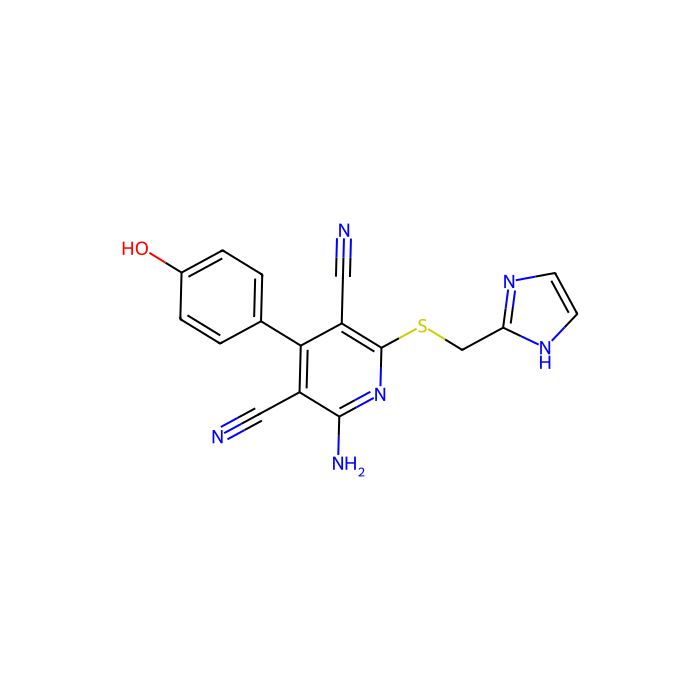
This compound belongs to the class of organic compounds known as phenylpyridines. These are polycyclic aromatic compounds containing a benzene ring linked to a pyridine ring through a CC or CN bond.
External Descriptors
Not available
1. Djoumbou Feunang Y, Eisner R, Knox C, Chepelev L, Hastings J, Owen G, Fahy E, Steinbeck C, Subramanian S, Bolton E, Greiner R, and Wishart DS. ClassyFire: Automated Chemical Classification With A Comprehensive, Computable Taxonomy. Journal of Cheminformatics, 2016, 8:61.
Determine the necessary mass, volume, or concentration for preparing a solution.
Dilution Calculator
Determine the dilution needed to prepare a stock solution.
Reconstitution Calculator
Reviews
Customer Reviews
Application Protocols
No tested applications, methods, or recommended dilutions are provided for this item in the Product Data.
General protocol guidance for small-molecule stock handling in bioassays:
Stock preparation: Dissolve in anhydrous DMSO to 10–50 mM. Sonication or gentle warming (≤37°C) can assist dissolution. Filter sterilize through 0.22 µm PTFE if sterility is required and the compound is solvent-stable.
Aliquoting: Dispense single-use aliquots to minimize freeze–thaw. Label with compound name, lot, concentration, and date.
Plate handling: Use low-binding plates/tubes. Pre-dilute in DMSO prior to addition to aqueous assay media to maintain constant vehicle% across wells.
Controls: Include vehicle-only controls, positive/negative controls relevant to the biological system, and counterassays to flag redox activity or aggregation.
These are general-use practices and are not item-specific recommendations. Always adapt conditions to your assay and consult the CoA/SDS for any stability or hazard constraints.
Biological Roles
Item-specific biological targets or modes of action are not provided in the Product Data for LUF 5834. The following guidance is general to small-molecule research probes and should not be interpreted as a claim for this specific item.
Potential roles (literature-driven approach): Small molecules denoted with the “LUF” prefix often originate from academic medicinal chemistry programs; to identify any reported targets or pathways for LUF 5834 specifically, search the primary literature using the CAS (333962-91-7) and product name.
Use in discovery biology: If a biological target is identified from literature, design both binding and functional assays (e.g., radioligand displacement, SPR, BRET, reporter assays) to confirm activity and rule out assay interference.
Selectivity profiling: Apply panel screening (e.g., off-target enzyme or receptor panels) to understand specificity, considering that small changes in purity or form can shift apparent potency.
ADME considerations (general): Early checks such as microsomal stability, permeability (PAMPA/MDCK), and solubility across pH 2–8 help contextualize assay outcomes; these are not specified for this item and must be determined empirically if needed.
Important: No medical or therapeutic claims are made. This product is supplied strictly for research use only, as stated in the Product Data.
Buffer Applications
This product is a small organic research compound and is not a buffering agent. No pKa or acid/base capacity data are provided, and it is not typically used to prepare laboratory buffers.
If this compound must be formulated in aqueous media for biological assays, select an appropriate external buffer (e.g., PBS, HEPES, Tris) based on your assay pH requirements and the compound’s stability profile determined experimentally.
Maintain consistent co-solvent (e.g., DMSO 0.1–1% v/v) across all wells/tubes to avoid precipitation or pH drift effects.
For buffer recipes and pH ranges, refer to standard buffering systems:
Note: None of these buffer characteristics apply specifically to LUF 5834; they are provided solely to aid formulation of assay media.
Green Alternatives
Because item-specific solvent and process requirements are not defined for this compound, “green” considerations focus on common handling scenarios for small-molecule stocks and assay workflows.
Greener choices for solution preparation (general guidance):
Prefer water with minimal co-solvent where feasible; if an organic vehicle is necessary, consider ethanol or 2-propanol as alternatives to DMF/DMAC/ACN when assay-compatible.
For high-solubility needs, DMSO remains common; minimize final DMSO concentration in assays (≤0.1–0.5% v/v) to reduce ecological and biological impacts.
For chromatographic purification (if applicable), consider ethanol/water or ethyl acetate/heptane systems instead of dichloromethane or hexane where practicable.
Illustrative comparison (general, not item-specific):
DMSO: High solvency; relatively low volatility; good lab safety profile but difficult to biodegrade.
Ethanol: Renewable feedstock; higher volatility; good for many assays up to 0.5–1% v/v.
2-MeTHF vs THF (for any synthetic work): 2-MeTHF has a better EHS profile and can replace THF in many cases; confirm solubility and reactivity with the specific compound first.
Operational practices:
Scale down screening volumes and adopt miniaturized assay formats to reduce solvent consumption.
Consolidate plates and pre-plan serial dilutions to minimize waste. Collect organic waste in segregated streams to facilitate compliant disposal.
Pharmaceutical Uses
No pharmacopeial status, excipient role, or formulation use is specified for this item. LUF 5834 is supplied for research use only and is not intended for human or veterinary use, clinical diagnostics, or as a drug substance/excipient.
General considerations (for preclinical formulation research only):
If preclinical in vitro/in vivo research requires dosing solutions, select vehicles based on experimentally determined solubility and stability (e.g., aqueous buffer with 0–10% co-solvent, PEG400/saline mixtures, or lipid-based vehicles). Ensure compatibility with the biological model and institutional approvals.
Perform stability-indicating assays (HPLC/LC–MS) to confirm concentration over the intended dosing period. Avoid adsorption losses by using low-binding plastics and preparing fresh solutions.
Record exact lot, form (free base vs salt), and concentration calculations to ensure reproducibility across studies.
Important: Aladdin Scientific makes no claims regarding therapeutic utility. This product is not a medicinal product and must not be used in humans.
Physical Properties
Item-specific physicochemical specifications were not provided with the Product Data. Do not treat the following placeholders as specifications for your lot; consult the CoA/Spec Sheet.
Appearance: Not specified for this item; refer to CoA/Spec Sheet.
Molecular weight: Not specified for this item; refer to CoA/Spec Sheet.
Molecular formula: Not specified for this item; refer to CoA/Spec Sheet.
Melting point: Not specified for this item; refer to CoA/Spec Sheet.
Boiling point: Not specified for this item; refer to CoA/Spec Sheet.
Density: Not specified for this item; refer to CoA/Spec Sheet.
Solubility: Not specified for this item; refer to CoA/Spec Sheet.
LogP/logD: Not specified for this item; refer to CoA/Spec Sheet.
pKa(s): Not specified for this item; refer to CoA/Spec Sheet.
Refractive index: Not applicable if solid; otherwise not specified; refer to CoA/Spec Sheet.
Practical guidance (general chemistry knowledge):
For small-molecule screening compounds, initial dissolution is commonly attempted in anhydrous DMSO to 10–50 mM, followed by dilution into aqueous buffers containing co-solvent (e.g., 0.1–1% DMSO) for assays.
If insoluble in DMSO at target concentration, evaluate DMF, ethanol, or PEG400 co-solvent systems; confirm compatibility with your assay.
Establish a solubility/compatibility panel (DMSO, DMF, MeOH, EtOH, acetonitrile, PBS with 0.01% Tween-80) and quantify using UV–Vis or HPLC to select a robust vehicle.
Quality & Grades
Grade/Purity: Not specified for this item; refer to CoA/Spec Sheet.
Interpretation and best practices (general guidance for small-molecule screening compounds):
Research-use chemicals may be supplied at high chemical purity (often ≥95% by HPLC), but exact assay purity, residual solvent content, and counter-ion/salt form must be confirmed on the lot-specific CoA.
If your workflow is LC–MS driven, review chromatographic purity traces and mass spectra included on the CoA. Verify that the primary peak corresponds to the expected m/z and isotopic pattern.
Low-level impurities can influence biological readouts; consider an orthogonal purity assessment (qNMR, additional HPLC methods) when SAR or potency ranking is sensitive to minor contaminants.
If optical activity is relevant, confirm enantiomeric/diastereomeric ratio on the CoA; otherwise, assume racemate if chirality is unknown.
Stabilizers: Not specified for this item; refer to CoA/Spec Sheet. If present, account for stabilizers when preparing solutions and interpreting UV/fluorescence assays.
Documentation to retain with the lot:
CoA, SDS, shipping records, and any in-house QC (NMR, LC–MS, KF moisture) to ensure full traceability from receipt through use in screening or synthesis.
Reaction & Applications
This product is categorized as a small molecule/compound library member and is typically used as a research probe or screening hit/standard rather than as a synthetic reagent. No item-specific “Manufacturer Applications” text was provided beyond the research-use note.
Practical research applications (general use of small-molecule probes):
Biochemical and cell-based assays: Evaluate concentration–response behavior, target engagement, and off-target profiling. Implement vehicle controls and counterscreens to deconvolute assay interference.
Analytical reference: Use as a reference standard in LC–MS/MS method development once identity and purity are verified for the lot.
Mechanistic studies: If primary literature identifies a target for LUF 5834 (consult CAS-indexed publications), design orthogonal assays (binding vs functional readouts) to triangulate mechanism.
Assay design tips:
Stock preparation: Prepare 10–50 mM DMSO stocks, aliquot, and avoid repeated freeze–thaw to prevent degradation or concentration drift due to precipitation.
Serial dilutions: Use intermediate DMSO plates to maintain constant vehicle percentage across the range; pre-wet tips to reduce adsorption of lipophilic compounds.
Interference controls: Incorporate redox, detergent, and aggregation controls (e.g., low Triton X-100 or Tween-20, dynamic light scattering if available) to identify colloidal aggregation artifacts.
Note: If you intend to use this compound in chemical synthesis, treat it as a specialized building block only after confirming functional groups and stability from the CoA—no synthetic reactivity is specified for this item.
Reaction Conditions
No reaction conditions are provided or implied for this item. LUF 5834 is primarily offered as a research compound for screening or analytical use, not as a reagent for general transformations.
If you plan to perform derivatization or analog synthesis (only after confirming the structure):
Solvents: Choose based on functional groups present (e.g., polar aprotic for SNAr or amide couplings; alcoholic solvents for solvolysis or transesterifications). Start with dry, oxygen-free conditions if air/moisture-sensitive motifs are suspected.
Temperatures: Screen 0–100°C as needed, starting at ambient to assess stability. Employ inert atmosphere for transition-metal catalysis.
Catalysts/reagents: Select per verified functional handles (e.g., Pd for cross-coupling of aryl halides; EDCI/HATU for amidation; base-promoted alkylations for acidic CH centers). None are specified for this item.
Monitoring: Use LC–MS and HPLC with photodiode array to detect degradation, isomerization, or formation of closely eluting impurities.
All values above are general literature guidance and are not specific to LUF 5834. For precise conditions, consult primary literature once the exact structure is confirmed.
Safety & Handling
Authoritative safety information must be taken from the product SDS. The Product Data provided does not include GHS hazard classifications or statements for this item.
GHS classification: Not specified for this item; refer to SDS.
Signal word / Pictograms: Not specified for this item; refer to SDS.
H-statements / Precautionary statements: Not specified for this item; refer to SDS.
General laboratory precautions (good practice for small organic molecules):
Wear appropriate PPE: lab coat, safety glasses, and suitable gloves (e.g., nitrile). Handle powders in a fume hood to avoid inhalation.
Avoid contact with strong oxidizers and strong acids/bases unless compatibility is confirmed. Prevent formation of dust/aerosols; avoid open flames/ignition sources when using organic solvents.
If preparing DMSO or DMF stock solutions, avoid skin contact—both are efficient dermal penetrants.
First aid overview: If inhaled—move to fresh air; if on skin—wash with soap/water; if in eyes—rinse cautiously for several minutes; if ingested—rinse mouth and seek medical advice. Always follow your institution’s emergency procedures.
Spill response: Absorb with inert material (vermiculite), collect in a chemically compatible waste container, and decontaminate surfaces per SDS guidance.
Storage and transport:
Storage: Store at -20°C (as provided in Product Data). Keep container tightly closed, desiccated, and segregated from incompatible materials.
Shipping: Shipped in ice chest with ice pads (as provided). Upon receipt, return to -20°C promptly.
Solvent Selection
Item-specific solubility data are not provided. The following guidance reflects common practice for handling small-molecule screening compounds while minimizing assay artifacts.
Primary solvent for stock solutions: Anhydrous DMSO is the default choice for many drug-like molecules due to broad solvating power and assay compatibility at ≤0.1–1% v/v.
Secondary options: DMF, ethanol, methanol, or acetonitrile. Validate biological assay tolerance for each vehicle.
Aqueous dilution: Use buffer containing the same organic co-solvent fraction as the stock to avoid precipitation (e.g., add DMSO last with vigorous mixing; consider 0.01–0.05% nonionic surfactant to stabilize dispersions if permitted).
Avoid adsorption losses: For lipophilic compounds, use low-binding plastics or silanized glass; include 0.1% BSA where compatible to reduce nonspecific binding.
Comparison notes (general knowledge):
DMSO vs ethanol: DMSO offers higher solubility for polar/lipophilic scaffolds; ethanol may be preferable for assays sensitive to DMSO’s effects on membranes/enzymes.
Acetonitrile: Good for HPLC sample prep and short-term stability but less favored for cell-based assays.
Buffered systems: If salt formation improves solubility, ensure pH is controlled near the compound’s pKa; since pKa is unknown here, perform a pH-solubility screen (pH 2–10) to identify optimal conditions.
Storage & Reconstitution
Storage conditions: Store at -20°C (per Product Data). Keep container tightly closed in a dry environment. If supplied as a solid, include desiccant. If supplied in solution, minimize headspace and protect from moisture ingress.
Shipping: Shipped in an ice chest with ice pads (per Product Data). Inspect upon arrival; if thawing occurred, refer to CoA/SDS for stability guidance and perform an integrity check (e.g., HPLC) before use.
Reconstitution guidance (general, not item-specific):
Solvent: Start with anhydrous DMSO for concentrated stocks (e.g., 10–50 mM). If aqueous use is required, dilute into buffer with gentle mixing to the desired final concentration, keeping DMSO constant across samples.
Aliquoting: Prepare single-use aliquots of stock to avoid repeated freeze–thaw. Store aliquots at -20°C or below. Record freeze–thaw count; discard if precipitation, discoloration, or LC–MS indicates degradation.
Light and air: In the absence of item-specific guidance, protecting from light and air is prudent for many aromatic/heteroaromatic compounds. Purge headspace with inert gas if prolonged storage is anticipated.
Stability notes:
Retest/expiry, water content, and peroxide or metal limits: Not specified for this item; refer to CoA/Spec Sheet.
Before critical experiments, verify concentration and purity by HPLC/LC–MS to ensure the stored material remains within your acceptance criteria.
Structure & Identity
Brief overview: LUF 5834 is listed as a small-molecule research compound. Item-specific structural identifiers are only partially available in the Product Data.
Product name: LUF 5834 (SKU: L288299)
CAS: 333962-91-7
PubChem CID: 135543624 (as provided)
InChIKey: 256425 (as provided; note: atypical length for a standard InChIKey; verify against CoA/SDS)
Molecular formula: Not specified for this item; refer to CoA/Spec Sheet.
Molecular weight: Not specified for this item; refer to CoA/Spec Sheet.
SMILES: Not specified for this item; refer to CoA/Spec Sheet.
Structural features (general guidance):
Functional groups, ring systems, and stereochemistry cannot be detailed without a supplied structure. Consult the CoA/Spec Sheet or primary literature indexed by the CAS for definitive 2D/3D structure, heteroatoms, and chiral centers.
2D description in words: Not specified for this item; refer to CoA/Spec Sheet.
Notes for identity verification:
Cross-check CAS, InChIKey, and CID against authoritative databases (PubChem, ChemSpider) prior to method development.
If using in bioassays, confirm batch identity/purity with LC–MS and 1H NMR as appropriate. Retain spectra with lot records for future traceability.
If a salt form or solvate is possible, confirm exact form on the label/CoA before calculating molar concentrations.
Synthetic Utility
This product is provisioned as a small-molecule library member rather than a synthetic reagent or building block. Because functional groups and reactivity are not specified, no item-specific transformations can be recommended.
General guidance if using as a building block (only after confirming structure from CoA/literature):
Identify reactive handles (e.g., aryl halides for cross-coupling, amines/acids for amide formation, heteroaryl nitrogens for SNAr) and verify stability to bases, acids, and transition-metal catalysts.
Protecting group strategy: If multiple nucleophilic/acidic sites exist, select orthogonal protection; confirm that deprotection conditions will not compromise the core scaffold.
Late-stage diversification: If applicable, consider C–H functionalization or photocatalytic methods to access analogs for SAR, but only after verifying the compound’s photostability.
Analytical controls:
Monitor reactions by LC–MS with a reference of the starting material to avoid misassignment when isomers or tautomers are possible.
Note: Without structural data, treat synthetic utility as speculative and proceed only after obtaining the full structure and spectral characterization.
Target Specificity
Target, binding site, selectivity profile, and biological pathway associations are not specified in the Product Data for LUF 5834.
Item-specific details such as target name, species reactivity, affinity (Kd/IC50/EC50), or mechanism of action: Not specified for this item; refer to CoA/Spec Sheet and primary literature indexed by CAS 333962-91-7.
If you identify a putative target from literature, validate with orthogonal assays (e.g., biochemical binding, functional activity, and counterscreens against homologs) and confirm identity/purity of the lot used for testing.
Note: No claims are made regarding target engagement or selectivity for this product.
We use cookies to ensure the website functions properly and, where permitted, to improve your experience. You can manage your preferences at any time in Settings. Learn more in our Cookie Policy.
Shall we send you a message when we have discounts available?
Remind me later
Thank you! Please check your email inbox to confirm.
Products are supplied to verified businesses, institutions, and qualified professionals for research and development use only. Not for use in humans, animals, diagnosis, or therapy.