Determine the necessary mass, volume, or concentration for preparing a solution.
Dilution Calculator
Determine the dilution needed to prepare a stock solution.
Reconstitution Calculator
Reviews
Customer Reviews
Application Protocols
No tested application protocols, recommended dilutions, or assay-specific procedures are provided in the Product Data for this SKU.
Guidance:
Follow your laboratory’s validated SOPs for handling cytotoxic small molecules.
For protocol development, consult peer-reviewed literature on camptothecin analogue usage in biochemical Topoisomerase I assays and cell-based DDR readouts.
Aladdin Scientific can supply lot-specific analytical documentation upon request; however, assay conditions (e.g., concentrations, exposure times, controls) must be established by the end user. For research use only.
Biological Roles
Contextual biological information (literature; not item-specific claims):
Primary molecular target: DNA Topoisomerase I. Camptothecin analogues bind at the Topo I–DNA interface, stabilizing the transient single-strand break intermediate and preventing re-ligation. This converts physiological DNA repair events into persistent lesions during replication.
Cellular response: Accumulation of Topo I–DNA covalent complexes triggers DNA damage signaling pathways (e.g., ATR/CHK1), S-phase checkpoint activation, and apoptosis or senescence depending on cellular context.
Structure–function aspects: The intact E‑ring lactone is crucial for high-affinity target engagement; hydrolysis to the carboxylate reduces activity (literature). Substituent patterns modulate solubility, uptake, efflux susceptibility, and protein binding.
Systems biology usage: Employed as a probe to map replication stress tolerance, chromatin dynamics at sites of DNA damage, and synthetic lethal interactions in genetic screens (e.g., CRISPR or RNAi-based) under research-use-only conditions.
Important notes for laboratory researchers:
Maintain consistent exposure conditions and control compounds to interpret DDR phenotypes.
Consider transporter expression (e.g., ABC family) and serum protein binding when comparing responses across cell lines.
All information above is provided for basic research and method development; this product is labeled For research use only in the Product Data.
Buffer Applications
This product is not a buffering reagent and is not used to prepare defined pH buffer systems. Accordingly:
No buffer capacity or pKa-based recipes apply.
General handling in buffered systems (literature guidance):
In neutral/basic aqueous buffers, camptothecin lactones hydrolyze to carboxylates, reducing the lactone fraction. If assays require predominately lactone form, minimize residence time in aqueous media, keep solutions cool, protect from light, and consider mildly acidic conditions where compatible.
Use low-binding plastics or glassware and pre-wet with assay media to reduce adsorption losses when working at low concentrations.
For any lot-specific recommendations on diluents or compatible buffers for Lurtotecan, consult the CoA/Spec Sheet.
Green Alternatives
Green chemistry considerations for handling and formulating camptothecin analogues:
Solvent choices:
Prefer DMSO over halogenated solvents for stock solutions when compatible with downstream assays. DMSO offers lower environmental impact compared to chlorinated solvents and supports closed-system handling.
Replace DMF/NMP with propylene carbonate or sulfone-based high-boiling solvents only when process needs justify them; assess toxicity and EHS profiles.
For analytical work, consider aqueous-organic systems using water with small amounts of acetonitrile or methanol, optimizing pH to balance lactone stability and greener solvent content.
Workup/waste minimization:
Prepare concentrated stocks to reduce solvent volumes and waste.
Use micro-scale assay formats and low-binding consumables to minimize adsorption losses and repeated preparations.
Energy/light management:
Store and handle under low-light conditions to reduce degradation and re-synthesis needs, conserving resources.
Tradeoffs (literature):
While water is the greenest solvent, neutral/basic aqueous media drive lactone opening; a small fraction of DMSO may be necessary to preserve integrity and solubility. Select conditions that meet both green and scientific requirements.
No alternative chemical entities are proposed here; selection of a different camptothecin analogue as a “greener” substitute depends on specific hazard and solubility profiles and must be evaluated case-by-case.
Pharmaceutical Uses
No pharmaceutical grade, excipient role, or pharmacopeial status is specified for this catalog item. This product is supplied strictly For research use only.
General formulation context for camptothecin analogues in research settings (literature; not medical/clinical use):
Stock solutions are commonly prepared in DMSO and diluted into assay media. Solubilizing excipients such as cyclodextrins, micelles, or serum proteins can modulate apparent solubility and stability of the lactone in vitro.
pH control is critical: neutral/basic aqueous environments shift the lactone–carboxylate equilibrium toward the open-ring form; mildly acidic conditions may favor lactone stability during short handling.
Light protection and oxygen control help limit degradation in solution.
No claims are made regarding therapeutic use, dosing, or clinical performance. For manufacturing/formulation inquiries beyond research-scale handling, request detailed characterization and stability data from the CoA and SDS, and conduct independent suitability assessments.
Physical Properties
Item-specific specifications (this catalog lot):
Melting point, boiling point, density, refractive index, UV/Vis cutoffs, water content, and residual solvents: Not specified for this item; refer to CoA/Spec Sheet.
General/literature characteristics for camptothecin analogues (contextual, not item specs):
Physical form: typically a solid, light- and moisture-sensitive, with color varying from off-white to yellow depending on substituents and polymorph.
Solubility behavior: poor aqueous solubility in neutral water; soluble in polar aprotic organic solvents such as DMSO and DMF; the closed-ring lactone is stabilized under mildly acidic conditions, while the open-ring carboxylate predominates at neutral/basic pH.
Acid–base/lactone equilibrium: the E‑ring hydrolyzes in aqueous buffers above pH ~6–7 (literature), reducing the fraction of active lactone.
Partitioning: amphiphilic behavior depends on side-chain ionization; many analogues show increased apparent solubility in the presence of serum proteins or cyclodextrins (literature).
Practical implications:
Prepare and handle solutions under low-light conditions and minimize exposure to neutral/basic aqueous environments to preserve the lactone form (general guidance).
For quantitative physicochemical constants specific to Lurtotecan (e.g., logP, pKa, ε), consult primary literature or the CoA for the supplied lot.
Quality & Grades
Grade/purity for this specific catalog item: Not specified for this item; refer to CoA/Spec Sheet for purity, residual solvent limits, and analytical data.
How to interpret common grades (general guidance):
Research grade: suitable for exploratory R&D; typically accompanied by NMR/LC–MS/HPLC data.
HPLC grade (solvents) or ≥98% purity (solids): indicates low levels of UV-active impurities and suitability for analytical/biological assay work where background signal is critical.
Reference standard grade: accompanied by full characterization and, where applicable, potency assignment. Used to qualify analytical methods.
Stabilizers and form factors:
No stabilizer information is provided for this item. If a stabilizer or salt form is used to enhance shelf-life or solubility, details will appear on the CoA/Spec Sheet.
What to look for on the CoA (best practices):
Identity confirmation by 1H NMR and LC–MS, purity by HPLC (with method details), water content (Karl Fischer) if hygroscopic, and notes on polymorph or salt form.
Documentation of storage history and appearance to monitor potential lactone hydrolysis or discoloration over time.
Contact Aladdin Scientific for lot-specific analytical documentation if your application requires defined impurity profiles or trace-level specifications.
Reaction & Applications
This product is primarily a bioactive small molecule tool compound rather than a general-purpose reagent. Accordingly, synthetic reaction coverage is limited. The following focuses on research applications relevant to the camptothecin chemotype (literature/general guidance):
Mechanistic studies of DNA Topoisomerase I: Lurtotecan, consistent with camptothecin analogues, stabilizes the Topo I–DNA cleavable complex, interfering with DNA re-ligation. Widely used to probe DNA damage responses (DDR), checkpoint activation, and replication stress in cellular models.
Structure–activity relationship (SAR) work: As a reference analogue within the camptothecin family, it can contextualize potency, stability, and solubility differences versus other derivatives (e.g., camptothecin, topotecan, irinotecan) in biochemical assays (literature).
Assay development: Applied as a positive control for Topo I inhibition in cell-free relaxation/cleavage assays and in cell-based readouts (e.g., γH2AX formation, comet assays) where permitted by institutional protocols (no medical/clinical claims).
Photostability and pH-lactone equilibrium investigations: Useful in method development to assess lactone/carboxylate speciation by HPLC under varying pH and temperature.
Notes:
Avoid extended exposure to aqueous basic media to maintain the active lactone fraction during experiments.
Use appropriate containment as for cytotoxic compounds. No manufacturer-specific application notes were provided for this SKU.
Reaction Conditions
This product is not commonly employed as a reagent or catalyst in synthetic transformations; therefore, generic “reaction conditions” are not typically applicable.
Method-development and assay-handling conditions (literature/general guidance):
Solution preparation: dissolve in anhydrous DMSO to make concentrated stocks; protect from light. Avoid prolonged residence in neutral/basic aqueous buffers to minimize lactone opening.
Temperature: room temperature handling is feasible for short periods; keep solutions cool (e.g., 2–8 °C) for extended work to limit degradation.
pH: lactone stability increases under mildly acidic conditions; hydrolysis accelerates with base.
Analytical chromatography: reversed-phase HPLC with acidified mobile phases (e.g., 0.05–0.1% formic acid) is commonly used to track lactone vs carboxylate peaks (literature). Use low-temperature autosampler conditions to enhance stability.
Expected outcomes:
Time-dependent interconversion between lactone and carboxylate forms in aqueous systems; design experiments to control and monitor speciation.
For any application-specific parameters (concentrations, incubation times, or assay readouts) involving this SKU, consult your institutional SOPs and the product CoA; no manufacturer protocols were provided.
Safety & Handling
Authoritative safety information for this item is not specified in the Product Data. Always consult the product SDS for definitive guidance.
From Product Data (item-specific):
Storage: Store at −20 °C, protected from light, desiccated. Shipments are sent cold (ice chest + ice pads).
GHS classification and hazards:
Signal word, hazard statements (H‑phrases), pictograms, and classification: Not specified for this item; refer to SDS.
General laboratory precautions appropriate for cytotoxic small-molecule research tools (literature/best practice; not item-specific):
Handle inside a certified chemical fume hood or containment device to avoid inhalation and aerosol exposure.
Wear appropriate PPE: lab coat, double nitrile gloves, and eye protection. Change outer gloves frequently when handling solutions/solids.
Avoid skin/eye contact and ingestion. Prevent exposure to neutral/basic aqueous media if maintaining lactone integrity is critical.
Incompatibilities: strong bases and prolonged contact with aqueous alkaline buffers promote lactone opening; strong oxidizers and reducing agents may cause degradation.
Light sensitivity: protect solids/solutions from light using amber containers or foil wrap.
First aid (overview; defer to SDS): upon skin contact, wash with soap and water; for eye exposure, rinse with water for at least 15 minutes and seek medical attention; if inhaled, move to fresh air; if ingested, seek medical attention.
Waste: collect contaminated materials as hazardous chemical waste following institutional cytotoxic handling procedures.
Solvent Selection
Purpose-driven solvent choices for camptothecin analogues like Lurtotecan (general/literature guidance; not item-specific specs):
Primary stock preparation: anhydrous DMSO is commonly used owing to good solvating power for polyaromatic lactones and stability of the lactone under dry, aprotic conditions.
Co-solvent systems: DMF or NMP can be alternatives for concentrated stocks; small percentages of DMSO (≤1–2%) in aqueous buffers are often used for final assay media after dilution.
Aqueous media: the E-ring lactone hydrolyzes toward the carboxylate under neutral/basic pH, reducing the lactone fraction; mildly acidic buffers may better preserve lactone integrity during short handling (literature).
Alcohols: methanol/ethanol can dissolve many camptothecins, but water content and basic impurities can accelerate hydrolysis; use dry, inhibitor-free grades.
Comparative solvent considerations (literature):
DMSO: excellent solubility, inert toward lactone; hygroscopic (control water content).
DMF: strong solvent, but more challenging to remove; monitor for base-catalyzed reactions if impurities are present.
Aqueous buffer: biologically relevant but drives lactone opening above pH ~6–7; limit time in solution.
Practical tips:
Use amber vials and minimize headspace moisture.
Filter-sterilize using low-binding PTFE membranes if sterility is required; avoid basic membranes.
For this catalog item, no numeric solubility limits are provided; consult the CoA/Spec Sheet for any lot-specific solubility notes.
Storage & Reconstitution
From Product Data (item-specific):
Storage: Store at −20 °C, desiccated, protected from light.
Shipping: Ice chest with ice pads (cold chain).
Reconstitution:
Not specified for this item; refer to CoA/Spec Sheet.
General handling notes (not a substitute for item-specific instructions):
Use amber, tightly sealed containers to limit light and moisture exposure.
Allow vials to equilibrate to room temperature in a desiccated environment before opening to prevent condensation.
After reconstitution (when performed per your SOP), aliquot into low-binding, light-protective microvials to minimize freeze–thaw cycles.
Stability considerations (literature):
The E‑ring lactone is sensitive to hydrolysis, particularly in neutral/basic aqueous media; maintain dry, cold, and dark conditions to preserve integrity.
Always consult the product’s CoA and SDS for definitive storage and handling guidance for the supplied lot.
Structure & Identity
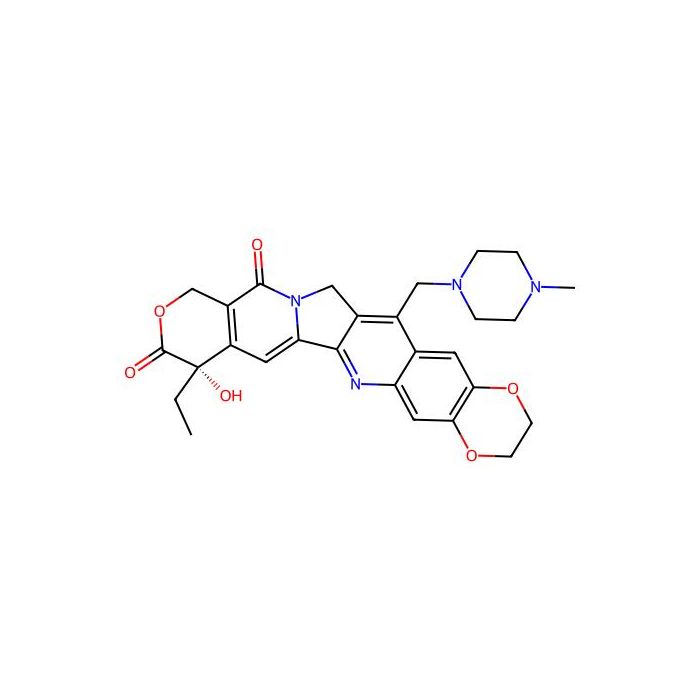
Product: Lurtotecan (SKU: L647116)
CAS: 149882-10-0; PubChem CID: 60956
Molecular formula: Not specified for this item; refer to CoA/Spec Sheet.
Molecular weight: Not specified for this item; refer to CoA/Spec Sheet.
SMILES: Not specified for this item; refer to CoA/Spec Sheet.
InChIKey: Not specified for this item; refer to CoA/Spec Sheet.
General structural notes (literature):
Lurtotecan is a semisynthetic camptothecin analogue. Camptothecins share a pentacyclic scaffold comprising an indolizino[1,2-b]quinolin-9-one core bearing an E‑ring α-hydroxy-δ-lactone.
Key functional motifs typically include: an E-ring lactone (reversibly hydrolyzes to an open-ring carboxylate), a planar polycyclic aromatic system critical for intercalation at the DNA cleavage complex, and basic side-chain substituent(s) tuned to modulate solubility and Topoisomerase I affinity.
Stereochemistry: camptothecin analogues possess defined stereocenters at the lactone-bearing ring junction; maintenance of the natural configuration is essential for Topoisomerase I engagement (literature). 2D depiction can be described as a fused tricyclic quinoline-like plane annulated to a five-membered pyridone and a five-membered lactone, with substituents extending from A- and B-ring positions.
Note: Exact identifiers (SMILES/InChIKey/formula) for this catalog item are not specified above; consult the product CoA/Spec Sheet for definitive identity data.
Synthetic Utility
As an advanced, densely functionalized small molecule, Lurtotecan is typically used as a bioactive probe rather than as a building block. Nevertheless, understanding its functional groups aids in analytical and derivatization studies (general/literature perspective):
Functional motifs: indolizinoquinoline core, an E‑ring α-hydroxy-δ-lactone essential for bioactivity, phenolic/tertiary amide-like features depending on substitution, and basic side-chain nitrogen(s) in certain analogues.
Reactivity considerations:
Lactone ring is susceptible to hydrolysis (base-catalyzed and in neutral aqueous media); acid stabilizes the closed form.
Phenolic or carbamate substituents (when present) can undergo acylation or carbamoylation; protect as needed during analytical derivatization.
Aromatic core is relatively inert but amenable to late-stage halogenation/electrophilic substitution in precursor synthesis (literature on camptothecin chemistry).
Analytical derivatization: formation of chromophoric/fluorogenic tags or isotopic labels is often performed on precursor scaffolds; direct modification of the final molecule risks activity loss.
Method development utility: serves as a challenging analyte for validating stability-indicating HPLC methods probing lactone/carboxylate interconversion and photodegradation.
Because this is not a commodity reagent for bond-forming chemistry, most users will prioritize assay reliability, solution stability, and purity characterization over synthetic transformations.
Target Specificity
This section is primarily applicable to biological affinity reagents (e.g., antibodies) with defined antigen/epitope information. Lurtotecan is a small-molecule research compound; no antigen/clone/isotype data apply.
Target class (literature context): DNA Topoisomerase I is the canonical molecular target for camptothecin analogues. However, no item-specific binding constants or selectivity data are provided here.
Item-specific target data (Ki, IC50, species specificity): Not specified for this item; refer to primary literature or the product CoA if available.
We use cookies to ensure the website functions properly and, where permitted, to improve your experience. You can manage your preferences at any time in Settings. Learn more in our Cookie Policy.
Shall we send you a message when we have discounts available?
Remind me later
Thank you! Please check your email inbox to confirm.
Products are supplied to verified businesses, institutions, and qualified professionals for research and development use only. Not for use in humans, animals, diagnosis, or therapy.