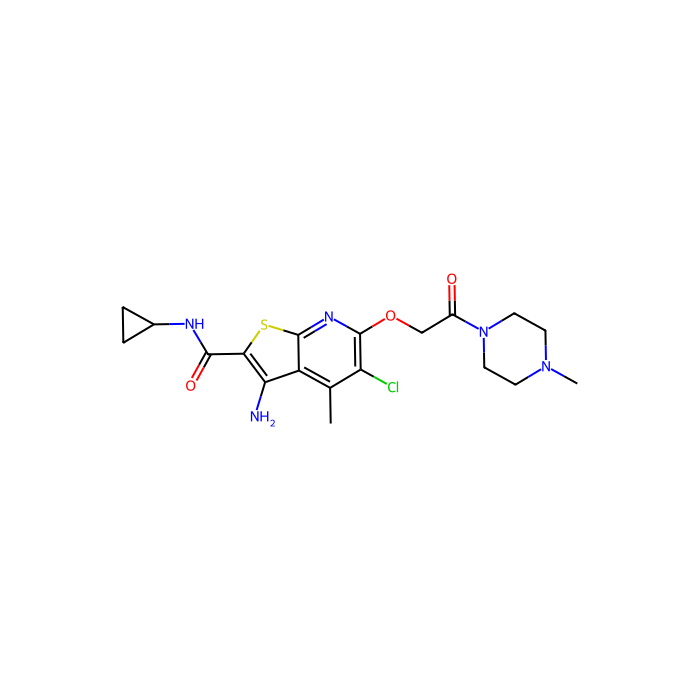
LY 2119620 - Moligand™, ≥98%(HPLC) , Allosteric modulator of M 2 receptor;Allosteric modulator of M 4 receptor, CAS No.886047-22-9, Allosteric modulator of M 2 receptor;Allosteric modulator of M 4 receptor

CAS: 886047-22-9 Cat. No.: L288532 Formula: C19H24ClN5O3S Molecular Weight: 437.94
AVAILABLE TO ORDER
GRADE & PURITY Moligand™ ? Moligand™ — Aladdin's line of ligands and bioactive small molecules. Use for receptor, pathway, and binding studies needing defined small-molecule tools. ≥98%(HPLC)
Synonyms
3-Amino-5-chloro-N-cyclopropyl-4-methyl-6-[2-(4-methyl-1-piperazinyl)-2-oxoethoxy]-thieno[2,3-b]pyridine-2-carboxamide | LY2119620 | 3-amino-5-chloro-N-cyclopropyl-4-methyl-6-[2-(4-methylpiperazin-1-yl)-2-oxoethoxy]thieno[2,3-b]pyridine-2-carboxamide
Storage
Store at -20°C
Shipped In
Ice chest + Ice pads
★
Size
Germany (EU)
USA*
Price
Qty
5mg
L288532-5mg
—
2 In stock
€164.78
10mg
L288532-10mg
—
3 In stock
€272.38
25mg
L288532-25mg
—
2 In stock
€589.98
50mg
L288532-50mg
—
2 In stock
€1,008.23
100mg
L288532-100mg
—
2 In stock
€1,716.30
Enter a quantity for the sizes you want to add.
🧪
Why this grade

Moligand™, ≥98%(HPLC) Moligand™ for sensitive chromatographic and analytical workflows requiring minimal baseline interference.

🌡

Storage & shipping

Store at -20°C Ships Ice chest + Ice pads Check lot-specific COA for exact specifications.

📋

Quality documents

SDS, COA, datasheet, and spec sheet available for download. Lot-specific COA accessible via lot number lookup.

📚

Literature proof

Cited in 0 peer-reviewed publications across chromatography, organic synthesis, and cross-coupling reactions.

Overview

Product description:

LY2119620 is a specific, and allosteric agonist of human M2 and M4 muscarinic acetylcholine receptors.

Specifications

Synonyms
3-Amino-5-chloro-N-cyclopropyl-4-methyl-6-[2-(4-methyl-1-piperazinyl)-2-oxoethoxy]-thieno[2,3-b]pyridine-2-carboxamide | LY2119620 | 3-amino-5-chloro-N-cyclopropyl-4-methyl-6-[2-(4-methylpiperazin-1-yl)-2-oxoethoxy]thieno[2,3-b]pyridine-2-carboxamide
Specifications & Purity
Moligand™, ≥98%(HPLC)
Biochemical and Physiological Mechanisms
Positive allosteric modulator of M2and M4muscarinic receptors. Potentiates activity of agonist at receptor in G protein-coupled functional assay. Cooperativity factor, α = 19.5 and 79.4 for M2and M4in presence of ACh, respectively. Binds in extracellular
Storage
Store at -20°C
Shipped In
Ice chest + Ice pads
This product requires cold chain shipping. Ground and other economy services are not available.
Grade
Moligand™
Action Type
ALLOSTERIC MODULATOR
Mechanism of action
Allosteric modulator of M 2 receptor;Allosteric modulator of M 4 receptor
Purity
≥98%(HPLC)
Names and Identifiers
Pubchem Sid
Pubchem Sid Url
https://pubchem.ncbi.nlm.nih.gov/substance/504771628
Canonical Smiles
CC1=C2C(=C(SC2=NC(=C1Cl)OCC(=O)N3CCN(CC3)C)C(=O)NC4CC4)N
IUPAC Name
3-amino-5-chloro-N-cyclopropyl-4-methyl-6-[2-(4-methylpiperazin-1-yl)-2-oxoethoxy]thieno[2,3-b]pyridine-2-carboxamide
InChIKey
TYTGOXSAAQWLPJ-UHFFFAOYSA-N
INCHI
1S/C19H24ClN5O3S/c1-10-13-15(21)16(17(27)22-11-3-4-11)29-19(13)23-18(14(10)20)28-9-12(26)25-7-5-24(2)6-8-25/h11H,3-9,21H2,1-2H3,(H,22,27)
Isomeric SMILES
CC1=C2C(=C(SC2=NC(=C1Cl)OCC(=O)N3CCN(CC3)C)C(=O)NC4CC4)N
Molecular Weight
437.94
Reaxy-Rn
12591127
Reaxys-RN_link_address
https://www.reaxys.com/reaxys/secured/hopinto.do?context=S&query=IDE.XRN=12591127&ln=

Documentation

📋 Safety Data Sheet (SDS)

Comprehensive hazard, handling, storage, and regulatory compliance document.

Download SDS →

✅ Certificate of Analysis (COA)

Lot-specific quality data. Enter your lot number to retrieve the exact COA.

Look up COA →

📊 Datasheet

Quick-reference summary of product specifications and applications.

View datasheet →

🔬 Specification Sheet

Full quality attributes and acceptance criteria for this grade.

View spec sheet →

Advanced Data

Taxonomic Classification

Taxonomy Tree

KingdomOrganic compounds
SuperclassOrganoheterocyclic compounds
ClassThienopyridines
SubclassNot available
Intermediate Tree Nodes Not available
Direct ParentThienopyridines
Alternative Parents Pyridinecarboxamides  2-heteroaryl carboxamides  Thiophene carboxamides  Alkyl aryl ethers  N-methylpiperazines  Methylpyridines  Aminothiophenes  Aryl chlorides  Vinylogous amides  Tertiary carboxylic acid amides  Heteroaromatic compounds  Trialkylamines  Secondary carboxylic acid amides  Amino acids and derivatives  Azacyclic compounds  Organochlorides  Primary amines  Carbonyl compounds  Organic oxides  Hydrocarbon derivatives  
Molecular FrameworkAromatic heteropolycyclic compounds
Substituents Pyridinecarboxamide - Thienopyridine - 2-heteroaryl carboxamide - Thiophene carboxamide - Thiophene carboxylic acid or derivatives - Alkyl aryl ether - Methylpyridine - N-methylpiperazine - N-alkylpiperazine - Aminothiophene - Aryl chloride - Aryl halide - 1,4-diazinane - Piperazine - Pyridine - Vinylogous amide - Tertiary carboxylic acid amide - Thiophene - Heteroaromatic compound - Tertiary amine - Secondary carboxylic acid amide - Tertiary aliphatic amine - Amino acid or derivatives - Carboxamide group - Azacycle - Carboxylic acid derivative - Ether - Organic oxide - Organohalogen compound - Organic nitrogen compound - Organochloride - Organonitrogen compound - Carbonyl group - Organooxygen compound - Hydrocarbon derivative - Primary amine - Organic oxygen compound - Amine - Aromatic heteropolycyclic compound
DescriptionThis compound belongs to the class of organic compounds known as thienopyridines. These are heterocyclic compounds containing a thiophene ring fused to a pyridine ring. Thiophene is 5-membered ring consisting of four carbon atoms and one sulfur atom. Pyridine is a 6-membered ring consisting of five carbon atoms and one nitrogen center.
External Descriptors Not available
3D Structure
Interactive Chemical Structure Model


Associated Targets(Human)
CHRM4 Tclin Muscarinic acetylcholine receptor M4 (1 Activities)
Activity TypeActivity Value -log(M)Mechanism of ActionActivity ReferencePublications (PubMed IDs)
CHRM2 Tclin Muscarinic acetylcholine receptor M2 (1 Activities)
Activity TypeActivity Value -log(M)Mechanism of ActionActivity ReferencePublications (PubMed IDs)
Mechanisms of Action
Certificates(CoA,COO,BSE/TSE and Analysis Chart)
C of A & Other Certificates(BSE/TSE, COO):
Analytical Chart:

Find and download the COA for your product by matching the lot number on the packaging.

6 results found

Lot NumberCertificate TypeDateItem
C2303817Certificate of AnalysisJan 05, 2026 L288532
C2303815Certificate of AnalysisJan 05, 2026 L288532
C2303664Certificate of AnalysisJan 05, 2026 L288532
C2303814Certificate of AnalysisDec 12, 2025 L288532
C2303816Certificate of AnalysisDec 12, 2025 L288532
C2513248Certificate of AnalysisOct 20, 2022 L288532
Chemical and Physical Properties
SolubilitySolvent:DMSO, Max Conc. mg/mL: 43.79, Max Conc. mM: 100; Solvent:1eq. HCl, Max Conc. mg/mL: 43.79, Max Conc. mM: 100
Molecular Weight437.900 g/mol
XLogP32.900
Hydrogen Bond Donor Count2
Hydrogen Bond Acceptor Count7
Rotatable Bond Count5
Exact Mass437.129 Da
Monoisotopic Mass437.129 Da
Topological Polar Surface Area129.000 Ų
Heavy Atom Count29
Formal Charge0
Complexity631.000
Isotope Atom Count0
Defined Atom Stereocenter Count0
Undefined Atom Stereocenter Count0
Defined Bond Stereocenter Count0
Undefined Bond Stereocenter Count0
The total count of all stereochemical bonds0
Covalently-Bonded Unit Count1
Solution Calculators
Reviews

Customer Reviews

Application Protocols

Not specified for this item; refer to CoA/Spec Sheet.

General note: In the absence of item-specific protocols, establish assay conditions empirically, including solvent controls, concentration–response design, and appropriate positive/negative controls per your laboratory SOPs.

Biological Roles

General/literature context: LY 2119620 is widely cited as a small-molecule modulator used to interrogate muscarinic acetylcholine receptors (GPCRs) in pharmacological research. No therapeutic or clinical claims are made; this product is for research use only.

  • Role in receptor pharmacology

    • Employed as a tool compound to study allosteric mechanisms at muscarinic receptors, enabling dissection of cooperativity with orthosteric ligands and pathway bias in cellular systems.
    • Useful for establishing operational models of allosterism, quantifying binding cooperativity and efficacy modulation via concentration–response analyses.
  • Experimental contexts

    • Cell-based functional readouts: calcium mobilization, cAMP modulation, β-arrestin recruitment, ERK phosphorylation, depending on receptor subtype and coupling.
    • Binding/engagement assays: radioligand displacement, NanoBRET/NanoBiT target engagement, thermal shift (CETSA/DSF) when compatible with target expression.
  • Selectivity considerations

    • Reported literature on LY-series modulators underscores the need to profile across muscarinic subtypes (M1–M5) and key off-targets (e.g., other GPCRs, transporters) to establish selectivity in your specific system.
  • Practical guidance

    • Verify receptor expression levels to avoid receptor reserve artifacts.
    • Include time-course studies to detect slow association/dissociation that can influence potency estimates.

Note: Item-specific target specificity is not provided here; consult primary literature and perform in-house profiling under your assay conditions.

Buffer Applications

Not typically applicable. LY 2119620 is not a buffering agent and is used at micromolar concentrations in biological assays.

  • Practical notes
    • Choose assay buffers based on target biology (e.g., HBSS/HEPES for calcium assays; PBS or HEPES-buffered media for binding/engagement). Maintain consistent ionic strength and pH across controls and treatments.
    • Keep final DMSO or other vehicle concentration constant across wells (commonly ≤0.1–0.5%). Include protein (e.g., 0.1% BSA) if nonspecific binding to plastics is suspected.

No validated buffer recipes are specified for this item; refer to your assay SOPs.

Green Alternatives

As a research ligand used at micromolar concentrations, the main environmental considerations center on solvent choice and waste minimization rather than replacement of the active compound.

  • Greener handling strategies (general)

    • Use the minimum DMSO volume necessary for stock solutions; consider higher-concentration stocks to reduce total solvent usage.
    • Evaluate alternative vehicles with improved EHS profiles when compatible with your assay (e.g., aqueous cyclodextrin complexes, PEG400, or propylene glycol), recognizing tradeoffs in solubility and assay interference.
    • Implement microscale assays (384–1536 well formats) to cut solvent and plastic waste.
  • Comparison of common vehicles (general)

    • DMSO: Gold standard for solubilizing diverse chemotypes; excellent solvent power but classified as a mild irritant; typically acceptable in small percentages in biological assays.
    • PEG400/propylene glycol: Lower volatility and odor; may increase solution viscosity and can affect membrane interactions or assay readouts.
    • Cyclodextrins: Enable aqueous delivery of hydrophobic ligands; may alter apparent potency/kinetics due to complexation—requires careful controls.

Note: The active small molecule itself is not typically amenable to a “greener alternative” substitution without altering biological activity. Focus sustainability efforts on solvent selection, miniaturization, and appropriate waste segregation.

Pharmaceutical Uses

This product is supplied strictly for laboratory research and discovery use. No therapeutic, diagnostic, or clinical applications are claimed or supported.

  • Formulation/analytical roles (research context)

    • May serve as a reference standard or control article in preclinical assay development, receptor binding studies, or method qualification (e.g., LC–MS quantitation in in vitro matrices).
    • For dissolution and handling, research formulations commonly employ DMSO stocks diluted into aqueous buffers; specific excipient systems for in vivo use are out of scope and not provided.
  • Pharmacopeia/compendial status

    • Not a compendial excipient or API; no pharmacopeial monograph is indicated.

Any use beyond laboratory research (e.g., clinical, veterinary, or diagnostic) is not permitted under the “For research use only” designation.

Physical Properties

Item-specific specifications are not provided in the Product Data.

  • Appearance: Not specified for this item; refer to CoA/Spec Sheet.
  • Molecular Weight: Not specified for this item; refer to CoA/Spec Sheet.
  • Melting point: Not specified for this item; refer to CoA/Spec Sheet.
  • Boiling point: Not applicable for most complex bioactive solids; not specified for this item.
  • Density: Not specified for this item; refer to CoA/Spec Sheet.
  • LogP/logD: Not specified for this item; refer to CoA/Spec Sheet.
  • pKa: Not specified for this item; refer to CoA/Spec Sheet.
  • Refractive index: Not applicable (solid) or not specified for this item.
  • Solubility guidance (general, non-item-specific)
    • Literature/common practice for small-molecule ligands: prepare concentrated stocks in anhydrous DMSO (e.g., 10–50 mM) and dilute into aqueous assay buffers to ≤0.1–0.5% DMSO final. Actual solubility limits must be verified empirically for your system.
    • If aqueous solubility is limited, co-solvent systems (DMSO + PEG400, DMSO + ethanol) or cyclodextrin inclusion may improve working concentrations; confirm compatibility with your assay.

Important: Do not treat the above as specifications. When developing analytical methods (HPLC/UPLC), first confirm identity/solubility from the lot-specific CoA and acquire UV/fluorescence spectra experimentally to set detection wavelengths and gradients.

Quality & Grades
  • Supplied Grade: Moligand™ (as provided)

    • Interpretation (general): Moligand™ designates a research-use small-molecule ligand suitable for screening, target engagement studies, and chemical biology workflows. Typical expectations for such materials include rigorous identity verification (e.g., NMR/LC–MS) and a defined purity threshold appropriate for discovery assays; however, exact analytical criteria for this SKU are Not specified for this item; refer to CoA/Spec Sheet.
  • What this means for users

    • Intended strictly for laboratory research. Not for human or veterinary use.
    • Expect batch-specific CoA documenting identity confirmation methods (e.g., LC–MS retention and mass match) and purity assessment (e.g., HPLC area%). Specific acceptance limits are Not specified for this item; refer to CoA/Spec Sheet.
    • If your application is sensitive to trace impurities (e.g., receptor pharmacology, biophysical binding), consider orthogonal quality checks (qNMR, HRMS) on receipt.
  • Stabilizers/additives

    • Presence/absence of stabilizers, counter-ions, or specific salt forms: Not specified for this item; refer to CoA/Spec Sheet.
  • UV cutoffs, residual solvent/metals, water/peroxide limits

    • Not specified for this item; refer to CoA/Spec Sheet. For analytical method transfer or GLP contexts, request extended characterization if needed.
Reaction & Applications

This product is supplied as a bioactive research ligand rather than a synthetic reagent. Consequently, it is not typically used as a stoichiometric substrate or catalyst in preparative organic reactions.

  • Relevant applications (research/pharmacology)

    • Tool compound for GPCR pharmacology, assay development, and target validation (general/literature context for LY-series ligands). Suitable for use in binding, functional (Gq/Gi signaling), or biophysical assays to characterize allosteric/orthosteric interactions and cooperativity.
    • Reference control in screening cascades to benchmark assay performance (signal-to-background, EC50/IC50 windows) and to anchor structure–activity relationship (SAR) studies.
    • Probe for operational model of allosterism (Black–Leff, allosteric ternary complex models) with concentration–response curve shifts in the presence of orthosteric agonists/antagonists.
  • Practical tips

    • Prepare fresh DMSO stocks or aliquot and store at −20 °C to minimize freeze–thaw. Assess chemical stability by LC–MS after repeated handling.
    • For radioligand or BRET/FRET binding assays, pre-equilibrate ligand and target to ensure steady-state conditions; confirm absence of time-dependent artifacts.
    • Control for solvent and vehicle effects; include matched DMSO controls and, when relevant, assess potential aggregation via detergent controls or dynamic light scattering.

If you require a synthetic intermediate or building block for organic transformations, please refer to other catalog categories better suited for preparative chemistry.

Reaction Conditions

Not applicable for this product’s typical use. LY 2119620 is a bioactive ligand employed in assays rather than a reagent for chemical synthesis.

  • Assay conditions (general guidance)
    • Stock preparation: dissolve in anhydrous DMSO (e.g., 10–50 mM), aliquot, and store at −20 °C. Thaw immediately before use and avoid repeated freeze–thaw.
    • Working concentrations: titrate across a broad range (e.g., 0.1 nM–30 μM) to map full concentration–response curves; exact ranges depend on target expression and assay sensitivity.
    • Temperature/time: perform incubations at 25–37 °C as appropriate for the biological system; allow sufficient equilibration to reach steady state.

These are general, literature-style recommendations and are not item-specific specifications.

Safety & Handling

Safety data for this specific item are not provided in the Product Data and must be obtained from the SDS.

  • GHS classification, signal word, H-statements, and pictograms: Not specified for this item; refer to SDS.
  • General laboratory precautions (good practice for small-molecule research compounds)
    • Wear appropriate PPE: lab coat, safety glasses, and chemical-resistant gloves.
    • Avoid inhalation, ingestion, and skin contact. Handle powders gently to minimize dusting; weigh in a fume hood.
    • Prevent environmental release. Dispose of contents/container in accordance with institutional and local regulations.
  • Incompatibilities (general)
    • Avoid strong oxidizers and strong acids/bases unless stability data indicate compatibility.
    • Protect from moisture for hygroscopic or acid/base-labile compounds; confirm with CoA.
  • First-aid overview (general)
    • Inhalation: Move to fresh air; seek medical attention if symptoms persist.
    • Skin/eye contact: Rinse with water for several minutes; remove contaminated clothing; seek medical advice if irritation develops.
    • Ingestion: Rinse mouth; seek medical attention.
  • Fire-fighting measures (general)
    • Use dry chemical, CO2, or foam as appropriate for surrounding materials. Combustion may produce COx and nitrogen-containing fumes; firefighters should wear SCBA.

Always defer to the item-specific SDS for authoritative hazard, exposure limits, and response guidance.

Solvent Selection

LY 2119620 is a small-molecule ligand typically handled as a DMSO stock for biological assays and screening.

  • Practical solvent guidance (general)

    • Primary solvent: Anhydrous DMSO is commonly used to prepare 10–50 mM stocks for HTS and pharmacology assays.
    • Co-solvent strategies: For limited solubility or precipitation upon aqueous dilution, consider DMSO/PEG400, DMSO/ethanol, or inclusion complexes (e.g., 2-hydroxypropyl-β-cyclodextrin). Validate assay compatibility and target stability.
    • Aqueous buffers: Upon dilution, maintain final DMSO ≤0.1–0.5% where feasible to minimize off-target solvent effects. Include carrier protein (e.g., 0.1% BSA) if nonspecific adsorption is observed; verify impact on readout.
  • Polarity/miscibility (general context)

    • As an organic small molecule of moderate polarity, expect good miscibility in polar aprotic solvents (DMSO, DMF) and variable solubility in alcohols and water, depending on ionization state and salt form. Confirm experimentally for your lot.
  • Selection vs. alternatives

    • If DMSO is incompatible with your assay (e.g., certain enzyme kinetics, membrane assays), test alternative vehicles (propylene glycol, PEG300/400, or aqueous cyclodextrin). Optimize to avoid precipitation and maintain compound integrity.

Note: Specific solubility values/logP for this item are Not specified; verify with small-scale solubility screens (nephelometry, HPLC area vs. concentration, or visual turbidity).

Storage & Reconstitution
  • Storage conditions (from Product Data)

    • Store at −20 °C.
    • Shipped in: Ice chest + ice pads.
  • Reconstitution guidance (general)

    • On receipt, allow the sealed container to equilibrate to room temperature before opening to minimize moisture condensation.
    • Prepare a concentrated stock in anhydrous DMSO (e.g., 10–50 mM), vortex to ensure complete dissolution, and, if necessary, sonicate briefly.
    • Sterile-filter (0.22 μm PTFE) if aseptic handling is required and the compound is fully soluble in the chosen vehicle.
    • Aliquot stocks into single-use portions to avoid repeated freeze–thaw. Store aliquots at −20 °C in amber vials or foil-wrapped tubes if the compound is light sensitive (confirm from CoA/SDS).
  • Stability

    • Item-specific stability, hygroscopicity, and light sensitivity: Not specified for this item; refer to CoA/Spec Sheet. As good practice, monitor integrity by LC–MS/HPLC after extended storage or multiple thaws.
  • Research Use Note

    • For research use only.
Structure & Identity

Brief overview: LY 2119620 is a research-only small molecule supplied as part of a screening/ligand collection.

  • Item-specific identifiers (from Product Data)

    • SKU: L288532
    • Product Name: LY 2119620
    • CAS: 886047-22-9
    • PubChem CID: 57664406
    • InChIKey: 353500 (as provided)
    • SMILES: Not specified for this item; refer to CoA/Spec Sheet.
    • Molecular Formula: Not specified for this item; refer to CoA/Spec Sheet.
    • Molecular Weight: Not specified for this item; refer to CoA/Spec Sheet.
  • Structural features (general/literature context)

    • LY 2119620 is widely described in the GPCR pharmacology literature as a small-molecule allosteric modulator of muscarinic acetylcholine receptors. Specific atom-connectivity, ring systems, and functional groups should be confirmed directly from primary literature or the CoA for this lot.
  • 2D structure description

    • Not specified for this item; refer to CoA/Spec Sheet. When available, a 2D depiction should highlight heteroatom-containing functional groups and cationic/neutral centers relevant to GPCR binding.

Notes: Because structural strings (SMILES/InChI) are not provided here, please consult the CoA/Spec Sheet or authoritative databases using the CAS or CID above to confirm exact structure and stereochemical details before computational work or method development.

Synthetic Utility

Not typically applicable. LY 2119620 is provided as a finished research ligand and is not intended as a building block or reagent for synthetic transformations.

  • If synthetic derivatization is desired (SAR studies, tagging), confirm the exact structure, functional handles, and salt form from the CoA and primary literature, then design appropriate protection/deprotection strategies.

For preparative chemistry applications (couplings, condensations, etc.), please consult our catalog of reagents and building blocks better suited for synthetic use.

Target Specificity

Not specified for this item; refer to CoA/Spec Sheet.

Note: While LY 2119620 is discussed in the literature in the context of muscarinic receptor pharmacology, this listing does not include validated target specificity data. Users should confirm target engagement and selectivity in their own assay systems.

Shall we send you a message when we have discounts available?

Remind me later

Thank you! Please check your email inbox to confirm.

Oops! Notifications are disabled.