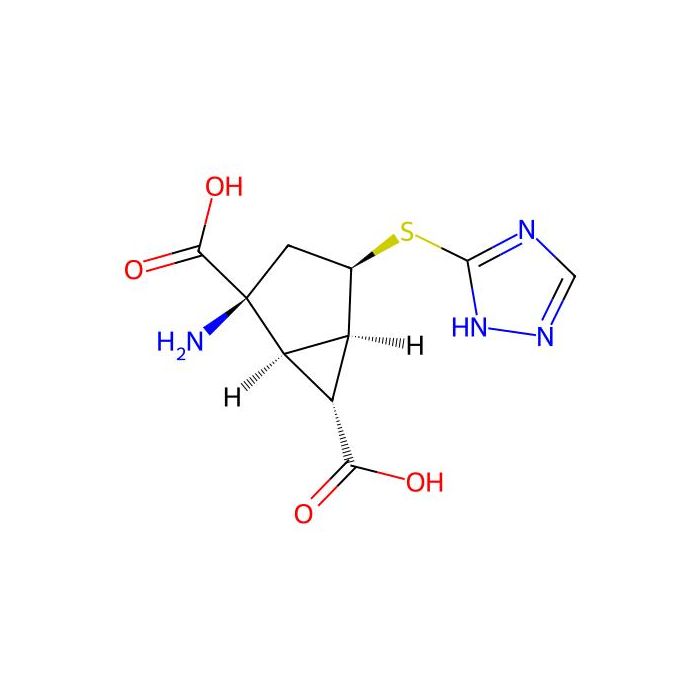
LY2812223 is a highly potent, functionally selective mGlu 2 receptor agonist with mGlu 2 binding affinity for mGlu 2 and mGlu 3 ( K i =144 nM and 156 nM, respectively)
LY2812223 is a highly potent, functionally selective mGlu 2 receptor agonist with mGlu 2 binding affinity for mGlu 2 and mGlu 3 ( K i =144 nM and 156 nM, respectively).
Storage
Store at -20°C,Argon charged
Shipped In
Ice chest + Ice pads
This product requires cold chain shipping. Ground and other economy services are not available.
This compound belongs to the class of organic compounds known as l-alpha-amino acids. These are alpha amino acids which have the L-configuration of the alpha-carbon atom.
External Descriptors
Not available
1. Djoumbou Feunang Y, Eisner R, Knox C, Chepelev L, Hastings J, Owen G, Fahy E, Steinbeck C, Subramanian S, Bolton E, Greiner R, and Wishart DS. ClassyFire: Automated Chemical Classification With A Comprehensive, Computable Taxonomy. Journal of Cheminformatics, 2016, 8:61.
H2O : 50 mg/mL (175.88 mM; Need ultrasonic) DMSO : 28.75 mg/mL (101.13 mM; Need ultrasonic)
Molecular Weight
284.290 g/mol
XLogP3
-2.900
Hydrogen Bond Donor Count
4
Hydrogen Bond Acceptor Count
8
Rotatable Bond Count
4
Exact Mass
284.058 Da
Monoisotopic Mass
284.058 Da
Topological Polar Surface Area
167.000 Ų
Heavy Atom Count
19
Formal Charge
0
Complexity
436.000
Isotope Atom Count
0
Defined Atom Stereocenter Count
5
Undefined Atom Stereocenter Count
0
Defined Bond Stereocenter Count
0
Undefined Bond Stereocenter Count
0
The total count of all stereochemical bonds
0
Covalently-Bonded Unit Count
1
Solution Calculators
Molarity Calculator
Determine the necessary mass, volume, or concentration for preparing a solution.
Dilution Calculator
Determine the dilution needed to prepare a stock solution.
Reconstitution Calculator
Reviews
Customer Reviews
Application Protocols
No tested application protocols are provided for this SKU in the Product Data.
General starting points for small-molecule testing (to be optimized by the end user):
Stock preparation: Dissolve in anhydrous DMSO to 10–50 mM. Vortex and, if needed, brief sonication. Aliquot and store at −20°C under inert gas to minimize freeze–thaw.
Biochemical assays: Prepare serial dilutions to achieve final DMSO ≤0.1–1%. Include vehicle controls, positive controls (known actives for the assay), and counter-screens to detect assay interference.
Cell-based assays: Begin with concentration ranges spanning 10 nM–30 µM with half-log dilutions; check for precipitation microscopically and by back-calculation of nominal vs measured concentrations.
Stability/adsorption: Assess stability over assay time and adsorption to plastics (compare glass vs PP vs low-bind plates) to ensure accurate exposure.
Data integrity: Use replicate wells, independent repeats, and orthogonal readouts (e.g., biochemical vs cellular) to confirm findings.
Important: These are generic research guidelines. Optimize for your assay system and consult the SDS/CoA for any constraints unique to this lot.
Biological Roles
No biological function, pathway engagement, or target assignment is provided for LY2812223 in the Product Data. As such, no biological roles can be claimed for this SKU.
General considerations for research-only small molecules:
Treat as a tool compound candidate of unknown mechanism until validated by your laboratory or by authoritative literature.
If investigating potential targets, deploy a polypharmacology screen (e.g., enzymatic panels, receptor binding, or chemoproteomics) and confirm hits with orthogonal assays.
Assess chemical liabilities relevant to biological testing (possible reactivity, redox activity, aggregation). Employ PAINS substructure and colloidal aggregation filters as part of triage. Perform detergent-sensitive assay controls to rule out nonspecific inhibition.
Evaluate stability in biological matrices (microsomes, plasma, cell culture media) and permeability/efflux if cellular readouts are required.
Important: This product is supplied strictly for research use only. No clinical, diagnostic, or therapeutic claims are made or implied. Any biological interpretation should be supported by your own data and/or peer-reviewed publications linked to the exact same CAS/batch/specification.
Buffer Applications
This item is a small-molecule research compound and is not a buffering reagent. No acid/base pair, pKa range, or buffer capacity is provided.
Practical notes (general, for assay preparation only):
Prepare working solutions by diluting a verified stock (often in DMSO) into your chosen biological buffer (e.g., PBS, HEPES, Tris) while keeping final co-solvent levels within tolerated limits for your assay system.
If compound ionization is relevant (unknown here), choose buffers that maintain a constant pH around the compound’s operational pKa to stabilize solubility and activity; determine pKa experimentally if needed.
Filter buffers (0.22 µm) and pre-equilibrate temperature to reduce precipitation upon dosing.
For dedicated buffer components and recipes, consult buffering reagents (e.g., phosphate, HEPES, MOPS) rather than this product.
Green Alternatives
In absence of an item-specific synthesis or solvent requirement, consider greener practices around handling, dissolution, and analysis for small-molecule research compounds.
Greener dissolution/assay media (general guidance):
Prefer ethanol or propylene glycol as co-solvents where chemically and biologically compatible, before resorting to high-boiling polar aprotics (DMF, NMP).
For chromatographic methods, consider water–ethanol or water–acetonitrile systems; avoid halogenated eluents. Recycle acetonitrile when feasible.
If synthetic manipulation is planned (not typical for a library compound but sometimes required):
Replace traditional ethers (THF, diethyl ether) with 2-MeTHF or CPME when compatible (lower peroxide hazard, potentially bio-based origin for 2-MeTHF).
Favor ethyl acetate, isopropanol, and MeOH/EtOH over chlorinated solvents for workups and crystallizations where performance allows.
Comparison highlights (general, not item-specific):
2-MeTHF vs THF: lower miscibility with water aids separations; reduced peroxide formation; may change reaction kinetics/chelation.
CPME vs Et2O: higher boiling point and stability; lower peroxide propensity; different extraction behavior.
Ethyl acetate vs DCM: less toxicity and environmental burden; higher boiling point requires longer evaporation times.
Operational practices:
Minimize DMSO and DMF volumes; use micro-aliquoting and high-concentration stocks to reduce solvent waste.
Implement closed-loop solvent capture and micro-scale assays to reduce environmental footprint.
Pharmaceutical Uses
No excipient role, compendial status, or formulation function is provided for this item. LY2812223 is offered strictly for research use only and is not manufactured to GMP or pharmacopeial monograph specifications based on the available Product Data.
Context for formulation scientists (general, non-clinical research):
If used in preclinical in vitro studies, establish suitable vehicles (e.g., DMSO stocks diluted into aqueous buffers). For any in vivo exploratory research (outside of clinical use), select vehicles based on compound solubility and tolerability (e.g., Captisol solutions, PEG/Saline, 0.5% methylcellulose suspensions), and ensure compliance with institutional animal care policies.
Characterize stability in intended vehicles (temperature cycling, light exposure, adsorption to plastics) and monitor concentration by validated LC–MS/MS.
Compliance note:
Do not use in humans, diagnostics, or as a drug substance/excipient in manufactured products. No therapeutic claims are made or implied. Any pharmaceutically oriented work should remain within non-clinical research frameworks and institutional approvals.
Physical Properties
Item-specific physicochemical constants are not provided in the Product Data.
Appearance: Not specified for this item; refer to CoA/Spec Sheet.
Molecular Weight: Not specified for this item; refer to CoA/Spec Sheet.
Molecular Formula: Not specified for this item; refer to CoA/Spec Sheet.
Melting/Boiling Point: Not specified for this item; refer to CoA/Spec Sheet.
Density/Refractive Index: Not specified for this item; refer to CoA/Spec Sheet.
pKa/logP/logD: Not specified for this item; refer to CoA/Spec Sheet.
UV–Vis characteristics: Not specified for this item; refer to CoA/Spec Sheet.
Solubility: Not specified for this item; refer to CoA/Spec Sheet.
General laboratory guidance (not item-specific; best practices):
For small-molecule tool compounds with unknown solubility, begin with a small-scale solubility screen: DMSO (analytical grade) at 10–50 mM, then serial dilution into assay media with 0.1–1% DMSO final.
If aqueous work is required, evaluate co-solvent systems (DMSO:buffer, 1:9 to 3:7), pH adjustment where chemically appropriate, or use of minimal non-ionic surfactant (e.g., 0.01–0.05% polysorbate) after confirming compound compatibility.
For analytical characterization, establish preliminary LC–MS and HPLC conditions with a reversed-phase C18 column, a water–acetonitrile or water–methanol gradient, and 0.05–0.1% formic acid or ammonium formate, adjusting based on retention/ionization.
Important: Treat all values as unknown until verified on the CoA/SDS for this SKU. Do not assume salt or solvate form without documentation.
Quality & Grades
Item-specific grade, purity, and stabilizers are not provided in the Product Data.
Grade/Purity: Not specified for this item; refer to CoA/Spec Sheet.
Stabilizers/Counter-ions: Not specified for this item; refer to CoA/Spec Sheet.
Guidance on interpreting grade (general):
Research-grade small molecules are commonly supplied with HPLC purity (e.g., >95%) and LC–MS identity confirmation; verify the actual acceptance criteria on the CoA.
If optical activity is relevant, check for enantiomeric excess (ee) data or racemate designation; none is provided here.
For screening libraries, low UV background, residual solvent limits, and tight identity confirmation are typical; confirm stated limits on the Spec Sheet.
Analytical recommendations:
Verify incoming quality by orthogonal methods where critical: HPLC/UPLC purity at multiple wavelengths; HRMS or accurate-mass MS; optional 1H NMR for integrity; Karl Fischer if water content is performance-critical. Do not assume peroxides, metals, or UV cutoffs—these are item-specific and not provided here.
Documentation:
For regulatory or GLP-like contexts, request the batch CoA and, if needed, a methods summary (chromatographic conditions, reference standards). Ensure the documented storage of this lot matches “Store at −20°C, Argon charged.”
Reaction & Applications
Manufacturer application details are not provided for this SKU. LY2812223 is listed under small molecules/compound libraries; typical research uses include assay development, screening, and mechanistic studies. No target or mode-of-action is specified here.
Biochemical and cell-based screening: Evaluate concentration–response relationships, stability in assay buffers, and potential off-target effects using appropriate controls and vehicle baselines.
Physicochemical characterization: Determine solubility, pKa, logD/logP, aqueous stability, and permeability (e.g., PAMPA or Caco-2) to inform formulation and assay design.
Analytical method development: Build LC–MS/MS quantitation methods (MRM/PRM) for exposure or stability tracking in in vitro systems.
Chemical stability studies: Assess susceptibility to hydrolysis, oxidation, photolysis, or phase transformations; storage guidance (−20°C, argon) suggests sensitivity to moisture/oxygen or slow oxidative degradation.
Practical tips:
Prepare fresh DMSO stocks and minimize freeze–thaw cycles; aliquot upon first thaw.
Use inert atmosphere during weighing and dissolution if solid is air/moisture sensitive; purge vials with argon or nitrogen after dispensing.
Implement adsorptive loss controls (low-binding plastics or silanized glass) if sub-µM assays show recovery issues.
Note: Without an identified target, do not infer biological activity from the code name alone. Consult CoA/Spec Sheet or primary literature for any validated use cases.
Reaction Conditions
No synthetic transformations or reaction conditions are associated with this SKU in the Product Data. LY2812223 is offered as a research compound for testing and analytical use, not as a reagent or catalyst.
General guidance for handling during solution preparation and dosing (non-synthetic context):
Dissolution: Begin with dry, oxygen-free solvents if the compound is air/moisture sensitive (storage indicates argon protection). Sonication or gentle warming (≤40°C) may assist dissolution; avoid prolonged heat.
Filtration: If particulate persists, sterile-filter stocks (0.22 µm PTFE for organic-rich solutions) to ensure clarity for assays.
Light and oxygen: Work under subdued light if chromophores are suspected; backfill vials with argon or nitrogen after aliquoting.
Stability checks: Monitor solutions by LC–MS at t = 0 and after 24–72 h at relevant temperatures to confirm stability prior to critical experiments.
If chemical reactions using this compound are intended (e.g., as a substrate or coupling partner), obtain the full structural information and consult primary literature for precedent conditions specific to the verified structure.
Safety & Handling
Safety data specific to this item are not provided in the Product Data; consult the SDS for authoritative guidance.
GHS Classification / Pictograms: Not specified for this item; refer to SDS.
Signal Word / H-Statements: Not specified for this item; refer to SDS.
Primary Hazards (general for research small molecules): May cause irritation upon contact or inhalation; dust/particulates should be minimized. Unknown toxicological profile—handle as a substance of unknown hazard.
PPE: Lab coat, safety glasses, and appropriate chemical-resistant gloves (e.g., nitrile). Use a certified fume hood when weighing, dissolving, or transferring.
Engineering Controls: Conduct manipulations in a fume hood; employ dust control (anti-static spatulas, gentle handling). Avoid aerosol generation.
Storage Incompatibilities: Without structural details, avoid strong oxidizers/reductants, strong acids/bases, and reactive metals until compatibility is confirmed. Segregate from foodstuffs and incompatible chemicals.
First Aid (general): Skin/eye contact—rinse with water for at least 15 minutes; remove contaminated clothing. Inhalation—move to fresh air. Ingestion—rinse mouth, seek medical attention. Always follow SDS-specific instructions.
Fire Fighting (general): Use CO2, dry chemical, or foam; avoid high-pressure water streams that may spread material. Combustion may produce irritating/toxic fumes—firefighters should wear SCBA.
Waste Disposal: Collect as organic chemical waste; do not discharge to drains. Follow institutional, local, and national regulations.
Storage from Product Data:
Store at −20°C, Argon charged. Maintain tightly sealed in an inert atmosphere to limit oxidation/moisture exposure. Shipped cold (ice chest + ice pads).
Solvent Selection
No item-specific solubility profile is provided. The following is general best practice for small-molecule research compounds of unknown polarity.
Primary stock solution approach:
Begin with DMSO for high-concentration stocks (e.g., 10–50 mM), verifying clarity and stability over 24–48 h at room temperature and 4°C.
If DMSO is insufficient, test DMF, NMP, or ethanol at lower target concentrations (1–10 mM) and evaluate stability.
Aqueous usage:
Prepare working solutions by diluting DMSO stocks into buffer or media; keep final DMSO ≤0.1–1% v/v depending on biological system tolerance.
Screen pH 6–8 buffers for non-ionizable compounds; if ionizable, adjust pH per pKa (unknown here—confirm via CoA or experimental determination).
Chromatography/analytical:
For RP-HPLC/LC–MS, start with water–acetonitrile (or water–methanol) gradients with 0.05–0.1% formic acid or volatile ammonium salts.
Solid handling:
Use anhydrous solvents in an inert atmosphere if the compound is moisture/oxygen sensitive (storage guidance suggests inerting with argon).
Quick comparison (general, not item-specific):
DMSO: highest solvency, strong for most heteroaromatics; may affect bioassays above ~1%.
Ethanol: good miscibility; lower solvency but biocompatible at modest %.
DMF/NMP: strong solvency; assess biocompatibility and extractables before cell-based use.
Storage & Reconstitution
Item-specific storage conditions are provided; reconstitution details are not.
Storage (from Product Data):
Store at −20°C, Argon charged. Maintain the container tightly sealed. Minimize headspace oxygen and moisture.
Shipping: Ice chest + ice pads (cold chain). Inspect upon receipt; return to −20°C promptly.
Reconstitution:
Solvent: Not specified for this item; common practice is to begin with anhydrous DMSO for stock solutions, then dilute into assay media. Verify solvent compatibility experimentally.
Concentration: Not specified; typical screening stocks are 10–50 mM if solubility permits.
Technique: Equilibrate vial to room temperature in a desiccated, inert environment before opening to avoid condensation. Backfill with argon or nitrogen after use. Vortex/sonicate gently to achieve a clear solution.
Aliquoting & Freeze–Thaw:
Prepare single-use aliquots to reduce freeze–thaw cycles; store aliquots at −20°C under inert gas. Record preparation date and solvent.
Stability:
Solution/shelf stability: Not specified for this item; verify by LC–MS/HPLC at relevant intervals. Protect from light if chromophoric.
Incompatibilities:
Not specified for this item; as a precaution, minimize exposure to moisture, oxygen, heat, and strong acids/bases until compatibility is confirmed.
For definitive guidance, consult the batch CoA and SDS accompanying SKU L648167.
Structure & Identity
Overview: LY2812223 is listed as a small-molecule research compound (Lilly code name). Item-level structural identifiers are not provided in the Product Data.
Product Name: LY2812223 (research compound code)
CAS: 1311385-20-2 (catalog identifier)
PubChem CID: 53240406 (catalog identifier)
InChIKey: Not specified for this item; refer to CoA/Spec Sheet. (Product Data lists a nonstandard placeholder "445815")
SMILES: Not specified for this item; refer to CoA/Spec Sheet.
Molecular Formula: Not specified for this item; refer to CoA/Spec Sheet.
Molecular Weight: Not specified for this item; refer to CoA/Spec Sheet.
Structural description (general):
Item-specific ring systems, heteroatoms, stereochemistry, and functional groups are not provided in the Product Data and are therefore not described here.
If structural elucidation is needed for your work (e.g., for LC–MS method development, docking, or analytical impurity profiling), please consult the Certificate of Analysis (CoA), Specification Sheet, or primary literature associated with CAS 1311385-20-2 or PubChem CID 53240406.
Notes:
LY- prefixes typically denote discovery-stage small molecules; final IUPAC names, salt forms, and tautomeric states may vary across literature sources. Verify the exact structure and form supplied with this SKU before quantitative or mechanistic studies.
For registration in ELN/LIMS, use the CAS and SKU as provisional identifiers until the complete structural record is confirmed from the CoA or authoritative databases.
Synthetic Utility
This SKU is supplied as a finished small-molecule research compound rather than a building block. No reactive handles or functional group specifications are provided in the Product Data; therefore, this item is not positioned for synthetic diversification in standard workflows.
General considerations if derivatization is contemplated (verify structure first):
Confirm the exact structure, functional groups, and protecting groups from the CoA or primary literature before planning any transformations.
Evaluate stability toward hydrogenation, oxidation, and hydrolysis on milligram scale to identify compatible conditions.
For SAR or probe development, consider ordering the corresponding building blocks or analogs with known functional handles (e.g., anilines, boronates, acid/amine termini) instead of modifying this reference compound directly.
Analytical support:
If derivatives are prepared, establish a robust analytical package (1H/13C NMR, HRMS, HPLC/UPLC purity) and document stereochemical integrity where applicable.
Note: Without the disclosed structure, no named reactions or reactivity profiles can be responsibly recommended for this specific item.
Target Specificity
No target, pathway, or binding profile is provided for this item in the Product Data.
Target/epitope/biomolecule: Not specified for this item; refer to CoA/Spec Sheet and primary literature.
Species reactivity/assay context: Not specified.
Potency/affinity (IC50/Ki/Kd): Not specified.
Selectivity panel data: Not specified.
Guidance for researchers:
If mechanistic studies are planned, acquire or generate target engagement data (e.g., biochemical inhibition, CETSA/thermal shift, SPR, DSF) using the exact same batch/lot.
Confirm any literature-sourced target assignment against CAS 1311385-20-2 and verify salt/form consistency to avoid misannotation.
Note: Do not infer pharmacology or biological selectivity from the LY code name alone. Treat as an uncharacterized small molecule until data are established.
Frequently Asked Questions
What is the purity of this product?
This product is supplied at ≥98% purity (chemical assay). Lot-specific values are stated on the Certificate of Analysis.
How should this product be stored?
Store at ?20 °C under argon. It is supplied under an argon blanket; reseal under inert gas after each use.
How is this product shipped?
This product ships in an insulated container with ice pads. Unpack on arrival and transfer it to the storage condition stated above.
What are the CAS number, molecular formula and molecular weight?
The CAS Number is 1311385-20-2, the molecular formula is C10H12N4O4S, and the molecular weight is 284.29 g/mol. InChIKey YSOWRGMLMZQSBX-AVUIYAGVSA-N.
What documentation is provided?
Available product documentation, including Certificates of Analysis (COA), Safety Data Sheets (SDS), and specification sheets, is shown in the product document area. Document availability and access follow the current site policy.
We use cookies to ensure the website functions properly and, where permitted, to improve your experience. You can manage your preferences at any time in Settings. Learn more in our Cookie Policy.
Shall we send you a message when we have discounts available?
Remind me later
Thank you! Please check your email inbox to confirm.
Products are supplied to verified businesses, institutions, and qualified professionals for research and development use only. Not for use in humans, animals, diagnosis, or therapy.