Alkaline earth metal sulfate - Inorganic oxide - Inorganic salt
Description
This compound belongs to the class of inorganic compounds known as alkaline earth metal sulfates. These are inorganic compounds in which the largest oxoanion is sulfate, and in which the heaviest atom not in an oxoanion is an alkaline earth metal.
External Descriptors
Not available
1. Djoumbou Feunang Y, Eisner R, Knox C, Chepelev L, Hastings J, Owen G, Fahy E, Steinbeck C, Subramanian S, Bolton E, Greiner R, and Wishart DS. ClassyFire: Automated Chemical Classification With A Comprehensive, Computable Taxonomy. Journal of Cheminformatics, 2016, 8:61.
Determine the necessary mass, volume, or concentration for preparing a solution.
Dilution Calculator
Determine the dilution needed to prepare a stock solution.
Reconstitution Calculator
Reviews
Customer Reviews
Application Protocols
Not applicable. This product is not supplied as a biological reagent with tested applications (e.g., WB, IHC, IF, FC). For practical use, see the sections on Buffer Applications, Reaction & Applications, and Reaction Conditions for guidance on preparing solutions and conducting inorganic transformations.
Biological Roles
Literature/general (biochemistry context; not medical/clinical claims)
Magnesium ion (Mg2+): Essential cofactor for a large fraction of enzymes, especially those utilizing nucleotides (ATP/ADP/GTP). Stabilizes phosphate groups, ribozymes, and nucleic acid structures, and participates in ion transport and signaling.
Sulfate (SO4 2−): Terminal oxidation product of sulfur metabolism; assimilated by organisms via ATP sulfurylase/APS reductase pathways to produce sulfide for biosynthesis of cysteine, methionine, and cofactors (e.g., PAPS).
Osmotic/ionic strength effects: In vitro, MgSO4 is commonly used to adjust Mg2+ levels in buffers that modulate DNA/RNA polymerase, ligase, and nuclease activities; sulfate is often chosen when avoidance of chloride is required (e.g., certain metalloenzyme studies).
Protein/nucleic acid stability: Mg2+ can impact folding and aggregation; sulfate, being a kosmotropic anion in the Hofmeister series, can influence hydration shells and promote “salting out” at sufficient concentration.
Notes for experimentalists
Hydrate state matters for accurate Mg2+ dosing. Calculate using the monohydrate molecular weight when preparing enzyme buffers or crystallization media.
Counterion choice can affect enzyme kinetics; compare MgSO4 with MgCl2 empirically for your system.
Buffer Applications
Applicability
Magnesium sulfate monohydrate is not itself a buffering agent. It is widely used as a salt additive to set Mg2+ concentration and ionic strength in aqueous buffers and reaction media.
Practical guidance (literature/general)
Enzyme assays: Many polymerases, ligases, nucleases, and kinases require 1–10 mM Mg2+; MgSO4 is often interchangeable with MgCl2 but may yield different activity profiles due to the sulfate counterion’s kosmotropic character.
Nucleic acid work: For PCR and reverse transcription variants that specify MgSO4, prepare a concentrated stock (e.g., 100 mM) in nuclease-free water, filter-sterilize (0.22 µm), and store aliquots at 2–8°C to limit contamination and evaporation.
Crystallography/biophysics: MgSO4 is a common precipitant or additive in protein crystallization screens; adjust alongside PEG/salt matrices to tune nucleation.
Compatibility: Avoid simultaneous inclusion of barium/lead/strontium in buffers to prevent sulfate precipitates. Phosphate buffers are generally compatible; monitor for scale formation at high ionic strengths.
Recipes and calculations
Use the monohydrate formula weight (~138.37 g/mol, literature) for molarity calculations. Example: To make 100 mL of 1.00 M MgSO4 (as MgSO4·H2O), dissolve 13.84 g in water and dilute to volume (literature calculation; verify in your lab context).
Filter sterilization is preferred over heat sterilization to avoid concentration changes from evaporation.
Green Alternatives
Context
Magnesium sulfate salts are generally recognized as having low environmental and health hazards in typical laboratory use. Selection of hydrate state can influence energy/waste footprints via drying and calcination steps.
Greener choices and trade-offs (literature/general)
MgSO4·H2O vs MgSO4·7H2O (heptahydrate):
Environmental aspect: Monohydrate transports less bound water per mole of Mg, reducing mass and energy for drying when water content must be minimized.
Process aspect: Heptahydrate dissolves very readily and is widely available, but introduces more water into formulations and may require additional drying.
MgSO4 vs MgCl2/Mg(NO3)2:
Chloride introduces corrosion and potential chlorinated waste; nitrate can contribute to NOx emissions and is a combustion risk upon decomposition. Sulfate is oxidatively stable but releases SOx if calcined to MgO at high temperature—use appropriate scrubbing.
Water as solvent: For most uses, water is the greenest practical medium. Avoid organic co-solvents unless required for process performance.
Operational best practices
Right-first-time stoichiometry: Choose the hydrate that matches water budget and Mg2+ molarity to reduce rework and drying energy.
Closed handling: Store in sealed containers to limit caking and extend shelf life, minimizing waste.
Solution reuse: Where feasible, recycle sulfate-containing aqueous streams via ion exchange or crystallization to lower effluent load.
Pharmaceutical Uses
Item-specific status
Grade/compliance: Not specified for this item; refer to CoA/Spec Sheet. No therapeutic claims—research and laboratory use only.
Literature/general formulation context
Excipient roles: Magnesium sulfate hydrates have been used as osmotic agents, tonicity modifiers, and processing salts in nonparenteral formulations. Selection of hydrate impacts water content and flow/caking behavior of the bulk solid.
Compendial notes: Pharmacopeial monographs commonly target magnesium sulfate heptahydrate; requirements (identity, limits for heavy metals, loss on drying) are hydrate-specific. If compendial compliance is required, confirm that the monohydrate form and its tests are acceptable for the intended use.
Manufacturing considerations: Sulfate salts are non-volatile, thermally stable up to dehydration; they can be used to control aw (water activity) during granulation/drying. Residual sulfate must be compatible with the drug substance and excipient matrix to avoid undesired salt formation or polymorph changes.
Device/process utilities: As a benign inorganic salt, MgSO4 solutions can serve as calibration standards for conductivity/osmometry in process development (non-clinical, research settings).
Practical cautions
Avoid substitution of hydrates without re-validating mass balances, assay, and stability.
For sterile applications, use validated water quality and sterile filtration; confirm endotoxin/bioburden as required by internal QA (not specified for this item).
Physical Properties
Item-specific specifications
Appearance: Not specified for this item; refer to CoA/Spec Sheet.
Assay/trace limits/UV cutoff: Not specified for this item; refer to CoA/Spec Sheet.
Hygroscopicity: Moderately hygroscopic; can exchange water with the environment to form higher hydrates at elevated relative humidity.
Solubility: Readily soluble in water; insoluble or only sparingly soluble in most common organic solvents (alcohols, ethers, hydrocarbons). Aqueous solubility increases with temperature (literature).
Density: On the order of ~2.4–2.6 g/cm³ for the monohydrate mineral (kieserite) phase (literature, phase-dependent).
Thermal behavior: Dehydrates upon heating, converting toward anhydrous MgSO4 and, upon further heating, decomposes to MgO with release of SOx at high temperatures (literature). No true “boiling point” (ionic solid).
pH (solution): Aqueous solutions are near neutral to slightly acidic depending on concentration and CO2 exposure (literature).
Conductivity: Dissociation to Mg2+ and SO4 2− affords high ionic conductivity in water (literature).
Practical notes
Because hydrate state affects mass percent Mg2+, calculations should explicitly use MgSO4·H2O formula weight when preparing solutions.
For precise solution work, allow solid to equilibrate to lab temperature in a closed container prior to weighing to minimize moisture exchange with air.
Quality & Grades
Item-specific details
Grade/purity: Not specified for this item; refer to CoA/Spec Sheet.
General guidance on grades (literature/industry practice)
Reagent grade: Typically indicates suitability for general laboratory use with controlled levels of common impurities (alkali metals, heavy metals). When required for analytical or materials-sensitive work, verify metal trace limits on the CoA.
ACS/Ph. Eur./USP: Pharmacopeial monographs commonly exist for the heptahydrate; monohydrate specifications may differ and are often geared to industrial/mineral forms (kieserite). If a compendial grade is required, confirm hydrate-specific compliance.
Water of hydration: The monohydrate provides a defined, lower water content versus heptahydrate, helpful for precise Mg2+ dosing, slurry rheology control, or moisture-sensitive solid-state syntheses where total water input must be limited.
Stabilizers/additives: Typically none; magnesium sulfate salts are intrinsically stable. If anti-caking agents or particle-size controls are critical, consult the CoA/specification sheet for this specific SKU.
Recommendations
Match hydrate state to your application and calculations; do not substitute with heptahydrate/anhydrous without re-deriving stoichiometry.
For trace-metal–sensitive catalysis or electronic materials, request trace analysis (ICP-MS) and moisture data specific to the delivered lot.
Reaction & Applications
Literature/general applications in research and materials science (no medical use)
Precursor to magnesium oxides: Thermal treatment of MgSO4·H2O yields anhydrous MgSO4, and at higher temperatures in air or inert gas followed by reducing/neutral atmospheres, MgO can be produced after SOx evolution. Useful for preparing MgO supports with defined impurity profiles.
Inorganic crystallization and salt effects: As a well-behaved 1:2 electrolyte, MgSO4·H2O is used to adjust ionic strength, supersaturation, and activity coefficients in aqueous crystallizations; sulfate counterion promotes precipitation of Ba2+, Pb2+ as sulfates for separations.
Coordination chemistry: Source of Mg2+ for assembling magnesium-organic frameworks or for ion-exchange into layered silicates/clays; the monohydrate minimizes extraneous water input compared to heptahydrate.
Polymer/materials processing: MgSO4 can act as a salting-out agent for certain hydrophilic polymers and proteins (research use), and as a porogen/templating salt in sol–gel or freeze-drying routes.
Electrochemistry: Provides Mg2+ in aqueous electrolytes for studies of Mg-ion transport and as a benign supporting electrolyte where chloride/nitrate are undesirable.
Practical tips
Dissolution: Add gradually to water with stirring; exotherm is mild. Filter to remove insoluble mineral fines if ultra-clear solutions are required.
Precipitation chemistry: For quantitative sulfate tests, add to solutions containing Ba2+ under acidic to neutral pH to avoid BaCO3 co-precipitation.
Solid-state routes: For MgO preparation, ramp temperature gradually to manage dehydration and SOx evolution; ensure adequate off-gas handling.
Dissolution: Dissolves readily in water at ambient temperature. For concentrated stocks (≥1 M), add in portions with stirring to avoid localized supersaturation; mild warming (25–40°C) can accelerate dissolution.
Precipitation/metathesis: For Mg(OH)2 formation, add aqueous MgSO4 to NaOH/KOH at pH ≥ 10 with vigorous stirring; aging at 60–80°C can increase crystallinity. For MgCO3/basic carbonates, bubble CO2 into a suspension of Mg(OH)2 or into alkaline MgSO4 solutions.
Sulfate precipitation tests: Generate BaSO4 by mixing Ba2+ solutions with sulfate-containing solutions at pH 2–5 to minimize carbonate interference; stir 30–60 min for completeness.
Solid-state conversion: Dehydrate MgSO4·H2O to anhydrous MgSO4 by heating to ~200–300°C (literature, apparatus-dependent). Further heating toward ≥700–900°C under controlled atmospheres can yield MgO with SOx evolution—ensure proper off-gas handling and corrosion-resistant materials.
Electrolytes: Prepare aqueous MgSO4 electrolytes in deionized water; degas if oxygen-sensitive measurements are planned. Typical conductivity standards span 0.01–1.0 M (adjust to instrument range).
Expected outcomes (literature)
High yields in metathesis due to favorable solubility/insolubility equilibria (e.g., BaSO4 quantitative precipitation).
Particle size and phase of magnesium hydroxide/carbonates strongly depend on addition rate, supersaturation control, and aging conditions.
Safety & Handling
Item-specific hazard information
GHS classification, signal word, pictograms, and H-statements: Not specified for this item; refer to SDS.
General safety guidance (literature/best practice; defer to SDS for authoritative detail)
Expected hazards: Generally regarded as presenting low acute toxicity; dust may cause mechanical eye/respiratory irritation. Ingestion of large quantities may cause gastrointestinal upset. Not flammable.
Personal protective equipment: Use safety glasses with side shields, lab coat, and suitable gloves (e.g., nitrile). Avoid creating or inhaling dust; use local exhaust or dust control where appropriate.
Handling: Keep container tightly closed to limit hydration-state changes and caking. Avoid contact with strong acids/bases only insofar as they may alter pH drastically; the sulfate salt itself is oxidatively stable.
Incompatibilities: Contact with strong dehydrating agents will alter hydrate state; mixing with barium or lead salts in solution will precipitate insoluble sulfates. Avoid mixing with reactive metals in molten state (not typical lab scenario).
First aid (overview): If inhaled, move to fresh air. If on skin or in eyes, rinse with water for several minutes; remove contact lenses if present and easy to do. If ingested, rinse mouth with water. Seek medical advice if symptoms persist.
Spills: Avoid dust formation; sweep up or use HEPA vacuum. Rinse area with water. Prevent large amounts from entering waterways due to potential for localized changes in ionic strength.
Fire: Non-combustible; use extinguishing media suitable for surrounding materials.
Solvent Selection
Applicability
This product is a solid inorganic salt, not a solvent. Solvent selection here refers to media for dissolving or processing magnesium sulfate monohydrate.
Literature/general guidance
Polarity class: Strongly ionic; dissolves readily in highly polar, protic media (water) and certain mixed aqueous systems.
Miscibility/solubility profile: High solubility in water; markedly reduced solubility in lower alcohols (MeOH/EtOH) and negligible in aprotic organics (ethers, esters, hydrocarbons, chlorinated solvents).
Dielectric constant considerations: Efficient dissolution requires high-permittivity media; pure organic solvents with low dielectric constants are unsuitable.
Practical choices
Aqueous systems: Preferred for rapid dissolution and delivery of Mg2+/SO4 2−. Buffer components (e.g., Tris, HEPES, phosphate) are generally compatible; avoid simultaneous presence of barium/lead/strontium if sulfate precipitation is undesirable.
Water–alcohol mixtures: Can modulate activity coefficients, crystallization behavior, or drying of supported materials; expect reduced solubility versus pure water.
Ionic liquids/deep eutectic solvents: Used in some materials workflows; dissolution may be limited and requires empirical screening.
Comparison (literature)
Versus MgCl2: MgCl2 is more deliquescent and more soluble in some organic-lean media; sulfate is less corrosive to some alloys and avoids chloride in chloride-sensitive systems.
Versus Mg(NO3)2: Nitrate can introduce redox/combustion risk upon calcination; sulfate is oxidatively inert but releases SOx on high-temperature decomposition.
Storage & Reconstitution
Item-specific storage
Storage conditions: Room temperature (as provided in Product Data). Keep tightly closed in a dry place. Shipped under normal conditions.
General handling and stability (literature/best practice)
Hygroscopicity/caking: Magnesium sulfate hydrates can absorb/desorb water; store in a well-sealed container with minimal headspace. If long-term storage is anticipated in humid environments, consider desiccated cabinets.
Shelf life: Inorganic salts are generally long-lived when kept dry and uncontaminated. Monitor for hard caking or visible contamination; re-mill only in clean, dry equipment if necessary.
Reconstitution/preparation of solutions (literature)
Aqueous stocks: Prepare desired concentration in deionized water. Example calculation for 1.0 M MgSO4 (as monohydrate): dissolve 13.84 g per 100 mL and mix until clear; adjust volume after dissolution. Filter sterilize (0.22 µm) if sterile solutions are required.
pH: Magnesium sulfate solutions are near neutral; adjust pH with compatible acids/bases as needed for your application.
Storage of solutions: For non-sterile laboratory stocks, store at 2–8°C in clean polyethylene or glass. For long-term or critical work, prepare fresh or aliquot and discard if turbidity/precipitation or microbial growth is observed.
Notes
Do not use for clinical or therapeutic applications.
Always calculate using the monohydrate formula weight for accurate Mg2+ dosing.
Storage: Room temperature; shipped under normal conditions
Research use: For research use only
InChIKey (as provided): 197902
SMILES: Not specified for this item; refer to CoA/Spec Sheet.
Literature/General identity information (for context)
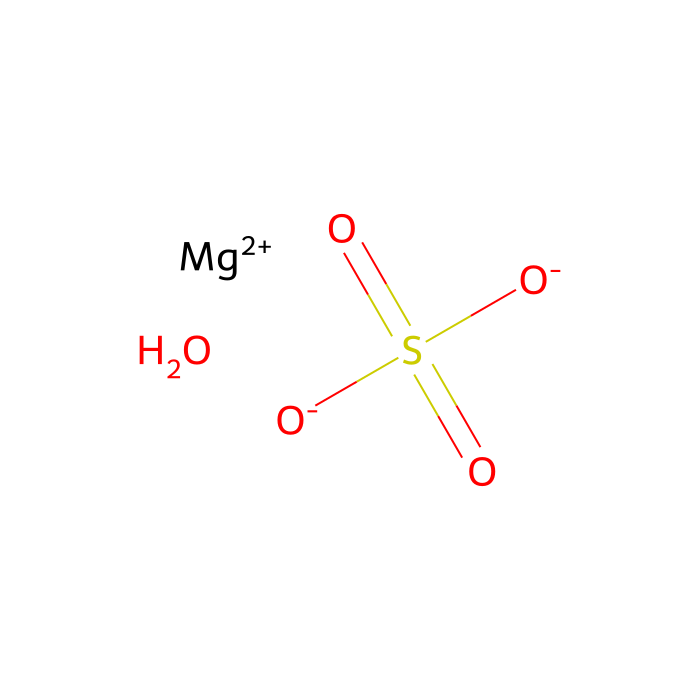
Preferred formula: MgSO4·H2O (also written as MgO4S·H2O)
Molecular weight: ~138.37 g/mol (literature)
Ions present: Mg2+ cation, SO4 2− anion; one molecule of water per formula unit (crystalline water of hydration)
Structural features: Infinite ionic lattice of octahedrally coordinated Mg2+ centers bridged by sulfate oxyanions and coordinated water. In 2D depiction, Mg2+ is centrally coordinated by oxygen atoms; sulfate is a tetrahedral SO4 unit.
Stereochemistry: Not applicable (inorganic salt lattice; no chiral centers).
Notes
Magnesium sulfate exists in multiple hydrates (n = 0, 1, 2, 3, 4, 5, 6, 7, etc.); the monohydrate (kieserite phase) contains exactly one equivalent of water per MgSO4, making it useful where a defined, low water content is required compared with the heptahydrate.
Synthetic Utility
Literature/general synthetic roles
Inorganic precursor: Convenient solid source of Mg2+ for preparing magnesium hydroxide (by basification), basic magnesium carbonates (via CO2 at alkaline pH), or magnesium silicates (via metathesis with soluble silicates).
Sulfate metathesis: Supplies SO4 2− for precipitation of insoluble sulfates (e.g., BaSO4, PbSO4) for separations, qualitative analysis, or as fillers/pigments.
Solid-state transformations: Thermal treatment enables stepwise dehydration (MgSO4·H2O → MgSO4) and eventual conversion to MgO under suitable high-temperature conditions; useful for generating MgO with controlled impurity inputs.
Materials templating: As a kosmotropic salt, MgSO4 can promote phase separation or pore formation in polymer/silica systems; salt leaching after solidification yields porous matrices.
Electrolyte preparation: Forms well-defined aqueous electrolytes for corrosion testing or electrodeposition studies where avoidance of chloride is desired.
Practical techniques
Stoichiometry: Use the monohydrate FW (~138.37 g/mol, literature) for charge balance and precipitation calculations.
pH control: For hydroxide/carbonate precipitations, maintain pH 9–11 while adding MgSO4 solution slowly to minimize amorphous gel formation and to tune particle size.
Washing: Precipitates formed in sulfate media may occlude sulfate; thorough washing or ion-exchange steps may be needed when sulfate carryover is detrimental.
Target Specificity
Not applicable. This product is an inorganic salt, not a biological targeting reagent (e.g., antibody, ligand, or inhibitor). No antigen/epitope, species reactivity, clone, or isotype information applies.
We use cookies to ensure the website functions properly and, where permitted, to improve your experience. You can manage your preferences at any time in Settings. Learn more in our Cookie Policy.
Shall we send you a message when we have discounts available?
Remind me later
Thank you! Please check your email inbox to confirm.
Products are supplied to verified businesses, institutions, and qualified professionals for research and development use only. Not for use in humans, animals, diagnosis, or therapy.

 F1723074