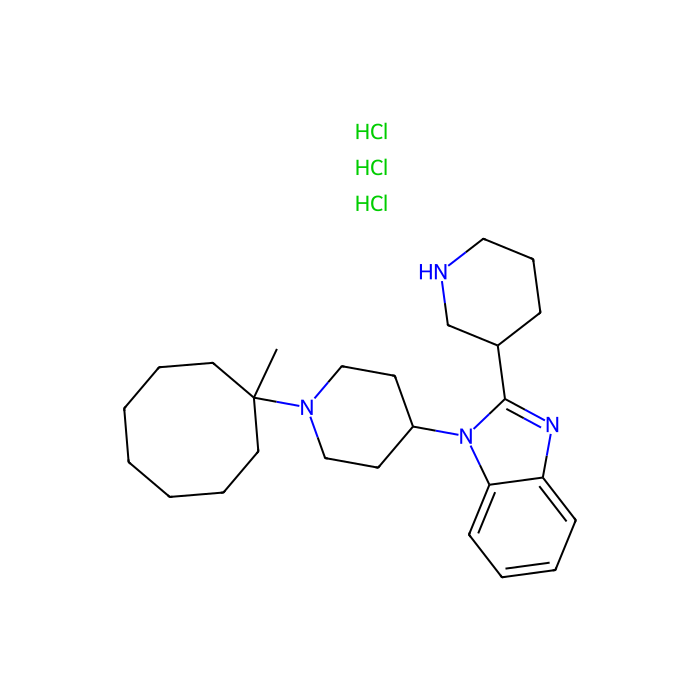
MCOPPB triHydrochloride | 1-[1-(1-Methylcyclooctyl)piperidin-4-yl]-2-[(3R)-piperidin-3-yl]benzimidazole trihydrochloride | MCOPPB 3HCl | MCOPPB (triHydrochloride) | 1-[1-(1-methylcyclooctyl)-4-piperidinyl]-2-(3R)-3-piperidinyl-1H-Benzimidazole trihydrochloride | 1H-Benzimidazole, 1-(1-(1-methylcyclooctyl)-4-piperidinyl)-2-(3R)-3-piperidin Show more
Specifications & Purity
≥99%(HPLC)
Biochemical and Physiological Mechanisms
High affinity NOP receptor agonist (pKi= 10.07 for the human NOP receptor). Exhibits anxiolytic effects with no effect on memory or locomotion. Regarded as one of the most potent, non-peptide NOP full agonistsin vitro.
Storage
Store at -20°C
Shipped In
Ice chest + Ice pads
This product requires cold chain shipping. Ground and other economy services are not available.
This compound belongs to the class of organic compounds known as benzimidazoles. These are organic compounds containing a benzene ring fused to an imidazole ring (five member ring containing a nitrogen atom, 4 carbon atoms, and two double bonds).
External Descriptors
Not available
1. Djoumbou Feunang Y, Eisner R, Knox C, Chepelev L, Hastings J, Owen G, Fahy E, Steinbeck C, Subramanian S, Bolton E, Greiner R, and Wishart DS. ClassyFire: Automated Chemical Classification With A Comprehensive, Computable Taxonomy. Journal of Cheminformatics, 2016, 8:61.
Solvent:water, Max Conc. mg/mL: 16.02, Max Conc. mM: 30; Solvent:DMSO, Max Conc. mg/mL: 32.04, Max Conc. mM: 60
Molecular Weight
518
XLogP3
Hydrogen Bond Donor Count
4
Hydrogen Bond Acceptor Count
3
Rotatable Bond Count
3
Exact Mass
516.255 Da
Monoisotopic Mass
516.255 Da
Topological Polar Surface Area
33.100 Ų
Heavy Atom Count
33
Formal Charge
0
Complexity
535.000
Isotope Atom Count
0
Defined Atom Stereocenter Count
1
Undefined Atom Stereocenter Count
0
Defined Bond Stereocenter Count
0
Undefined Bond Stereocenter Count
0
The total count of all stereochemical bonds
0
Covalently-Bonded Unit Count
4
Solution Calculators
Molarity Calculator
Determine the necessary mass, volume, or concentration for preparing a solution.
Dilution Calculator
Determine the dilution needed to prepare a stock solution.
Reconstitution Calculator
Reviews
Customer Reviews
Application Protocols
No tested applications, protocols, or recommended dilutions are provided in the Product Data for MCOPPB trihydrochloride. As this is not an antibody or kit, standardized protocols are not applicable.
Item-specific guidance: Not specified for this item; refer to CoA/Spec Sheet and SDS.
Note: Users should develop and validate assay-specific procedures (e.g., stock preparation, dilution schemes, plate-based workflows) appropriate to their instruments and endpoints.
Biological Roles
Item-specific biological targets, modes of action, or endogenous roles are not provided in the Product Data for MCOPPB trihydrochloride.
General notes for research small molecules (not item-specific):
Synthetic origin: As a library member, the compound has no known endogenous metabolic role unless otherwise documented in literature.
Use in discovery: Such compounds are commonly profiled across biochemical or cell-based panels to identify potential target interactions; follow-up validation (orthogonal biophysical/biochemical assays) is essential to confirm specificity and rule out assay interferences (e.g., aggregation, redox cycling, fluorescence artifacts).
Salt effects: The trihydrochloride counterions contribute chloride and acidity; consider potential effects on chloride-sensitive transporters or channels when used at high concentrations in cellular systems.
Caveat: Without item-specific literature or data from the manufacturer, no biological function or pathway association can be asserted. Users should develop their own target/phenotype hypotheses and validate rigorously.
Buffer Applications
There is no item-specific buffer recipe or pKa data in the Product Data. The compound is not a classical buffering reagent. However, the trihydrochloride salt form informs practical dissolution strategies (general guidance, not item-specific):
Stock solutions: Prepare concentrated stocks in water or DMSO. If using water, slight acidification (e.g., 0.1% HCl) can help maintain full solubility for basic salts.
Working solutions: Dilute into assay buffers compatible with your system (e.g., PBS, HEPES, or acetate). To minimize precipitation, match ionic strength and keep organic co-solvent below assay tolerance.
pH considerations: Protonated amines are more soluble at lower pH. If precipitation occurs near neutral pH, adjust pH modestly (while staying within biological compatibility) or increase dilution.
Filtration: For sterilization or particulate removal, 0.22 µm PVDF or PTFE filters are typical. Pre-wet with solvent to reduce binding; assess analyte loss by measuring pre/post filtration concentration.
Note: Since this is not a buffer component, standard buffer-making (target pH, conjugate acid/base ratios) does not apply directly. Verify stability and solubility in your selected buffer experimentally.
Green Alternatives
This section is typically focused on replacing hazardous solvents or reagents. For a discrete research compound (MCOPPB trihydrochloride), green chemistry considerations relate to handling and solution preparation rather than substitution of the compound itself.
Practical green considerations (general, not item-specific):
Solvent choice: Prefer water or aqueous buffers for stock/dilutions when compatible with your assay. If an organic co-solvent is necessary, consider ethanol or isopropanol before higher-toxicity options; DMSO remains common but should be minimized in biological assays (<0.5–1% v/v final).
Waste minimization: Prepare concentrated master stocks to reduce solvent volumes and freezer space. Use micro-aliquots to minimize freeze–thaw cycles and disposal.
Energy: Store at the recommended −20°C, but avoid unnecessary ultra-low temperatures if not required by stability data.
Analytical methods: Use shorter UPLC methods and aqueous mobile phases where possible to reduce solvent consumption.
Applicability note: Because this product is a specific small molecule rather than a process reagent or solvent, substitution with a “greener alternative compound” is generally not applicable. Instead, emphasize greener solvents and right-sizing experiments to reduce waste.
Pharmaceutical Uses
No pharmacopeial status, excipient role, or GMP-related information is provided for this product. It is labeled for research use only.
General context (not item-specific):
Discovery phase use: Such small molecules are commonly utilized in medicinal chemistry and pharmacology research settings for in vitro or exploratory in vivo studies under appropriate institutional approvals. They are not intended for human or veterinary use.
Formulation screening: Salt forms (e.g., trihydrochloride) are often evaluated in preformulation to enhance solubility and stability; any translation beyond research requires comprehensive CMC development, which is outside the scope of this product.
Regulatory: Absence of compendial monographs (USP/EP/JP) and GMP documentation precludes use in clinical manufacturing.
Conclusion: Treat this material strictly as a research chemical. For any development activities, generate full specifications, stability data, and regulatory documentation independently.
Physical Properties
Item-specific specifications are not provided in the Product Data. Do not treat the following general notes as specifications.
Item-specific (from Product Data):
Appearance: Not specified for this item; refer to CoA/Spec Sheet.
Molecular weight: Not specified for this item; refer to CoA/Spec Sheet.
Literature/general expectations for small-molecule trihydrochloride salts (not item-specific):
Physical state: Often crystalline or microcrystalline solids; color ranges from white to off-white depending on chromophores and trace impurities.
Melting point: Salt forms may show decomposition or broad melt ranges; exact MP is structure-dependent.
Solubility: Trihydrochloride salts commonly display high solubility in water and polar protic/aprotic solvents (e.g., water, methanol, ethanol, DMSO). Actual solubility must be confirmed experimentally.
pKa: The free base typically contains multiple basic sites; protonation equilibria result in a strongly cationic species under neutral conditions. Exact pKa values are structure-specific.
Hygroscopicity: Polyhydrochloride salts can be hygroscopic, absorbing atmospheric moisture; handling under dry conditions is often beneficial.
LogP/logD: Protonation substantially decreases apparent logD at physiological pH versus the free base; measured values depend on structure.
UV–Vis: Many drug-like scaffolds exhibit UV absorption in the 190–300 nm region; an actual spectrum requires measurement.
Recommendation: For precise BP/MP/solubility/UV cutoff, consult the certificate of analysis (CoA) or measure under your assay conditions.
Quality & Grades
Item-specific quality information:
Grade/Purity: Not specified for this item; refer to CoA/Spec Sheet.
Interpretation and best practices (general, not item-specific):
Research grade: In the absence of a stated pharmacopeial grade, materials in discovery libraries are typically intended for research use only and are not manufactured to GMP or pharmacopoeial monographs. Batch-specific purity, residual solvents, and identity are established by analytical methods listed on the CoA (e.g., HPLC/UPLC purity, NMR, MS).
Counterion identity: Trihydrochloride indicates three equivalents of HCl as counterions; CoA typically confirms chloride content and overall assay for the salt form.
Stabilizers: None are listed for this item. If stabilizers are present in a future batch, the CoA should disclose type and level, with implications for UV background or reactive impurities.
Trace specifications: Water content, inorganic residues, or metal ion limits are not specified here. For regulated workflows, request full specifications and analytical methods.
Recommendations:
Review the lot-specific CoA for assay, identity, and impurity profile.
If low-UV applications (e.g., HPLC detectors at 210–230 nm) are planned, verify UV background and baseline stability using your mobile phase.
For quantitative biology assays, verify salt factor (free-base equivalent) using chloride assay or NMR for accurate dosing.
Reaction & Applications
This product is supplied as a finished small molecule for research use (discovery screening, assay development). No manufacturer application notes are provided in the Product Data. The following are general, non-item-specific use cases:
Screening and SAR: Suitable for inclusion in biochemical, cell-based, or biophysical assays to probe pathways or target classes. Confirm target engagement with orthogonal methods (e.g., thermal shift, SPR, enzymatic kinetics) where applicable.
Reference control: In phenotypic screens, a characterized small molecule can serve as a positive/negative control if its activity is independently verified in your lab. Given the absence of target data here, users should establish their own benchmarks.
Analytical characterization: For QC or method development, use as a representative polycationic analyte to optimize HPLC/UPLC methods (acidic mobile phases often improve peak shape for basic salts).
Form determination: Evaluate the salt factor (free-base equivalent) for accurate dosing in molar terms; employ ion chromatography or quantitative NMR.
Solid-state studies: Trihydrochloride salts can exhibit polymorphism; PXRD and DSC/TGA can be used to characterize form stability under assay storage conditions.
Note: No specific biological target, potency, or mode-of-action is provided for this item. Avoid assuming pharmacology without independent verification under your assay conditions.
Reaction Conditions
No item-specific reaction conditions are applicable because MCOPPB trihydrochloride is provided as a finished small molecule for research use rather than as a reagent or catalyst.
General notes (not item-specific):
If converting to the free base for further chemistry, conduct basification at low temperature to control potential decomposition, and use inert atmosphere if the scaffold is air/moisture sensitive (unknown here). Extract promptly into an appropriate organic solvent and dry thoroughly.
For analytical method development (HPLC/UPLC), acidic mobile phases (e.g., 0.05–0.1% formic acid or TFA in water/acetonitrile) often sharpen peaks of basic analytes. Column selection: C18 or polar-embedded phases; temperature 30–40°C can improve reproducibility.
Because the structure and functional groups are not specified in the Product Data, no specific temperatures, catalysts, or yields can be responsibly provided.
Safety & Handling
Authoritative safety information is provided in the SDS; the notes below are general guidance only.
Item-specific (from Product Data):
GHS classification, pictograms, signal word, H-statements: Not specified for this item; refer to SDS.
Storage: Store at −20°C.
Shipping: Shipped in ice chest with ice pads.
General laboratory precautions for small-molecule polyhydrochloride salts (not item-specific):
Likely hazards: Many research chemicals may cause skin/eye irritation or respiratory irritation. Avoid inhalation of dust and contact with skin/eyes.
PPE: Lab coat, safety glasses, and appropriate chemical-resistant gloves (e.g., nitrile). Handle powders in a fume hood or ventilated enclosure to minimize dust exposure.
Incompatibilities: Strong bases may liberate the free base; strong oxidizers should be avoided unless intended. Hygroscopic salts may clump—keep container tightly closed with desiccant.
First aid (general): If inhaled—move to fresh air. If on skin—wash with soap/water. If in eyes—rinse cautiously with water for several minutes and remove contact lenses if present. If ingested—rinse mouth and seek medical attention. Always follow your institutional emergency procedures.
Spill/cleanup: Avoid dust generation; collect by gentle sweeping or HEPA vacuum. Dispose according to local regulations.
Always consult the SDS for definitive hazard classifications and response measures before use.
Solvent Selection
Item-specific solubility data are not provided; the following are general considerations for small-molecule trihydrochloride salts (not item-specific):
Polarity class: As a polycationic salt, the compound is expected to be polar and typically dissolves in water and polar organic solvents.
Common stock solvents: DMSO and water are standard for screening stocks. For salt forms, water or aqueous buffers often afford rapid dissolution; DMSO can be used for high-concentration master stocks when compatible with the assay.
Miscibility profile: DMSO mixes with water in any ratio, enabling serial dilutions into aqueous assay buffers. Methanol or ethanol may also be used for intermediate stocks if required by downstream workflows.
pH influence: Solubility generally increases under acidic conditions for basic amines. If precipitation occurs upon dilution into neutral buffers, pre-acidify the diluent slightly (e.g., 0.1–1% v/v HCl) or reduce organic content to minimize salting-out. Validate against assay tolerance.
Counterion considerations: The presence of chloride may increase ionic strength; for sensitive biophysical assays (ITC, MST), match ionic strength across samples/controls.
Comparison notes (general):
Free base vs. HCl salt: Free bases can offer better solubility in nonpolar solvents but are less stable toward CO2 uptake; HCl salts typically provide better aqueous solubility and handling. Conversion between forms should be verified analytically.
Storage & Reconstitution
Item-specific (from Product Data):
Storage: Store at −20°C.
Shipping: Shipped in ice chest with ice pads.
Additional general guidance (not item-specific; verify with your CoA/SDS):
Container: Keep tightly closed in the original vial. If hygroscopic, include desiccant and minimize headspace/exposure time at ambient humidity.
Aliquoting: Upon first opening, consider preparing single-use or small working aliquots to avoid repeated freeze–thaw and moisture uptake.
Reconstitution: If solubility data are absent, start with sterile water or DMSO to make a concentrated stock (e.g., 10–50 mM, as solubility permits). If using water, slight acidification (e.g., 0.1% HCl) may aid dissolution of basic salts. Filter-sterilize if required for cell-based assays (0.22 µm).
Stability: Without item-specific stability data, store solutions at −20°C or below and protect from light if the scaffold contains chromophores. Use fresh working dilutions the day of the experiment and discard after use unless stability is verified.
Always consult the lot-specific CoA and SDS for authoritative instructions on storage, handling, and solution stability.
Structure & Identity
Overview: MCOPPB trihydrochloride is supplied as a research-use small molecule salt form, suitable for screening and discovery workflows.
SMILES: Not specified for this item; refer to CoA/Spec Sheet.
Molecular formula: Not specified for this item; refer to CoA/Spec Sheet.
Molecular weight: Not specified for this item; refer to CoA/Spec Sheet.
Structural notes (general/literature context, not item-specific):
“Trihydrochloride” typically indicates a polycationic free-base scaffold (often with three basic nitrogens) isolated as the 3HCl salt. This salt form frequently improves aqueous solubility, handling, and stability under ambient CO2 exposure versus the free base.
Without a supplied structure, specific functional groups, ring systems, and stereochemistry for MCOPPB cannot be confirmed here. Consult the CoA/SDS or primary literature for definitive structural details.
2D description (general):
As a trihydrochloride, the solid typically comprises the protonated organic cation paired with three chloride anions; hydrogen-bonding networks can influence crystallinity and hygroscopicity. Exact atom connectivity and substituent patterns are not specified in the current item data.
Synthetic Utility
As supplied, MCOPPB trihydrochloride is a finished small molecule intended for screening and research, not a general-purpose synthetic reagent. No reactive functional group information is provided in the Product Data; therefore, specific transformations cannot be recommended.
General considerations for polyamine hydrochloride salts (not item-specific):
Free-base liberation: If synthetic derivatization is desired, the free base may be generated by basification (e.g., NaHCO3/Na2CO3 or stronger organic bases) followed by extraction into an organic solvent. Verify identity and purity after neutralization.
Salt interconversion: Alternative salts (e.g., mesylate, tartrate) can be prepared to explore solid-state properties; confirm stoichiometry and polymorph via analytical methods (NMR, PXRD, TGA/DSC).
Derivatization: If nucleophilic amines are present in the free base, acylation, sulfonylation, alkylation, or carbamate formation are typical routes to analogs. Reaction conditions must be tailored to the actual structure, which is not provided here.
Given the lack of structural details for this specific item, treat any synthetic modification as exploratory and confirm all intermediates/products with orthogonal analytics.
Target Specificity
No target, pathway, or binding specificity information is provided for MCOPPB trihydrochloride in the Product Data.
Antigen/epitope/clone/isotype: Not applicable (not an antibody product).
Target class, IC50/Ki/EC50: Not specified for this item; refer to literature or generate in-house data.
Users should establish target engagement and selectivity experimentally using orthogonal assays suited to their system.
Frequently Asked Questions
What documentation is provided?
Available product documentation, including Certificates of Analysis (COA), Safety Data Sheets (SDS), and specification sheets, is shown in the product document area. Document availability and access follow the current site policy.
What is the purity of this product, and how is it determined?
This product is supplied at ≥99% purity, determined by HPLC. Lot-specific values are stated on the Certificate of Analysis.
How should this product be stored?
Store at ?20 °C. Freezer storage is required to maintain the specified shelf life.
How is this product shipped?
This product ships in an insulated container with ice pads. Unpack on arrival and transfer it to the storage condition stated above.
What are the CAS number, molecular formula and molecular weight?
The CAS Number is 1108147-88-1, the molecular formula is C??H??N?.?HCl, and the molecular weight is 534.05 g/mol. InChIKey DTIPEVOPCGEULQ-RFCADEKQSA-N.
We use cookies to ensure the website functions properly and, where permitted, to improve your experience. You can manage your preferences at any time in Settings. Learn more in our Cookie Policy.
Shall we send you a message when we have discounts available?
Remind me later
Thank you! Please check your email inbox to confirm.
Products are supplied to verified businesses, institutions, and qualified professionals for research and development use only. Not for use in humans, animals, diagnosis, or therapy.