This compound belongs to the class of organic compounds known as 5-alkyl-2-carboxypyrimidines. These are pyrimidine-2-carboxylic acids that carry an alkyl group at the 5-position of the pyridine ring.
External Descriptors
Not available
1. Djoumbou Feunang Y, Eisner R, Knox C, Chepelev L, Hastings J, Owen G, Fahy E, Steinbeck C, Subramanian S, Bolton E, Greiner R, and Wishart DS. ClassyFire: Automated Chemical Classification With A Comprehensive, Computable Taxonomy. Journal of Cheminformatics, 2016, 8:61.
Determine the necessary mass, volume, or concentration for preparing a solution.
Dilution Calculator
Determine the dilution needed to prepare a stock solution.
Reconstitution Calculator
Reviews
Customer Reviews
Application Protocols
Not applicable. No validated biological assay protocols (e.g., WB, IHC, IF, FC) are provided for this small-molecule reagent. For synthetic use, follow standard organic chemistry procedures relevant to the chosen transformation (see Reaction Conditions and Synthetic Utility tabs).
Biological Roles
This product is intended for research use as a synthetic building block. No direct biological role or function is assigned to methyl 5-methylpicolinate in vivo.
General context (literature; not product-specific and not a medical claim):
Picolinic acid is an endogenous metabolite from tryptophan catabolism (kynurenine pathway) and is a known N,O-bidentate chelator; 5-substitution modulates its electronic and coordination properties.
Methyl picolinate esters are commonly utilized as protected forms of picolinic acids for synthetic manipulation and for preparing ligands, probes, and coordination complexes after deprotection.
The pyridine nitrogen and ester carbonyl confer metal-binding potential once converted to the corresponding acid or amide, relevant for biomimetic coordination studies.
For use in any biological assays or labeling experiments, ensure appropriate purification, removal of residual solvents, and verification of identity and purity by analytical methods (NMR, LC–MS, HPLC).
Buffer Applications
Not typically applicable. Methyl 5-methylpicolinate is an aromatic ester, not a buffering agent. For experiments requiring controlled pH, select established buffer systems (e.g., phosphate, HEPES, MOPS) and use this compound as a substrate/intermediate in separate reaction steps as needed.
Green Alternatives
While the substance itself is a target building block rather than a solvent, greener choices can be applied to its handling and transformations.
Greener solvent choices (for typical operations):
Replace DCM with EtOAc, MTBE, or CPME for extractions and medium-polarity reactions when feasible.
Use 2-MeTHF or CPME instead of THF for reductions and nucleophilic substitutions; both offer improved safety and sustainability profiles (renewable feedstock for 2-MeTHF, reduced peroxide formation rates vs THF; still monitor peroxides when appropriate).
Favor MeCN or green amide alternatives (e.g., propylene carbonate) over DMF/NMP when processing allows.
Greener reagents/conditions:
Ester hydrolysis: aqueous base (Na2CO3/K2CO3) in water-alcohol mixtures at ambient temperature can replace strong base/acid conditions.
Reductions: catalytic hydrogenation to alcohols or aldehydes (with appropriate catalysts) can reduce waste vs stoichiometric hydrides, though selectivity must be managed.
Oxidations at the benzylic methyl: adopt metal-free or oxygen-based protocols (e.g., TEMPO/O2, aerobic photocatalysis) in place of Cr(VI) or Se-based reagents when compatible.
Trade-offs (general):
2-MeTHF/CPME may change solubility and reaction rates vs THF; process optimization is required.
EtOAc is greener than DCM but less effective for very polar substrates or Lewis-acid-catalyzed steps; mixed solvent systems can balance performance and sustainability.
Pharmaceutical Uses
No excipient or pharmacopeial status is specified for this item; refer to CoA/Spec Sheet.
General, non-clinical context:
Methyl 5-methylpicolinate is employed as a synthetic intermediate in discovery and process chemistry to access 5-substituted picolinic acids, amides, hydroxamates, and related scaffolds found in agrochemical and pharmaceutical research libraries.
The ester serves as a protecting/activating group to enable convergent assembly of heteroaromatic ligands and fragments. After functionalization at the ring or benzylic position, saponification/amide coupling yields target analogs.
For any use in GMP settings, material qualification (identity, purity, residual solvents, and elemental impurities) must be established per applicable guidelines; this listing is for research use only.
Physical Properties
Item-specific values (grade-specific specs such as exact bp, mp, density, UV cutoff, metal limits) are Not specified for this item; refer to CoA/Spec Sheet.
Literature/general properties for the chemical identity (for reference; not product specifications):
Physical state at ambient conditions: typically a colorless to pale liquid or low-melting solid for many methyl picolinate isomers (literature).
Approximate formula and mass (literature): C8H9NO2, Mr ~151.16 g/mol.
Polarity/functional class: polar, aprotic, heteroaromatic ester; capable of H-bond acceptance (ring N, carbonyl O) but not donation.
Solubility profile (qualitative, literature):
Good solubility in common organic solvents (e.g., dichloromethane, ethyl acetate, THF, acetonitrile, toluene, alcohols).
Very low solubility in water expected for aryl methyl esters with a single ring nitrogen.
Acid–base character (literature):
Pyridine N basicity attenuated by ortho ester; typical pyridine pKaH ca. 5.2; 2-carboxylate substitution generally decreases basicity slightly (qualitative guidance only).
Partitioning (literature): aryl methyl esters with one ring nitrogen often show moderate lipophilicity (estimated logP in the ~1–2.5 range depending on isomer; qualitative guidance only).
Quality & Grades
Grade/Purity: Not specified for this item; refer to CoA/Spec Sheet.
Appearance: Not specified for this item; refer to CoA/Spec Sheet.
Guidance on typical grades for this compound class (general, non-specification):
Research/technical grade methyl picolinate derivatives are commonly supplied at >95% GC/HPLC purity for synthetic use. Higher purities (≥98–99%) reduce background in sensitive steps (e.g., metal-catalyzed couplings, chiral resolutions), but the optimal grade depends on application.
UV/Chromatography considerations: Aromatic esters and pyridines absorb in the UV; for photometric applications (e.g., as internal standards), low-UV-absorbance solvent residues and minimal UV-active impurities are preferred. HPLC-grade diluents are recommended for analytical work.
Stabilizers/antioxidants: Not typically required for this scaffold; however, strictly anhydrous handling limits ester hydrolysis and preserves purity. If a stabilizer is present in a specific lot, consult the CoA for identity and removal procedures if necessary.
Documentation and traceability:
Request CoA for each lot to confirm identity (1H/13C NMR, MS), purity (GC/HPLC), and residual solvents.
If metal content matters (e.g., for catalysis-limited synthesis), ask for metal screening results; otherwise, trace metals are generally not controlled for this class unless specified.
Reaction & Applications
Methyl 5-methylpicolinate is a versatile heteroaromatic building block combining a pyridine ring and an activated aryl ester. Its orthogonal reactivity enables diverse synthetic routes.
Key application families (literature/general):
Ester transformations:
Hydrolysis to 5-methylpicolinic acid (acid or base conditions); subsequent coupling to amides or hydroxamates.
Aminolysis/alcoholysis to 2-carboxamide or 2-carbonate analogs under nucleophilic catalysis or with activating agents (e.g., DMAP).
Reductions: DIBAL-H or related hydrides to the corresponding aldehyde; LiAlH4/borane to benzyl-type alcohols. Catalytic hydrogenation of the ester is typically more challenging without activation.
Heteroaromatic nitrogen chemistry:
N-oxidation (mCPBA, H2O2 systems) to the N-oxide, enabling directed C–H functionalization (e.g., at C-4/C-6) and subsequent deoxygenation.
N-alkylation to pyridinium salts, tuning electronic properties and enabling SNAr-like substitutions on activated positions.
Benzylic (5-methyl) modifications:
Oxidation (e.g., SeO2, MnO2, Cr-free oxidants) to the 5-formyl or 5-carboxyl derivatives, expanding ligand libraries.
Radical bromination (NBS/AIBN) for subsequent substitution (e.g., to amines, azides) or cross-couplings after conversion to organoboron/organostannane.
Coordination chemistry precursors:
5-Substituted picolinates serve as chelating motifs (N,O-bidentate) in catalysts, MOF linkers, and luminescent metal complexes after saponification to the acid.
Practical notes:
The ortho-ester relative to the ring nitrogen can influence reactivity via chelation and resonance; drying reagents/solvents suppress hydrolysis.
For metal-catalyzed C–H activation strategies, the N-oxide or transient directing groups are often employed to achieve site-selectivity.
Reaction Conditions
General literature guidance for common transformations of methyl 5-methylpicolinate (not product specifications):
Hydrolysis (to 5-methylpicolinic acid):
Basic: KOH or NaOH (1–2 M) in MeOH/H2O or THF/H2O, 25–50 °C, 2–6 h; typical isolated yields high (70–95%) after acidification and extraction.
Acidic: HCl (6 M) or H2SO4 (aq)/dioxane, reflux, longer times; choose when base-sensitive groups are present elsewhere.
Amidation (from the acid):
HATU/DIPEA or EDCI/HOBt in DMF/MeCN, 0–25 °C, 1–12 h; often 70–95% yields with suitable nucleophiles.
Reduction of ester:
DIBAL-H (1.0–1.5 equiv) in toluene/2-MeTHF at −78 to −20 °C to aldehyde; quench at low temperature to avoid over-reduction.
LiAlH4 (2–3 equiv) in THF at 0–25 °C to give primary alcohol; 1–3 h; careful quench.
Benzylic bromination (5-methyl position):
NBS (1.1–1.2 equiv), AIBN (cat.), CCl4 or greener alternatives (PhMe, MeCN) under hv or 80–100 °C; 2–6 h; typically affords benzyl bromide in good yield; monitor for overbromination.
N-oxidation:
mCPBA (1.1–1.5 equiv) in DCM or EtOAc at 0–25 °C, 1–3 h; subsequent directed C–H functionalization conditions vary by transformation (Pd, Rh, Ru catalysts, 60–120 °C).
Notes:
Exclude moisture for reactions where ester hydrolysis is undesirable.
Coordinate bases (e.g., DMAP) can accelerate aminolysis/transesterification.
For scale-up, prefer safer solvents (EtOAc, 2-MeTHF) and catalytic oxidants/reductants when compatible.
Safety & Handling
Item-specific GHS information (signal word, hazard statements, pictograms, classification) is Not specified for this item; refer to SDS.
General laboratory safety guidance for heteroaromatic methyl esters (not product-specific; consult the SDS for authoritative data):
Hazards: Organic esters and pyridine derivatives may cause irritation to skin, eyes, and respiratory tract. Some picolinate esters can be harmful if swallowed or inhaled (literature/general).
PPE: Wear lab coat, safety glasses or goggles, and appropriate chemically resistant gloves (e.g., nitrile). Use in a fume hood to avoid inhalation exposure.
Handling: Avoid contact with strong acids/bases (can hydrolyze the ester) and strong oxidizers. Prevent inhalation of vapors/aerosols. Avoid prolonged exposure to air at elevated temperature.
Incompatibilities: Strong bases (saponification), strong acids (acidic hydrolysis), powerful oxidants (can oxidize benzylic methyl or pyridine ring). Avoid reducing agents that may target the ester unless intended.
First aid (overview):
Skin/eye contact: Rinse with water for at least 15 minutes; remove contaminated clothing; seek medical attention if irritation persists.
Inhalation: Move to fresh air; seek medical attention if symptoms occur.
Ingestion: Rinse mouth; do not induce vomiting; get medical attention.
Fire safety: Treat as combustible organic liquid/solid; use CO2, dry chemical, or foam. Thermal decomposition can release NOx and CO/CO2 (general for nitrogenous aromatics).
Always defer to the product’s SDS for definitive hazard and response information.
Solvent Selection
As a moderately polar, aprotic heteroaromatic ester, methyl 5-methylpicolinate dissolves well in common organic solvents. Selection depends on downstream transformation and workup.
Polarity/miscibility (general, literature):
Readily soluble in DCM, EtOAc, THF, MeCN, DMF/DMAc, DMSO, toluene, and alcohols; poorly soluble in water.
Choosing a solvent by operation:
Nucleophilic substitutions/aminolysis: Use polar aprotics (MeCN, THF, 2-MeTHF, CPME, DMF) to activate ester carbonyl and solubilize amines; add base as needed.
Hydrolysis (saponification): Alcohol/water or THF/water mixtures; for base-promoted conditions, MeOH/H2O with NaOH or K2CO3 is common.
Reductions (e.g., to alcohol/aldehyde): Use non-protic ethers (THF, 2-MeTHF) for hydride reagents; DCM or toluene for catalytic hydrogenations.
Metal-catalyzed steps on the pyridine ring (e.g., C–H activation after directing-group strategies): High-boiling polar solvents (NMP, DMAc) or mixed solvent systems may be beneficial.
Workup/crystallization:
Ester products often extract cleanly into EtOAc or MTBE from aqueous phases; anti-solvent trituration with hexanes/heptane can help remove nonpolar impurities.
Comparison (general guidance):
THF vs 2-MeTHF: 2-MeTHF is greener and less miscible with water, aiding separations; THF offers broader literature precedent.
DCM vs EtOAc: DCM provides faster kinetics and easy evaporation but is less green; EtOAc is preferred when feasible.
Storage & Reconstitution
Storage conditions (from Product Data): Store at room temperature.
Shipped in (from Product Data): Normal.
Appearance: Not specified for this item; refer to CoA/Spec Sheet.
General handling guidance (non-specification):
Keep container tightly closed under an inert headspace if available, especially for long-term storage, to limit moisture ingress and ester hydrolysis.
Store away from strong acids/bases and oxidizing agents. Protect from prolonged exposure to light and heat.
If solidification occurs (some aryl esters may crystallize at low temperature), gently warm to ambient and mix thoroughly before use.
Reconstitution: Not applicable; the product is supplied neat. For solution preparation, use dry, oxygen-free solvents when moisture-sensitive transformations are planned. Prepare stock solutions fresh or store aliquots in sealed vials to minimize repeated air/moisture exposure.
Always consult the product CoA/SDS for definitive storage stability and incompatibility details.
Research Use Note: For research use only.
Structure & Identity
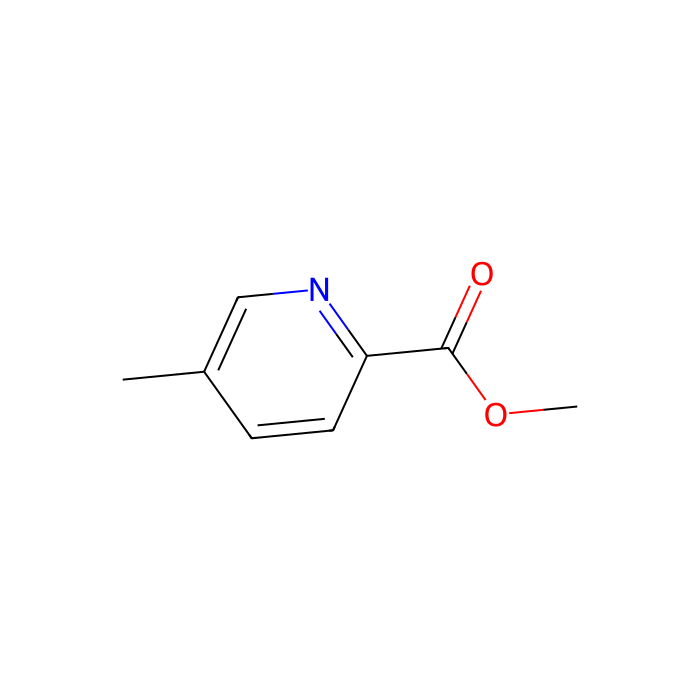
Methyl 5-methylpicolinate is a methyl ester of 5-methylpicolinic acid (pyridine-2-carboxylic acid), bearing a methyl substituent at the 5-position of the pyridine ring.
Item-specific identifiers (from Product Data):
CAS: 29681-38-7
PubChem CID: 268759
InChIKey: Not specified for this item; refer to CoA/Spec Sheet.
SMILES: Not specified for this item; refer to CoA/Spec Sheet.
Literature/computed identity (non-specification, for reference):
Preferred IUPAC name (literature): methyl 5-methylpyridine-2-carboxylate
Molecular formula (literature): C8H9NO2
Relative molecular mass (literature): ~151.16 g/mol
Heteroaromatic core: a six-membered pyridine ring (one ring nitrogen at position 1).
Ester functionality at the 2-position: pyridine-2-carboxylate methyl ester (–CO2Me) ortho to the ring nitrogen.
Alkyl substituent: methyl group at the 5-position (meta to N, para to the ester carbonyl).
Planarity: largely planar aromatic system with a conjugated ester; potential for intramolecular N→C(=O) conjugation affecting reactivity and NMR chemical shifts.
Functional groups: aromatic nitrogen (basic, can form N-oxide or pyridinium salts), aryl methyl (benzylic-type C–H), and an aryl ester (amenable to hydrolysis, reduction, and amidation).
Synthetic Utility
Strategic value arises from the combination of an ortho-ester relative to a ring nitrogen and a benzylic methyl at C-5.
Transformations (literature/general):
Carbonyl chemistry of the ester:
Hydrolysis → 5-methylpicolinic acid; then amidation (EDC/HOBt, HATU) or conversion to acid chlorides (SOCl2, Ghosez reagent) for coupling.
Reduction → aldehyde (DIBAL-H, −78 to 0 °C) or alcohol (LiAlH4, BH3·THF); selective partial reduction requires temperature and stoichiometry control.
Transesterification → alternate alkyl esters under acid catalysis or via alkoxide exchange.
Quaternization (MeI, BnBr) to pyridinium salts, facilitating subsequent nucleophilic substitutions on activated positions.
Benzylic methyl functionalization:
Radical bromination (NBS/AIBN, hv) to benzyl bromide, enabling displacement (e.g., to azide, amine) or further cross-coupling after conversion to boronate.
Oxidation to aldehyde/acid (e.g., KMnO4 under controlled conditions, or catalytic aerobic oxidation), expanding to 5-formyl/5-carboxy libraries.
Directed metalation/C–H activation: The ester/N-oxide can guide lithiation or transition-metal-catalyzed C–H activation at C-6/C-4, enabling arylation/alkylation.
Orthogonality: The ester tolerates mild electrophilic aromatic substitution poorly (pyridine is deactivated), but nucleophilic and metal-catalyzed routes are effective.
Target Specificity
Not applicable. This product is a small-molecule building block, not a biological targeting reagent (e.g., antibody, ligand with defined biomolecular target) in this listing. No antigen/epitope, species reactivity, clone, or isotype information applies.
We use cookies to ensure the website functions properly and, where permitted, to improve your experience. You can manage your preferences at any time in Settings. Learn more in our Cookie Policy.
Shall we send you a message when we have discounts available?
Remind me later
Thank you! Please check your email inbox to confirm.
Products are supplied to verified businesses, institutions, and qualified professionals for research and development use only. Not for use in humans, animals, diagnosis, or therapy.

 B2604029