GRADE & PURITYMoligand™?Moligand™ — Aladdin's line of ligands and bioactive small molecules. Use for receptor, pathway, and binding studies needing defined small-molecule tools.10 mM in DMSO
Moligand™, 10 mM in DMSO Moligand™ for sensitive chromatographic and analytical workflows requiring minimal baseline interference.
🌡
Storage & shipping
Desiccated,Store at -80°C Ships Dry ice packs + Cold packs Check lot-specific COA for exact specifications.
📋
Quality documents
SDS, COA, datasheet, and spec sheet available for download. Lot-specific COA accessible via lot number lookup.
📚
Literature proof
Cited in 0 peer-reviewed publications across chromatography, organic synthesis, and cross-coupling reactions.
Overview
Mifamurtide sodium (MTP-PE sodium), an analog of the muramyl dipeptide (MDP), is a nonspecific immunomodulator by stimulating the immune response activating macrophages and monocytes. Mifamurtide sodium is a specific ligand for NOD2 and acts as an insulin sensitizer. Mifamurtide sodium has potential for use in rare disease and osteosarcoma research.
Specifications
Specifications & Purity
Moligand™, 10 mM in DMSO
Storage
Desiccated,Store at -80°C
Shipped In
Dry ice packs + Cold packs
This product requires cold chain shipping. Ground and other economy services are not available.
Determine the necessary mass, volume, or concentration for preparing a solution.
Dilution Calculator
Determine the dilution needed to prepare a stock solution.
Reconstitution Calculator
Reviews
Customer Reviews
Application Protocols
Item-specific, tested application protocols and recommended working concentrations are not provided for this product. Refer to the CoA/Spec Sheet and your laboratory SOPs.
General guidance (literature/context-only; not product instructions)
Stock preparation: Prepare a concentrated stock in DMSO or ethanol under anhydrous conditions; vortex and, if needed, brief sonication to ensure homogeneity.
Working solutions: Dilute into assay buffer or culture medium, keeping final organic solvent below system-specific tolerance (commonly ≤0.1–0.5% v/v).
Formulation option: For studies requiring enhanced dispersion, incorporate into preformed liposomes or mixed micelles, then characterize particle size and polydispersity.
Controls: Include vehicle controls and, where relevant, empty carrier controls to isolate ligand-specific effects.
Note: The above are literature-based considerations to aid planning and do not represent validated protocols for this specific lot or item.
Biological Roles
Scope: The following describes literature/general biological roles of mifamurtide-class molecules; it does not constitute medical or clinical claims and is provided solely to guide research use.
Mode-of-action context (literature/general)
Mifamurtide is a synthetic muramyl dipeptide (MDP) analog conjugated to a phosphatidylethanolamine lipid. Such compounds are known to engage innate immune recognition pathways associated with peptidoglycan sensing. In many systems, MDP analogs signal via cytosolic pattern-recognition receptors (e.g., NOD-family), leading to downstream transcriptional programs characteristic of innate immune activation.
The amphiphilic lipid tail can enhance membrane interactions and delivery of the MDP headgroup to intracellular compartments.
Research utility
Tool compound for dissecting macrophage/monocyte responses, NF-κB and MAPK pathway activation, cytokine/chemokine expression profiling, and synergy/antagonism with other innate stimuli.
Useful in exploring dose–response behaviors and tolerance phenomena to repeated peptidoglycan-pattern exposure in vitro.
Assay considerations
Activity depends on effective intracellular access and dispersion state; liposomal or micellar delivery often enhances functional readouts.
Include proper controls (vehicle, empty liposomes, and inactive analogs where available) to differentiate formulation effects from ligand-specific signaling.
Note: Specific bioactivity values, EC50 ranges, or cell-line sensitivities are not provided for this catalog item; consult primary literature for your model of interest.
Buffer Applications
This compound is not a buffering agent and is not typically used to control solution pH. Therefore, standard buffer formulation guidance (e.g., phosphate, HEPES, Tris systems) does not apply directly.
Practical notes for use with buffers (general)
Choose biologically compatible buffers (e.g., HEPES, PBS) appropriate to your assay system, ensuring the final co-solvent concentration (DMSO/ethanol) remains within acceptable limits.
Filter buffers to reduce particulates that can seed aggregation of amphiphiles.
Where liposomal or micellar carriers are used, prepare buffers with ionic strength and pH that maintain colloidal stability (avoid divalent cation concentrations that may bridge anionic headgroups).
Item-specific buffer instructions are not provided for this product; refer to your internal SOPs and CoA/Spec Sheet for any lot-specific recommendations.
Green Alternatives
Green chemistry considerations are generally framed for reaction solvents and reagents. For a bioactive amphiphile like mifamurtide sodium, the primary environmental footprint arises from formulation solvents and single-use plastics rather than from the active itself.
If organic stocks are needed, select lower-toxicity, more benign options at minimal concentrations (e.g., ethanol) over higher-toxicity carriers, provided assay compatibility is maintained.
Use small-volume, sealed aliquots to reduce waste from repeated freeze–thaw and to avoid discarding degraded material.
Illustrative comparison (literature/general)
DMSO vs Ethanol
DMSO: excellent solvency but can require higher dilution and may affect some cell phenotypes at ≥0.5–1% v/v.
Ethanol: greener profile and easier removal, but lower solvency; often acceptable at ≤0.5% v/v in many cell assays.
Operational practices
Employ microplate-based screening to minimize total mass used per experiment.
Consolidate cold shipments and use validated insulated shippers to reduce dry ice consumption.
Note: No specific greener substitute exists for the active ligand itself; optimization focuses on the solvent system, formulation, and workflow efficiency.
Pharmaceutical Uses
No therapeutic or clinical claims are made for this catalog item. The following notes are provided solely to inform formulation scientists and researchers working on preclinical studies.
Literature/general formulation context
Amphiphilic MDP–lipid conjugates like mifamurtide have been studied in liposomal formulations to improve dispersion and delivery in biological systems. Typical excipients in such research formulations include phosphatidylcholine and cholesterol, with controlled hydration and size-reduction steps (e.g., extrusion) to achieve target vesicle sizes.
The sodium form can aid handling and influence ionic interactions with membrane surfaces during formulation.
Considerations for preclinical research (general)
Excipient compatibility: Avoid surfactants or lipids that interfere with your biological readouts. Validate that residual organic solvent levels meet internal acceptance criteria.
Stability: Monitor for hydrolysis/oxidation of lipid chains and degradation of peptide/sugar moieties under storage and accelerated conditions.
Regulatory note
This Moligand™ product is not manufactured under GMP and is not intended for human or veterinary administration. For any translational work, source GMP-grade materials and follow relevant pharmacopeial and regulatory guidance.
Physical Properties
Item-specific data
Appearance: Not specified for this item; refer to CoA/Spec Sheet.
Molecular weight: Not specified for this item; refer to CoA/Spec Sheet.
Molecular formula: Not specified for this item; refer to CoA/Spec Sheet.
Other specifications (mp/bp, density, refractive index, water/peroxide/metal limits, UV cutoff): Not specified for this item; refer to CoA/Spec Sheet.
Literature/general behavior (for context; not product specifications)
Physical state: typically an amorphous to microcrystalline solid for the sodium salt; amphiphilic.
Solubility tendencies: poor intrinsic solubility in pure water as the free base/acid; the sodium salt and/or inclusion of co-solvents (DMSO, ethanol) and lipid carriers markedly improve apparent solubility and dispersion. Frequently handled via stock solutions in DMSO or via liposomal/micellar systems.
Aggregation: amphiphiles may exhibit critical aggregation/CMC-like behavior; dispersion quality strongly affects apparent activity in bioassays.
pKa/ionization: multiple ionizable groups (phosphate, peptide side chains, terminal amine/carboxylate) can yield pH-dependent charge states; sodium counterions stabilize anionic forms.
LogP/logD: overall amphiphilic character; hydrophobic lipid tail increases membrane affinity while polar headgroup supports aqueous dispersion with appropriate formulation.
Practical notes (general)
For analytical characterization, LC-MS with soft ionization and mixed-mode or HILIC chromatography are common choices for amphiphilic peptidoglycan derivatives.
Avoid prolonged warming of dry solid under humid air to minimize hygroscopic uptake and potential physical-state changes.
Quality & Grades
Item-specific
Grade: Moligand™ (Aladdin). This denotes a research-grade small-molecule/ligand product intended for discovery, screening, and mechanistic studies. It does not imply pharmacopeial compliance.
What Moligand™ typically implies (general guidance; not a substitute for item CoA)
Emphasis on identity confirmation and batch-to-batch consistency suitable for biochemical and cell-based assays.
Packaged to protect from moisture and thermal stress (see −80 °C storage guidance provided for this item).
Not a GMP material; not for human or veterinary use.
How to verify suitability
Consult the CoA/Spec Sheet for the specific lot to confirm identity test methods (e.g., LC-MS, HPLC purity), residual solvent profile, water content, counterion content, and any additives.
If your assay is sensitive to trace contaminants or endotoxin, perform in-house qualification (e.g., HPLC profiling, MS, LAL test) prior to large screens.
Stabilizers/Excipients
None are specified for this item; refer to CoA/Spec Sheet if stabilizers or bulking agents are used in the lyophilized form.
Documentation practices
Record lot, storage history, and number of freeze–thaw cycles. For assay reproducibility, prepare a master stock and aliquot under anhydrous conditions.
Reaction & Applications
This compound is supplied as a bioactive research ligand rather than as a general synthetic reagent. As such, conventional synthetic reaction applications (e.g., cross-coupling, reductions) are not typically relevant for mifamurtide sodium.
Research application context (literature/general)
Used as a molecular probe in immunology and innate immune signaling studies, particularly to interrogate pathways responsive to peptidoglycan derivatives.
Amphiphilicity and anionic character can influence membrane interactions; formulation strongly affects cellular uptake and distribution in in vitro systems.
Frequently evaluated in macrophage/monocyte models to study transcriptional responses, cytokine signatures, and pathway cross-talk. Appropriate negative controls and vehicle controls (DMSO, ethanol, liposomes without ligand) are essential.
Assay design tips (general)
Validate dispersion: dynamic light scattering (DLS) or simple turbidity checks help ensure consistent particle size when using lipid carriers.
Titrate vehicle: confirm that solvent or carrier concentrations are within tolerable limits for the biological system under study.
Time course: amphiphile uptake may be time-dependent; include kinetic sampling where informative.
Note: No item-specific bioassay performance data are provided here. Consult the literature and your internal SOPs for pathway readouts and controls appropriate to your model system.
Reaction Conditions
This product is not intended as a reagent for preparative chemical reactions; therefore, standard tables of reaction conditions (solvent, temperature, catalysts, expected yield) are not applicable.
General stability considerations (literature/general)
Hydrolytic sensitivity: phosphate esters and amide bonds may degrade under strongly acidic or basic conditions and at elevated temperatures.
Oxidative sensitivity: lipid chains can be susceptible to autoxidation; limit exposure to air and light, and consider antioxidants during forced-degradation studies (for research-only stability profiling).
Thermal constraints: avoid extended heating; many amphiphilic conjugates undergo phase transitions and aggregation changes with temperature that complicate handling.
If chemical modification is desired (e.g., pro-drugging, labeling), consult specialized literature on peptide–lipid conjugates and perform small-scale feasibility tests with rigorous analytical monitoring. No reaction-condition recommendations specific to this catalog item are provided.
Safety & Handling
Authoritative safety classification for this catalog item is not provided here. Always consult the product SDS for definitive information.
Item-specific status
GHS Classification: Not specified for this item; refer to SDS.
Signal Word: Not specified for this item; refer to SDS.
H-Statements/Pictograms: Not specified for this item; refer to SDS.
Research use note: For research use only.
Storage conditions (from Product Data): Desiccated, Store at −80 °C. Shipment: Dry ice packs + Cold packs.
General laboratory precautions (good practice; not product-specific)
PPE: lab coat, safety glasses, and appropriate chemically resistant gloves. Use a certified chemical fume hood to avoid aerosol exposure when weighing or reconstituting.
Handling: Amphiphilic, peptide–lipid molecules can generate fine particulate; avoid inhalation and dust formation. Use antistatic tools and slow addition of solvent to minimize foaming.
Incompatibilities: Strong oxidizers and strong acids/bases may degrade peptide and lipid functionalities; avoid prolonged exposure to reactive metals or elevated temperatures.
First aid (general): In case of contact, rinse affected area with water; seek medical attention according to institutional protocols. If inhaled, move to fresh air. If ingested, do not induce vomiting; consult medical support.
Spills: Absorb with inert material, avoid aqueous flush that may cause emulsification; decontaminate surfaces with suitable detergent and water while preventing environmental release.
Disposal: Treat as organic laboratory waste per local regulations; avoid drain disposal.
Solvent Selection
Applicability: As an amphiphilic, peptidoglycan–phospholipid analog, mifamurtide sodium often requires thoughtful solvent and formulation selection to ensure homogeneous solutions or dispersions.
General solvent/formulation guidance (literature/general; not item specifications)
Primary stock solvents: DMSO is commonly used for concentrated stocks; ethanol or isopropanol can also be used, sometimes in combination with aqueous buffers.
Aqueous dispersion: Direct dissolution in pure water may be limited. Incorporating co-solvents (2–10% DMSO or ethanol) or employing mild surfactants/lipid carriers facilitates dispersion.
Lipid carriers: Liposomal or micellar systems (e.g., phosphatidylcholine/cholesterol) are often used for amphiphiles of this class to improve colloidal stability and bioassay performance.
pH considerations: Ionizable groups (phosphate/peptide) mean solubility and aggregation can be pH-dependent; neutral to slightly basic buffers often improve apparent solubility while minimizing hydrolysis.
Comparison (general)
DMSO: maximal solvency, miscible with water; may require dilution below assay tolerance.
Ethanol: compatible with many bioassays at ≤0.5–1% v/v; lower solvency than DMSO.
Aqueous buffers alone: often inadequate without co-solvent or formulation aid for amphiphiles; risk of aggregation/precipitation.
Practical tips
Warm gently (room temperature) and vortex/sonicate briefly to aid dissolution; avoid prolonged heating.
Filter through low-protein-binding membranes (e.g., PVDF, 0.22 µm) only after ensuring no significant adsorption losses.
Storage & Reconstitution
Item-specific storage and shipping
Storage conditions (from Product Data): Desiccated, Store at −80 °C.
Shipped in: Dry ice packs + Cold packs.
Reconstitution
Item-specific reconstitution instructions, concentration limits, and diluents: Not specified for this item; refer to CoA/Spec Sheet.
General handling guidance (literature/context-only)
Allow vial to equilibrate to room temperature in a desiccator before opening to avoid moisture condensation.
Prepare a dry, concentrated stock (e.g., in DMSO or ethanol) under anhydrous conditions. Mix thoroughly; brief sonication can assist dissolution of amphiphiles. If using aqueous buffers, consider co-solvent or lipid carriers to prevent aggregation.
Aliquot immediately after initial dissolution to minimize freeze–thaw cycles; store aliquots at −80 °C in tightly sealed, low-bind tubes.
Protect from light and air to limit oxidative degradation of lipid chains; consider inert gas backfill for long-term storage.
Monitor integrity periodically by LC-MS/HPLC.
Stability disclaimer
No item-specific shelf-life or stability data are provided here. Actual stability depends on concentration, solvent system, container, headspace, and temperature. Always verify suitability of stored solutions before critical experiments.
Structure & Identity
Concise overview: Mifamurtide sodium is a research-grade, amphiphilic small-molecule ligand supplied under Aladdin’s Moligand™ line for exploratory and screening use.
Item-specific identifiers
SKU: M1496541
CAS: 90825-43-7
Grade: Moligand™
Molecular formula: Not specified for this item; refer to CoA/Spec Sheet.
Molecular weight: Not specified for this item; refer to CoA/Spec Sheet.
SMILES: Not specified for this item; refer to CoA/Spec Sheet.
InChIKey: Not specified for this item; refer to CoA/Spec Sheet.
PubChem CID (catalog reference): 76972714
Structural description (literature/general)
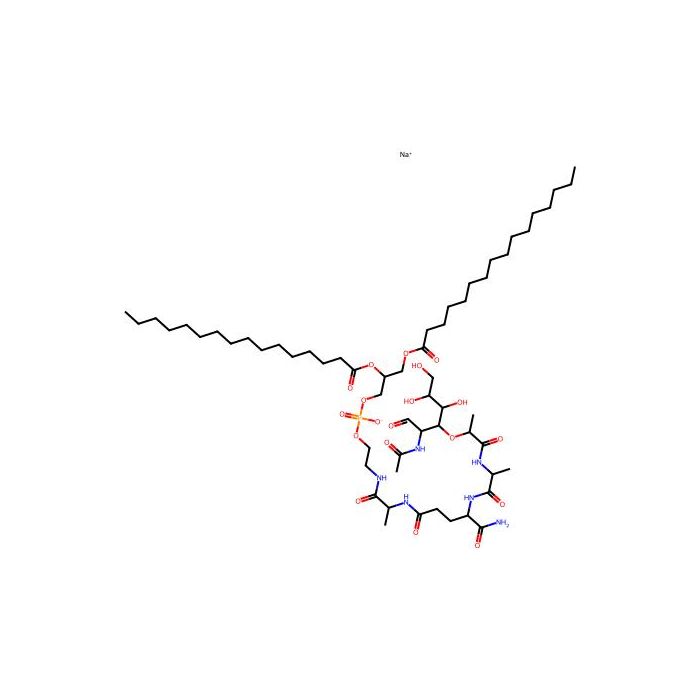
Mifamurtide is a synthetic analog of bacterial cell-wall muramyl dipeptide (MDP) covalently coupled to a phosphatidylethanolamine (PE) lipid moiety. The sodium designation reflects counterion(s) associated with acidic functionalities (e.g., phosphate/carboxylate) to improve handling.
Key features: peptidoglycan-derived dipeptide core (l-Ala–d-isoGln motif), β-glycosidic linkage to a muramic acid-type sugar, and a phospholipid tail (phosphoryl-ethanolamine with acyl chains), yielding an amphiphilic, anionic molecule.
2D perspective (in words): a saccharide-peptide headgroup bearing a phosphate, attached via phosphate/ethanolamine to a diacylglycerol-like tail; the headgroup carries multiple heteroatoms (O, N), while the tail comprises long aliphatic chains.
Stereochemistry (literature/general)
Multiple defined stereocenters within the muramic acid and peptide segments; lipid chains typically saturated or mono-unsaturated depending on the specific PE used in the defined mifamurtide structure.
Note: Precise atom-level descriptors for this catalog lot are not specified here; consult the CoA/Spec Sheet for definitive structure strings and assay identifiers.
Synthetic Utility
Mifamurtide sodium is supplied as a finished bioactive ligand rather than as a building block or reagent. It is not commonly employed as a substrate, catalyst, or auxiliary in synthetic transformations.
General chemical considerations (literature/general)
Functional groups present include a glycosidic linkage, amide bonds (dipeptide), phosphate ester, and long-chain aliphatic esters/ethers typical of phospholipids. These moieties are sensitive to strong acids/bases and to prolonged heating.
Potential liabilities in synthetic contexts include:
Hydrolysis of amide and phosphate linkages under strongly acidic/basic conditions.
Oxidation of unsaturated lipid chains by peroxides or reactive oxygen species.
Epimerization at stereocenters under harsh conditions.
Analytical characterization tips (general)
Multi-modal chromatography (HILIC or mixed-mode) coupled to HRMS is useful for identity and impurity profiling.
1D/2D NMR in mixed solvents (e.g., CD3OD/D2O, or CDCl3/CD3OD with ionic modifiers) may be required to fully resolve amphiphilic domains.
If you seek a synthetic precursor or fragment (e.g., MDP analogs, phosphatidylethanolamine derivatives), consider procuring dedicated building blocks rather than the intact amphiphile.
Target Specificity
This section is typically used for antibodies/biologics (clone, isotype, species reactivity). It does not directly apply to small-molecule ligands.
Item-specific target data: Not specified for this item; refer to CoA/Spec Sheet.
Literature/general note
Mifamurtide-class molecules are widely used to interrogate innate immune sensing of peptidoglycan motifs in research. Any receptor engagement details should be established empirically in your assay system and validated against appropriate controls.
No antibody-like specificity parameters are associated with this product listing.
Frequently Asked Questions
What is Moligand??
Moligand? is one of Aladdin Scientific's premium product lines, formulated for high-purity applications across multiple workflows. Compared to standard grades in the same workflow, Moligand? products typically offer tighter specifications, more rigorous QC, and stronger lot-to-lot consistency.
How should this product be stored?
Store at ?80 °C, desiccated. Keep the container tightly closed with desiccant — the material is moisture-sensitive.
What are the CAS number, molecular formula and molecular weight?
The CAS Number is 90825-43-7, the molecular formula is C59H108N6NaO19P, and the molecular weight is 1259.48 g/mol.
How is this product shipped?
This product ships frozen with dry ice and cold packs. Unpack on arrival and transfer it to the storage condition stated above; handle dry ice with insulated gloves in a ventilated area.
What documentation is provided?
Available product documentation, including Certificates of Analysis (COA), Safety Data Sheets (SDS), and specification sheets, is shown in the product document area. Document availability and access follow the current site policy.
Need help choosing the grade?
Our grade selection guide covers purity, stabilizer status, and application suitability for all variants in our catalog.
We use cookies to ensure the website functions properly and, where permitted, to improve your experience. You can manage your preferences at any time in Settings. Learn more in our Cookie Policy.
Shall we send you a message when we have discounts available?
Remind me later
Thank you! Please check your email inbox to confirm.
Products are supplied to verified businesses, institutions, and qualified professionals for research and development use only. Not for use in humans, animals, diagnosis, or therapy.