GRADE & PURITYMoligand™?Moligand™ — Aladdin's line of ligands and bioactive small molecules. Use for receptor, pathway, and binding studies needing defined small-molecule tools.10 mM in DMSO
Moligand™, 10 mM in DMSO Moligand™ for sensitive chromatographic and analytical workflows requiring minimal baseline interference.
🌡
Storage & shipping
Store at -80°C Ships Dry ice packs + Cold packs Check lot-specific COA for exact specifications.
📋
Quality documents
SDS, COA, datasheet, and spec sheet available for download. Lot-specific COA accessible via lot number lookup.
📚
Literature proof
Cited in 0 peer-reviewed publications across chromatography, organic synthesis, and cross-coupling reactions.
Overview
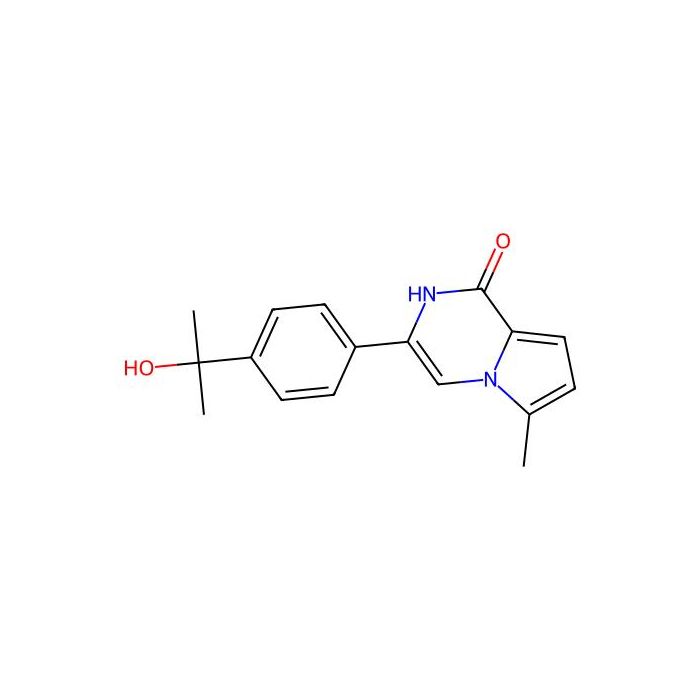
MSC2504877 (M2912) is a potent and orally active tankyrase inhibitor with IC 50 s of 0.0007, 0.0008, 0.54 µM for TNKS, TNKS2, PARP1 , respectively. MSC2504877 increases the expression of AXIN2 and TNKS protein levels and decreases β-catenin levels. MSC2504877 shows anti-tumor activity.
Specifications
Specifications & Purity
Moligand™, 10 mM in DMSO
Storage
Store at -80°C
Shipped In
Dry ice packs + Cold packs
This product requires cold chain shipping. Ground and other economy services are not available.
Grade
Moligand™
Action Type
INHIBITOR
Names and Identifiers
Molecular Weight
282.34
Documentation
📋 Safety Data Sheet (SDS)
Comprehensive hazard, handling, storage, and regulatory compliance document.
Determine the necessary mass, volume, or concentration for preparing a solution.
Dilution Calculator
Determine the dilution needed to prepare a stock solution.
Reconstitution Calculator
Reviews
Customer Reviews
Application Protocols
Not applicable
No tested applications (e.g., WB, IHC, IF, FC) or recommended dilutions are relevant to this small-molecule library compound.
General handling for screening workflows (informative only)
Prepare DMSO stock (e.g., 10 mM) under dry conditions, vortex/sonicate as needed, and sterile-filter if required by your assay (compatible with solvent and solute stability).
Dispense into low-binding plates or tubes to reduce adsorption; seal and store at subzero temperatures per storage guidance.
Item-specific application protocols: Not specified for this item; refer to CoA/Spec Sheet.
Biological Roles
Item-specific facts (from Product Data)
No biological role, target class, or pathway annotations are provided for this item.
General notes
As a library compound, MSC2504877 may be used to probe biological systems in research settings, but no mechanism-of-action, target specificity, or phenotype is claimed or implied by the listing.
Any observed activity should be considered preliminary until validated by orthogonal assays and structure-confirmed retesting. Evaluate liabilities such as aggregation (PAINS-like behavior), covalency, redox activity, or fluorescence interference using appropriate counterscreens.
For biophysical binding measurements, match DMSO content in sample/reference and confirm compound integrity by LC–MS prior to testing.
Important
No medical, diagnostic, or therapeutic use is claimed. For research use only (as stated in Product Data).
For definitive biological annotations, consult your screening results and follow-up characterization; none are specified for this SKU.
Buffer Applications
Not typically applicable
This item is a small-molecule library member, not a buffering agent. No buffer system, pKa, or buffering range is specified.
General lab practice (if used in aqueous assays)
Prepare concentrated DMSO stocks, then dilute into assay buffers (e.g., HEPES, PBS, Tris) ensuring consistent final DMSO across wells.
Include mild nonionic surfactant (e.g., 0.01–0.05% Tween-20) if compound aggregation or adsorption to plastics is suspected.
Item-specific buffer data: Not specified for this item; refer to CoA/Spec Sheet.
Green Alternatives
Context
This product is a small-molecule library member, not a bulk solvent or reagent. Greener considerations mainly affect solvent choices for stock preparation, plating, and any optional synthesis.
Greener handling choices (general guidance)
Prefer aqueous assay buffers with minimal DMSO where feasible (0.1–0.5% v/v), validated for target compatibility.
Consider ethanol or water/ethanol mixtures as cosolvents in biological assays when compatible, reducing reliance on amide solvents.
For optional synthetic work, favor greener ethers (2-MeTHF) or cyclopentyl methyl ether (CPME) over chlorinated solvents when reaction scope allows (literature guidance).
Tradeoffs (general, literature-based)
DMSO: High boiling point and excellent solvency; difficult solvent recovery and potential target interference at higher percentages.
Ethanol: Renewable and low toxicity; narrower solubility window for highly lipophilic molecules.
2-MeTHF/CPME vs THF/Et2O: Lower peroxide formation rates and improved sustainability metrics; may alter reaction rates/selectivities and water miscibility.
Operational tips
Reduce plate dead volumes and use low-evaporation seals to minimize solvent waste.
Centrally manage make-up solutions and consolidate freeze–thaw cycles to limit discard volumes.
Item-specific greener data: Not specified for this item; refer to CoA/Spec Sheet.
Pharmaceutical Uses
Not applicable for this listing
This product is supplied for research use only; no pharmacopeial status, GMP grade, or excipient/formulation role is specified.
General notes
Library compounds may serve as reference materials or internal research standards in discovery laboratories. Any use in regulated manufacturing would require separate qualification and documentation not provided here.
Item-specific regulatory/formulation information: Not specified for this item; refer to CoA/Spec Sheet.
Physical Properties
Item-specific facts (from Product Data)
Appearance: Not specified for this item; refer to CoA/Spec Sheet.
Molecular weight: Not specified for this item; refer to CoA/Spec Sheet.
Literature/computed values (not item-specific)
Without a disclosed structure, properties such as melting point, boiling point, density, logP, pKa, refractive index, and aqueous/organic solubility cannot be enumerated for this item.
General chemistry knowledge (how to approach when structure is undisclosed)
For screening-library solids, DMSO is commonly used to prepare 10–50 mM stocks; final assay DMSO is often kept at 0.1–1% v/v to minimize solvent effects.
Preliminary solubility checks can be performed by serial dilution in DMSO, followed by dilution into assay buffer containing 0.01–0.05% nonionic surfactant (e.g., Tween-20) to mitigate aggregation (general practice).
If hygroscopicity or polymorphism is a concern, verify handling instructions and solid-state form on the CoA before weighing.
For compounds prone to oxidation/hydrolysis, low-temperature storage (as specified for this item) helps maintain integrity between freeze–thaw cycles.
Quality & Grades
Item-specific facts (from Product Data)
Grade/Purity: Moligand™ (screening-library grade)
What Moligand™ typically signifies (general description)
Curated small-molecule library members intended for discovery screening, hit validation, and SAR exploration. Emphasis is usually on identity confirmation and suitability for DMSO stock preparation rather than chromatographic-grade solvent specifications.
Documentation commonly provided: CoA including identity confirmation (often by LC–MS and/or NMR), purity by HPLC/UPLC, and recommended handling. For exact tests and acceptance criteria, refer to the CoA/Spec Sheet for this SKU.
Implications for use
Analytical verification: Prior to critical studies, independently confirm identity/purity under your in-house method (orthogonal LC–MS or NMR), as many screening assays are sensitive to trace impurities or degradation.
Batch traceability: Record lot numbers when plating compounds into assay-ready formats to ensure reproducibility.
Stabilizers/additives: Not specified for this item; refer to CoA/Spec Sheet. If present, document their potential assay interference.
What is not specified for this item
Water/peroxide/metal limits, UV cutoff, residual solvents, salt form, and specific purity percentage: Not specified for this item; refer to CoA/Spec Sheet.
Reaction & Applications
Item-specific facts (from Product Data)
Manufacturer Applications: Not specified for this item.
General applications for library compounds (non-clinical, research use only)
Primary use: Inclusion in screening decks for biochemical, biophysical, or cell-based assays to identify preliminary actives. Suitable for HTS, H2L, and SAR-by-catalog workflows.
Plate formatting: Aliquot as DMSO stocks into 96/384-well plates under dry conditions to minimize water uptake. Seal plates (heat or adhesive) and store at subzero temperatures to reduce degradation.
Orthogonal confirmation: Hits should be reconfirmed with freshly prepared solutions and counterscreens for assay interference (e.g., fluorescence quenching, redox activity, detergent-sensitive aggregation).
Biophysical follow-up: If target-binding assays are employed (DSF/TSA, SPR, MST, NMR), ensure buffer composition and DMSO matching between sample and reference to prevent baseline artifacts.
Analytical tracking: Monitor compound integrity by LC–MS before and after screening campaigns to catch hydrolysis/oxidation products.
Note: Specific reaction chemistry (e.g., cross-couplings, cycloadditions) cannot be detailed without a disclosed structure; if synthetic elaboration is intended, request the full structural dossier.
Reaction Conditions
Not applicable without structure
No functional-group information is provided; therefore, recommended reagents, catalysts, temperatures, or expected yields cannot be supplied for this specific compound.
General best practices (when synthesizing or modifying related analogs)
Select solvents considering green metrics where possible (2-MeTHF, CPME, MeCN, EtOH) and ensure water content control for moisture-sensitive steps.
Use microscale scouting (0.01–0.05 mmol) to establish conditions before scale-up; employ DoE to map temperature, time, and catalyst/base ranges efficiently.
Monitor reactions by LC–MS to track starting material consumption and identify side products early.
Item-specific reaction condition data: Not specified for this item; refer to CoA/Spec Sheet.
Safety & Handling
Item-specific facts (from Product Data)
Storage conditions: Store at −80°C.
Shipped in: Dry ice packs + Cold packs.
GHS classification, signal word, pictograms, H-statements: Not specified for this item; refer to SDS.
General safety guidance (defer to SDS for authoritative data)
Handle in a fume hood with standard PPE: lab coat, safety glasses, and appropriate chemically resistant gloves.
Avoid inhalation, ingestion, and skin/eye contact. Prevent aerosols and dust formation during weighing.
Library compounds may exhibit unknown biological activity; minimize exposure and practice good hygiene. Treat as potentially harmful.
Incompatibilities: Until identity is confirmed, avoid strong oxidizers, strong acids/bases, and reactive reducing agents. Segregate from peroxidizers and sources of ignition.
First aid (general): In case of skin/eye contact, flush with water for ≥15 min; if inhaled, move to fresh air; if ingested, rinse mouth. Seek medical attention in all cases. Provide the SDS to responders.
Spill/accident: Contain with inert absorbent, collect as hazardous waste. Decontaminate surfaces and ventilate area.
Waste: Dispose of according to institutional and local regulations for organic laboratory chemicals.
Always consult the item-specific SDS and CoA for definitive hazard and handling instructions.
Solvent Selection
Item-specific facts (from Product Data)
No solvent recommendations are specified for this item; refer to CoA/Spec Sheet.
General guidance for small-molecule library members
Primary stock solvent: DMSO is the de facto choice for screening stocks due to broad solubilizing power and assay compatibility. Typical stock concentrations: 10–50 mM.
Aqueous compatibility: On dilution into biochemical buffers, maintain final DMSO at 0.1–1% v/v. Include detergents (e.g., 0.01–0.05% Tween-20) if aggregation is suspected.
Alternative cosolvents (when needed): DMF or ethanol can be used for difficult solutes; confirm assay tolerance. For cell-based assays, ethanol is often preferred over DMF for cytocompatibility at low percentages.
Pre-wetting trick: For highly hydrophobic solids, pre-wet with a minimal amount of DMSO before adding buffer to avoid precipitation.
Comparison (general, literature-based)
DMSO vs DMF: DMSO offers lower volatility and better biocompatibility; DMF can solubilize extremely polar/charged species but may be more cytotoxic.
DMSO vs ethanol: Ethanol has favorable volatility for plate drying but narrower solubility scope; use at ≤1% v/v in most cell assays.
Always confirm solvent compatibility with your assay system and consult the item’s CoA for any specific notes.
Storage & Reconstitution
Item-specific facts (from Product Data)
Storage conditions: Store at −80°C.
Shipped in: Dry ice packs + Cold packs.
General guidance (not item-specific; verify with CoA/SDS)
Upon receipt: Keep frozen. Minimize time at room temperature during inventory and plating.
Aliquoting: Prepare small, single-use DMSO stock aliquots (e.g., 10–50 mM) to avoid repeated freeze–thaw. Use dry, inert conditions if the compound is moisture/air sensitive (status not specified).
Freeze–thaw: Limit to a single thaw where possible. If multiple uses are required, store at −80°C in tightly sealed, low-permeability vials or heat-sealed plate wells.
Thawing: Thaw on ice or at 4°C. Mix thoroughly (vortex/brief sonication) to ensure homogeneity before use. Inspect for precipitation or discoloration.
Stability: No stability data are provided for this item; monitor integrity periodically by LC–MS or HPLC.
What is not specified for this item
Exact solvent for reconstitution, recommended stock concentration, salt form, light/moisture sensitivity, and shelf life: Not specified for this item; refer to CoA/Spec Sheet.
Research Use Note
For research use only.
Structure & Identity
Item-specific facts (from Product Data)
SKU: M1495554
Product Name: MSC2504877 (library member)
CAS: 1460286-21-8
Grade/Purity: Moligand™
Molecular formula: Not specified for this item; refer to CoA/Spec Sheet.
Molecular weight: Not specified for this item; refer to CoA/Spec Sheet.
SMILES: Not specified for this item; refer to CoA/Spec Sheet.
InChIKey: Not specified for this item; refer to CoA/Spec Sheet.
Interpretive notes (general guidance)
This listing belongs to a small-molecule/compound library collection (category: 小分子和化合物库). Structure descriptors (SMILES, InChI) and exact identity fields are typically provided on the Certificate of Analysis (CoA) or an accompanying SD file for informatics workflows.
Without a supplied structure, functional-group annotations, ring systems, stereocenters, and 2D topology cannot be specified. Request the structure file (SDF/MOL) to enable cheminformatics tasks (substructure, similarity, and physicochemical profiling).
Synthetic Utility
Not fully assessable without structure
No functional groups, protecting-group patterns, or reactive handles are provided for MSC2504877; therefore, specific synthetic transformations and retrosynthetic roles cannot be described.
General guidance for library-member modification (if structure becomes available)
Typical derivatizations include amide coupling, Suzuki–Miyaura or Buchwald–Hartwig cross-couplings (for aryl halides/boronates), heteroatom alkylations/acylations, or late-stage C–H functionalization. Choice depends entirely on the disclosed scaffold and functional-group tolerance.
For SAR expansion, maintain core scaffold integrity and vary substituents using parallel synthesis or microfluidic platforms; confirm identity/purity of analogs by LC–MS and NMR.
Item-specific synthetic notes: Not specified for this item; refer to CoA/Spec Sheet.
Target Specificity
Not applicable
This listing is not an antibody, protein, or targeted biological reagent. No antigen/epitope, species reactivity, clone, or isotype information applies.
Item-specific target info: Not specified for this item; refer to CoA/Spec Sheet.
Need help choosing the grade?
Our grade selection guide covers purity, stabilizer status, and application suitability for all variants in our catalog.
We use cookies to ensure the website functions properly and, where permitted, to improve your experience. You can manage your preferences at any time in Settings. Learn more in our Cookie Policy.
Shall we send you a message when we have discounts available?
Remind me later
Thank you! Please check your email inbox to confirm.
Products are supplied to verified businesses, institutions, and qualified professionals for research and development use only. Not for use in humans, animals, diagnosis, or therapy.