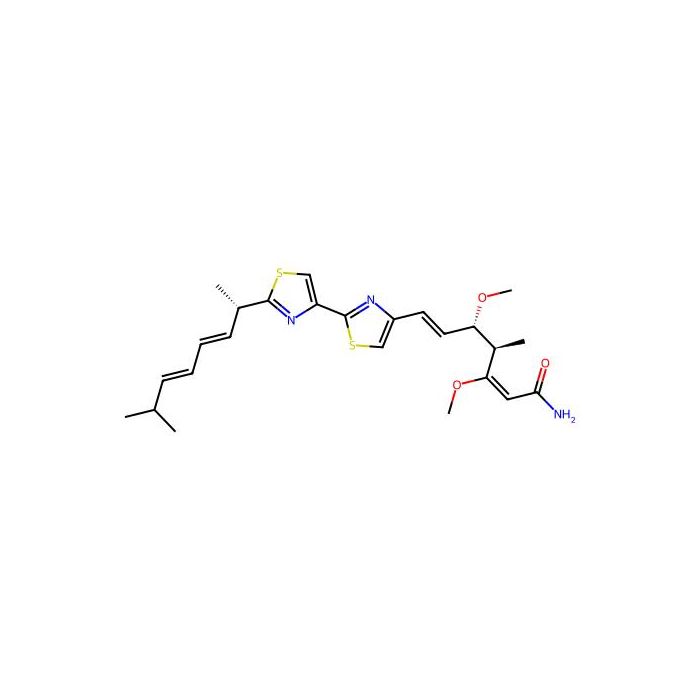
Myxothiazol - ≥99% , CAS No.76706-55-3

CAS: 76706-55-3 Cat. No.: M648797 Formula: C25H33N3O3S2 Molecular Weight: 487.68 EC Number: 622-464-9 PubChem CID: 10972974
AVAILABLE TO ORDER
GRADE & PURITY ≥99%
Synonyms
1sqp | UNII-6VY98BQ7NB | 2,6-HEPTADIENAMIDE, 7-(2'-((1S,2E,4E)-1,6-DIMETHYL-2,4-HEPTADIEN-1-YL)(2,4'-BITHIAZOL)-4-YL)-3,5-DIMETHOXY-4-METHYL-, (2E,4R,5S,6E)- | SCHEMBL447904 | MS-29066 | 2,6-HEPTADIENAMIDE, 7-(2'-(1,6-DIMETHYL-2,4-HEPTADIENYL)(2,4'-BITHIA
Storage
Store at -20°C
Shipped In
Ice chest + Ice pads
★
Size
Germany (EU)
USA*
Price
Qty
1mg
M648797-1mg
Made to order · 8–12 wks
€729.68
5mg
M648797-5mg
Made to order · 8–12 wks
€1,823.03
Enter a quantity for the sizes you want to add.
🧪
Why this grade

≥99% for sensitive chromatographic and analytical workflows requiring minimal baseline interference.

🌡

Storage & shipping

Store at -20°C Ships Ice chest + Ice pads Check lot-specific COA for exact specifications.

📋

Quality documents

SDS, COA, datasheet, and spec sheet available for download. Lot-specific COA accessible via lot number lookup.

📚

Literature proof

Cited in 0 peer-reviewed publications across chromatography, organic synthesis, and cross-coupling reactions.

Overview

Myxothiazol, an antifungal antibiotic , is a mitochondrial electron transport chain complex III (bc1 complex) inhibitor. Myxothiazol inhibits the growth of many yeasts and fungi at concentrations between 0.01 and 3 μg/ml.

In Vitro

Myxothiazol inhibits the growth of many yeasts and fungi at concentrations between 0.01 and 3 μg/ml. Myxothiazol binds to the ubiquinol oxidation site Qo of complex III and blocks electron transfer from ubiquinol to cytochrome b and thus inhibits complex III activity. MCE has not independently confirmed the accuracy of these methods. They are for reference only.

In Vivo

Myxothiazol (i.p.; 0.56 mg/kg; daily for 4 days)-induced complex III inhibition can be induced in mice for four days in a row without overt hepatotoxicity or lethality. MCE has not independently confirmed the accuracy of these methods. They are for reference only. Animal Model: C57Bl/J6 miceDosage: 0.56 mg/kg Administration: I.p.; 24 hours intervals for at most 4 times Result: A reversible complex III activity decrease to 50% of control value occurred at 2 h post-injection. At 74 h only minor histological changes in the liver were found, supercomplex formation was preserved and no significant changes in the expression of genes indicating hepatotoxicity or inflammation were found.

Form:Solid

Specifications

Synonyms
1sqp | UNII-6VY98BQ7NB | 2,6-HEPTADIENAMIDE, 7-(2'-((1S,2E,4E)-1,6-DIMETHYL-2,4-HEPTADIEN-1-YL)(2,4'-BITHIAZOL)-4-YL)-3,5-DIMETHOXY-4-METHYL-, (2E,4R,5S,6E)- | SCHEMBL447904 | MS-29066 | 2,6-HEPTADIENAMIDE, 7-(2'-(1,6-DIMETHYL-2,4-HEPTADIENYL)(2,4'-BITHIA
Specifications & Purity
≥99%
Biochemical and Physiological Mechanisms
Myxothiazol, an antifungal antibiotic , is a mitochondrial electron transport chain complex III (bc1 complex) inhibitor. Myxothiazol inhibits the growth of many yeasts and fungi at concentrations between 0.01 and 3 μg/ml.
Storage
Store at -20°C
Shipped In
Ice chest + Ice pads
This product requires cold chain shipping. Ground and other economy services are not available.
Action Type
INHIBITOR
Purity
≥99%
Names and Identifiers
Canonical Smiles
CC(C)C=CC=CC(C)C1=NC(=CS1)C2=NC(=CS2)C=CC(C(C)C(=CC(=O)N)OC)OC
IUPAC Name
(2E,4R,5S,6E)-3,5-dimethoxy-4-methyl-7-[2-[2-[(2S,3E,5E)-7-methylocta-3,5-dien-2-yl]-1,3-thiazol-4-yl]-1,3-thiazol-4-yl]hepta-2,6-dienamide
InChIKey
XKTFQMCPGMTBMD-FYHMSGCOSA-N
INCHI
1S/C25H33N3O3S2/c1-16(2)9-7-8-10-17(3)24-28-20(15-33-24)25-27-19(14-32-25)11-12-21(30-5)18(4)22(31-6)13-23(26)29/h7-18,21H,1-6H3,(H2,26,29)/b9-7+,10-8+,12-11+,22-13+/t17-,18+,21-/m0/s1
Isomeric SMILES
C[C@@H](/C=C/C=C/C(C)C)C1=NC(=CS1)C2=NC(=CS2)/C=C/[C@@H]([C@@H](C)/C(=C\C(=O)N)/OC)OC
WGK Germany
3
PubChem CID
10972974
Molecular Weight
487.68

Documentation

📋 Safety Data Sheet (SDS)

Comprehensive hazard, handling, storage, and regulatory compliance document.

Download SDS →

✅ Certificate of Analysis (COA)

Lot-specific quality data. Enter your lot number to retrieve the exact COA.

Look up COA →

📊 Datasheet

Quick-reference summary of product specifications and applications.

View datasheet →

🔬 Specification Sheet

Full quality attributes and acceptance criteria for this grade.

View spec sheet →

Advanced Data

Taxonomic Classification

Taxonomy Tree

KingdomOrganic compounds
SuperclassOrganoheterocyclic compounds
ClassAzoles
SubclassThiazoles
Intermediate Tree Nodes Not available
Direct Parent2,4-disubstituted thiazoles
Alternative Parents Vinylogous esters  Heteroaromatic compounds  Primary carboxylic acid amides  Dialkyl ethers  Azacyclic compounds  Organopnictogen compounds  Organonitrogen compounds  Organic oxides  Hydrocarbon derivatives  Carbonyl compounds  
Molecular FrameworkAromatic heteromonocyclic compounds
Substituents 2,4-disubstituted 1,3-thiazole - Vinylogous ester - Heteroaromatic compound - Carboxamide group - Primary carboxylic acid amide - Carboxylic acid derivative - Dialkyl ether - Ether - Azacycle - Organooxygen compound - Organonitrogen compound - Carbonyl group - Organic nitrogen compound - Organopnictogen compound - Organic oxide - Organic oxygen compound - Hydrocarbon derivative - Aromatic heteromonocyclic compound
DescriptionThis compound belongs to the class of organic compounds known as 2,4-disubstituted thiazoles. These are compounds containing a thiazole ring substituted at the positions 2 and 3.
External Descriptors Not available
3D Structure
Interactive Chemical Structure Model


Associated Targets(Human)
SK-MEL-2 (46422 Activities)
Activity TypeRelationActivity valueUnitsAction TypeJournalPubMed IddoiAssay Aladdin ID
SK-OV-3 (52876 Activities)
Activity TypeRelationActivity valueUnitsAction TypeJournalPubMed IddoiAssay Aladdin ID
XF498 (12972 Activities)
Activity TypeRelationActivity valueUnitsAction TypeJournalPubMed IddoiAssay Aladdin ID
A549 (127892 Activities)
Activity TypeRelationActivity valueUnitsAction TypeJournalPubMed IddoiAssay Aladdin ID
Associated Targets(non-human)
MT-CYB Cytochrome b (0 Activities)
Activity TypeRelationActivity valueUnitsAction TypeJournalPubMed IddoiAssay Aladdin ID
Mechanisms of Action
Certificates(CoA,COO,BSE/TSE and Analysis Chart)
C of A & Other Certificates(BSE/TSE, COO):
Analytical Chart:
Chemical and Physical Properties
Molecular Weight487.700 g/mol
XLogP34.800
Hydrogen Bond Donor Count1
Hydrogen Bond Acceptor Count7
Rotatable Bond Count12
Exact Mass487.196 Da
Monoisotopic Mass487.196 Da
Topological Polar Surface Area144.000 Ų
Heavy Atom Count33
Formal Charge0
Complexity738.000
Isotope Atom Count0
Defined Atom Stereocenter Count3
Undefined Atom Stereocenter Count0
Defined Bond Stereocenter Count4
Undefined Bond Stereocenter Count0
The total count of all stereochemical bonds4
Covalently-Bonded Unit Count1
Solution Calculators
Reviews

Customer Reviews

Application Protocols

Tested, item-specific application protocols and recommended dilutions are not provided in this listing. Not specified for this item; refer to CoA/Spec Sheet.

General considerations (non-validated, literature/context only):

  • Prepare a concentrated DMSO stock and perform a small pilot solubility and dose–response study in your assay matrix.
  • Include vehicle-only controls and, when relevant, orthogonal inhibitors (e.g., antimycin A, rotenone) to validate pathway attribution.
  • Document final solvent concentrations and pre-incubation times for reproducibility.

For validated, product-specific protocols, please consult the certificate of analysis or contact technical support.

Biological Roles

Literature-based overview (for research use only):

  • Primary target/process: Myxothiazol is a potent inhibitor of the mitochondrial cytochrome bc1 complex (Complex III), binding at the Qo (outer) quinol-oxidation site. It prevents electron transfer from ubiquinol to the Rieske iron–sulfur protein and cytochrome b, thereby halting downstream reduction of cytochrome c.
  • Bioenergetic consequences: Inhibition collapses electron flux through Complex III, typically decreasing proton translocation at this step and diminishing mitochondrial membrane potential when not compensated by upstream inputs.
  • ROS implications: By stabilizing the Qo site and limiting semiquinone formation, Myxothiazol often reduces superoxide generation from Complex III compared to Qi-site inhibitors (e.g., antimycin A), enabling differential analysis of ROS sources in cells and isolated mitochondria.
  • Selectivity context: Acts on bc1 complexes across species (eukaryotes and many bacteria possessing similar complexes), but potency can vary with organismal isoforms and membrane environments.
  • Applications:
    • Dissecting contributions of Complex III to respiration in intact cells, isolated mitochondria, and permeabilized fibers.
    • Benchmarking Qo-site pharmacology alongside stigmatellin and Qo-site analogs.
    • Calibrating oxygen-consumption-rate (OCR) assays and determining spare respiratory capacity in platform workflows where Complex III inhibition is a defined step.
  • Practical notes:
    • Deliver via concentrated DMSO stocks; keep final DMSO within assay tolerance.
    • Include time- and dose-response curves; membrane partitioning may slow equilibration.

No medical/therapeutic claims are made; use is limited to laboratory research.

Buffer Applications

This compound is not a buffering agent and is not used to establish or maintain pH. Therefore, buffer formulation guidance is not applicable.

Practical laboratory note (literature/context):

  • When dosing Myxothiazol into biochemical buffers or cell culture media, ensure the vehicle (commonly DMSO) is matched in control wells/tubes. Maintain final co-solvent below assay-specific toxicity thresholds (often ≤0.1–0.5% v/v for cells) and pre-warm buffers to minimize precipitation upon dilution.
Green Alternatives

This product is a specialized bioactive small molecule, not a process solvent or bulk reagent where greener substitutions are typically made. As such, a “green alternative” is generally not applicable.

Context (literature/general):

  • If your primary concern is the environmental footprint of the vehicle used to deliver Myxothiazol, consider solvent choices and waste minimization rather than replacing the active tool compound itself.

Vehicle considerations (qualitative comparison):

  • DMSO: high solvency and low volatility reduces evaporative emissions; proper waste handling still required.
  • Ethanol: biorenewable origin possible; higher volatility and flammability require controls.
  • Aqueous buffers with minimal co-solvent: reduce organic solvent use but risk precipitation and dosing variability.

Operational green practices:

  • Use the lowest effective working concentration and minimize stock volumes to reduce waste.
  • Employ reusable glassware where compatible to limit plastic consumption.
  • Consolidate experiments to limit freeze–thaw cycles and disposal of expired solutions.

Because the bioactivity is specific to Myxothiazol, substituting a different compound changes experimental outcomes. Select alternatives only based on scientific rationale (e.g., antimycin A or stigmatellin as site-differentiated comparators), not “greenness.”

Pharmaceutical Uses

This product is supplied strictly for research use only and is not intended for human or veterinary applications, diagnostics, or as an excipient.

Context (literature/general):

  • Myxothiazol is a natural-product respiratory-chain inhibitor employed as a biochemical probe in preclinical research. It is not an approved pharmaceutical ingredient, and no pharmacopeial monograph usage is applicable to this listing.

Formulation-style considerations for research:

  • For in vitro work, prepare concentrated DMSO stocks and dilute into assay medium immediately prior to use.
  • For ex vivo tissue or organelle studies, confirm compatibility of the vehicle and concentration with tissue viability and instrumentation (e.g., oxygen electrodes, extracellular flux analyzers).

Quality/regulatory note:

  • No GMP or clinical-grade specification is provided. If a regulated-use material is required, contact us to discuss feasibility under appropriate quality systems.
Physical Properties

Item-specific specifications (this lot):

  • Appearance: Not specified for this item; refer to CoA/Spec Sheet.
  • Molecular weight: Not specified for this item; refer to CoA/Spec Sheet.
  • Molecular formula: Not specified for this item; refer to CoA/Spec Sheet.
  • Melting point, boiling point, density, refractive index, UV cut-off, elemental/impurity limits: Not specified for this item; refer to CoA/Spec Sheet.

General/literature characteristics (for context only; not item specifications):

  • Physical state: typically an organic-soluble solid with high lipophilicity (often supplied as a powder or film for reconstitution).
  • Solubility profile: readily soluble in DMSO; soluble in ethanol and other polar aprotic organic solvents; very low aqueous solubility without co-solvent or carrier.
  • Partitioning: high logP expected for cell-permeant mitochondrial inhibitors of the cytochrome bc1 Qo site.
  • Spectral features: conjugated chromophore can show UV absorption in the near-UV range; use DMSO/EtOH blanks for baseline correction in spectroscopic assays.

Practical implications:

  • Prepare concentrated stock solutions (e.g., in dry DMSO) and dilute into assay buffers immediately prior to use to minimize precipitation.
  • Use amber vials or limit light exposure if monitoring UV–vis signatures or when storing for extended periods, as conjugated systems can photoisomerize/oxidize.
  • Always verify actual solubility/appearance for your lot against the CoA prior to critical experiments.
Quality & Grades
  • Grade/Purity: Not specified for this item; refer to CoA/Spec Sheet for assay purity, residual solvents, and identification tests.

How to interpret grades (general guidance):

  • Research grade small-molecule inhibitors are typically supplied with chromatographic purity (e.g., HPLC/UPLC AUC) and identity confirmation (NMR/HRMS). Low-level degradants (e.g., oxidation/photolysis products) can impact bioassay readouts; verify with a fresh CoA.
  • If a stabilizer is present (e.g., antioxidant), it will be declared on the CoA/label. No stabilizer is declared in this listing. Absence of a declared stabilizer does not imply stability—follow Storage guidance.

Recommended QC checks upon receipt (good practice):

  • Visual inspection of appearance and mass verification.
  • Quick analytical check (e.g., analytical HPLC-UV and MS in your lab’s diluent) to confirm purity and retention time consistency with CoA.
  • Small-scale solubility test in your intended vehicle (e.g., DMSO → buffer) to confirm absence of precipitation at working concentrations.

Regulatory/traceability:

  • This product is for research use only (RUO) and not intended for human or veterinary applications, diagnostics, or food use.
  • For GMP or pharmacopeial compliance: not offered under those frameworks in this listing; contact us if a qualified grade is required.
Reaction & Applications

This compound is primarily a biochemical research tool rather than a synthetic reagent or catalyst.

Applicable research applications (literature/context):

  • Mechanistic studies of mitochondrial electron transport: used to acutely inhibit the cytochrome bc1 complex (Complex III) at the Qo (outer quinol-oxidation) site to dissect electron flow and proton motive force generation.
  • Bioenergetics profiling: applied in mitochondrial stress tests to assess coupling, electron flux partitioning, and reserve capacity when used alongside other inhibitors (e.g., rotenone, antimycin A).
  • Reactive oxygen species (ROS) studies: Qo-site blockade can modulate superoxide formation, enabling controlled interrogation of ROS sources compared to Qi-site inhibitors.
  • Spectroscopic/kinetic assays: used in enzymology of ubiquinol–cytochrome c reductase to define Qo-site turnover and inhibitor binding kinetics.

Not typical for chemical synthesis:

  • Myxothiazol is not commonly used as a reagent, ligand, or solvent in preparative organic synthesis. For guidance on chemical transformations, see other catalog entries specialized for synthesis.

Practical notes:

  • Prepare fresh working solutions from a frozen DMSO stock to ensure potency and avoid adsorption losses.
  • Include vehicle-only controls and, when relevant, alternative site inhibitors to confirm site-specific effects in your system.
Reaction Conditions

Not applicable for chemical reaction optimization. Myxothiazol is not used as a reagent or catalyst in preparative synthesis.

Experimental handling conditions (literature/context for bioassays):

  • Stock preparation: dissolve in anhydrous DMSO to prepare concentrated stocks (e.g., mM range); vortex and, if necessary, gently warm to aid dissolution. Filter through a low-protein-binding 0.2 µm filter if particulate persists.
  • Working solutions: dilute into assay buffer or culture media immediately before use; maintain consistent final vehicle concentration in controls. Pre-warm solutions to promote homogeneous distribution.
  • Exposure parameters: time to steady-state inhibition may depend on membrane partitioning; allow adequate pre-incubation (commonly minutes to tens of minutes) before readout. Optimize dose–response empirically in your system.

These are general literature practices and are not item-specific specifications. Consult your protocol and the product CoA/SDS for any constraints relevant to your application.

Safety & Handling

Authoritative safety data are provided in the SDS for this product and supersede any summary below.

Item-specific hazard fields (this listing):

  • GHS Classification, Signal Word, H-Statements, Pictograms: Not specified for this item; refer to the SDS.

General laboratory safety guidance (literature/context; not item-specific):

  • Hazard profile: Myxothiazol is a potent biochemical inhibitor of mitochondrial complex III in eukaryotic cells. Handle as a harmful/toxic research chemical; avoid inhalation, ingestion, and skin/eye contact. Use in a chemical fume hood.
  • PPE: lab coat, safety glasses, and appropriate chemically resistant gloves (e.g., nitrile). For weighing or preparing concentrated DMSO stocks, consider double-gloving.
  • Incompatibilities: strong oxidizers may degrade conjugated organics; avoid prolonged exposure to light, heat, and air. Store separate from bases/acids if formulating stocks with sensitive co-solvents.
  • First aid overview: in case of skin contact, wash with soap and water; for eye exposure, rinse cautiously with water for several minutes and seek medical attention; if inhaled, move to fresh air; if swallowed, rinse mouth and seek medical advice. Always follow institutional SOPs.
  • Waste: collect solutions and contaminated disposables as hazardous organic chemical waste; do not discharge to drains.
  • Special risks: lipophilic inhibitors can adsorb to plastics—use low-bind consumables or glass when preparing low-µM stocks to ensure dose accuracy.

Always consult and follow the SDS for this exact SKU before use.

Solvent Selection

Purpose: Selecting vehicles for stock solutions and assay dilutions of a hydrophobic mitochondrial inhibitor.

General characteristics (literature/context):

  • Polarity/Lipophilicity: high lipophilicity; favors aprotic organic solvents.
  • Recommended solvents for stocks: DMSO (preferred), DMF, or ethanol. DMSO provides the broadest compatibility across cell-based and enzyme assays.
  • Aqueous handling: very low intrinsic water solubility; for biological assays, prepare a concentrated DMSO stock (e.g., 10–50 mM) and dilute into pre-warmed buffer or media, keeping final DMSO ≤0.1–0.5% v/v as assay-tolerated.
  • Surfactants/carriers: if precipitation occurs at working concentrations, consider adding small amounts of non-ionic surfactants (e.g., 0.01–0.05% Tween-80) or use serum-containing media to aid dispersion (check assay compatibility).

Selection tips:

  • DMSO vs ethanol: DMSO minimizes volatility and improves dosing precision; ethanol may be preferable for organisms/cells intolerant of DMSO but can evaporate and alter membrane fluidity.
  • Avoid strong acids/bases during dissolution to prevent degradation of conjugated systems.
  • Use amber vials and minimize freeze–thaw of stock solutions to limit oxidative or photolytic changes.

Small comparison (literature, qualitative):

  • DMSO: highest solvency, low volatility, widely assay-compatible.
  • Ethanol: good solvency, higher volatility; check cytotoxicity threshold.
  • Aqueous buffers: require co-solvent; direct dissolution is typically poor.

Always validate the chosen vehicle in your specific assay system.

Storage & Reconstitution

Item-specific storage/shipping (from Product Data):

  • Storage Conditions: Store at -20°C.
  • Shipped In: Ice chest + Ice pads.

Additional handling guidance (literature/general; not item-specific specifications):

  • Keep container tightly closed, protected from light and moisture. Allow vial to equilibrate to room temperature in a desiccator before opening to minimize condensation.
  • Reconstitution: dissolve the contents in anhydrous DMSO to prepare a concentrated stock; mix thoroughly until fully dissolved. If needed, sonicate briefly or gently warm (<40°C) to assist dissolution.
  • Aliquoting: dispense single-use aliquots into amber or foil-wrapped microvials to avoid repeated freeze–thaw and light exposure.
  • Storage of stocks: store DMSO stocks at -20°C or below. Avoid frost-free freezers that cycle temperatures. Record preparation date and discard upon signs of degradation (discoloration, precipitation that does not redissolve, altered chromatographic profile).
  • Thawing/usage: thaw on ice or at room temperature, mix, and use promptly. Avoid repeated freeze–thaw cycles; refreeze unused aliquots once only if possible.

Refer to the product CoA and SDS for any additional, lot-specific instructions and stability information.

Structure & Identity
  • SKU: M648797; Product Name: Myxothiazol (research use only)
  • CAS: 76706-55-3; PubChem CID: 10972974
  • InChIKey (catalog record): 420472 (note: truncated; full hashed InChIKey not specified for this item; refer to CoA/Spec Sheet.)
  • SMILES: Not specified for this item; refer to CoA/Spec Sheet.
  • Molecular formula: Not specified for this item; refer to CoA/Spec Sheet.
  • Molecular weight: Not specified for this item; refer to CoA/Spec Sheet.

Structural features (literature, general):

  • Myxothiazol is a lipophilic natural-product inhibitor featuring a thiazole heteroaromatic ring embedded in a polyunsaturated/polyketide-like framework with ether/alkoxy functionality.
  • Lacks ionizable groups under neutral conditions; overall neutral, hydrophobic character; typically handled in organic solvents.
  • 2D description: a thiazole ring connected to an extended, conjugated carbon chain bearing methoxy/alkoxy substituents; no stereocenter-dependent activity is generally discussed in routine assay usage, though natural isolates can possess defined geometry along the chain.

Identity notes:

  • Category Path: 全部 / 可售 / 生命科学.
  • For definitive structural identifiers (complete InChI, SMILES, stereochemical assignment), consult the product CoA/Spec Sheet or authoritative databases (literature).
Synthetic Utility

Not typically applicable. Myxothiazol is a specialized bioactive natural product used as a mitochondrial research tool, not a general-purpose reagent, catalyst, or building block in synthetic chemistry.

Literature/context notes:

  • While total synthesis and analog development of Myxothiazol have been described in the academic literature for SAR and target engagement studies, the compound itself is not commonly deployed to effect chemical transformations.
  • Researchers interested in synthetic methodology around thiazole-containing polyketide frameworks should consult dedicated synthetic literature; this product is offered for biological/biochemical experimentation rather than as a synthetic intermediate.
Target Specificity

Item-specific target data are not provided in this listing. Not specified for this item; refer to CoA/Spec Sheet.

Context (see Biological Roles tab for literature background):

  • Literature commonly uses Myxothiazol as a Qo-site inhibitor of the mitochondrial cytochrome bc1 complex (Complex III). This contextual information is provided to aid experimental design but is not a certified specification of this SKU.

Shall we send you a message when we have discounts available?

Remind me later

Thank you! Please check your email inbox to confirm.

Oops! Notifications are disabled.