This compound belongs to the class of organic compounds known as acrylic acids and derivatives. These are organic compounds containing acrylic acid CH2=CHCO2H or a derivative thereof.
External Descriptors
Not available
1. Djoumbou Feunang Y, Eisner R, Knox C, Chepelev L, Hastings J, Owen G, Fahy E, Steinbeck C, Subramanian S, Bolton E, Greiner R, and Wishart DS. ClassyFire: Automated Chemical Classification With A Comprehensive, Computable Taxonomy. Journal of Cheminformatics, 2016, 8:61.
Determine the necessary mass, volume, or concentration for preparing a solution.
Dilution Calculator
Determine the dilution needed to prepare a stock solution.
Reconstitution Calculator
Reviews
Customer Reviews
Application Protocols
Not applicable as validated assay protocols.
Guidance
No vendor-validated biological assay protocols (e.g., WB, IHC, IF, FC) apply to this chemical reagent. For synthetic or materials applications, follow standard polymerization or conjugate-addition procedures as outlined under Reaction Conditions.
Always adapt conditions to your specific setup and consult primary literature for the chosen transformation.
Biological Roles
Applicability
N-Methyl-2-propenamide is a synthetic small molecule monomer. It is not a natural metabolite and has no established physiological role.
Literature context (non-clinical)
Acrylamide-class compounds are electrophilic Michael acceptors that can react with nucleophilic biomolecules (e.g., cysteine thiols) under certain conditions, a factor in observed toxicity for related structures. This reactivity is exploited in materials science (e.g., bioconjugation, hydrogel crosslinking) but is not a biological function per se.
Research uses at the biointerface (materials/biochemistry)
Precursor to hydrophilic polymers and copolymers used in biomaterials research (e.g., hydrogels, antifouling coatings). The secondary amide increases hydrogen bonding and water uptake, supporting hydrated network formation (literature).
Post-polymer modification via thiol–Michael chemistry enables attachment of peptides, dyes, or crosslinkers for biosensing or cell culture substrates (research context only).
Important note
No medical, diagnostic, or therapeutic use is intended or implied. For research use only, as stated in the Product Data. Handle with appropriate biosafety and chemical safety practices when used near biological systems.
Buffer Applications
Not typically applicable.
Explanation
N-Methyl-2-propenamide is not a buffering agent and does not constitute a defined conjugate acid/base pair with useful pKa in the physiological pH range. It is a reactive monomer rather than a buffer component.
Practical guidance
When employing this compound in aqueous systems (e.g., hydrogel formation or aqueous polymerization), choose a separate buffer (e.g., phosphate, Tris, borate) appropriate to the catalyst/initiator system and target pH. Ensure the buffer and any amine components do not undesirably consume the Michael acceptor (aza-Michael side reactions).
Deoxygenate buffered solutions prior to radical polymerization to suppress inhibition by dissolved O2. Verify compatibility of salts with the chosen initiation or CRP method.
Green Alternatives
Context
The main EHS concerns for acrylamide-class monomers are toxicity/sensitization and potential neurotoxicity (class-level), along with risks from radical initiators and organic solvents. Greener practice emphasizes safer solvents, minimized residual monomer, and energy-efficient polymerizations.
Strategies (literature-based)
Use water as reaction medium for radical polymerization and Michael additions when compatible. Photoinitiated systems at ambient temperature can lower energy input and avoid thermal initiators.
Consider alternative monomers with improved EHS profiles where performance allows: N-vinylpyrrolidone (NVP) or 2-hydroxyethyl acrylamide (HEAA) may offer different hazard balances; always verify toxicity and regulatory status.
Implement continuous-flow photopolymerization to improve heat/mass transfer and reduce runaway risk.
Employ low-toxicity catalysts or organocatalysts for Michael additions (e.g., tertiary amines) and avoid heavy metals when possible.
Comparison snapshot (qualitative, literature)
N-Methylacrylamide (this item): Water-soluble; robust Michael acceptor; class-level toxicity concerns; polymerization readily in water.
N,N-Dimethylacrylamide: Similar performance; typically liquid; comparable hazards; excellent water solubility.
N-Vinylpyrrolidone: High water solubility, different reactivity (vinyl amide, not α,β-unsaturated amide); PVP widely used as excipient; hazard profile differs but still requires care.
Process improvements
Oxygen-tolerant CRP methods (enzymatic degassing, photoATRP with ppm copper) reduce deoxygenation burden and solvent use (literature). Employ real-time conversion monitoring (ATR-IR/NMR) to avoid overreaction and minimize waste.
Pharmaceutical Uses
Scope and limitations
This compound is not an approved drug and should not be used in humans. The following describes formulation/manufacturing context only and makes no therapeutic claims.
Materials/formulation context (literature)
As a hydrophilic acrylamide-class monomer, N-methyl-2-propenamide can be polymerized to yield water-swellable polymers or copolymers. Such polymers may be investigated in research settings for coatings, viscosity modifiers, or hydrogel matrices in drug-device prototypes (e.g., controlled release matrices, biointerfaces). Any downstream use must ensure extremely low residual monomer due to toxicity concerns typical for acrylamides.
Processing considerations include: inhibitor content management, oxygen control during polymerization, and thorough purification (dialysis, Soxhlet, or exhaustive extraction) to reduce extractables/leachables to acceptable levels.
Regulatory/quality notes
No pharmacopeial monograph is known for N-methylacrylamide as a raw material. If pursuing device or excipient-oriented research, comprehensive characterization (residual monomer by GC/HPLC, average MW by GPC, endotoxin/bioburden for biomedical prototypes) is essential.
Alternatives
For established pharmaceutical excipients, poly(N-vinylpyrrolidone) (PVP) and crosslinked polyacrylates (e.g., carbomers) are more common; selection depends on performance and regulatory status.
Physical Properties
Item-specific (from Product Data)
Appearance: Not specified for this item; refer to CoA/Spec Sheet.
Molecular Formula: Not specified for this item; refer to CoA/Spec Sheet.
Molecular Weight: Not specified for this item; refer to CoA/Spec Sheet.
Literature/General reference values (for context; not item specifications)
Typical physical state: Low-melting solid or viscous liquid depending on purity and temperature; highly water soluble due to the secondary amide (literature).
Solubility: Freely soluble in water; soluble in polar organic solvents (e.g., MeOH, EtOH, DMSO) (literature).
Acid/base: Secondary amide is weakly basic/acidic; non-ionized at neutral pH; pKa of conjugate acid expected <1; amide N–H pKa in mid-to-high teens in DMSO (qualitative, literature trends for secondary amides).
Partitioning: Expected low logP (hydrophilic) owing to amide; logP often reported near 0 to –0.5 for closely related acrylamides (qualitative, literature trend).
Refractive index/density/MP/BP: Not specified here; consult primary references or CoA/SDS for definitive values.
Practical notes
The α,β-unsaturated system can undergo spontaneous polymerization; physical properties (viscosity, phase) may change with aging/polymer content.
Hygroscopicity: Amide functionality can promote water uptake; store tightly sealed to maintain composition.
Quality & Grades
Item-specific (from Product Data)
Grade/Purity: Not specified for this item; refer to CoA/Spec Sheet.
Guidance on grades (general, for acrylamide-class monomers)
Research grade: Suitable for most synthetic/polymerization tasks. Verify inhibitor content (if any) and monomer purity prior to precision polymerizations.
High-purity/polymerization grade: Low residual water, low inhibitor, and tight control of UV-active/ionic impurities—recommended for controlled radical polymerization (CRP) techniques (ATRP/RAFT), where adventitious inhibitors/oxygen strongly affect kinetics and dispersity.
HPLC grade (solvents) vs monomer grade: For monomers, “HPLC grade” is not typically used; instead, specs may cite assay by GC/1H NMR, residual solvent, water (Karl Fischer), color (APHA), and inhibitor type/level. If present, inhibitor identity and concentration significantly impact initiation and shelf life.
Practical recommendations
If the application is sensitive (e.g., RAFT/ATRP), request a recent CoA with assay, residual inhibitor, and water content. Consider brief inhibitor removal only when required and safe; otherwise, maintain inhibitor during storage to suppress autopolymerization.
For analytical use (e.g., standards, mechanistic studies), confirm identity by NMR/IR/GC–MS and check polymer content by GPC or simple solubility/viscosity screening.
Documentation
In absence of a declared grade, treat as research-use reagent; rely on CoA/SDS for definitive quality attributes.
Reaction & Applications
Overview (literature)
N-Methyl-2-propenamide is both a monomer for radical polymerization and a competent Michael acceptor. The conjugated α,β-unsaturated amide enables diverse transformations while the secondary amide imparts hydrophilicity and H-bonding capacity.
Polymerization applications
Free-radical polymerization to poly(N-methylacrylamide) (PNMAM) using thermal (AIBN) or redox (APS/TEMED) initiators in water or polar solvents. Copolymerizes with acrylamide, N,N-dimethylacrylamide, acrylic acid, N-vinylpyrrolidone, and various acrylates to tune Tg, LCST, and mechanical properties—useful for hydrogels, coatings, and responsive materials (literature).
Controlled radical polymerization (RAFT/ATRP): RAFT agents (trithiocarbonates/dithiobenzoates) provide narrow dispersities in water/DMF; ATRP feasible with Cu catalysts and suitable ligands under rigorous O2 exclusion (literature).
Conjugate additions (Michael chemistry)
Thiol–Michael: Rapid addition of thiols to the β-carbon under base or nucleophilic catalysis, enabling post-polymer modification and hydrogel crosslinking.
Aza-Michael: Amines add across the double bond; secondary/tertiary amines and guanidines accelerate.
Hydroboration/oxidation or catalytic hydrogenation: Reduce the alkene while retaining the amide.
Other reactivity and uses
Amidation chemistry is not typically performed on this molecule (amide already formed), but N-protection/deprotection and acyl transfer under harsh conditions are known in amide chemistry (not generally recommended here).
Practical tips
Prevent autopolymerization: cool storage (2–8°C per Product Data), minimal light, avoid radical contaminants. Degas solutions for kinetic or CRP studies. Verify monomer purity by 1H NMR (vinyl resonances ~5.5–6.5 ppm).
Reaction Conditions
General guidance (literature; adapt to your protocol and consult primary sources)
Free-radical polymerization
Solvent: Water, MeOH/water, DMF, or dioxane (choose per solubility and application).
Initiators: AIBN (thermal, 60–70°C in organic media); APS/TEMED (redox, 20–25°C in water); photoinitiators (e.g., Irgacure 2959) for UV at ambient.
Oxygen control: Degas by N2 sparge, freeze–pump–thaw, or use oxygen-tolerant photochemical methods. Typical times: 1–24 h depending on temperature and target conversion.
Thiol–Michael: Base-catalyzed (e.g., 0.05–0.2 equiv tertiary amine or DBU) in water/MeOH/DMF at 20–40°C; reactions often reach completion within minutes to hours.
Aza-Michael: Primary/secondary amines add with base or nucleophilic catalysis in polar solvents; monitor to avoid overaddition/polymerization.
Hydrogenation
Catalyst: Pd/C (5–10 wt%). Solvent: MeOH/EtOH. Conditions: 1–3 atm H2, 20–25°C to 50°C; monitor to prevent amide reduction.
Workup and analysis
Quench initiators and remove residual monomer by precipitation, dialysis, or extraction. Verify conversion/purity by 1H NMR (disappearance of vinyl signals), GPC (for polymers), and LC/GC for residual monomer.
Safety notes
Prevent runaway polymerization: control temperature, monomer concentration, and initiator loading; use ice bath for exothermic additions. Always follow SDS and institutional safety protocols.
Safety & Handling
Authoritative source: Always consult the SDS for this product before use. The following are general precautions for acrylamide-type monomers and are not a substitute for an SDS.
General hazards (literature-based, class information)
Acrylamide-class monomers are toxic and may be harmful if inhaled, ingested, or absorbed through skin. They can cause skin and eye irritation and may cause allergic skin reactions. Avoid aerosol generation and skin contact.
The α,β-unsaturated amide can act as a Michael acceptor toward biological nucleophiles (e.g., thiols), underpinning sensitization/toxicity concerns.
PPE and engineering controls
Use in a certified fume hood.
Wear lab coat, chemical-resistant gloves (e.g., nitrile; change frequently), and splash goggles or face shield.
Avoid open handling of powders/monomer dust; minimize dermal exposure.
Handling and incompatibilities
Prevent unintended polymerization: avoid heat, light, peroxides, radical initiators, and metal contamination. Work under inert atmosphere if performing radical chemistry.
Incompatible with strong oxidizers and strong bases/acids for prolonged contact (possible hydrolysis or polymerization).
First-aid overview (general)
Skin: Remove contaminated clothing, wash with soap/water for ≥15 min.
Eyes: Rinse cautiously with water for ≥15 min; seek medical attention.
Inhalation: Move to fresh air; seek medical attention if symptoms occur.
Ingestion: Rinse mouth; do not induce vomiting; seek medical attention.
Storage and transport
Follow Product Data: Store at 2–8°C; shipped on wet ice. Keep container tightly closed, protected from light and sources of ignition/initiators. Segregate from oxidizers.
Waste
Collect as hazardous organic waste; do not discharge to drains. Deactivate residual radicals before disposal when applicable.
Solvent Selection
Compound class notes (literature)
Polarity: Polar, protic secondary amide; strong hydrogen-bond donor/acceptor; high affinity for aqueous and polar organic media.
Miscibility profile: Readily soluble in water, alcohols (MeOH, EtOH, i-PrOH), and dipolar aprotics (DMSO, DMF, NMP). Limited solubility anticipated in nonpolar hydrocarbons.
Choosing solvents by application
Aqueous polymerization (free-radical): Water is preferred for safety and green metrics; buffer ionic strength can tune polymer conformation. Initiate with APS/TEMED or photoinitiators; rigorously deoxygenate.
CRP (RAFT/ATRP): Use deoxygenated water, dioxane, DMF, or mixed water/MeOH depending on CTA/catalyst solubility. Maintain inhibitor control and oxygen exclusion.
Michael additions (thiol–ene/aza-Michael): Polar protic (MeOH, EtOH, water) or polar aprotic (DMF, DMSO) promote reaction; mild base or nucleophilic catalyst (e.g., DBU, tertiary amines) often beneficial.
Purification/handling: For recrystallizable forms, EtOAc/hexanes or EtOH/Et2O systems may work for impurity removal; verify solubility and avoid conditions that trigger polymerization.
Brief comparison (literature trends)
Water: Safest, greenest; slows some nucleophilic additions without catalyst; excellent for hydrogel formation.
DMSO/DMF: Maximizes solubility and rate; higher EHS burden.
Alcohols: Good compromise; benign but may participate in transesterification-like side processes under harsh conditions (amide is stable under neutral conditions).
Storage & Reconstitution
Item-specific (from Product Data)
Storage Conditions: Store at 2–8°C.
Shipped In: Wet ice.
General handling and storage (literature-informed best practices)
Keep container tightly closed, protected from light, and away from heat and radical sources to minimize autopolymerization. If supplied with inhibitor, do not remove it unless necessary for your application; if removed, prepare only the quantity needed and use promptly.
Minimize headspace oxygen removal only when appropriate for planned free-radical processes; for storage, some oxygen plus inhibitor can suppress polymerization.
Avoid repeated freeze–thaw of solutions; prepare fresh solutions immediately before use. Store solids in desiccators to limit moisture uptake.
Reconstitution and solution preparation
Solvents: Water, methanol, ethanol, DMSO, or DMF are typical. Filter through PTFE or PES (0.2 µm) if particulate/polymer content is suspected.
Concentration guidance: For polymerizations, 5–50 wt% is common depending on viscosity and heat removal; for Michael additions, 0.05–1.0 M solutions are practical. Adjust per protocol.
Stability monitoring
Inspect periodically for increased viscosity, discoloration, or loss of vinyl signals by 1H NMR—all indicative of polymerization. If significant polymer content is detected, replace with fresh material.
Note
Specifications not provided here should be confirmed against the product’s CoA/Spec Sheet and SDS before use.
Structure & Identity
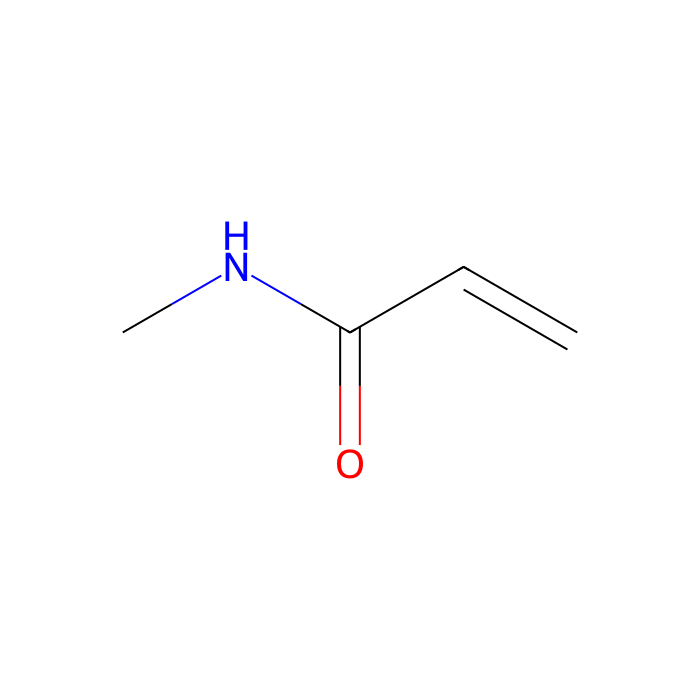
Brief overview: N-Methyl-2-propenamide is the N-methyl analog of acrylamide (commonly named N-methylacrylamide), a small α,β-unsaturated amide bearing a conjugated C=C–C=O motif and a secondary amide nitrogen.
Item-specific (from Product Data)
SKU: N189941
Product Name: N-Methyl-2-Propenamide
CAS: 1187-59-3
PubChem CID: 14471
InChIKey: 443345 (as provided)
Storage Conditions: Store at 2-8°C
Shipped In: Wet ice
Research Use Note: For research use only
Literature/Computed (general reference; not item-specific specs)
Structural description (2D): A vinyl group (CH2=CH–) conjugated to an amide carbonyl (–C(=O)–), with the amide nitrogen bearing one hydrogen and one methyl substituent (–NH–CH3). Planar amide and alkene moieties are conjugated, enabling resonance stabilization and electrophilicity at the β-carbon.
Notes
Stereochemistry: None (propenamide double bond is E/Z rotamer-free under standard notation; geometric isomerism not assigned for terminal vinyl).
Synthetic Utility
Retrosynthetic/value perspective (literature)
Functional motif: α,β-unsaturated secondary amide. This provides a conjugate electrophile that tolerates many nucleophiles and enables modular synthesis of β-functionalized amides.
Key transformations
Conjugate (Michael) additions: Formation of C–S, C–N, and C–C bonds at the β-position using thiols, amines, and stabilized carbanions (e.g., malonates) under mild base or organocatalysis. Offers high functional group tolerance compared to direct acylation routes.
Hydrogenation/hydroboration: Selective alkene reduction furnishes saturated N-methylpropionamide derivatives, useful as references or intermediates.
Radical polymerization and CRP (RAFT/ATRP): Access to poly(N-methylacrylamide) with tunable molecular weight/architecture (block, gradient, star) for advanced materials.
Post-polymer functionalization: Residual double bond (if copolymerized at sub-stoichiometric ratios) enables thiol–ene click-like modifications.
Selectivity and directing effects
The amide carbonyl withdraws electron density, increasing β-carbon electrophilicity. Secondary amide N–H can engage in H-bonding and, in catalysis, interact with bases/catalysts, influencing stereochemical outcomes in asymmetric Michael additions (with chiral catalysts).
Practical considerations
Control moisture and inhibitors to achieve reproducible kinetics. Monitor by 1H NMR (vinyl protons ~5.5–6.5 ppm) or in situ IR (νC=C decrease, νC=O shifts upon addition). Employ buffered conditions if nucleophile/basicity could promote unwanted polymerization or hydrolysis.
Target Specificity
Not applicable.
Explanation
This product is a small-molecule monomer, not a biological affinity reagent (e.g., antibody, ligand, or inhibitor with defined biomolecular targets). No antigen, epitope, species reactivity, clone, or isotype information applies.
Frequently Asked Questions
What is the purity of this product?
This product is supplied at ≥95% purity (chemical assay). Lot-specific values are stated on the Certificate of Analysis.
How should this product be stored?
Store at 2–8 °C. Refrigerated storage is required to maintain the specified shelf life.
How is this product shipped?
This product ships chilled on wet ice. Unpack on arrival and transfer it to the storage condition stated above.
What are the CAS number, molecular formula and molecular weight?
The CAS Number is 1187-59-3, the molecular formula is C4H7NO, and the molecular weight is 85.1 g/mol. InChIKey YPHQUSNPXDGUHL-UHFFFAOYSA-N.
What documentation is provided?
Available product documentation, including Certificates of Analysis (COA), Safety Data Sheets (SDS), and specification sheets, is shown in the product document area. Document availability and access follow the current site policy.
We use cookies to ensure the website functions properly and, where permitted, to improve your experience. You can manage your preferences at any time in Settings. Learn more in our Cookie Policy.
Shall we send you a message when we have discounts available?
Remind me later
Thank you! Please check your email inbox to confirm.
Products are supplied to verified businesses, institutions, and qualified professionals for research and development use only. Not for use in humans, animals, diagnosis, or therapy.

 I2602122