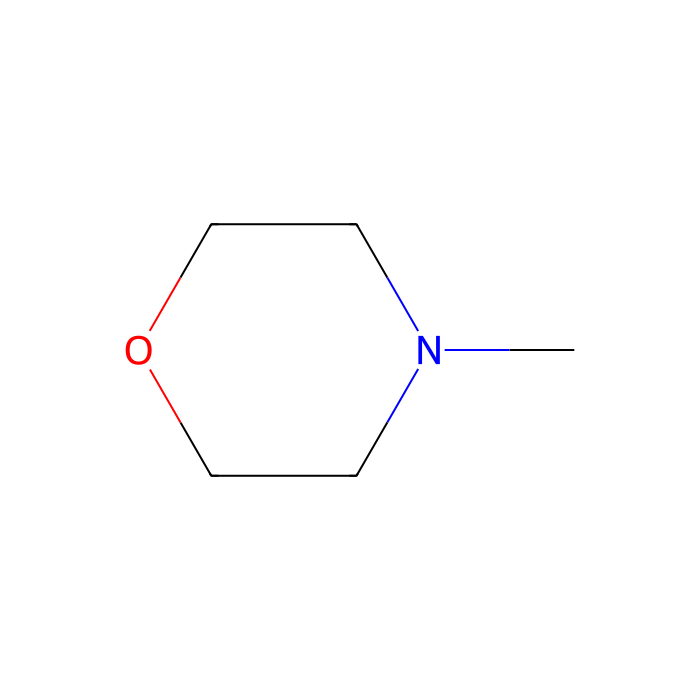
N-Methyl morpholine - for protein sequencing, ≥99.8%(GC) , CAS No.109-02-4

CAS: 109-02-4 Cat. No.: M104644 Formula: C5H11NO Molecular Weight: 101.15 Beilstein Registry Number: 102719 EC Number: 203-640-0
AVAILABLE TO ORDER
GRADE & PURITY for Protein sequencing ? Protein-sequencing grade — ultra-clean reagents for Edman/MS sequencing. Use where contaminants would obscure sequence determination. ≥99.8%(GC)
Synonyms
4-Methylmorpholine|N-METHYLMORPHOLINE|109-02-4|Morpholine, 4-methyl-|Methylmorpholine|1-Methylmorpholine|N-methyl morpholine|4-methylmorpholin|Morpholine, N-methyl-|4-Methylmorfolin|NSC 9382|4-methyl-morpholine|11P91ANU5X|NMM|DTXSID9029146|NSC-9382|DTXCID
Storage
Protected from light,Room temperature
Shipped In
FedEx DG Service
★
Size
Germany (EU)
USA*
Price
Qty
25ml
M104644-25ml
—
9 In stock

€97.10

€112.72
Save €15.62 (13.86%)
100ml
M104644-100ml
—
In stock ≥10
€303.62
500ml
M104644-500ml
—
2 In stock
€1,214.75
Enter a quantity for the sizes you want to add.
🧪
Why this grade

for protein sequencing, ≥99.8%(GC) for Protein sequencing for sensitive chromatographic and analytical workflows requiring minimal baseline interference.

🌡

Storage & shipping

Protected from light,Room temperature Ships FedEx DG Service Check lot-specific COA for exact specifications.

📋

Quality documents

SDS, COA, datasheet, and spec sheet available for download. Lot-specific COA accessible via lot number lookup.

📚

Literature proof

Cited in 69 peer-reviewed publications across chromatography, organic synthesis, and cross-coupling reactions.

Specifications

Synonyms
4-Methylmorpholine | N-METHYLMORPHOLINE | 109-02-4 | Morpholine, 4-methyl- | Methylmorpholine | 1-Methylmorpholine | N-methyl morpholine | 4-methylmorpholin | Morpholine, N-methyl- | 4-Methylmorfolin | NSC 9382 | 4-methyl-morpholine | 11P91ANU5X | NMM | DTXSID9029146 | NSC-9382 | DTXCID
Specifications & Purity
for protein sequencing, ≥99.8%(GC)
Storage
Protected from light,Room temperature
Shipped In
FedEx DG Service
Grade
for Protein sequencing
Purity
≥99.8%(GC)
Names and Identifiers
Pubchem Sid
Pubchem Sid Url
https://pubchem.ncbi.nlm.nih.gov/substance/504751533
Canonical Smiles
CN1CCOCC1
IUPAC Name
4-methylmorpholine
InChIKey
SJRJJKPEHAURKC-UHFFFAOYSA-N
INCHI
1S/C5H11NO/c1-6-2-4-7-5-3-6/h2-5H2,1H3
Isomeric SMILES
CN1CCOCC1
WGK Germany
1
RTECS
QE5775000
UN Number
2535
Packing Group
II
Molecular Weight
101.15
Beilstein
102719
Reaxy-Rn
102719
Reaxys-RN_link_address
https://www.reaxys.com/reaxys/secured/hopinto.do?context=S&query=IDE.XRN=102719&ln=

Documentation

📋 Safety Data Sheet (SDS)

Comprehensive hazard, handling, storage, and regulatory compliance document.

Download SDS →

✅ Certificate of Analysis (COA)

Lot-specific quality data. Enter your lot number to retrieve the exact COA.

Look up COA →

📊 Datasheet

Quick-reference summary of product specifications and applications.

View datasheet →

🔬 Specification Sheet

Full quality attributes and acceptance criteria for this grade.

View spec sheet →

Advanced Data

Taxonomic Classification

Taxonomy Tree

KingdomOrganic compounds
SuperclassOrganoheterocyclic compounds
ClassOxazinanes
SubclassMorpholines
Intermediate Tree Nodes Not available
Direct ParentMorpholines
Alternative Parents Trialkylamines  Oxacyclic compounds  Dialkyl ethers  Azacyclic compounds  Organopnictogen compounds  Hydrocarbon derivatives  
Molecular FrameworkAliphatic heteromonocyclic compounds
Substituents Morpholine - Tertiary aliphatic amine - Tertiary amine - Oxacycle - Azacycle - Ether - Dialkyl ether - Organic nitrogen compound - Organic oxygen compound - Organopnictogen compound - Hydrocarbon derivative - Organooxygen compound - Organonitrogen compound - Amine - Aliphatic heteromonocyclic compound
DescriptionThis compound belongs to the class of organic compounds known as morpholines. These are organic compounds containing a morpholine moiety, which consists of a six-member aliphatic saturated ring with the formula C4H9NO, where the oxygen and nitrogen atoms lie at positions 1 and 4, respectively.
External Descriptors Not available
3D Structure
Interactive Chemical Structure Model


Mechanisms of Action
Certificates(CoA,COO,BSE/TSE and Analysis Chart)
C of A & Other Certificates(BSE/TSE, COO):
Analytical Chart:

Find and download the COA for your product by matching the lot number on the packaging.

12 results found

Lot NumberCertificate TypeDateItem
K2101193Certificate of AnalysisAug 11, 2025 M104644
A2409374Certificate of AnalysisDec 25, 2023 M104644
A2409375Certificate of AnalysisDec 25, 2023 M104644
A2409376Certificate of AnalysisDec 25, 2023 M104644
A2409377Certificate of AnalysisDec 25, 2023 M104644
A2409378Certificate of AnalysisDec 25, 2023 M104644
A2409379Certificate of AnalysisDec 25, 2023 M104644
F2601096Certificate of AnalysisDec 25, 2023 M104644
H2525147Certificate of AnalysisDec 25, 2023 M104644
D2318222Certificate of AnalysisSep 21, 2022 M104644
D2318298Certificate of AnalysisSep 21, 2022 M104644
L1805161Certificate of AnalysisSep 21, 2022 M104644
Chemical and Physical Properties
SolubilityMiscible with water, soluble in benzene.
SensitivityLight sensitive.
Refractive Index1.4332
Flash Point(°C)12℃
Boil Point(°C)111-114°C
Melt Point(°C)-65°C
Molecular Weight101.150 g/mol
XLogP3-0.300
Hydrogen Bond Donor Count0
Hydrogen Bond Acceptor Count2
Rotatable Bond Count0
Exact Mass101.084 Da
Monoisotopic Mass101.084 Da
Topological Polar Surface Area12.500 Ų
Heavy Atom Count7
Formal Charge0
Complexity50.000
Isotope Atom Count0
Defined Atom Stereocenter Count0
Undefined Atom Stereocenter Count0
Defined Bond Stereocenter Count0
Undefined Bond Stereocenter Count0
The total count of all stereochemical bonds0
Covalently-Bonded Unit Count1
Documents & Articles
For Protein Sequencing
Why Do So Many Molecules Incorporate an “Oxadiazole Ring”? A Stability-Oriented Design Guide from Structural Effects to Application Storylines (with Product Navigation Tables 1–3)
β-Acyloxy Alkenyl Amides (AAAs): A New Approach to Amide Bond and Peptide Bond Construction Worth Attention
Understanding ATD-DMAP: From Reagent Design to Esterification, Amidation, and Stereochemical Integrity
A New Balance in Coupling Reagents: How DMT-TU Balances Reactivity, Racemization Control, and Thermal Hazard
The Positioning of TBTU in Practice: Racemization Risk, Extended Uses, and Selection Criteria
The Methodological Value of HATU in Difficult Couplings: Reactivity Advantages, Stereochemical Retention, and Condition Management
The Methodological Value of Boc-Oxyma: Low-Racemization Coupling, Route Continuity, and Extended Applications
Low Racemization in Peptide Synthesis Is Not Just About Reagent Choice: Stereochemical Risk During the Activation Stage and Practical Strategies for Experimental Control
The Methodological Value of TCFH: Advantages in Challenging Amidation and the Switching Logic of Carboxylic Acid Activation Pathways
Decision Logic for Peptide Synthesis Routes: Applicability and Criteria for Choosing among SPPS, LPPS, and Recombinant Expression
Decision Logic for Selecting Coupling Reagents in Amide Bond Formation: Activation Pathways, Side Reactions, Epimerization, Workup, and Safety
Experimental Selection Logic for Carboxylic Acid Preactivation Pathways: Differences and Suitable Use Cases for Classical Mixed Anhydrides, CDI, Sulfonyl Chloride Systems, and the Yamaguchi System
Boc₂O Selection Cannot Be Judged by Protection Installation Alone: Experimental Decision-Making from Substrate Nucleophilicity and Medium Effects to Deprotection Pathways
DMAP Is More Than Just an Organic Base: Experimental Judgment from Nucleophilic Acyl Transfer to Esterification and Macrolactonization
Experimental Evaluation of Triphosgene in Organic Synthesis: Understanding Its Selection Logic Through Reaction Tasks
Experimental Judgment for TFPN in Carboxylic Acid Activation: Suitable Scenarios, Intermediate Distribution, and Nucleophile Compatibility
Selective Acylation of Less Reactive Amines in Complex Substrates: Strategies for N/O and N/N Selectivity Control This article draws on the work of Li et al. on the TCFH/catalytic Oxyma system and transient imine protection, and summarizes design strateg
How to Troubleshoot Abnormal Impurities in Peptide Synthesis? Locating Process Issues Through Amino-Related Side Reactions
Peptide Intermediates Difficult to Dissolve and Separate? Route Design and Workup Strategies for Tag-Assisted Liquid-Phase Peptide Synthesis (TAG-LPPS)
AITF-Mediated Carboxylic Acid Activation for the Synthesis of Amides, Peptides, and Esters: Activation Mechanism and Applicable Scenarios
Formation and Control of Carboxyl- and Hydroxyl-Related Impurities in Peptide Synthesis — Using Asp/Glu and Ser/Thr Residue Side Reactions as Examples
Logic for Selecting Amidation Reagents in Aqueous Media: Competing Reactions, Activated Intermediates, and Substrate Effects
How to Select Morpholine Intermediates: From Connection Sites and Target Bond Types to Synthetic Route Design
Citations of This Product
Solution Calculators
Reviews

Customer Reviews

Application Protocols

No manufacturer-validated biological assay protocols are provided for this reagent. As a small-molecule base/catalyst, usage is protocol-specific to the reaction.

Illustrative literature-style procedures (for planning; adjust to your system):

  • Amide formation (acid chloride):
    • Dissolve acid chloride (1.0 eq) and amine nucleophile (1.05–1.2 eq) in dry DCM at 0–5 °C. Add NMM (2.0–3.0 eq) dropwise, maintain temperature, then allow to warm to rt for 1–2 h. Quench with 1 M HCl, separate, wash, dry, and purify.
  • Peptide coupling (solution phase):
    • To a solution of carboxylic acid (1.0 eq) and amine (1.0–1.2 eq) in DMF, add HBTU/HATU (1.0–1.1 eq) and NMM (2–4 eq) at 0–25 °C. Stir 1–4 h, monitor by HPLC. Work up by aqueous acid/base extraction.
  • Sulfonamide formation:
    • Combine sulfonyl chloride (1.0 eq) and amine (1.1–1.5 eq) in DCM; add NMM (2.0–3.0 eq) at 0 °C, then stir at rt until completion.

Note: These are generalized examples; substrate-specific optimization is essential. For analytical workflows and sequencing, consult your method SOP and ensure compatibility with detection (e.g., remove residual amine prior to LC–MS).

Biological Roles

This product is a synthetic tertiary amine used as a reagent; it has no known native biological role.

  • Biochemical context (literature):

    • Tertiary amines can perturb membrane integrity and protein conformation at sufficient concentrations; they are therefore used cautiously around live biological systems.
    • In protein sequencing workflows (Edman chemistry), N-methyl morpholine acts as a base to facilitate derivatization of peptide N-termini; its role is purely chemical, not biological.
  • Metabolism/biotransformation: Not a natural metabolite. Aliphatic tertiary amines can undergo N-oxidation (e.g., to N-oxide) or dealkylation under oxidative conditions; these pathways are relevant to environmental fate rather than physiology.

  • Enzyme/target interactions: No specific enzymatic cofactor or receptor function is associated with NMM.

Note: All uses are for research or laboratory processing; this reagent is not intended for use in humans or animals.

Buffer Applications

N-Methyl morpholine is not a standard biological buffer. While its conjugate acid has a pKa around 7.4 (literature), making buffering near neutral pH theoretically possible, practical use as a routine buffer is uncommon due to volatility, odor, and interference with enzymes and assays.

  • If used in specialized chemical procedures:
    • Target pH range (literature): ~6.5–8.0 via NMM/NMM·H+ pairs.
    • Preparation: Titrate NMM with a strong acid (e.g., HCl) to desired pH using an appropriate ionic strength background; verify pH drift over time due to CO2 absorption/volatilization.
    • Compatibility: Avoid systems sensitive to amines (e.g., aldehyde-containing biomolecules or amine-reactive labeling reagents). Expect significant UV background reduction compared to aromatic amines (e.g., pyridine), but still validate for analytical impact.

For biological samples, choose established Good’s buffers (HEPES, MOPS, PIPES) or phosphate/Tris systems instead. For peptide chemistry and sequencing needs, see Reaction & Applications and Synthetic Utility sections.

Green Alternatives

Context: N-Methyl morpholine serves mainly as a soluble base/catalyst. Greener selection considers human toxicity, volatility, persistence, and process safety.

Comparison (literature-based; choose per reaction constraints):

  • Triethylamine (TEA)

    • Pros: Widely available, inexpensive, lower water miscibility facilitates phase separation.
    • Cons: Higher vapor pressure/odor; workplace exposure concerns; often higher VOC emissions.
  • DIPEA (Hünig’s base)

    • Pros: Sterically hindered, lower nucleophilicity reduces side reactions; often efficient in peptide couplings.
    • Cons: Less water miscible; removal can be harder; typically higher cost.
  • DBU/DBN

    • Pros: Strong, non-nucleophilic; catalytic loadings possible.
    • Cons: Corrosive; more hazardous; persistent in aqueous waste; can over-deprotonate sensitive substrates.
  • 2-Methyltetrahydrofuran (2-MeTHF) or CPME as solvent choices around the base

    • Pros: Bio-based/safer solvent profiles relative to DCM/THF in some metrics.
    • Cons: Base selection must ensure solubility/reactivity; NMM remains the base but overall process EHS improves.
  • Water/ethanol media with phase-transfer or micellar catalysis

    • Pros: Reduces reliance on chlorinated solvents; easier waste handling.
    • Cons: Substrate solubility and selectivity may limit applicability.

Trade-offs:

  • NMM’s water miscibility simplifies workups but can increase amine in aqueous effluent; plan neutralization and biological treatment compatibility. Use minimal effective equivalents and recover organics via distillation where feasible.
  • For peptide applications, DIPEA is a frequent greener swap when nucleophilicity must be minimized; otherwise, NMM offers favorable handling versus pyridine.
Pharmaceutical Uses

N-Methyl morpholine is not typically an excipient in finished dosage forms; its main relevance in pharmaceutical contexts is as a process aid in chemical synthesis.

  • Roles in drug substance/process development (literature):

    • Base for acylation, sulfonylation, carbamate formation, and coupling reactions during API/intermediate synthesis.
    • Alternative to pyridine or TEA where reduced odor, increased water miscibility, or different basicity/nucleophilicity profile is advantageous.
    • Facilitates crystallization control by protonation/deprotonation of intermediates and as a transient counterion.
  • Regulatory/quality considerations:

    • Residual levels must meet ICH Q3C/Q3D/Q3A/B expectations where applicable; ensure validated purge of tertiary amines and demonstration of clearance by aqueous acid washes or distillation steps.
    • Sequencing-grade quality (this item) is beneficial when extremely low impurity backgrounds are necessary in analytical peptide workflows associated with characterization, not as an excipient.
  • Note: No therapeutic or clinical claims are made; this product is for research and manufacturing use in controlled laboratory settings only.

Physical Properties

Item-specific specifications: Not specified for this item; refer to CoA/Spec Sheet.

Literature/typical values (for planning purposes only; verify experimentally):

  • Appearance: Colorless to pale yellow liquid with amine odor (literature)
  • Boiling point: ~116–118 °C at 1 atm (literature)
  • Melting point: ~−66 °C (literature)
  • Density: ~0.92 g/mL at 20 °C (literature)
  • Refractive index (n20 D): ~1.44 (literature)
  • Vapor pressure: moderate; appreciable volatility at room temperature (literature)
  • Solubility: Miscible with water and common organic solvents (alcohols, ethers, chlorinated solvents); forms salts with strong acids (literature)
  • pKa (conjugate acid, pKaH): ~7.4 at 25 °C (aqueous, literature)
  • LogP (octanol/water): ~−0.5 to 0 (literature)
  • UV cutoff: Not specified for this item; refer to CoA/Spec Sheet.

Notes for practitioners:

  • Being a tertiary amine, NMM is basic and hygroscopic to a limited extent; it can absorb CO2 from air, gradually forming ammonium carbamate species in highly CO2-rich environments (literature observation).
  • Water content and amine-neutralizing impurities can impact base strength in moisture-sensitive reactions; dry and degas as required (see Reaction Conditions).
Quality & Grades
  • Item-specific grade: for Protein sequencing (as provided). This indicates elevated purity and low background levels of contaminants that interfere with peptide chemistry and sequencing workflows (e.g., Edman degradation and Fmoc-based coupling/deprotection cycles). Key expectations typically include low UV-absorbing impurities, low amine-reactive contaminants, and tight control of water and volatile basic impurities. Exact numerical specifications are Not specified for this item; refer to CoA/Spec Sheet.

  • What this means in practice:

    • Supports high-sensitivity peptide coupling steps (e.g., PITC derivatization in Edman chemistry) by minimizing side reactions from acidic or nucleophilic impurities.
    • Reduced background in chromatographic readouts (HPLC/UPLC) commonly associated with sequencing workflows.
  • Stabilizers/additives: Not specified for this item; refer to CoA/Spec Sheet. If no stabilizer is present, practices such as storing tightly sealed under inert gas minimize CO2 uptake and maintain basicity.

  • Comparison to general-purpose grades (context):

    • General reagent grades may have higher levels of water, aldehydes, peroxides, or residual solvents. For peptide sequencing, even trace acidic or electrophilic impurities can depress coupling yields or introduce artifacts; sequencing-grade minimizes these risks.
  • Documentation: For method validation or regulated environments, retain the lot-specific CoA and, if required, a detailed impurity profile or residual solvent statement from the manufacturer.

Reaction & Applications

N-Methyl morpholine is a versatile tertiary amine base and nucleophilic catalyst widely applied in peptide chemistry and general organic synthesis.

  • Protein sequencing/peptide chemistry (aligned with grade):

    • Base in Edman degradation steps (e.g., PITC coupling to N-terminus) where low-UV and low-amine-impurity profile is critical.
    • Catalyst/base in Fmoc-SPPS with uronium/phosphonium activators (HBTU/HATU/TBTU, PyBOP), assisting in rapid formation of active esters and scavenging of generated acids.
  • General acylation chemistry:

    • Promotes formation of amides/esters/sulfonamides with acid chlorides, anhydrides, and sulfonyl chlorides; forms the corresponding ammonium salt to sequester HX.
    • Useful in carbamate formation (e.g., chloroformate chemistry) and protection strategies (Boc-, Cbz- installation) where a soluble, moderately strong base is preferred.
  • Catalysis and specialty roles:

    • Epoxide-opening and urethane formation catalyst in polymer and materials synthesis (literature).
    • Precursor to N-methylmorpholine N-oxide (NMMO), an important oxidant and cellulose solvent (note: distinct compound with different properties).
  • Practical tips:

    • Drying: Distill from CaH2 or KOH, or sparge with dry inert gas; store tightly closed to limit CO2 uptake.
    • Dosing: 1.1–3.0 equiv relative to acid chlorides/anhydrides; catalytic (5–20 mol%) for some acyl transfers.
    • Removal: Aqueous acidic washes (e.g., 0.5–1 M HCl) efficiently remove NMM and its salts; follow with basification if needed for product extraction.
    • Analytics: Low UV absorbance simplifies HPLC monitoring versus pyridine-based systems.
Reaction Conditions

General guidance from literature and practice (verify for your substrate):

  • Solvents: DCM, DMF, NMP, THF, EtOAc, MeCN, and alcohols are typical. Water can be included for biphasic systems; ensure substrate stability.

  • Equivalents/loading:

    • Acylations/sulfonylations: 1.2–3.0 equiv NMM relative to acylating agent or nucleophile to ensure full HX scavenging.
    • Peptide couplings (HBTU/HATU/TBTU, PyBOP): 2–4 equiv base versus carboxylate; DIPEA is often benchmark, but NMM is widely used and can be interchangeable in many systems.
    • Catalysis: 5–20 mol% for acyl transfer/epoxide-opening catalysis where stoichiometric base is undesirable.
  • Temperature/time:

    • 0–25 °C for sensitive acylations; 20–50 °C for robust systems; up to 80 °C in polar aprotic solvents when needed.
    • Reaction times range from minutes (acid chloride couplings) to hours (sterically hindered amide formations).
  • Atmosphere/drying:

    • Dry solvents and inert atmosphere (N2/Ar) recommended for moisture-sensitive couplings. Sparge NMM with inert gas to reduce dissolved CO2 and moisture.
  • Workup:

    • Quench with aqueous acid (e.g., 0.5–1 M HCl) to protonate and extract NMM; back-extract product under basic conditions if necessary. Carbon treatment may reduce trace amine odor.
  • Typical outcomes:

    • High yields in acylations when stoichiometry is controlled; minimized side products compared to pyridine in some systems due to different nucleophilicity/basicity balance (literature observations).
Safety & Handling

Item-specific hazard labeling: Not specified for this item; refer to SDS for authoritative classification.

General safety information (literature; tertiary aliphatic amine):

  • Likely GHS hazards: Flammable liquid (Cat. 3) and skin/eye irritant or corrosive; harmful if inhaled. Always consult the specific SDS for this product/lot.
  • Pictograms (typical): Flame; Corrosion/Exclamation (literature expectation). Confirm with SDS.

Handling recommendations:

  • Use in a certified fume hood to avoid inhalation of vapors.
  • Wear appropriate PPE: chemical-resistant gloves (e.g., nitrile), lab coat, splash goggles or face shield.
  • Keep away from heat, sparks, open flames, and hot surfaces. Use only non-sparking tools and grounded equipment when handling bulk quantities.
  • Incompatibilities: Strong acids (exothermic neutralization; salt formation), acyl halides, acid anhydrides, chloroformates (vigorous acylation), strong oxidizers, nitrosating agents (risk of nitrosamine formation). Absorbs CO2 from air; keep container tightly closed.
  • First aid overview (consult SDS):
    • Inhalation: Move to fresh air; seek medical attention if symptoms persist.
    • Skin contact: Remove contaminated clothing; rinse with water for at least 15 minutes.
    • Eye contact: Rinse cautiously with water for several minutes; remove contact lenses if present; seek medical attention.
    • Ingestion: Rinse mouth; do not induce vomiting; seek medical attention.
  • Spill response: Contain/absorb with inert material; ventilate area; dispose per local regulations.
  • Fire-fighting: Alcohol-resistant foam, dry chemical, or CO2; water spray for cooling. Vapors may form explosive mixtures with air (literature).
Solvent Selection

N-Methyl morpholine is primarily used as a base/catalyst rather than as a bulk solvent, but its polarity and miscibility profile are relevant for method development.

  • Polarity/miscibility (literature):

    • Polar, basic, aprotic tertiary amine; miscible with water and a wide range of organics (alcohols, acetone, acetonitrile, ethers, chlorinated solvents).
    • Dielectric constant: moderate (not widely tabulated; use co-solvent data and empirical trials).
  • Practical use contexts:

    • As a soluble base in DCM, DMF, NMP, THF, MeCN, and alcohols for acylation, sulfonylation, and peptide coupling.
    • Aqueous/organic biphasic systems: NMM partitions appreciably into water; salt formation under acidic conditions drives phase behavior.
  • Choosing NMM vs alternatives (literature guidance):

    • Versus triethylamine (TEA): NMM is more polar and often more water-miscible, aiding phase-transfer and aqueous workups; TEA is more volatile and hydrophobic.
    • Versus DIPEA (Hünig’s base): DIPEA is more hindered and less nucleophilic; preferred when nucleophilicity must be minimized. NMM offers higher water miscibility and can give faster acylation catalysis in some systems.
    • Versus pyridine: NMM is less odorous/toxic and more basic; lacks pyridine’s aromatic UV background, which can benefit analytical detection.
  • Tip: When used in LC workflows, ensure mobile-phase compatibility; remove residual NMM prior to MS analysis to avoid ion suppression.

Storage & Reconstitution
  • Item-specific storage conditions (from Product Data): Protected from light, Room temperature.
  • Shipping: FedEx DG Service (dangerous goods) per Product Data.
  • Physical state/reconstitution: Liquid reagent; no reconstitution required.

Practical guidance:

  • Keep container tightly closed to minimize CO2 uptake and evaporation. If frequent openings are expected, consider storing under inert gas (N2/Ar) and using septum caps with dry-gas headspace.
  • Store away from acids and oxidizers; segregate from ignition sources. Use amber glass to comply with “protected from light,” or store in a light-protective secondary container.
  • If drying is required for moisture/CO2-sensitive procedures, treat by standing over KOH or CaH2, followed by distillation under inert atmosphere (literature practice). Document any in-lab purification if process-critical.
  • Freeze–thaw: Not applicable. Avoid low-temperature storage near the pour point only to ensure easy handling; viscosity increases at low temperature.
  • Stability: Amines are generally stable at ambient conditions when protected from light and air; verify assay and water content prior to critical applications (especially sequencing-grade workflows). Exact shelf life and allowable impurities are Not specified for this item; refer to CoA/Spec Sheet.
Structure & Identity

N-Methyl morpholine (NMM) is a six-membered saturated heterocycle (morpholine ring) bearing an N-methyl substituent, containing one ring oxygen and a tertiary amine nitrogen.

  • Item-specific identifiers (from Product Data):

    • SKU: M104644
    • CAS: 109-02-4
    • PubChem CID: 7972
    • InChIKey: Not specified for this item; refer to CoA/Spec Sheet.
    • SMILES: Not specified for this item; refer to CoA/Spec Sheet.
  • Literature identity data (for reference; not item specifications):

    • Synonyms: N-methylmorpholine; 4-methylmorpholine (IUPAC: N-methylmorpholin-4-amine is sometimes used but less common)
    • Molecular formula: C5H11NO (literature)
    • Molecular weight: 101.15 g/mol (literature)
    • Canonical SMILES (literature): O1CCN(C)CC1
    • Key structural features: tertiary amine (non-protic), cyclic ether (morpholine), N-methyl substituent; no stereocenters.
    • 2D description: A six-membered ring with an oxygen atom at position 1 and a tertiary nitrogen at position 4; the nitrogen bears a methyl substituent and is flanked by two ethylene (–CH2–CH2–) linkers to the ring oxygen.
  • Research use note: For research use only.

Synthetic Utility

Key functional elements: a tertiary amine and an embedded ether within the morpholine ring. Reactivity is dominated by the amine’s basicity and modest nucleophilicity.

  • As base (literature):

    • Neutralizes HX in acylations (acid chlorides/anhydrides), sulfonylations, and chloroformate reactions; enhances rates by forming reactive acylammonium intermediates in some cases.
    • Effective in coupling with uronium/phosphonium reagents (HBTU/HATU/TBTU, PyBOP) for amide bond formation in SPPS and solution-phase peptide synthesis.
  • As nucleophilic catalyst:

    • Promotes acyl transfer and ring-opening of activated epoxides; catalyzes urethane formation and certain transesterifications.
  • Salt formation and phase behavior:

    • Readily forms ammonium salts with strong acids, enabling phase-switching strategies for purification (acid-base extraction).
  • Derivatization/preparative chemistry:

    • Precursor to N-methylmorpholine N-oxide (NMMO) via controlled oxidation (distinct reagent used as oxidant or cellulose solvent).
  • Retrosynthetic value:

    • Serves as a benign, recoverable base that does not add stereochemical complexity; minimizes risk of E/Z or racemization artifacts compared with stronger, less selective bases.

Selection guidance: Choose NMM when a water-miscible, moderately strong, operationally simple base is desired, especially in peptide couplings or acylations where low UV background and straightforward removal by aqueous acid are beneficial.

Target Specificity

Not applicable. This product is a small-molecule reagent (tertiary amine), not a biological targeting agent or antibody. No antigen/epitope specificity, clone, isotype, or species reactivity is relevant. For application-focused guidance, see Reaction & Applications and Synthetic Utility sections.

Shall we send you a message when we have discounts available?

Remind me later

Thank you! Please check your email inbox to confirm.

Oops! Notifications are disabled.