GRADE & PURITYMoligand™?Moligand™ — Aladdin's line of ligands and bioactive small molecules. Use for receptor, pathway, and binding studies needing defined small-molecule tools.≥98%(GC)
Moligand™, ≥98%(GC) Moligand™ for sensitive chromatographic and analytical workflows requiring minimal baseline interference.
🌡
Storage & shipping
Protected from light,Room temperature,Desiccated Ships Normal Check lot-specific COA for exact specifications.
📋
Quality documents
SDS, COA, datasheet, and spec sheet available for download. Lot-specific COA accessible via lot number lookup.
📚
Literature proof
Cited in 1 peer-reviewed publications across chromatography, organic synthesis, and cross-coupling reactions.
Overview
N-Phenylacrylamide is a special polymer showing high affinity with Ochratoxin A, a colorless and crystalline mycotoxin compound. N-Phenylacrylamide can be applied in the field of mycotoxin extraction, and be used for the security research of agricultural commodities and foods made from cereals and grapes.
This compound belongs to the class of organic compounds known as anilides. These are organic heterocyclic compounds derived from oxoacids RkE(=O)l(OH)m (l not 0) by replacing an OH group by the NHPh group or derivative formed by ring substitution.
External Descriptors
Not available
1. Djoumbou Feunang Y, Eisner R, Knox C, Chepelev L, Hastings J, Owen G, Fahy E, Steinbeck C, Subramanian S, Bolton E, Greiner R, and Wishart DS. ClassyFire: Automated Chemical Classification With A Comprehensive, Computable Taxonomy. Journal of Cheminformatics, 2016, 8:61.
Determine the necessary mass, volume, or concentration for preparing a solution.
Dilution Calculator
Determine the dilution needed to prepare a stock solution.
Reconstitution Calculator
Reviews
Customer Reviews
Application Protocols
No standardized bioassay or immunoassay protocols apply to this small-molecule monomer. For representative laboratory uses:
Polymerization (general): Deoxygenate monomer solution, add AIBN (ca. 1 mol%), and heat at 70 °C with stirring until desired conversion; precipitate polymer into a non-solvent (e.g., methanol or hexanes) and dry under vacuum.
Thiol–Michael conjugation (general): Dissolve substrate and N-phenylacrylamide in MeCN or EtOH, add catalytic Et3N, and stir at room temperature; monitor by TLC/HPLC; isolate by evaporation and chromatography.
These are literature-style, non-validated examples provided for context. Optimize conditions for your specific substrates and consult primary literature.
Biological Roles
This product is supplied for research use only. N-Phenylacrylamide is a synthetic small molecule and does not have a known endogenous biological role.
General chemical biology context (literature)
The α,β-unsaturated amide motif is a soft Michael acceptor that can react with nucleophilic amino acid side chains (e.g., cysteine thiols) under suitable conditions. Such reactivity underpins many bioconjugation strategies; however, intrinsic bioactivity and selectivity depend strongly on substitution and environment.
Compared with maleimides, acrylamides are typically less reactive and more chemoselective toward thiols at neutral pH, which can be advantageous for controlled labeling in model systems.
Solubility/handling for biochemical experiments
Stock solutions are commonly prepared in DMSO due to low aqueous solubility; final DMSO content should be minimized in biological assays to avoid solvent effects.
N-Phenyl substitution increases hydrophobicity relative to acrylamide, potentially enhancing non-specific binding to proteins or membranes in vitro.
No claims are made regarding biological efficacy, safety, or therapeutic utility. Any use in biochemical assays should be preceded by pilot experiments to define concentration ranges and reactivity under the specific conditions of interest.
Buffer Applications
N-Phenylacrylamide is not a buffering reagent and is not typically used to prepare biological or analytical buffers.
Practical note: If used in bioconjugation or polymerization within buffered systems, select buffers that do not introduce strong nucleophiles or bases that could prematurely consume the Michael acceptor (avoid primary amine-rich buffers at high concentration when thiol selectivity is desired). Phosphate or HEPES at neutral pH are commonly compatible in mixed aqueous-organic systems for conjugate addition chemistry.
No specific buffer recipes or pKa-based buffering ranges apply to this compound.
Green Alternatives
Green chemistry considerations involve solvent choice, energy input, and monomer hazard profile rather than the inherent functionality of N-phenylacrylamide.
Greener solvent choices (literature guidance)
Prefer ethyl acetate, 2-MeTHF, or bio-derived alcohols (EtOH, i-PrOH) over chlorinated solvents where feasible.
For polar media needs, propylene carbonate or Cyrene can substitute for DMF/DMSO in some reactions and polymerizations.
Energy and process intensification
Conduct polymerizations at the lowest effective temperature using efficient radical initiators or controlled radical methods (RAFT/ATRP) to reduce side reactions and energy consumption.
Consider photopolymerization under visible light with appropriate initiators to avoid thermal input.
Comparative overview (general)
Solvent or approach | Environmental note | Trade-offs
--------------------|--------------------|-----------
2-MeTHF | Biomass-derived, low peroxide tendency vs THF | Different polarity; may impact solubility and rates
Ethyl acetate | Low toxicity, readily biodegradable | Limited solubility for highly polar comonomers
Propylene carbonate | Low volatility, non-flammable | High bp; challenging removal
Aqueous-organic mixtures | Reduced VOC load | Limited solubility; may require surfactants/bases for reactivity
Material selection
If the goal is purely Michael reactivity, acrylates or maleimides can sometimes substitute with different reactivity/hazard profiles; selection depends on required amide functionality and downstream stability.
These are general recommendations; validate substitutions experimentally to ensure performance and compatibility.
Pharmaceutical Uses
No pharmacopeial status or excipient designation is provided for this item. This product is for research use only.
As a monomeric Michael acceptor, N-phenylacrylamide and its polymers may be explored in materials research related to coatings, hydrogels, and functional polymer backbones that could, in principle, find roles in drug delivery or device coatings after appropriate qualification. Such uses require extensive toxicological and regulatory evaluation not covered by this product.
The parent monomer is not a typical pharmaceutical excipient.
For any development or scale-up work, obtain detailed specifications, impurity profiles, and stability data from the CoA/Spec Sheet and perform risk assessments per ICH guidelines.
Physical Properties
Item-specific physical constants are not provided in the Product Data; consult the CoA/Spec Sheet for release specifications. The following are general literature characteristics for N-phenylacrylamide (reference values only, not specifications):
Aggregate state: typically a crystalline solid (literature)
Color/appearance: often off-white to light tan solid (literature)
Melting point: typical reports in the ~120–140 °C range (literature, source-dependent). Exact value for this item: Not specified for this item; refer to CoA/Spec Sheet.
Boiling point: generally decomposes before boiling at atmospheric pressure (literature). Item-specific BP: Not specified for this item; refer to CoA/Spec Sheet.
Density: Not specified for this item; refer to CoA/Spec Sheet.
Refractive index: Not applicable to solids; Not specified for this item; refer to CoA/Spec Sheet.
Solubility profile (qualitative, literature)
Good solubility in polar aprotic organics (DMF, DMSO, NMP, acetone, acetonitrile)
Moderate in alcohols (MeOH, EtOH); limited in nonpolar solvents (hexanes, toluene)
Low aqueous solubility relative to unsubstituted acrylamide due to the phenyl substituent
LogP/logD: expected higher hydrophobicity than acrylamide; specific values vary by source (literature). Item-specific value: Not specified for this item; refer to CoA/Spec Sheet.
pKa: amide N–H is non-basic; pKa for deprotonation typically >15 in DMSO (literature).
Practical note (general): As an α,β-unsaturated amide, it can slowly self-polymerize under heat/light; handle accordingly (see Safety & Handling).
Quality & Grades
Grade/Purity per Product Data: Moligand™
Item-specific purity, stabilizers, residual solvents, and contaminant limits: Not specified for this item; refer to CoA/Spec Sheet.
About the designation (general guidance):
Moligand™ is a catalog designation used by Aladdin Scientific to support research workflows (materials science, ligand/monomer libraries, and related discovery). It does not, by itself, define a pharmacopeial grade.
In absence of detailed grade descriptors (e.g., AR, HPLC, ACS), users should consult the CoA/Spec Sheet for trace analyses (UV profile, metals, water/peroxide, inhibitors) relevant to their application.
What to verify before use (practical recommendations):
For polymerization work: check inhibitor content and UV absorption; if an inhibitor is present, plan purification (e.g., column over basic alumina) before radical polymerization.
For catalysis or surface grafting: request metals analysis if ppm-level metals are critical; otherwise, perform appropriate blank controls.
For electronic/optical materials: confirm color/absorbance and particulate profile; low-UV or low-fluorescence specifications may be needed.
Release documentation: For final specifications (purity assay, chromatographic profile, identity confirmation), see the lot-specific CoA. Where necessary, request additional documentation (SDS, TDS) from Aladdin Scientific.
Reaction & Applications
N-Phenylacrylamide is a versatile Michael acceptor and polymerizable monomer combining an electron-deficient C=C with a secondary anilide.
Representative applications (literature)
Radical polymerization to poly(N-phenylacrylamide) and copolymers for materials science (tunable Tg, H-bonding, and aromatic interactions).
Michael additions of thiols/amines under base or nucleophilic catalysis to form β-functionalized amides; useful in small-molecule diversification and post-polymer modification.
Orthogonal “thiol–ene” type conjugations (conjugate addition to the activated alkene) for surface and macromolecular grafting.
Cycloaddition/cascade chemistry where conjugate addition is followed by intramolecular trapping (substrate-dependent).
Practical tips
Inhibitors: If present, remove prior to free-radical polymerization (e.g., pass through basic alumina). Work under oxygen-free conditions with AIBN or peroxide initiators at 50–80 °C depending on solvent.
Chemoselectivity: The amide dampens electron density on the double bond, favoring 1,4-addition over 1,2-addition; soft nucleophiles (thiols) add efficiently at room temperature.
Base sensitivity: Strong bases can promote aza-Michael self-addition or undesired side reactions; use mild bases (e.g., triethylamine) and monitor by TLC/LCMS.
Metal-catalyzed transformations: The aromatic ring allows further diversification via electrophilic aromatic substitution or cross-coupling if halogenated derivatives are prepared; the parent compound itself is not a typical cross-coupling partner.
Characterization pointers
Michael addition products show loss of alkene signals (δ 5.5–6.5 ppm) and new β-CH resonances (δ 2.5–3.5 ppm) in 1H NMR; amide NH often broad and H-bond sensitive.
Polymer formation is evident by disappearance of vinylic bands in IR and broadening in NMR; SEC/GPC for Mn/Mw determination.
Reaction Conditions
The conditions below are representative literature guidance for this class of substrate; they are not product specifications. Optimize for your specific system.
Free-radical polymerization (literature)
Solvent: bulk, DMF, dioxane, toluene, or MeCN; deoxygenate by sparging.
Initiator: AIBN (0.5–2 mol%) or benzoyl peroxide.
Temperature: 60–80 °C depending on solvent/initiator half-life.
Time: 2–24 h; monitor monomer conversion by 1H NMR or gravimetry.
Notes: Remove inhibitors before polymerization. For better control, use RAFT (e.g., trithiocarbonate CTAs) at 60–70 °C.
Michael addition with thiols (literature)
Solvent: MeCN, MeOH, EtOH, or mixed aqueous-organic.
Time: 0.5–12 h; typically rapid at rt with soft nucleophiles.
Notes: Maintain neutral to slightly basic pH in aqueous media for thiolate formation; avoid strong base to limit side reactions.
Michael addition with amines (literature)
Solvent: polar aprotic (DMF, DMSO) or alcohols.
Conditions: neat or with mild base; heating (40–80 °C) may be needed for less nucleophilic amines.
Notes: Competes with polymerization at elevated temperatures; consider inhibitor traces or radical scavengers if needed.
Workup/analysis
Quench by dilution and neutralization; remove solvent under reduced pressure.
Purify by column chromatography (EtOAc/hexanes gradients) or recrystallization from EtOAc/hexanes or MeOH/water, as dictated by product polarity.
Safety & Handling
Safety classifications for this specific item are not provided in the Product Data. Always review the product SDS for authoritative information.
GHS information for this item
Signal word: Not specified for this item; refer to CoA/Spec Sheet/SDS.
Hazard statements: Not specified for this item; refer to SDS.
GHS classification and pictograms: Not specified for this item; refer to SDS.
General hazard considerations for α,β-unsaturated amides (literature/good practice)
May cause irritation to skin, eyes, and respiratory tract upon exposure to dust or vapors.
Can undergo exothermic polymerization upon heating or prolonged exposure to light; avoid heat sources and direct sunlight.
Avoid contact with strong bases, strong acids, strong oxidizers, and radical initiators that may trigger polymerization or decomposition.
Recommended PPE and engineering controls (good laboratory practice)
Wear lab coat, safety glasses or splash goggles, and appropriate chemical-resistant gloves (e.g., nitrile). Handle solids in a fume hood to minimize dust inhalation.
Use inert atmosphere (nitrogen/argon) and amber containers if conducting reactions or storing solutions for extended periods.
First-aid overview (general)
Skin: Wash with soap and water. Remove contaminated clothing.
Eyes: Rinse cautiously with water for several minutes; remove contact lenses if present and easy to do; continue rinsing.
Inhalation: Move to fresh air; seek medical attention if symptoms persist.
Ingestion: Rinse mouth; do not induce vomiting; seek medical attention.
Defer to the SDS for spill response, firefighting measures, disposal, and detailed toxicological information.
Solvent Selection
As an aromatic, α,β-unsaturated amide, N-phenylacrylamide shows amphiphilic behavior with a bias toward organic solubility.
Poorly soluble: alkanes (hexanes, heptane); limited in toluene
Aqueous solubility: low relative to acrylamide; increases with cosolvents (EtOH, DMSO) or surfactants
Selection tips by application
Radical polymerization: use dry, oxygen-free polar aprotics (DMF, dioxane, MeCN) or bulk polymerization; remove inhibitors if present.
Michael additions (thiols/amines): polar protic/aprotic media (MeOH, EtOH, MeCN, DMF) with mild base or nucleophile; aqueous-organic mixtures can work when a base is used.
Surface grafting/initiated polymerization: choose solvents that wet the substrate; for hydrophobic surfaces, MeCN/EtOAc often balance solubility and volatility.
Quick comparison (literature-based)
DMSO/DMF: maximum solubility; higher boiling points; harder to remove.
MeCN/EtOAc: good balance of solubility and ease of removal; MeCN supports controlled radical polymerizations (ATRP/RAFT) with good mass transfer.
Alcohols: greener option; may participate in transesterification-like side reactions under strong base is not expected for amides but can influence Michael additions via hydrogen bonding.
Dry, oxygen-poor conditions are advisable when seeking to suppress unintended polymerization.
Storage & Reconstitution
Follow the item-specific storage guidance provided.
Storage conditions (from Product Data)
Protected from light
Room temperature
Desiccated
Cool
Shipped: Normal
Practical handling tips (general)
Store in an amber, tightly sealed container with desiccant to minimize moisture uptake and light exposure. If feasible, blanket headspace with inert gas to deter unintended polymerization.
Avoid elevated temperatures; do not store near heat sources or in direct sunlight.
Prepare stock solutions in dry, oxygen-free solvents (e.g., anhydrous MeCN, DMF, or DMSO) for short-term use. For longer-term solution storage, use amber vials, minimize headspace, and refrigerate if compatible with your workflow.
Stability notes
As an α,β-unsaturated monomer, it can slowly polymerize upon exposure to light/heat or in the presence of radicals. Inspect periodically for changes in appearance or solubility.
For any uncertainties (shelf life, inhibitor presence, lot-specific purity), consult the CoA/Spec Sheet accompanying your lot. This product is for research use only.
Structure & Identity
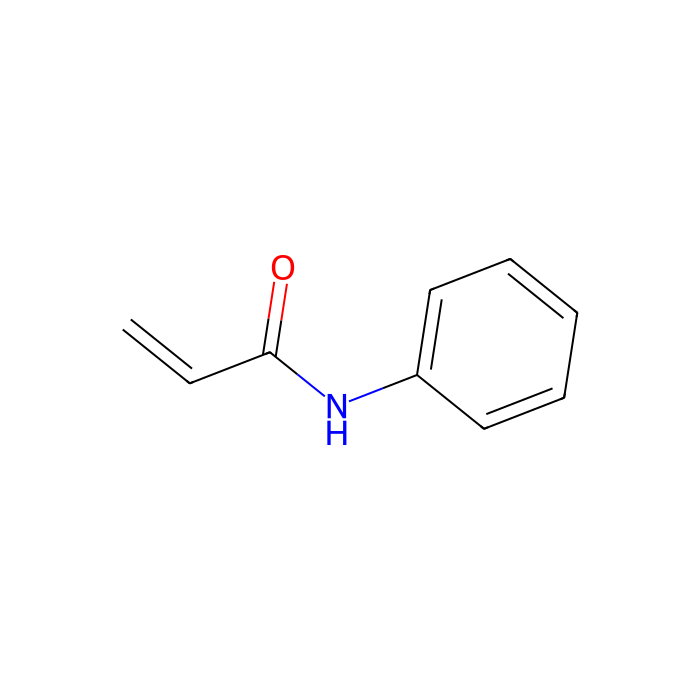
N-Phenylacrylamide is an anilide bearing an α,β-unsaturated amide (acrylamide) conjugated to a phenyl-substituted nitrogen, making it both an aromatic amide and a Michael acceptor.
Item identifiers
SKU: N159041
CAS: 2210-24-4
PubChem CID (literature): 221792
InChIKey: Not specified for this item; refer to CoA/Spec Sheet.
Composition (literature)
Molecular formula: C9H9NO
Molecular weight: 147.17 g/mol
Structure descriptors (literature)
SMILES: C=CC(=O)Nc1ccccc1
2D description: an acrylamide fragment (CH2=CH–C(=O)–) attached to an anilide nitrogen (–NH–Ph). The double bond is conjugated with the amide carbonyl, forming an electron-deficient alkene suitable for conjugate (Michael) addition. No stereocenters are present; E/Z geometry does not apply to the terminal alkene substituents as it is monosubstituted on the β-carbon.
Functional groups and features (literature)
Aromatic ring (phenyl)
Secondary amide (–NH–C(=O)–)
Conjugated α,β-unsaturated system (Michael acceptor)
Notes: Structural and identifier details labeled “literature” are general reference values for this compound and are not item-specific specifications.
Synthetic Utility
N-Phenylacrylamide offers a conjugated Michael acceptor tethered to an anilide, enabling both polymerization and small-molecule transformations.
Functional group leverage (literature)
Michael acceptor: undergoes conjugate addition with thiols (fast), amines (moderate), and stabilized carbanions; enables β-functionalized amides.
Amide handle: can direct hydrogen bonding and influence regio-/stereoselectivity; allows further N-protection/deprotection chemistry (acyl activation not straightforward without prior derivatization).
Aromatic ring: platform for further derivatization after pre-functionalization (e.g., halogenation on the aniline precursor prior to acrylamido formation).
Typical synthetic roles
Monomer for free-radical, RAFT, or ATRP polymerization to introduce aromatic amide side chains into polymers and copolymers.
Building block in cascade sequences where initial conjugate addition is followed by intramolecular cyclization.
Scaffold for preparing β-thioether- or β-amino-amide motifs under mild conditions.
Retrosynthetic insight
Readily accessed by acylation of aniline with acryloyl chloride under basic conditions (Schotten–Baumann type), or via coupling of acrylic acid with aniline using carbodiimide or other peptide-coupling reagents.
Analytical convenience: UV activity from the phenyl chromophore facilitates HPLC monitoring; the disappearance of vinylic protons tracks conversion in NMR.
Target Specificity
Not applicable. This product is a small organic molecule, not a biological targeting reagent. No antigen, epitope, species reactivity, clone, or isotype information applies.
We use cookies to ensure the website functions properly and, where permitted, to improve your experience. You can manage your preferences at any time in Settings. Learn more in our Cookie Policy.
Shall we send you a message when we have discounts available?
Remind me later
Thank you! Please check your email inbox to confirm.
Products are supplied to verified businesses, institutions, and qualified professionals for research and development use only. Not for use in humans, animals, diagnosis, or therapy.

 L2220039