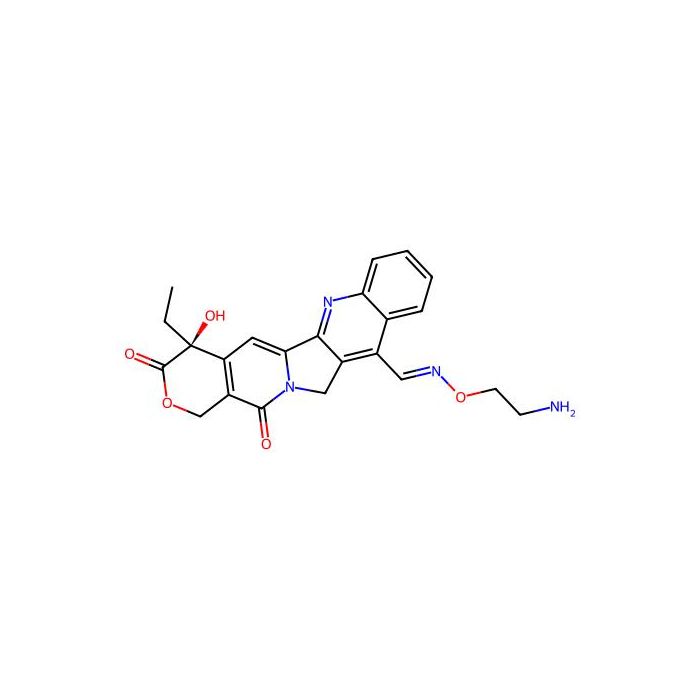
Namitecan is a potent topoisomerase I inhibitor, with antitumor property.
In Vitro
Namitecan and cetuximab cooperate in inhibiting EGFR expression. Namitecan induces a dose-dependent decrease in EGFR expression in the different cell lines. ST1968 induces a comparable level of apoptosis in A431 and A431/TPT cells with IC 50 of 0.21 and 0.29 μM. MCE has not independently confirmed the accuracy of these methods. They are for reference only.
In Vivo
Namitecan (10 mg/kg) in combination with cetuximab (1 mg/mouse) induces synergistic antitumor effects in SCC models as a function of EGFR gene copy number . ST1968 (25 mg/kg) causes acceptable body weight loss and no toxic deaths. ST1968 produces a 100% complete response rate in the mice bearing the A431 tumor, and retains a relevant activity in the topotecan-resistant tumor. MCE has not independently confirmed the accuracy of these methods. They are for reference only.
Form:Solid
IC50& Target:Topoisomerase I
Specifications
Synonyms
NAMITECAN [WHO-DD] | ST-1968 | ST 1968 | (S)-4-Ethyl-4-hydroxy-3,14-dioxo-3,4,12,14-tetrahydro-1H-pyrano[3',4':6,7]indolizino[1,2-b]quinoline-11-carbaldehyde O-(2-aminoethyl) oxime | Namitecan [INN] | Namitecan | (4S)-11-((E)-((2-Aminoethoxy)imino)methyl)-4-ethyl-4-hydroxy-1,12-dihydro-14H-pyrano(3',4':6,7)indolizino(1,2-b)quinoline-3,14( Show more
Specifications & Purity
≥99%
Biochemical and Physiological Mechanisms
Namitecan is a potent topoisomerase I inhibitor, with antitumor property.
Storage
Store at -20°C
Shipped In
Ice chest + Ice pads
This product requires cold chain shipping. Ground and other economy services are not available.
This compound belongs to the class of organic compounds known as camptothecins. These are heterocyclic compounds comprising a planar pentacyclic ring structure, that includes a pyrrolo[3,4-beta]-quinoline moiety (rings A, B and C), conjugated pyridone moiety (ring D) and one chiral center at position 20 within the alpha-hydroxy lactone ring with (S) configuration (the E-ring).
External Descriptors
Not available
1. Djoumbou Feunang Y, Eisner R, Knox C, Chepelev L, Hastings J, Owen G, Fahy E, Steinbeck C, Subramanian S, Bolton E, Greiner R, and Wishart DS. ClassyFire: Automated Chemical Classification With A Comprehensive, Computable Taxonomy. Journal of Cheminformatics, 2016, 8:61.
Determine the necessary mass, volume, or concentration for preparing a solution.
Dilution Calculator
Determine the dilution needed to prepare a stock solution.
Reconstitution Calculator
Reviews
Customer Reviews
Application Protocols
No item-specific, validated application protocols are provided in the Product Data.
General research-use workflow (informational, to be adapted and validated by the user):
Reconstitution: Dissolve the compound in anhydrous DMSO to prepare a 10–50 mM stock. Mix thoroughly; gentle warming (room temperature) and brief sonication can aid dissolution. Protect from light.
Storage of stock: Aliquot to minimize freeze–thaw; store at −20°C in amber vials. Allow to warm to room temperature before opening to prevent moisture ingress.
Working dilutions: Prepare serial dilutions in DMSO, then add to buffer/cell media to reach final concentrations. Maintain consistent vehicle (%) in all wells/tubes. Mix immediately and thoroughly upon addition.
Controls: Include vehicle control, a positive control Top1 inhibitor if available, and plate edge controls to monitor evaporation effects.
Users must validate all steps for their specific systems. This guidance is not a substitute for a formal, item-specific protocol.
Biological Roles
General, literature-based overview (no clinical claims):
Namitecan is categorized within the camptothecin class of DNA topoisomerase I (Top1) poisons. It acts by stabilizing the transient Top1–DNA cleavage complex, converting a catalytic intermediate into a persistent DNA lesion that can trigger replication-associated damage responses.
The lactone form is typically considered the pharmacologically active species; at neutral/basic pH the carboxylate form predominates and can exhibit altered target engagement and protein binding.
Cellular effects observed in research models include S-phase–biased cytotoxicity, accumulation of DNA single-strand breaks that convert to double-strand breaks upon fork collision, activation of ATR/CHK1 signaling, γH2AX formation, and apoptosis pathways (literature).
Structure–activity relationships across CPT analogs show that substitutions at the 7-, 9-, or 10-positions modulate lipophilicity, plasma stability, and transporter susceptibility (e.g., ABCB1/ABCG2 interactions can influence intracellular exposure).
In systems biology contexts, Top1 inhibitors are used to interrogate DNA topology management, transcriptional stress, and replication fork dynamics.
Note: Specific potency values (IC50/Ki), permeability, protein binding, and transporter profiles are compound- and system-dependent and are Not specified for this item; consult primary literature or generate in-house data under your assay conditions.
Buffer Applications
This item is not a buffer reagent. However, buffer choice is important for preserving the active lactone form of camptothecin-class compounds in biological assays (general, literature-based):
pH control: Favor mildly acidic buffers (pH ~5.5–6.5) to shift equilibrium toward the lactone. If physiological pH is required, minimize pre-incubation time in aqueous media and prepare stocks in DMSO.
Suggested buffers for acidic conditions: Citrate (pH 5–6.5) or MES (pH 5.5–6.7). Avoid strong bases and prolonged exposure to pH >7.4.
Protein effects: Serum proteins (e.g., albumin) can bind the carboxylate form; consider serum-free pre-incubations or controlled protein content during dosing to reduce sequestration.
Light and temperature: Use amberware and keep solutions cool during setup; return plates to 37°C only after dosing to reduce degradation.
Recipes and exact compositions are assay-specific and Not specified for this item; validate buffer systems for your biological context.
Green Alternatives
Because Namitecan is a specialized research small molecule (not a bulk solvent or reagent), “green alternatives” primarily concern the choice of dissolution and process solvents rather than replacement of the active itself.
Greener solvent considerations (general):
Prefer water-rich systems when compatible with solubility/activity; maintain acidic pH to preserve lactone (literature). Buffer with citrate or MES if assay-tolerant.
If high-organic solvents are required, select DMSO over DMF/NMP where possible due to more favorable toxicological and regulatory profiles.
Minimize solvent volumes by preparing concentrated stocks (e.g., 10–50 mM in DMSO) and performing serial dilutions.
Illustrative comparison (general):
DMSO: broad solvency, miscible with water, widely accepted in bioassays; moderate environmental impact relative to DMF/NMP.
Ethanol: renewable feedstock but limited solvency for many camptothecins; higher volatility can complicate dosing accuracy.
Acetonitrile: good for LC analytics; higher environmental burden and flammability; typically avoided for dosing stocks.
Operational green tips:
Use micro-scale assays (96–384 well) to reduce solvent consumption.
Implement closed, low-loss dispensing (acoustic or positive-displacement) to limit VOC emissions.
Dispose of organic waste via approved routes; do not discharge to drains.
Pharmaceutical Uses
This product is supplied strictly for research use only and is not intended for human or veterinary use, diagnostic procedures, or clinical applications.
Formulation-related considerations for research and preformulation studies (general, literature-based for camptothecin analogs):
Salt/solid-state screening: Evaluate possible salt forms, co-crystals, or amorphous dispersions to improve physical stability and dissolution (where chemically feasible for the scaffold).
Enabling formulations: Cyclodextrins, liposomes, micelles, or polymeric carriers have been explored to enhance solubility and stabilize the lactone (literature). Such systems can be informative for in vitro delivery studies.
Vehicle selection for in vivo research (not for clinical use): Acidified co-solvent systems (e.g., DMSO/PEG/saline with mild acidification) are sometimes used to maintain the lactone; ensure IACUC/EHS approval and compound compatibility.
Regulatory status and compendia:
No pharmacopeial monograph is cited for this item. Any GMP or compendial status is Not specified for this item; refer to CoA/Spec Sheet if needed for regulated studies.
All handling must comply with institutional and regulatory requirements for non-clinical research chemicals.
Physical Properties
Item-specific values from Product Data:
Appearance: Not specified for this item; refer to CoA/Spec Sheet.
Molecular Weight: Not specified for this item; refer to CoA/Spec Sheet.
Literature/general expectations for camptothecin-class analogs (informational only; not product specifications):
Physical state: Typically a solid (often pale yellow to off-white) with poor aqueous solubility and good solubility in polar aprotic organic solvents such as DMSO and DMF.
Solubility (typical, literature):
Water: very low; solubility increases for the open-ring carboxylate at neutral/basic pH but may reduce biological relevance.
DMSO: typically high (stock solutions 10–50 mM commonly prepared for screening).
pH sensitivity (literature): The lactone–carboxylate equilibrium shifts toward the closed lactone at acidic pH (<6) and toward the open carboxylate at neutral to basic pH.
LogP/LogD (literature): Many camptothecin analogs are lipophilic (LogP often >2), aiding cell permeability but reducing aqueous solubility.
Notes:
Exact BP/MP, density, refractive index, pKa, and partition parameters are compound-specific and are Not specified for this item; refer to CoA/Spec Sheet.
For experimental planning, measure actual solubility in your assay buffers, as protein content and pH can markedly affect apparent solubility.
Quality & Grades
Item-specific quality details:
Grade/Purity: Not specified for this item; refer to CoA/Spec Sheet.
How to interpret grades/purity for screening compounds (general guidance):
Screening/Library grade materials are typically provided at ≥95% purity by HPLC unless otherwise noted. Exact acceptance criteria, chromatographic conditions, and impurity profiling are defined in the item’s CoA/Spec Sheet.
For bioassays, low non-volatile impurities and well-characterized counterions/solvates are important to prevent assay artifacts. Verify:
Purity and identity (HPLC/UPLC, NMR, HRMS).
Residual solvents and water content (GC, KF) if assay sensitivity requires.
Counterion/salt form when applicable (affects solubility and potency reporting).
UV absorbance/background:
Camptothecin analogs often have significant UV absorbance in the 250–380 nm range (literature), which can be advantageous for HPLC monitoring but may interfere with certain absorbance-based assays. Consider fluorescence/LC-MS readouts if needed.
What is specific to this item:
Where a grade, stabilizer, salt form, or exact purity is important for your application, please consult the CoA/Spec Sheet for SKU N648533. In the absence of a stated grade, treat this as a research-use screening compound and qualify to your internal specifications as needed.
Reaction & Applications
This product is offered as a research small molecule rather than a synthetic reagent. Consequently, it is not typically employed as a stoichiometric reagent or catalyst in preparative organic reactions.
Research application contexts (general, literature-based for Namitecan/camptothecin-class compounds):
Biochemical assays: Evaluate inhibition of human or recombinant DNA topoisomerase I via plasmid relaxation or DNA cleavage-complex stabilization assays.
Cell-based studies: Probe DNA damage responses, S-phase checkpoint activation, and apoptosis pathways associated with Top1 poisoning. Suitable for pathway validation and phenotypic screening (non-clinical, research-only).
Mechanistic studies: Examine lactone–carboxylate interconversion, protein binding, and intracellular accumulation driven by lipophilicity and efflux transporter interactions (e.g., ABC transporters) (literature).
Practical tips (general):
Prepare fresh DMSO stocks and avoid extended exposure of aqueous working solutions to neutral/basic pH to maintain the lactone.
Control DMSO content across dose–response plates; include vehicle controls.
Use amber vials or foil-wrapped tubes to limit photodegradation.
If synthetic derivatization is planned (e.g., prodrug or linker conjugation for tool development), consult primary literature on camptothecin 7-, 9-, and 10-position modification strategies.
Reaction Conditions
Not typically applicable: this product is a research screening compound, not a reagent for chemical reactions.
Assay preparation conditions (general, literature-based guidance for camptothecin-class compounds):
Stock solutions: Prepare 10–50 mM in anhydrous DMSO; vortex and, if needed, sonicate briefly. Filter (0.2 µm PTFE) if particulate persists.
Working solutions: Dilute into assay buffer or media to the desired concentration, keeping final DMSO at 0.1–0.5% v/v (or per assay tolerance). Mix thoroughly to prevent local supersaturation.
pH and stability: Use mildly acidic buffers when compatible to preserve the lactone; minimize residence time at pH ≥7.4 before assay readout.
Light/temperature: Protect from light and avoid prolonged exposure at elevated temperature. Prepare fresh on the day of use when possible.
Expected performance metrics (IC50, kinetics) and exact incubation times are system-dependent and are Not specified for this item; determine empirically under your assay conditions.
Safety & Handling
Authoritative safety information must be obtained from the product SDS.
Item-specific hazards (from Product Data):
GHS Classification: Not specified for this item; refer to SDS.
Signal Word: Not specified for this item; refer to SDS.
H-Statements: Not specified for this item; refer to SDS.
Pictograms: Not specified for this item; refer to SDS.
General laboratory handling guidance for potent small molecules (informational, not a substitute for SDS):
Assume acute toxicity and potential reproductive toxicity/genotoxicity risk typical of DNA-topoisomerase I inhibitors (literature). Use a chemical fume hood or ventilated enclosure.
Wear appropriate PPE: lab coat, safety glasses, and double nitrile gloves when handling powders/solutions. Avoid aerosol generation.
Use weighing boats and antistatic measures to minimize powder dispersion. Consider closed transfer tools for solutions.
Avoid skin/eye contact and inhalation; prevent environmental release. Collect waste as hazardous organic waste; follow institutional policies.
First aid (overview):
Inhalation: move to fresh air; seek medical attention.
Skin/eye contact: rinse with water for at least 15 minutes; remove contaminated clothing; seek medical attention.
Ingestion: do not induce vomiting; seek immediate medical attention.
Storage incompatibilities (general): avoid strong bases (promote lactone opening), strong oxidizers, and prolonged exposure to moisture or light.
Always defer to the SDS and your institutional EHS guidance for definitive hazard and response procedures.
Solvent Selection
Practical solvent guidance for Namitecan in research workflows (general/literature-based for camptothecin analogs):
Preferred stock solvent: DMSO due to strong solvating power and chemical compatibility. Typical lab stocks: 10–50 mM.
Secondary solvents: DMF, NMP, or mixed organic systems (e.g., DMSO:water co-solvent) for assay introduction. Acetonitrile or ethanol can work but may offer lower solubility.
Aqueous media: Poor intrinsic water solubility for the lactone form; neutral/basic pH favors the carboxylate, increasing solubility but potentially altering biological activity.
Miscibility and polarity (general):
DMSO: miscible with water and most organics; expedites preparation of homogeneous assay solutions.
Ethanol/Acetonitrile: miscible with water but may precipitate compound upon dilution if the final organic fraction is too low.
Tips to avoid precipitation and activity loss:
Keep DMSO at ≥0.1–0.5% v/v in final assay wells to maintain solubility while minimizing solvent effects.
Add compound stock last with vigorous mixing; consider serial dilution in DMSO before stepwise aqueous dilution.
Maintain assay buffers near pH 5.5–6.5 when compatible to preserve the lactone form (literature). If neutral pH is required, minimize pre-incubation time before use.
Comparison (general):
DMSO vs DMF: DMSO is more commonly used in biological assays; DMF may pose additional cytotoxicity and volatility concerns. Choose DMSO unless there is a specific incompatibility.
Storage & Reconstitution
Item-specific conditions (from Product Data):
Storage: Store at −20°C.
Shipped In: Ice chest + Ice pads.
Additional best practices (general guidance):
Protect from light and moisture; keep containers tightly sealed. For hygroscopic sensitivity and lactone stability, consider desiccated storage.
Upon first opening, promptly prepare single-use aliquots (e.g., DMSO stock solutions) to minimize repeated freeze–thaw and headspace humidity exposure.
If provided as a solid: Allow vial to equilibrate to room temperature in a desiccator before opening to prevent condensation. Weigh rapidly in a hood with appropriate PPE.
Dissolve in anhydrous DMSO to 10–50 mM. Vortex/sonicate briefly if needed.
For aqueous use, dilute into buffer/media immediately before the experiment; maintain appropriate vehicle % and consider mildly acidic buffers to preserve the lactone (literature).
Stability: Exact shelf-life, solution stability, and freeze–thaw tolerance are Not specified for this item; refer to CoA/Spec Sheet and verify in your system.
Research Use Only: Not for human or veterinary use. Follow institutional chemical hygiene and EHS requirements.
Structure & Identity
Brief overview: Namitecan (CAS 372105-27-6) is a small-molecule research compound in the camptothecin/topoisomerase I inhibitor chemical class (literature). It is supplied for research use only.
Item-specific (from Product Data):
Product Name: Namitecan
CAS: 372105-27-6
SKU: N648533
InChIKey: 136798 (as provided)
SMILES: Not specified for this item; refer to CoA/Spec Sheet.
Molecular Formula: Not specified for this item; refer to CoA/Spec Sheet.
Molecular Weight: Not specified for this item; refer to CoA/Spec Sheet.
Structural features (general, literature-based description for the name “Namitecan”):
Belongs to the camptothecin scaffold family featuring a fused pentacyclic lactone-containing system (E-ring lactone) and an α-hydroxylactone moiety (lactone/carboxylate equilibrium is pH-dependent).
Contains a topoisomerase I–active pharmacophore that stabilizes the covalent Top1–DNA cleavage complex (interfacial inhibition) (literature).
Substituent pattern is designed to increase lipophilicity and metabolic stability relative to camptothecin (literature generalization for modern CPT analogs).
2D structure (verbal, literature-based):
A rigid polycyclic core with an embedded δ-lactone ring (E ring), a quinoline-like aromatic system (A–D rings), and a pendant aliphatic/aryloxy substituent (exact pattern depends on the specific analog). The stereochemistry at the lactone center is critical for activity in CPT-class agents (literature).
Synthetic Utility
Namitecan is supplied as a finished bioactive small molecule and is not typically used as a building block or reagent in routine synthetic chemistry.
General synthetic context for camptothecin analogs (literature):
The camptothecin core presents limited functional handles; derivatization often occurs at 7-, 9-, or 10-positions via etherification, carbamate/urea formation, or aryl/alkyl substitutions to modulate physicochemical properties.
The E-ring lactone is sensitive to base; protecting/group strategies and carefully buffered workups are required to avoid ring opening during synthesis or purification.
For conjugate development (e.g., prodrugs or affinity probes), linkers are commonly attached through phenolic or amine-bearing positions when present, balancing stability vs. release kinetics in biological media.
If you intend to use this molecule as a scaffold for analog generation, consult primary literature on:
Regioselective substitution of the A–D rings.
Stabilization of the active lactone via steric/electronic tuning.
Late-stage diversification under mild, non-basic conditions.
Note: No item-specific reactivity or transformation data are provided; treat this as an endpoint compound rather than a synthetic intermediate.
Target Specificity
This section is primarily applicable to biologics (e.g., antibodies) with defined antigen/epitope data. For this small-molecule product, no item-specific target-binding metadata are provided in the Product Data.
General mechanism context (literature, informational): Namitecan is described in the literature as a topoisomerase I poison, stabilizing the Top1–DNA cleavage complex. Off-target profiles, selectivity ratios, and binding constants are assay-dependent and Not specified for this item; consult primary literature or establish in-house profiling.
Frequently Asked Questions
What is the purity of this product?
This product is supplied at ≥99% purity (chemical assay). Lot-specific values are stated on the Certificate of Analysis.
How should this product be stored?
Store at ?20 °C. Freezer storage is required to maintain the specified shelf life.
How is this product shipped?
This product ships in an insulated container with ice pads. Unpack on arrival and transfer it to the storage condition stated above.
What are the CAS number, molecular formula and molecular weight?
The CAS Number is 372105-27-6, the molecular formula is C23H22N4O5, and the molecular weight is 434.44 g/mol. InChIKey IBTISPLPBBHVSU-UVOOVGFISA-N.
What documentation is provided?
Available product documentation, including Certificates of Analysis (COA), Safety Data Sheets (SDS), and specification sheets, is shown in the product document area. Document availability and access follow the current site policy.
We use cookies to ensure the website functions properly and, where permitted, to improve your experience. You can manage your preferences at any time in Settings. Learn more in our Cookie Policy.
Shall we send you a message when we have discounts available?
Remind me later
Thank you! Please check your email inbox to confirm.
Products are supplied to verified businesses, institutions, and qualified professionals for research and development use only. Not for use in humans, animals, diagnosis, or therapy.