
 L2525642
Determine the necessary mass, volume, or concentration for preparing a solution.
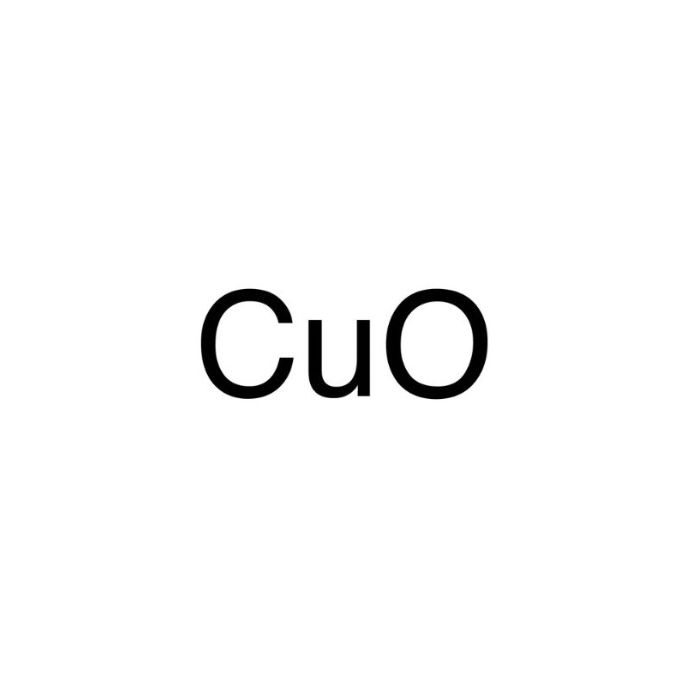
Nanometer cupric oxide - ≥99%, Diameter 20-50nm, length 1-3 μ m , CAS No.1317-38-0
AVAILABLE TO ORDER
Storage
Room temperature,Desiccated
Shipped In
Normal
≥99%, Diameter 20-50nm, length 1-3 μ m for sensitive chromatographic and analytical workflows requiring minimal baseline interference.
Room temperature,Desiccated Ships Normal Check lot-specific COA for exact specifications.
SDS, COA, datasheet, and spec sheet available for download. Lot-specific COA accessible via lot number lookup.
Cited in 458 peer-reviewed publications across chromatography, organic synthesis, and cross-coupling reactions.
Copper oxides (Cu 2 O, CuO) are p-type semiconductor materials with small band gap energy. High physical and chemical stability of metal oxide nanoparticles renders them extremely useful in catalytic applications.The structures of the compounds are monoclinic. Nanoscaled copper oxide compounds can be prepared by thermal plasma technology. A study reports its antimicrobial properties.
Application
Toxicity of copper oxide nanoparticles was reported. Cu 2 O has been used in coating Cu nanoparticles (Cu 2 O NPs). Copper oxide nanoparticles has been reported to be used as an anode material for lithium ion cells and as gas sensors on account of it high surface reactivity. Hollow Cu 2 O NPs has been used in the preparation of nucleosides and as a catalyst in azide-alkyne cycloadditions by other groups. CuO NPs may be used as a catalyst for CSe, CTe, and CS bond formation and synthesis of 2-aminobenzothiazole. Molecular responses of mouse macrophages to CuO and Cu 2 O NPs were studied.
| InChIKey | QPLDLSVMHZLSFG-UHFFFAOYSA-N |
|---|---|
| INCHI | 1S/Cu.O |
| Isomeric SMILES | O=[Cu] |
| UN Number | 3077 |
| Packing Group | III |
| Molecular Weight | 79.55 |
| Reaxy-Rn | 8128137 |
| Reaxys-RN_link_address | https://www.reaxys.com/reaxys/secured/hopinto.do?context=S&query=IDE.XRN=8128137&ln= |
Comprehensive hazard, handling, storage, and regulatory compliance document.
Download SDS →Lot-specific quality data. Enter your lot number to retrieve the exact COA.
Look up COA →Full quality attributes and acceptance criteria for this grade.
View spec sheet →Taxonomy Tree
| Kingdom | Inorganic compounds |
|---|---|
| Superclass | Mixed metal/non-metal compounds |
| Class | Transition metal organides |
| Subclass | Transition metal oxides |
| Intermediate Tree Nodes | Not available |
| Direct Parent | Transition metal oxides |
| Alternative Parents | Inorganic salts Inorganic oxides |
| Molecular Framework | Not available |
| Substituents | Transition metal oxide - Inorganic oxide - Inorganic salt |
| Description | This compound belongs to the class of inorganic compounds known as transition metal oxides. These are inorganic compounds containing an oxygen atom of an oxidation state of -2, in which the heaviest atom bonded to the oxygen is a transition metal. |
| External Descriptors | Not available |
| Sensitivity | Moisture sensitive |
|---|---|
| Molecular Weight | 79.550 g/mol |
| XLogP3 | |
| Hydrogen Bond Donor Count | 0 |
| Hydrogen Bond Acceptor Count | 1 |
| Rotatable Bond Count | 0 |
| Exact Mass | 78.9245 Da |
| Monoisotopic Mass | 78.9245 Da |
| Topological Polar Surface Area | 17.100 Ų |
| Heavy Atom Count | 2 |
| Formal Charge | 0 |
| Complexity | 2.000 |
| Isotope Atom Count | 0 |
| Defined Atom Stereocenter Count | 0 |
| Undefined Atom Stereocenter Count | 0 |
| Defined Bond Stereocenter Count | 0 |
| Undefined Bond Stereocenter Count | 0 |
| The total count of all stereochemical bonds | 0 |
| Covalently-Bonded Unit Count | 1 |