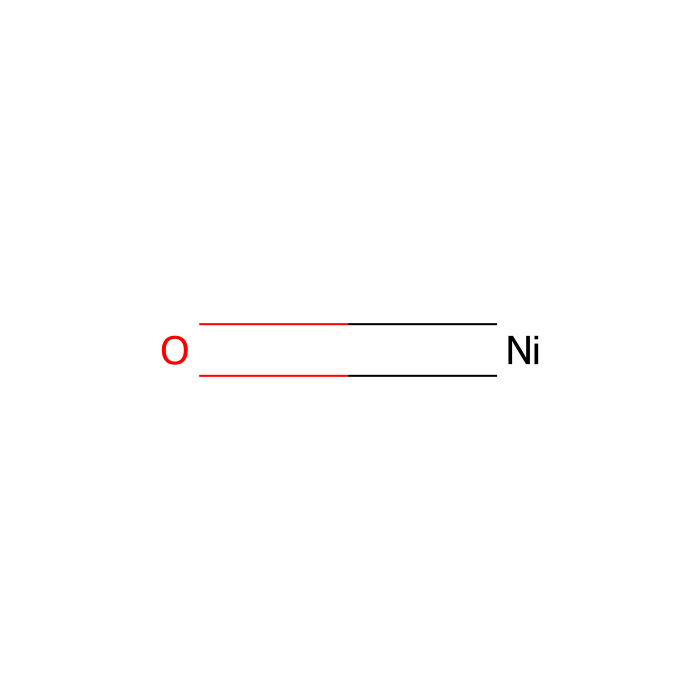
Nickel oxide - AR, ≥99% , CAS No.1313-99-1

CAS: 1313-99-1 Cat. No.: N108314 Formula: NiO Molecular Weight: 74.69 EC Number: 215-215-7
AVAILABLE TO ORDER
GRADE & PURITY AR ? Analytical Reagent grade — high-purity chemicals meeting strict assay limits for lab analysis. Use when accuracy matters and trace impurities could skew results. ≥99%
Synonyms
Nickel oxide sinter 75|Nano Nickel Oxide Powder|Nickelous oxide|Nickel II Oxide Dispersion|NICKEL OXIDE|Mononickel oxide|Nickel oxide (NiO)|Nickel(2+) oxide|Nickel (II) oxide green|Bunsenite (NiO)|Nickel Oxide Nanofibers|Nickel(II)oxide99.99%|Black nickel oxide|Nickel Oxide nanowire|Nickel(II) oxide (1:1)|nickel(II)oxide|Nickel Oxide Nanopowder|Nickel oxide supported on silica, 60 wt. % (NiO)|Nickel (II) Oxide Nanopowder|Nickel(II) oxide, green|NICKEL MONOOXIDE|oxonickel|oxo-nickel|nickel hydride oxide|nickel(II) oxide, black|Copper Doped Nickel Oxide Dispersion|Bunsenite|Nickel(II) oxide|Nickel(II) Oxide Nanowires|Nickel(II) oxide, CP
Storage
Room temperature
Shipped In
Normal
★
Size
Germany (EU)
USA*
Price
Qty
100g
N108314-100g
—
In stock ≥10

€38.96

€58.92
Save €19.96 (33.87%)
250g
N108314-250g
4 In stock
3 In stock

€77.14

€116.19
Save €39.05 (33.61%)
Enter a quantity for the sizes you want to add.

Specifications

Synonyms
Nickel oxide sinter 75 | Nano Nickel Oxide Powder | Nickelous oxide | Nickel II Oxide Dispersion | NICKEL OXIDE | Mononickel oxide | Nickel oxide (NiO) | Nickel(2+) oxide | Nickel (II) oxide green | Bunsenite (NiO) | Nickel Oxide Nanofibers | Nickel(II)oxide99.99% | Black nickel oxide | Nickel Oxide nanowire | Nickel(II) oxide (1:1) | nic Show more
Specifications & Purity
AR, ≥99%
Storage
Room temperature
Shipped In
Normal
Grade
AR
Action Type
ANTAGONIST
Purity
≥99%
Names and Identifiers
Pubchem Sid
Pubchem Sid Url
https://pubchem.ncbi.nlm.nih.gov/substance/508814099
SMILES
O=[Ni]
IUPAC Name
oxonickel
InChIKey
GNRSAWUEBMWBQH-UHFFFAOYSA-N
InChI
1S/Ni.O
Isomeric SMILES
O=[Ni]
WGK Germany
3
RTECS
QR8400000
UN Number
3288
Packing Group
I
Molecular Weight
74.69
Reaxys
13286008
Reaxys-RN_link_address
https://www.reaxys.com/reaxys/secured/hopinto.do?context=S&query=IDE.XRN=13286008&ln=

Advanced Data

Taxonomic Classification

Taxonomy Tree

KingdomInorganic compounds
SuperclassMixed metal/non-metal compounds
ClassTransition metal organides
SubclassTransition metal oxides
Intermediate Tree Nodes Not available
Direct ParentTransition metal oxides
Alternative Parents Inorganic salts  Inorganic oxides  Inorganic nickel compounds  
Molecular FrameworkNot available
Substituents Transition metal oxide - Inorganic oxide - Inorganic salt - Inorganic nickel compound
DescriptionThis compound belongs to the class of inorganic compounds known as transition metal oxides. These are inorganic compounds containing an oxygen atom of an oxidation state of -2, in which the heaviest atom bonded to the oxygen is a transition metal.
External Descriptors Not available
3D Structure
Interactive Chemical Structure Model


Certificates (CoA,COO,BSE/TSE and Analysis Chart)
C of A & Other Certificates(BSE/TSE, COO):
Analytical Chart:

Find and download the COA for your product by matching the lot number on the packaging.

27 results found

Lot NumberCertificate TypeDateItem
G2228037G2228037Certificate of AnalysisMay 19, 2026 N108314
D2615076D2615076Certificate of AnalysisApr 17, 2026 N108314
D2615075D2615075Certificate of AnalysisApr 17, 2026 N108314
A2630030A2630030Certificate of AnalysisOct 14, 2022 N108314
K2513060K2513060Certificate of AnalysisOct 14, 2022 N108314
J2431114J2431114Certificate of AnalysisOct 14, 2022 N108314
J2422020J2422020Certificate of AnalysisOct 14, 2022 N108314
J2222360J2222360Certificate of AnalysisOct 14, 2022 N108314
G2525082G2525082Certificate of AnalysisOct 14, 2022 N108314
F2511080F2511080Certificate of AnalysisOct 14, 2022 N108314
C2301793C2301793Certificate of AnalysisOct 14, 2022 N108314
C2301792C2301792Certificate of AnalysisOct 14, 2022 N108314
D2523042D2523042Certificate of AnalysisOct 14, 2022 N108314
B23031197B23031197Certificate of AnalysisOct 14, 2022 N108314
C2301783C2301783Certificate of AnalysisOct 14, 2022 N108314
C2301791C2301791Certificate of AnalysisOct 14, 2022 N108314
A2627161A2627161Certificate of AnalysisJul 05, 2022 N108314
I2517102I2517102Certificate of AnalysisJul 05, 2022 N108314
G2228033G2228033Certificate of AnalysisJul 05, 2022 N108314
G2227954G2227954Certificate of AnalysisJul 05, 2022 N108314
F2220349F2220349Certificate of AnalysisJun 07, 2022 N108314
F2220348F2220348Certificate of AnalysisJun 07, 2022 N108314
F2220347F2220347Certificate of AnalysisJun 07, 2022 N108314
E2227116E2227116Certificate of AnalysisMay 20, 2022 N108314
C2202626C2202626Certificate of AnalysisFeb 14, 2022 N108314
C2202624C2202624Certificate of AnalysisFeb 14, 2022 N108314
C2202608C2202608Certificate of AnalysisFeb 14, 2022 N108314
Chemical and Physical Properties
SensitivityMoisture sensitive.
Melt Point1960°C
Molecular Weight74.69
XLogP3
Hydrogen Bond Donor Count0
Hydrogen Bond Acceptor Count1
Rotatable Bond Count0
Exact Mass73.9303 Da
Monoisotopic Mass73.9303 Da
Topological Polar Surface Area17.100 Ų
Heavy Atom Count2
Formal Charge0
Complexity2.000
Isotope Atom Count0
Defined Atom Stereocenter Count0
Undefined Atom Stereocenter Count0
Defined Bond Stereocenter Count0
Undefined Bond Stereocenter Count0
The total count of all stereochemical bonds0
Covalently-Bonded Unit Count1
Safety and Hazards(GHS)
Pictogram(s)
GHS07,   GHS08
Signal
Danger
Hazard Statements

H317:May cause an allergic skin reaction

H332:Harmful if inhaled

H334:May cause allergy or asthma symptoms or breathing difficulties if inhaled

H350:May cause cancer

H360:May damage fertility or the unborn child

H372:Causes damage to organs through prolonged or repeated exposure

H411:Toxic to aquatic life with long lasting effects

H413:May cause long lasting harmful effects to aquatic life

Precautionary Statements

P260:Do not breathe dust/fume/gas/mist/vapors/spray.

P261:Avoid breathing dust/fume/gas/mist/vapors/spray.

P264:Wash hands [and …] thoroughly after handling.

P270:Do not eat, drink or smoke when using this product.

P271:Use only outdoors or in a well-ventilated area.

P272:Contaminated work clothing should not be allowed out of the workplace.

P273:Avoid release to the environment.

P280:Wear protective gloves/protective clothing/eye protection/face protection.

P284:[In case of inadequate ventilation] Wear respiratory protection.

P321:Specific treatment (see ... on this label).

P391:Collect spillage.

P302+P352:IF ON SKIN: wash with plenty of water.

P304+P340:IF INHALED: Remove person to fresh air and keep comfortable for breathing.

P333+P313:IF SKIN irritation or rash occurs: Get medical advice/attention.

P362+P364:Take off contaminated clothing and wash it before reuse.

P405:Store locked up.

P501:Dispose of contents/container to an approved waste disposal plant.

P203:Obtain, read and follow all safety instructions before use.

P318:if exposed or concerned, get medical advice.

P317:Get emergency medical help.

P319:Get medical help if you feel unwell.

P342+P316:If experiencing respiratory symptoms: Get emergence medical help immediately.

WGK Germany
3
RTECS
QR8400000
Reaxys
13286008
Reaxys-RN_link_address
https://www.reaxys.com/reaxys/secured/hopinto.do?context=S&query=IDE.XRN=13286008&ln=
Class
6.1
Documents & Articles
Aldol Condensation Reaction
Basic Concepts about Catalysts
Why Did My Ni-Agarose Beads Turn Black or Brown?
SOFC Solid Oxide Fuel Cells: From “What It Is and How It Generates Power” to a Key Materials Map, Application Scenarios, and Selection Navigation (Electrolytes / Electrodes / Interconnects / Sealing)
Panorama Guide to Lithium-Ion Battery Electrode Materials: Working Principles, Materials Map, and Selection Navigation (incl. Tables 1–4)
Ceramic Materials Guide: Basic Definitions, Classification Framework, and Research-Task-Oriented Selection (with Product Navigation and Tables 1–4)
Metal Halide Perovskite Solar Cells: Sources of High Efficiency, Stability Bottlenecks, and Experimental Decision Logic
Perovskite Oxides for Energy and Environmental Catalysis: How Oxygen Vacancies, B-Site Metals, and the Metal–Oxygen Bond Network Regulate Reaction Performance
Citations of This Product
Solution Calculators
Reviews

Customer Reviews

Shall we send you a message when we have discounts available?

Remind me later

Thank you! Please check your email inbox to confirm.

Oops! Notifications are disabled.