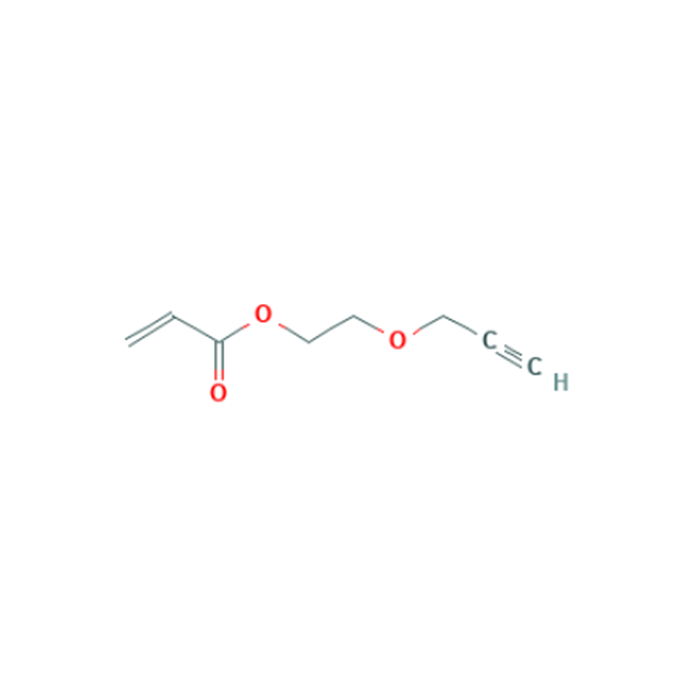
Propargyl-PEG2-acrylate is a PEG derivative containing a propargyl group and an acrylate group. The propargyl group can be reacted with azide-bearing compounds or biomolecules via copper catalyzed azide-alkyne Click Chemistry to yield a stable triazole linkage. The acrylate group enables Michael addition. The hydrophilic PEG spacer increases solubility in aqueous media.
Specifications
Synonyms
2-(Prop-2-yn-1-yloxy)ethyl acrylate
Specifications & Purity
≥95%
Storage
Protected from light,Store at -20°C,Argon charged
Shipped In
Ice chest + Ice pads
This product requires cold chain shipping. Ground and other economy services are not available.
Purity
≥95%
Names and Identifiers
Molecular Weight
154.16
Advanced Data
Certificates (CoA,COO,BSE/TSE and Analysis Chart)
C of A & Other Certificates(BSE/TSE, COO):
Analytical Chart:
Find and download the COA for your product by matching the lot number on the packaging.
Determine the necessary mass, volume, or concentration for preparing a solution.
Dilution Calculator
Determine the dilution needed to prepare a stock solution.
Reconstitution Calculator
Reviews
Customer Reviews
Application Protocols
No item-specific, validated application protocols are provided in the Product Data. The following generic procedures illustrate common uses; optimize for your system.
Stock solution preparation (general):
Dissolve in anhydrous DMSO or DMF to 50–200 mM under argon; aliquot and store at −20°C protected from light (per Storage tab). Thaw immediately before use.
CuAAC conjugation (general workflow):
Combine azide partner (1.0 equiv) and Propargyl-PEG2-acrylate (1.0–1.5 equiv) in tBuOH/H2O (1:1) or DMSO/H2O.
Add CuSO4 (5–10 mol%), sodium ascorbate (20–50 mol%), and a Cu(I)-stabilizing ligand (e.g., THPTA 10–20 mol%).
Stir under argon at RT until TLC/LC-MS indicates completion. Quench with EDTA and remove copper using a scavenger or dialysis (for bioconjugates).
Thiol–Michael addition to acrylate (general workflow):
Dissolve acrylate and thiol partner (1.0–1.2 equiv) in dry DMF or buffered aqueous/organic medium (pH 7.5–8.5).
Add catalytic base (e.g., DIPEA 5–10 mol%).
Stir at RT; monitor by NMR/LC-MS. Upon completion, neutralize, and purify by precipitation or chromatography.
Precautions:
Exclude light and oxygen to discourage undesired radical polymerization of the acrylate.
Minimize water for acrylate reactions where hydrolysis is a concern.
These are example procedures only; tailor equivalents, solvent, and catalyst to substrate solubility and sensitivity.
Biological Roles
This compound is a synthetic, heterobifunctional PEG linker; it does not have inherent biological roles or occur in metabolism. However, its functional groups are deliberately selected to enable bioorthogonal and bioconjugation workflows in a research context.
Relevance to bioconjugation (general):
Terminal alkyne enables bioorthogonal CuAAC ligation with azide-bearing biomolecules (peptides, glycans, nucleic acids, proteins after azide introduction). The triazole linkage formed is chemically robust and generally inert in biological media (literature).
Acrylate group serves as a Michael acceptor for thiols (cysteine residues, thiolated ligands) under mild basic conditions; also used to crosslink thiol-functional polymers into hydrogels.
PEG2 spacer effects:
Increases hydrophilicity and conformational flexibility, often improving solubility of conjugates and reducing nonspecific adsorption relative to purely hydrophobic linkers.
Short PEG length preserves compactness while providing minimal spacing to reduce steric crowding at conjugation sites.
Typical laboratory uses:
Installing orthogonal handles on surfaces or carriers for dual-modality attachment (e.g., ligand + fluorophore, or targeting group + polymer handle) in analytical or materials biology.
Note: All uses are for research only. No claims are made regarding in vivo use, safety, or efficacy. If conjugating to biomolecules, ensure removal of copper after CuAAC (where used) and verify compatibility with the biomolecule’s stability window (pH, solvent, temperature).
Buffer Applications
This product is not a buffering reagent and does not participate in defined acid–base equilibria for pH control. Consequently, it is not typically used to prepare biochemical buffers.
Practical note:
When used in bioconjugation (CuAAC or thiol–Michael), select buffers/solutions that support the reaction without side reactions: for example, phosphate-buffered saline (PBS) or HEPES with added co-solvent for solubility, while maintaining pH 7.0–8.5 for thiol–Michael additions. Avoid buffers containing primary amines (e.g., Tris) if undesired aza-Michael additions are possible with acrylates.
Degas buffers for CuAAC if oxygen sensitivity is a concern and include appropriate copper ligand to minimize protein damage.
Refer to the reaction/application sections for solvent and medium choices more relevant to this reagent.
Green Alternatives
Greener chemistry for using Propargyl-PEG2-acrylate focuses on solvent choice, catalyst selection, and energy minimization, since the reagent itself is structurally defined by performance needs (alkyne + acrylate). Consider the following tradeoffs.
Solvent considerations (general):
Replace DMF/NMP with dimethyl carbonate, ethyl acetate, 2-MeTHF, CPME, or aqueous/ethanol systems when solubility/performance permit.
For CuAAC, water/tBuOH or water/ethanol mixtures can often substitute for purely aprotic solvents, aided by water-compatible Cu(I) ligands (e.g., THPTA).
For thiol–Michael additions, ethanol or water/ethanol can be effective with organocatalysts or mild bases; avoid excess solvent volumes to minimize waste.
Catalyst and reagent choices:
Employ ligand-accelerated, aqueous CuAAC (CuSO4 + sodium ascorbate + water-soluble triazole ligands) to reduce copper loading and improve biocompatibility; consider copper-scavenging resins for easier metal removal.
Utilize organocatalysis (e.g., tertiary amines, phosphines) for thiol–Michael reactions to avoid strong inorganic bases.
Process and workup:
Conduct reactions at ambient temperature where feasible; make use of photoinitiated processes with LED sources for radical polymerizations to reduce thermal input.
Favor solvent recycling and minimal chromatographic purification (precipitation or membrane separations for polymers).
Greener: EtOAc/2-MeTHF/water–alcohol mixtures, photoredox or ambient-temperature CuAAC with low Cu, organocatalyzed Michael additions.
These are literature-driven, generalized options; always validate against your specific substrates and performance criteria.
Pharmaceutical Uses
For research use only. This product is not an excipient or API and is not intended for clinical or diagnostic applications. No pharmacopeial status is provided in the Product Data.
Research/formulation context (general):
As a bifunctional linker, Propargyl-PEG2-acrylate can be explored in R&D for preparing model polymers, hydrogels, or surface-modified materials that simulate drug delivery matrices in laboratory studies.
The acrylate end can be polymerized or thiol–Michael crosslinked to form networks; the propargyl end permits orthogonal attachment of probes or model ligands via CuAAC.
Considerations before any formulation experimentation (R&D only):
Verify residual inhibitor/copper and solvent content (if applicable) on the CoA to understand potential impacts on polymerization and stability.
Assess extractables/leachables from resulting materials only within research settings; this product is not produced to GMP and is not for use in human/animal products.
Any translation of research findings toward regulated products requires sourcing GMP-/pharmacopeia-grade materials and comprehensive safety/toxicology assessments, which are outside the scope of this research reagent.
Physical Properties
Item-specific physicochemical specifications are not provided in the Product Data and should be verified on the item’s CoA/Spec Sheet.
Appearance: Not specified for this item; refer to CoA/Spec Sheet.
Molecular Weight: Not specified for this item; refer to CoA/Spec Sheet.
Molecular Formula: Not specified for this item; refer to CoA/Spec Sheet.
Melting/Boiling points, density, refractive index, UV cutoff: Not specified for this item; refer to CoA/Spec Sheet.
General/literature expectations for propargyl-terminated PEG-acrylates of PEG2 length (for context only):
Physical state: typically low-viscosity liquids or low-melting waxy liquids owing to short PEG chain and ester functionality (literature).
Polarity/solubility: miscible with many polar aprotic solvents (e.g., DMF, DMSO, acetonitrile, ethyl acetate) and with alcohols; limited but nonzero water miscibility due to PEG2 chain (literature). Insoluble in alkanes (literature).
Hygroscopicity: PEG-containing molecules can be hygroscopic; moisture uptake may influence handling and reactions (general observation).
Practical notes (general):
Acrylate functionality can undergo spontaneous polymerization upon heating or prolonged light exposure; maintain cool, dark storage and consider inhibitor-containing media for long-term stability per SDS guidance.
Avoid prolonged contact with strong bases/acids that can induce transesterification or hydrolysis of the acrylate ester.
Always treat the above as contextual guidance only; rely on the product’s SDS and CoA for definitive values and acceptance criteria.
Quality & Grades
Item-specific grade, purity, stabilizer content, and chromatographic specifications are not provided in the Product Data and should be confirmed on the product CoA/Spec Sheet.
What “research use only” means:
The material is intended solely for laboratory research and development. It is not for human or animal use in diagnostic, therapeutic, or clinical applications.
Considerations specific to acrylate- and alkyne-functional PEG linkers (general guidance):
Inhibitors: Many commercial acrylates are shipped with trace polymerization inhibitors (e.g., MEHQ, BHT) to enhance shelf life. The presence/absence and level of any inhibitor for this item are Not specified for this item; refer to CoA/Spec Sheet. If present, these inhibitors may need to be removed (e.g., inhibitor-removal columns) before free-radical polymerization.
Purity profile: Typical quality control for bifunctional linkers may include NMR (1H/13C), LC/MS or HRMS, HPLC/GC purity, and water/peroxide content. Item-specific acceptance criteria are Not specified for this item; refer to CoA/Spec Sheet.
Residual solvents/metals: For sensitive polymer or bioconjugation work, verify residual solvent levels and trace metals on the CoA.
Practical QC tips:
Record baseline 1H NMR immediately after receipt to monitor stability (vinyl and acetylenic resonances are diagnostic).
Test for inhibitor content if your downstream polymerization is inhibited.
Perform small-scale trial reactions (CuAAC or Michael addition) to confirm functional-group integrity before scale-up.
Reaction & Applications
Propargyl-PEG2-acrylate is a heterobifunctional linker enabling orthogonal chemistries at opposite termini, facilitating sequential or convergent assembly of polymers, surfaces, and bioconjugates.
Terminal alkyne (propargyl) end:
Copper-catalyzed azide–alkyne cycloaddition (CuAAC, “click”): forms 1,4-disubstituted 1,2,3-triazoles under Cu(I) catalysis. Useful for attaching azide-bearing ligands, polymers, dyes, or biomolecules. Compatible with mixed aqueous–organic media; use CuSO4/ascorbate or preformed Cu(I) + triazole ligands (e.g., TBTA, THPTA) to accelerate and control selectivity.
Ruthenium-catalyzed azide–alkyne cycloaddition (RuAAC): affords 1,5-disubstituted triazoles where needed; typically anhydrous and under inert atmosphere.
Radical additions to alkynes and hydrosilylation (with appropriate catalysts) provide further diversification.
Acrylate end:
Michael acceptor: undergoes conjugate addition with thiols (thiol–Michael click), amines, and other soft nucleophiles; base- or nucleophile-catalyzed. Useful for hydrogel formation, surface grafting, and macromolecular end-capping.
Free-radical polymerization: copolymerize with acrylates/methacrylates to install terminal-alkyne handles within polymer backbones or side chains.
Transesterification/esterification: allows exchange with alcohols under acid/base catalysis (carefully controlled to avoid degradation).
Applications (general):
Spacer/linker in bioconjugation to increase hydrophilicity and reduce steric hindrance.
Surface functionalization of nanoparticles, resins, and planar substrates via one end while preserving the other for downstream ligation.
Preparation of amphiphilic block copolymers or end-functional PEGylated small molecules.
Practical tips: keep reactions anhydrous when targeting acrylate conjugations to limit hydrolysis; exclude oxygen and light to suppress inadvertent radical polymerization; store under argon at −20°C (per Product Data) between steps.
Reaction Conditions
Below are representative, literature-style conditions for the two principal reaction modes of Propargyl-PEG2-acrylate. These are general guidelines only and must be optimized for specific substrates.
CuAAC (terminal alkyne + organic azide):
Solvent: tBuOH/H2O (1:1) or DMSO/H2O (up to 1:1). Concentration 1–20 mM in limiting partner.
Catalyst: CuSO4·5H2O (0.05–0.5 equiv) + sodium ascorbate (0.2–1.0 equiv) to generate Cu(I) in situ; or preformed Cu(I) sources (CuBr) with ligands.
Ligand: TBTA or water-soluble THPTA (5–20 mol%) enhances rate and minimizes side reactions with biomolecules.
Temperature/time: RT to 40°C; 30 min to several hours depending on substrate and dilution.
Atmosphere: inert gas recommended; degas solutions to reduce oxidative side reactions. Chelate or scavenge residual copper after completion when used with biomolecules.
Thiol–Michael addition (acrylate + thiol):
Solvent: DMF, DMSO, MeCN, EtOH, or aqueous buffer (pH 7.5–8.5) with co-solvent.
Base/catalyst: tertiary amines (e.g., DIPEA, TEA, DBU 1–10 mol%), phosphines, or photoinitiated (eosin Y/visible light) systems. For bioconjugation, mild bases at pH 7.5–8.0 minimize side reactions.
Stoichiometry: typically 1.0–1.2 equiv thiol per acrylate; slight excess of the nucleophile drives completion.
Temperature/time: RT to 37°C; minutes to hours depending on catalyst and medium.
Notes: Minimize water when aiming to suppress acrylate hydrolysis; exclude oxygen/light to reduce undesired radical polymerization.
Initiator: AIBN (0.5–2 mol%) or photoinitiators (Irgacure family) under UV/visible.
Solvent: bulk or dioxane/MeOH/H2O systems.
Control techniques: RAFT/ATRP variants can be used to regulate molecular weight and retain alkyne functionality.
All conditions are literature-style generalizations; consult primary sources and pilot trials.
Safety & Handling
Follow good laboratory practice and consult the product SDS for authoritative information. Item-specific GHS hazard classification and statements are not provided in the Product Data.
GHS/Classification (item-specific):
Signal Word: Not specified for this item; refer to SDS.
H-Statements: Not specified for this item; refer to SDS.
Pictograms: Not specified for this item; refer to SDS.
Anticipated hazards (general for acrylates and alkynes; consult SDS):
Acrylates are often skin/eye irritants and may cause skin sensitization. Avoid inhalation of vapors/aerosols and prevent skin contact.
Terminal alkynes can be irritants; some are flammable. Handle away from ignition sources and heat.
PEG segments may increase dermal absorption of small molecules—use appropriate PPE.
PPE and engineering controls:
Wear lab coat, chemical-resistant gloves (e.g., nitrile), and splash goggles. Work in a fume hood to minimize exposure to vapors and to oxygen that may promote acrylate polymerization.
Storage incompatibilities and precautions:
From Product Data: Store at −20°C, protected from light, under argon; ship cold (ice chest + ice pads).
Keep container tightly closed. Exclude moisture and oxygen to minimize hydrolysis and premature polymerization.
Segregate from strong bases/acids, strong nucleophiles, and radical initiators/oxidizers.
First-aid overview (general):
Skin/eye contact: Rinse with water for ≥15 min; remove contaminated clothing; seek medical attention as needed.
Inhalation: Move to fresh air; seek medical attention if symptoms persist.
Ingestion: Rinse mouth; do not induce vomiting; seek medical attention.
Always defer to the SDS for definitive hazards, exposure limits, and spill/firefighting guidance.
Solvent Selection
This reagent is a short-chain PEG acrylate with a terminal alkyne. Its mixed polarity profile provides broad solubility in polar organic media.
Moderate solubility: water (PEG2 confers some hydrophilicity, but complete miscibility is not guaranteed), dichloromethane, toluene (may require co-solvent).
Poor solubility: aliphatic hydrocarbons (hexanes) without co-solvent.
Choosing a solvent by application:
CuAAC (click) on the propargyl end: tBuOH/H2O, DMSO/H2O, or DMF/H2O mixtures commonly used to solubilize both organic linker and azide partners; add Cu(I) source and ligand as appropriate.
Thiol–Michael addition or nucleophilic conjugation at the acrylate: polar aprotic solvents (DMF, DMSO, MeCN) or alcohols; base-catalyzed or nucleophile-promoted conditions benefit from minimal water to limit hydrolysis.
Free-radical polymerization of the acrylate: bulk polymerization or solution polymerization in dioxane, MeOH, or water/organics, depending on comonomers.
Small comparison (general):
DMSO: maximal solubility range; good for bioconjugation stocks; hygroscopic.
DMF: excellent solvent for organic synthesis; may facilitate base-catalyzed additions.
MeCN: volatile, easy removal; lower viscosity; sometimes limited solubility for higher-MW partners.
tBuOH/H2O: favored in CuAAC for bioconjugation friendliness and phase homogeneity.
Storage & Reconstitution
Adhere to the item-specific storage requirements in the Product Data to preserve functional integrity of the acrylate and alkyne groups.
Storage conditions (from Product Data):
Store at −20°C.
Protect from light.
Maintain under inert atmosphere (argon charged).
Shipped in an ice chest with ice pads.
Container/handling practices:
Keep tightly sealed in amber vials to limit light exposure.
After opening, backfill headspace with argon or nitrogen. Limit freeze–thaw cycles by preparing single-use aliquots.
Avoid prolonged exposure to moisture and air to reduce acrylate hydrolysis and premature polymerization.
Reconstitution and stock solutions (general guidance):
Prepare concentrated stocks in anhydrous DMSO or DMF (e.g., 50–200 mM) under inert atmosphere. Filter through 0.2 µm PTFE if particulate is observed.
For aqueous applications, dilute immediately before use with suitable co-solvent to maintain homogeneity. Use freshly prepared solutions for acrylate chemistry.
Stability notes (general):
Acrylates are susceptible to radical polymerization on exposure to heat, light, or peroxides; maintain low temperature and darkness.
Monitor integrity by 1H NMR (vinyl and acetylenic signals) or LC-MS upon extended storage.
For any specifications regarding stabilizers, inhibitor content, or retest date: Not specified for this item; refer to CoA/Spec Sheet.
Structure & Identity
Propargyl-PEG2-acrylate is a heterobifunctional PEG linker bearing a terminal alkyne (propargyl) on one end and an acrylate ester on the other, separated by two ethylene glycol units (PEG2). The molecule features an internal ether backbone and an acrylate ester susceptible to Michael-type additions and radical polymerization, while the terminal alkyne enables click (CuAAC) chemistry.
Item-specific identifiers from Product Data:
CAS: 52436-42-7
SMILES: Not specified for this item; refer to CoA/Spec Sheet.
InChIKey: Not specified for this item; refer to CoA/Spec Sheet.
Molecular Formula: Not specified for this item; refer to CoA/Spec Sheet.
Molecular Weight: Not specified for this item; refer to CoA/Spec Sheet.
Structural features (general/literature description):
Functional groups: terminal alkyne (–C≡CH), internal ether linkages (–CH2–CH2–O–), and an acrylate ester (–O–C(=O)–CH=CH2).
Topology: linear PEG2 spacer between reactive termini; no stereogenic centers expected.
2D description: Propargyl–O–(CH2–CH2–O)2–C(=O)–CH=CH2 (literature depiction). The alkyne is conjugation-isolated from the acrylate; the acrylate is conjugated (vinyl–carbonyl).
Category: Chemical and Biochemical Reagents (research use only).
Note: Exact identifiers and analytical characterizations (elemental composition, HRMS, NMR assignments) should be taken from the item-specific CoA/Spec Sheet.
Synthetic Utility
The molecule combines three reactive motifs—terminal alkyne, PEG2 ether spacer, and acrylate ester—offering orthogonal handles for stepwise synthesis.
Retrosynthetic logic:
Disconnect at the acrylate to reveal the corresponding PEG2 alcohol (propargyl-PEG2-OH) and acryloyl chloride/anhydride. Alternatively, disconnect at the propargyl ether to a PEG2 diol derivative and propargyl halide or propargyl alcohol with Mitsunobu/Williamson ether strategies.
Transformations (general):
Alkyne: CuAAC/RuAAC to triazoles; Sonogashira-type coupling after prior halogenation of the alkyne (or vice versa) for further diversification; hydroboration–oxidation to aldehydes/ketones (with care); azide–alkyne cycloadditions are typically the most selective.
Acrylate: thiol–Michael addition (organobase- or photoinitiated), aza-Michael with secondary amines, radical copolymerization with vinyl monomers to embed the alkyne-labeled unit.
Ester handle: controlled hydrolysis to the acid or transesterification for handle exchange, enabling access to carboxyl or other ester derivatives while retaining the alkyne.
Orthogonality and sequencing:
Perform acrylate conjugations first under base-free or mild basic conditions, or protect the alkyne if radical processes are used; alternatively, complete CuAAC first under neutral aqueous-organic conditions, then carry out Michael addition/polymerization.
Purification:
Small-molecule products: flash chromatography on silica using EtOAc/hexanes or MeOH/DCM gradients (monitor for acrylate polymerization).
Polymer/conjugates: precipitation, dialysis, or SEC.
These strategies are general literature practices; adapt conditions to substrate sensitivity.
Target Specificity
Not applicable. This product is a small-molecule bifunctional linker, not a biological targeting reagent or antibody. No antigen/epitope, species reactivity, clone, or isotype information applies.
We use cookies to ensure the website functions properly and, where permitted, to improve your experience. You can manage your preferences at any time in Settings. Learn more in our Cookie Policy.
Shall we send you a message when we have discounts available?
Remind me later
Thank you! Please check your email inbox to confirm.
Products are supplied to verified businesses, institutions, and qualified professionals for research and development use only. Not for use in humans, animals, diagnosis, or therapy.

 H2512444