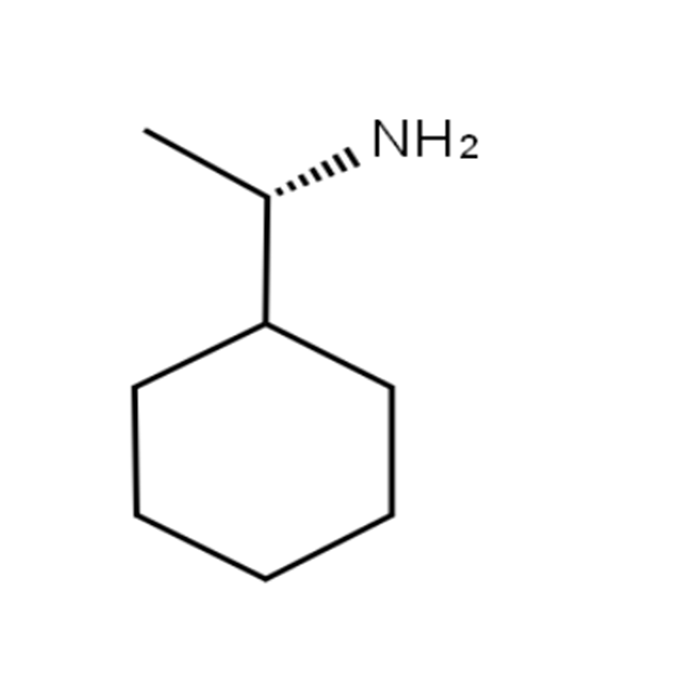
(S)-(+)-1-Cyclohexylethylamine - ≥98%(GC) , CAS No.17430-98-7

CAS: 17430-98-7 Cat. No.: S161320 Formula: C8H17N Molecular Weight: 127.23 Beilstein Registry Number: 2935070 EC Number: 629-006-7 PubChem CID: 5325951
AVAILABLE TO ORDER
GRADE & PURITY ≥98%(GC)
Synonyms
N-((S)-1-cyclohexyl-ethyl)amine|(1S)-1-(cyclohexyl)ethylamine|(s)-1-cyclohexylethan-1-amine|(S)-1-cyclohexylethylamine|(S)-1-cyclohexyl-ethylamine|1-Cyclohexylethanamine #|(1S)-1-Cyclohexyl-1-ethylamine|(1S)-1-Cyclohexylethan-1-Amine|(1S)-1-cyclohexylethanamine|(S)-(+)-alpha-Methylcyclohexanemethylamine|(S)-1-Cyclohexylethanamine|(s)-(-)-1-cyclohexylethylamine|(1S)-1-amino-1-cyclohexylethane|(S)-1-cyclohexylethyl amine|(1S)-1-cyclohexylethylamine|(s)-(+)-1-cyclohexylethyl amine|(S)-(+)-1-Cyclohexylethylamine
Storage
Room temperature,Argon charged
Shipped In
Normal
★
Size
Germany (EU)
USA*
Price
Qty
1g
S161320-1g
2 In stock
5 In stock
€13.80
5g
S161320-5g
—
3 In stock
€39.83
25g
S161320-25g
—
1 In stock
€130.07
Enter a quantity for the sizes you want to add.

Overview

(S)-(+)-1-Cyclohexylethylamine is a chiral amine.

Specifications

Synonyms
N-((S)-1-cyclohexyl-ethyl)amine | (1S)-1-(cyclohexyl)ethylamine | (s)-1-cyclohexylethan-1-amine | (S)-1-cyclohexylethylamine | (S)-1-cyclohexyl-ethylamine | 1-Cyclohexylethanamine # | (1S)-1-Cyclohexyl-1-ethylamine | (1S)-1-Cyclohexylethan-1-Amine | (1S)-1-cyclohexylethanamine | (S)-(+)-alpha-Methylcyclohexanemethylamine | (S)-1-Cyclohexy Show more
Specifications & Purity
≥98%(GC)
Storage
Room temperature,Argon charged
Shipped In
Normal
Purity
≥98%(GC)
Names and Identifiers
Pubchem Sid
Pubchem Sid Url
https://pubchem.ncbi.nlm.nih.gov/substance/504763623
SMILES
CC(C1CCCCC1)N
IUPAC Name
(1S)-1-cyclohexylethanamine
InChIKey
XBWOPGDJMAJJDG-ZETCQYMHSA-N
InChI
1S/C8H17N/c1-7(9)8-5-3-2-4-6-8/h7-8H,2-6,9H2,1H3/t7-/m0/s1
Isomeric SMILES
C[C@@H](C1CCCCC1)N
WGK Germany
3
PubChem CID
5325951
Molecular Weight
127.23
Beilstein
2935070
Reaxys
2935070

Advanced Data

Taxonomic Classification

Taxonomy Tree

KingdomOrganic compounds
SuperclassOrganic nitrogen compounds
ClassOrganonitrogen compounds
SubclassAmines
Intermediate Tree Nodes Primary amines
Direct ParentMonoalkylamines
Alternative Parents Hydrocarbon derivatives  
Molecular FrameworkAliphatic homomonocyclic compounds
Substituents Hydrocarbon derivative - Primary aliphatic amine - Aliphatic homomonocyclic compound
DescriptionThis compound belongs to the class of organic compounds known as monoalkylamines. These are organic compounds containing an primary aliphatic amine group.
External Descriptors Not available
3D Structure
Interactive Chemical Structure Model


Mechanisms of Action
Certificates (CoA,COO,BSE/TSE and Analysis Chart)
C of A & Other Certificates(BSE/TSE, COO):
Analytical Chart:

Find and download the COA for your product by matching the lot number on the packaging.

16 results found

Lot NumberCertificate TypeDateItem
G2602655G2602655Certificate of AnalysisJun 06, 2026 S161320
G2602730G2602730Certificate of AnalysisJun 06, 2026 S161320
G2602736G2602736Certificate of AnalysisJun 06, 2026 S161320
B2524328B2524328Certificate of AnalysisFeb 10, 2025 S161320
B2524329B2524329Certificate of AnalysisFeb 10, 2025 S161320
I2504573I2504573Certificate of AnalysisJun 15, 2024 S161320
I2504574I2504574Certificate of AnalysisJun 15, 2024 S161320
I2301653I2301653Certificate of AnalysisAug 15, 2023 S161320
I2301659I2301659Certificate of AnalysisAug 15, 2023 S161320
I2301667I2301667Certificate of AnalysisAug 15, 2023 S161320
I2301729I2301729Certificate of AnalysisAug 15, 2023 S161320
E2304412E2304412Certificate of AnalysisJun 08, 2022 S161320
E2304419E2304419Certificate of AnalysisJun 08, 2022 S161320
G2207273G2207273Certificate of AnalysisJun 08, 2022 S161320
G2207307G2207307Certificate of AnalysisJun 08, 2022 S161320
G2207308G2207308Certificate of AnalysisJun 08, 2022 S161320
Chemical and Physical Properties
SensitivityMoisture & Air sensitive
Refractive Index1.46
Specific Rotation[α]3.3° (neat)
Flash Point125.6 °F
Flash Point52°C(lit.)
Boil Point74°C/20mmHg(lit.)
Molecular Weight127.23
XLogP32.100
Hydrogen Bond Donor Count1
Hydrogen Bond Acceptor Count1
Rotatable Bond Count1
Exact Mass127.136 Da
Monoisotopic Mass127.136 Da
Topological Polar Surface Area26.000 Ų
Heavy Atom Count9
Formal Charge0
Complexity74.600
Isotope Atom Count0
Defined Atom Stereocenter Count1
Undefined Atom Stereocenter Count0
Defined Bond Stereocenter Count0
Undefined Bond Stereocenter Count0
The total count of all stereochemical bonds0
Covalently-Bonded Unit Count1
Safety and Hazards(GHS)
Pictogram(s)
GHS02,   GHS05,   GHS06,   GHS07,   GHS09
Signal
Danger
Hazard Statements

H226:Flammable liquid and vapor

H302:Harmful if swallowed

H311:Toxic in contact with skin

H314:Causes severe skin burns and eye damage

H318:Causes serious eye damage

H411:Toxic to aquatic life with long lasting effects

Precautionary Statements

P210:Keep away from heat, hot surface, sparks, open flames and other ignition sources. - No smoking.

P233:Keep container tightly closed.

P240:Ground/bond container and receiving equipment.

P241:Use explosion-proof [electrical/ventilating/lighting/.../] equipment.

P242:Use only non-sparking tools.

P243:Take precautionary measures against static discharge.

P260:Do not breathe dust/fume/gas/mist/vapors/spray.

P264:Wash hands [and …] thoroughly after handling.

P270:Do not eat, drink or smoke when using this product.

P273:Avoid release to the environment.

P280:Wear protective gloves/protective clothing/eye protection/face protection.

P321:Specific treatment (see ... on this label).

P330:Rinse mouth.

P363:Wash contaminated clothing before reuse.

P391:Collect spillage.

P301+P330+P331:IF SWALLOWED: Rinse mouth. Do NOT induce vomiting.

P302+P352:IF ON SKIN: wash with plenty of water.

P303+P361+P353:IF ON SKIN (or hair): Take off Immediately all contaminated clothing. Rinse SKIN with water [or shower].

P304+P340:IF INHALED: Remove person to fresh air and keep comfortable for breathing.

P361+P364:Take off immediately all contaminated clothing and wash it before reuse.

P370+P378:In case of fire: Use ... to extinguish.

P405:Store locked up.

P403+P235:Store in a well-ventilated place. Keep cool.

P501:Dispose of contents/container to an approved waste disposal plant.

P264+P265:Wash hands [and …] thoroughly after handling. Do not touch eyes.

P301+P317:IF SWALLOWED: Get medical help.

P305+P354+P338:IF IN EYES: Immediately rinse with water for several minutes. Remove contact lenses if present and easy to do. Continue rinsing.

P317:Get emergency medical help.

P302+P361+P354:IF ON SKIN: Take off Immediately all contaminated clothing. Immediately rinse with water for several minutes.

P316:Get emergency medical help immediately.

WGK Germany
3
Reaxys
2935070
Citations of This Product
Solution Calculators
Reviews

Customer Reviews

Application Protocols

No assay-specific or immuno-based application protocols apply to this small-molecule reagent. For use in synthesis, refer to the Reaction Conditions and Synthetic Utility sections for detailed procedural guidance. If employing as a resolving agent, develop crystallization screens (solvent/acid selection, temperature, seeding) based on your substrate’s properties.

Biological Roles

This compound is a synthetic, chiral, aliphatic primary amine and is not known as a natural metabolite.

  • General biochemical context (literature/general)

    • Primary amines interact with acids to form ammonium salts and can engage in reversible imine formation with carbonyls; such reactions underlie many bioconjugation and derivatization strategies but this molecule is not typically used directly in biological systems.
    • Hydrophobic cyclohexyl moiety and basic amine suggest membrane affinity and potential protonation near physiological pH (pKaH typical of aliphatic amines ~10.3–10.8), but no specific endogenous targets or transporters are associated with this structure.
  • Utility in bio-oriented research

    • Can serve as a chiral selector or derivatization agent for creating diastereomeric adducts with acids or carbonyl compounds, assisting in enantiomeric analysis by NMR or chromatography.
    • Salt forms (e.g., hydrochloride) may be used to increase aqueous compatibility during intermediate handling, but applications remain in chemical synthesis rather than cellular/biochemical pathways.

No medical, diagnostic, or therapeutic uses are implied; for research use only as stated by the manufacturer.

Buffer Applications

Not typically used as a biological buffer. As a strong organic base, it lacks a well-defined buffering range or conjugate pair appropriate for standard biochemical buffers.

  • Practical note
    • If a protonated form is used transiently in aqueous workups, it behaves simply as an ammonium salt without conventional buffer capacity. For buffering needs, choose established systems (e.g., phosphate, Tris, HEPES) that provide defined pKa and buffering ranges.
Green Alternatives

Choosing greener media and processes around this chiral amine can reduce environmental and safety impact without compromising performance.

  • Solvent and process substitutions (general guidance)

    • Replace chlorinated solvents: use EtOAc, 2-MeTHF, CPME, or MeCN instead of DCM/CHCl3 for acylations and extractions when feasible.
    • Alcohol media for reductive amination: i-PrOH or EtOH can serve as both solvent and reductant in transfer hydrogenation protocols (with appropriate catalysts), reducing use of hydride reagents.
    • Solid-supported reagents: employ polymer-supported carbodiimides or scavengers to minimize solvent volumes and simplify workup.
  • Energy efficiency

    • Conduct imine formation via azeotropic water removal in 2-MeTHF or toluene to avoid Dean–Stark with benzene; exploit higher bp of 2-MeTHF for faster equilibration.
    • Flow chemistry for exothermic acylations can improve heat transfer and reduce solvent inventory.
  • Waste minimization

    • Crystallize as an acid salt (e.g., tosylate) to isolate and purify without silica chromatography.
    • Recycle mother liquors and employ solvent swaps to greener options during scale-up.
  • Comparative snapshot (general)

    • DCM vs EtOAc: EtOAc offers lower toxicity and better biodegradability; may require larger volumes for equivalent solubility.
    • THF vs 2-MeTHF: 2-MeTHF is bio-derived, less peroxide-prone, and has favorable partitioning for workups; note odor and cost considerations.

Note: The amine identity is unchanged; improvements focus on solvent choice, energy use, and workup strategy.

Pharmaceutical Uses

This item is a chiral amine building block used in research-scale synthesis of intermediates and potential API candidates; it is not an approved excipient, drug, or clinical material.

  • Roles in formulation/synthesis (general)

    • Salt formation: production of crystalline ammonium salts (e.g., hydrochloride, p-toluenesulfonate) useful for purification and solid handling of intermediates.
    • Chiral pool/reagent: introduces an (S)-configured center via amide/urea/spiro or tethered structures; may function as a chiral counterion in forming diastereomeric salts for resolution of acidic APIs.
    • Pro-drug intermediate research: conversion to carbamates/urethanes or amide linkages as masked amines during candidate optimization (research context only).
  • Regulatory note

    • No pharmacopeial monograph is implied. Any GMP or residual-solvent/impurity requirements are process- and program-specific and must be defined by the user.
  • Quality considerations

    • Control of enantiomeric purity and residual amine in final API is critical to meet ICH Q3A/B and chiral impurity control strategies; verify with chiral HPLC/GC methods.

For all clinical or manufacturing uses, separate qualification under appropriate quality systems is required; this catalog item is for research use only.

Physical Properties

Primary aliphatic amines of this size are typically low-volatility liquids or low-melting solids with strong basicity and characteristic amine odor. Specific item-level specifications are not provided here.

  • Item-specific specs

    • Appearance: Not specified for this item; refer to CoA/Spec Sheet.
  • Typical physicochemical parameters (literature/general for C8 primary aliphatic chiral amines; not item specifications)

    • State at ambient conditions: generally liquid.
    • Basicity: conjugate acid pKa (pKaH) typically ~10.3–10.8 for unhindered primary aliphatic amines; expect strong basicity in water and organic media.
    • Solubility: miscible with many organic solvents (alcohols, ethers, chlorinated, aromatics); moderate solubility in water (salt formation greatly increases aqueous solubility).
    • Partitioning: logP for similar cyclohexyl-containing aliphatic amines is often in the 1.5–2.5 range (literature, indicative only).
    • Refractive index: primary amines of similar structure frequently nD20 ~1.45–1.47 (literature range; for guidance only).
    • Density: typically near 0.86–0.92 g/mL at 20–25 C for C8 primary amines (literature range).
    • Boiling behavior: medium-high bp; distillable under reduced pressure to limit thermal discoloration/oxidation (literature practice for analogous amines).
  • Other relevant behavior (general)

    • Can absorb CO2 and moisture from air; may form carbamate films and discolor upon prolonged exposure.
    • Forms stable salts with mineral or organic acids (e.g., HCl, TsOH), often crystalline and higher-melting than the free base.
Quality & Grades
  • Item-specific grade/purity: Not specified for this item; refer to CoA/Spec Sheet.

  • Interpreting typical grades (general guidance)

    • “Analytical” or “Reagent” grade: suitable for routine synthesis and sample preparation.
    • “High-purity” or “>98%”: supports asymmetric induction studies, ligand/salt synthesis, and chiral resolution work; lower impurity background for catalysis.
    • “HPLC grade solvent” is not applicable; this is a reagent/building block, not a chromatography solvent.
  • Optical purity

    • For chiral amines, enantiomeric excess (ee) or enantiomeric ratio (er) is often specified on the CoA. Ensure the (S)-configuration and optical rotation match your application’s needs.
    • Typical verification: chiral HPLC/GC, derivatization with Mosher acid chlorides, or comparison of [α]D to literature. Item-specific optical rotation is Not specified for this item; refer to CoA/Spec Sheet.
  • Stabilizers and additives

    • Many amines are supplied neat under inert gas. This item is specified as Argon charged for storage, indicating protection from air/CO2 and moisture. No stabilizer is listed for this item.
  • Documentation

    • For assay method, residual solvents, metal content, water content, and optical rotation: Not specified for this item; refer to CoA/Spec Sheet.
Reaction & Applications

(S)-(+)-1-Cyclohexylethylamine is a versatile chiral primary amine used in asymmetric synthesis, salt formation, and as a building block.

  • Representative uses (literature/general)

    • Chiral auxiliary/inductor: formation of chiral imines or enamines enabling diastereoselective additions (e.g., nucleophilic additions to imines, Strecker-type reactions).
    • Resolving agent: diastereomeric salt formation with racemic carboxylic acids or phosphoric acids; crystallization-based resolution exploiting steric bias around the chiral center.
    • Amide/urea synthesis: coupling with activated acids (acid chlorides, anhydrides, EDC/HATU) to furnish chiral amides; reaction with isocyanates or carbonyldiimidazole to give ureas/thioureas.
    • Reductive amination: condensation with prochiral ketones/aldehydes to give secondary amines; stereocontrol can arise from chiral environment in iminium intermediates.
    • Ligand precursor: incorporation into chiral ligands/organocatalysts or derivatization into chiral ammonium salts.
  • Practical notes

    • Use inert atmosphere (argon, as supplied) to prevent CO2 uptake and carbamate formation that can hamper reactivity and chromatography.
    • For enantiosensitive applications, verify ee/er before use; monitor for racemization under strongly basic or high-temperature conditions.
    • Purification: free-base amines tail on silica; pre-treat silica with base (1–2% Et3N) or isolate as acid salts and basify later.
    • Analytical controls: monitor imine formation by IR (C=N ~1660 cm−1) and 1H NMR (imine CH). Use chiral HPLC/GC for enantioselective outcomes.
  • Scalability

    • Distill under reduced pressure to remove low-boiling impurities; avoid atmospheric distillation to limit discoloration/oxidation.
Reaction Conditions

General conditions for common transformations involving chiral primary aliphatic amines (guidance from literature/standard practice; not item specifications):

  • Amide coupling

    • Solvent: DCM, DMF, or EtOAc (greener). Reagents: EDC·HCl/HOBt or HOAt, HATU/DIPEA, or T3P/DIPEA. Temperature: 0–25 C (often RT). Time: 1–12 h. Monitor by TLC/HPLC. Typical isolated yields: 70–95% depending on substrate.
  • Acyl chloride/anhydride acylation

    • Base: Et3N, DIPEA, or Na2CO3 (biphasic). Solvent: DCM, THF, or toluene. Temperature: 0 C to RT. Add acylating agent slowly to control exotherm.
  • Imine formation and reductive amination

    • Condensation: aldehyde/ketone (1.0 eq), amine (1.2–1.5 eq), 3A molecular sieves; solvent MeCN, toluene, or 2-MeTHF. Temperature: RT to reflux until imine forms (1–6 h).
    • Reduction: NaBH3CN in MeOH with acetic acid (pH ~5–6), or NaBH(OAc)3 in DCE/MeCN; 0–25 C, 1–16 h. Alternative: H2 (1–5 bar) with Pd/C in EtOH/i-PrOH.
  • Urea/thiourea formation

    • With CDI: solvent THF/MeCN, 0–25 C, then add nucleophile. With isocyanates: toluene/THF, RT to 60 C.
  • Salt formation/crystallization

    • Dissolve amine in Et2O/EtOAc and treat with dry HCl in dioxane or gaseous HCl; cool to precipitate salt. Wash with ether; dry under vacuum.
  • Workup/purification

    • Avoid acidic silica unless pre-treated with base. For sticky bases, convert to salt forms for crystallization; basify during final step to obtain free base.

Ensure inert atmosphere (argon) when required and confirm enantiopurity post-reaction if stereoretention is critical.

Safety & Handling

Follow standard practices for handling aliphatic primary amines. Item-specific GHS classification and statements are not provided here; consult the SDS for authoritative safety information.

  • Item-specific safety fields

    • Signal word: Not specified for this item; refer to CoA/Spec Sheet.
    • H-Statements: Not specified for this item; refer to CoA/Spec Sheet.
    • GHS classification: Not specified for this item; refer to CoA/Spec Sheet.
    • Pictograms: Not specified for this item; refer to CoA/Spec Sheet.
  • General hazards (literature/analogous substances)

    • Irritant/corrosive potential to skin, eyes, and respiratory tract; may cause burns on prolonged contact.
    • Harmful if swallowed or inhaled; strong odor typical of amines.
  • Handling recommendations

    • Use in a fume hood; avoid inhalation and skin/eye contact.
    • PPE: chemical-resistant gloves (e.g., nitrile), safety goggles/face shield, lab coat; consider splash protection for transfers.
    • Incompatibilities: strong oxidizers; acyl halides and anhydrides (vigorous acylation); isocyanates, aldehydes/ketones (imine/urea formation); CO2 and moisture (carbamate formation); copper/Brønsted acids may catalyze darkening.
    • First aid (general): rinse skin/eyes with water for ≥15 min; remove contaminated clothing; seek medical attention if symptoms persist; move to fresh air if inhaled.
  • Fire & reactivity

    • Combustible liquid; use dry chemical, CO2, or alcohol-resistant foam.
    • Amines can attack certain plastics/elastomers—verify compatibility for tubing/seals.

Always defer to the product SDS and institutional procedures for definitive guidance.

Solvent Selection

This product is a chiral primary amine reagent rather than a solvent. However, its performance depends on solvent choice in reactions and handling.

  • Polarity and miscibility (general)

    • Moderately nonpolar organic base; miscible with many organic solvents (THF, Et2O, toluene, DCM, MeOH, EtOH, acetonitrile). Limited water miscibility as free base; forms water-soluble salts with acids.
  • Selection guidance by operation

    • N-acylation/couplings: use polar aprotic media (DCM, DMF, MeCN, THF). For greener options, Me-THF or 2-MeTHF can replace THF/DCM; EtOAc often works for carbodiimide couplings.
    • Reductive amination: alcohols (MeOH, i-PrOH) or MeCN; control water content to limit imine hydrolysis.
    • Imine formation: toluene, benzene, or 3A molecular sieves in MeCN/THF; azeotropic removal of water can drive equilibrium.
    • Salt formation/crystallization: IPA/Et2O/EtOAc mixtures are common for precipitating HCl or p-toluenesulfonate salts.
  • Comparison notes (general)

    • DCM vs EtOAc: DCM offers superior substrate solubility; EtOAc is greener and often adequate for acylations.
    • THF vs 2-MeTHF: 2-MeTHF provides similar solvation with better safety/greenness and higher boiling point for imine/reductive amination workflows.
  • Drying/conditioning

    • For base-sensitive transformations, pre-dry solvents and use inert atmosphere. The amine itself can absorb CO2/water; minimize headspace air.
Storage & Reconstitution
  • Item-specific storage from Product Data

    • Storage conditions: Room temperature, Argon charged.
    • Shipped in: Normal.
  • Practical guidance (general for aliphatic primary amines)

    • Keep container tightly closed under inert gas to minimize CO2/moisture uptake and prevent carbamate film formation or discoloration.
    • Store away from oxidizers and acid chlorides/anhydrides. Use amber glass if prolonged light exposure is expected; although not strongly photosensitive, light protection helps limit discoloration.
    • If solidification occurs at low temperature, gently warm to ambient; mix thoroughly before use.
    • For long-term storage, consider refrigeration (2–8 C) under argon if permissible by your process controls; allow to equilibrate to room temperature in sealed container before opening to avoid condensation.
  • Reconstitution/dispensing

    • Supplied neat (appearance not specified). If preparing solutions, use dry, oxygen-free solvents (e.g., anhydrous THF, toluene, MeCN, or alcohols). Purge vials with argon and cap promptly.
    • For salt formation (e.g., HCl), dissolve in anhydrous ether/EtOAc and add dry HCl source at 0–25 C; isolate precipitated salt and dry under vacuum.

Always consult the CoA and SDS for lot-specific guidance and stability information.

Structure & Identity

A chiral, branched aliphatic primary amine that serves as a useful building block and resolving agent.

  • Item-specific identifiers (from Product Data)

    • SKU: S161320
    • Product name: (S)-(+)-1-Cyclohexylethylamine
    • CAS: 17430-98-7
    • PubChem CID: 5325951
    • InChIKey: Not specified for this item; refer to CoA/Spec Sheet.
    • SMILES: Not specified for this item; refer to CoA/Spec Sheet.
  • Core structural features (general description)

    • Functional groups: primary amine (–NH2); stereogenic secondary carbon adjacent to nitrogen; cyclohexyl ring (saturated C6 carbocycle).
    • Stereochemistry: (S) configuration at the benzylic-like carbon bearing –NH2 and –CH3 substituents (absolute configuration per product title).
    • 2D description: a cyclohexyl ring bonded to a chiral methine carbon that also bears a methyl group and a primary amine (cyclohexyl–CH(–NH2)–CH3).
  • Molecular formula and mass (literature/computed)

    • Molecular formula (neutral free base): C8H17N (literature)
    • Molecular weight: ~127.23 g/mol (literature, calculated from C8H17N)

Note: Structural line notations (SMILES/InChI) and stereochemical descriptors should be verified against the CoA for this specific lot/item.

Synthetic Utility

Functional motif: a primary amine attached to a stereogenic center bearing a cyclohexyl and methyl substituent. This combination provides nucleophilicity/basicity with a chiral environment.

  • Transformations (literature/general)

    • N-Acylation to chiral amides using acid chlorides, anhydrides, or coupling reagents (EDC/HATU/T3P). Steric and chiral environment can bias diastereoselective steps downstream.
    • Imine/enamine chemistry with aldehydes/ketones; enables asymmetric induction in additions (e.g., Strecker, Mannich variants) when used stoichiometrically or as a chiral auxiliary.
    • Reductive amination to install the amine onto carbonyl frameworks; NaBH3CN, NaBH(OAc)3, or catalytic hydrogenation of iminium intermediates.
    • Urea/thiourea and carbamate formation with isocyanates, CDI, or chloroformates to generate H-bonding organocatalysts or protecting groups.
    • Quaternization to chiral ammonium salts (e.g., with benzyl halides), potentially useful as phase-transfer catalysts or chiral selectors.
  • Retrosynthetic value

    • The (S)-center may be preserved or transferred, offering a chiral pool handle. Amide/auxiliary derivatives can be cleaved later to regenerate a chiral product or provide resolution.
  • Handling tips

    • Use inert gas to avoid CO2 uptake; pre-neutralize silica or isolate as salts to streamline purification.
    • Verify optical purity after harsh conditions (strong base, >120 C) to ensure no racemization has occurred.
Target Specificity

Not applicable. This product is a small-molecule chiral amine reagent and does not have biological target specificity (no antigen/epitope, clone, isotype, or species reactivity). For target-specific biomolecules, refer to antibody or protein products.

Frequently Asked Questions

What is the purity of this product, and how is it determined?
This product is supplied at ≥98% purity, determined by gas chromatography (GC). Lot-specific values are stated on the Certificate of Analysis.
How should this product be stored?
Store at room temperature under argon. It is supplied under an argon blanket; reseal under inert gas after each use.
How is this product shipped?
This product ships under standard ambient conditions. No temperature-controlled packaging is required.
What are the CAS number, molecular formula and molecular weight?
The CAS Number is 17430-98-7, the molecular formula is C8H17N, and the molecular weight is 127.23 g/mol. InChIKey XBWOPGDJMAJJDG-ZETCQYMHSA-N.
What documentation is provided?
Available product documentation, including Certificates of Analysis (COA), Safety Data Sheets (SDS), and specification sheets, is shown in the product document area. Document availability and access follow the current site policy.

Shall we send you a message when we have discounts available?

Remind me later

Thank you! Please check your email inbox to confirm.

Oops! Notifications are disabled.