
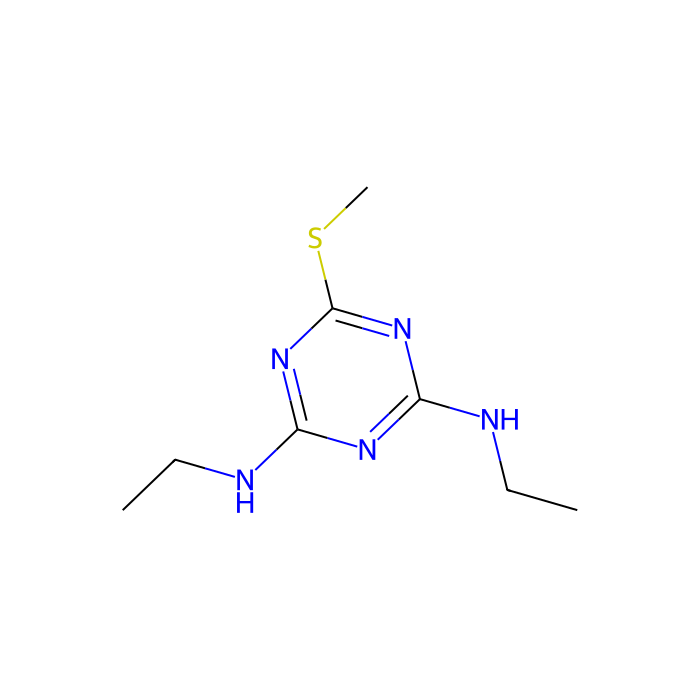
Determine the necessary mass, volume, or concentration for preparing a solution.
| Activity Type | Relation | Activity value | Units | Action Type | Journal | PubMed Id | doi | Assay Aladdin ID |
|---|
Pesticides Single Component Standards
Taxonomy Tree
| Kingdom | Organic compounds |
|---|---|
| Superclass | Organoheterocyclic compounds |
| Class | Triazines |
| Subclass | 1,3,5-triazines |
| Intermediate Tree Nodes | Not available |
| Direct Parent | Methylthio-s-triazines |
| Alternative Parents | Alkyl-2-thio-S-triazines Alkylarylthioethers Heteroaromatic compounds Sulfenyl compounds Azacyclic compounds Organopnictogen compounds Organonitrogen compounds Hydrocarbon derivatives |
| Molecular Framework | Aromatic heteromonocyclic compounds |
| Substituents | Methylthio-s-triazine - Alkyl-2-thio-s-triazine - Aryl thioether - Alkylarylthioether - Heteroaromatic compound - Azacycle - Sulfenyl compound - Thioether - Organic nitrogen compound - Organopnictogen compound - Hydrocarbon derivative - Organosulfur compound - Organonitrogen compound - Aromatic heteromonocyclic compound |
| Description | This compound belongs to the class of organic compounds known as methylthio-s-triazines. These are aromatic compounds containing a 1,3,5-triazine ring that is substituted at the 2-position with a methylthio group. |
| External Descriptors | Triazine herbicides |
| Activity Type | Relation | Activity value | Units | Action Type | Journal | PubMed Id | doi | Assay Aladdin ID |
|---|
| Activity Type | Relation | Activity value | Units | Action Type | Journal | PubMed Id | doi | Assay Aladdin ID |
|---|
| Activity Type | Relation | Activity value | Units | Action Type | Journal | PubMed Id | doi | Assay Aladdin ID |
|---|
| Activity Type | Relation | Activity value | Units | Action Type | Journal | PubMed Id | doi | Assay Aladdin ID |
|---|
| Activity Type | Relation | Activity value | Units | Action Type | Journal | PubMed Id | doi | Assay Aladdin ID |
|---|
| Activity Type | Relation | Activity value | Units | Action Type | Journal | PubMed Id | doi | Assay Aladdin ID |
|---|
| Activity Type | Relation | Activity value | Units | Action Type | Journal | PubMed Id | doi | Assay Aladdin ID |
|---|
| Activity Type | Relation | Activity value | Units | Action Type | Journal | PubMed Id | doi | Assay Aladdin ID |
|---|
| Activity Type | Relation | Activity value | Units | Action Type | Journal | PubMed Id | doi | Assay Aladdin ID |
|---|
Find and download the COA for your product by matching the lot number on the packaging.
| Lot Number | Certificate Type | Date | Item |
|---|---|---|---|
 E1529126 | Certificate of Analysis | Oct 18, 2024 | S128280 |
| Melt Point | 82-83°C |
|---|---|
| Molecular Weight | 213.31 |
| XLogP3 | 2.500 |
| Hydrogen Bond Donor Count | 2 |
| Hydrogen Bond Acceptor Count | 6 |
| Rotatable Bond Count | 5 |
| Exact Mass | 213.105 Da |
| Monoisotopic Mass | 213.105 Da |
| Topological Polar Surface Area | 88.000 Ų |
| Heavy Atom Count | 14 |
| Formal Charge | 0 |
| Complexity | 143.000 |
| Isotope Atom Count | 0 |
| Defined Atom Stereocenter Count | 0 |
| Undefined Atom Stereocenter Count | 0 |
| Defined Bond Stereocenter Count | 0 |
| Undefined Bond Stereocenter Count | 0 |
| The total count of all stereochemical bonds | 0 |
| Covalently-Bonded Unit Count | 1 |
H302:Harmful if swallowed
H332:Harmful if inhaled
H410:Very toxic to aquatic life with long lasting effects
P264:Wash hands [and …] thoroughly after handling.
P270:Do not eat, drink or smoke when using this product.
P273:Avoid release to the environment.
P391:Collect spillage.
P501:Dispose of contents/container to an approved waste disposal plant.
P301+P312+P330:IF SWALLOWED: Call a POISON CENTER/ doctor if you feel unwell. Rinse mouth.
No vendor‑validated protocols are provided in the product data. General practices for analytical standards:
Refer to your laboratory SOPs and regulatory guidelines (e.g., SANTE/US EPA) for full method details.
General biological context (literature; not a claim for use in living systems):
Relevance to this product:
Not typically applicable. Simetryne is a neutral organic analyte used as an analytical reference standard, not a buffering reagent. For laboratory use, prepare stock solutions in appropriate organic solvents (see Solvent Selection) and dilute into mobile phases or extraction media as required.
Context: This listing is an analytical standard, so “green alternatives” relate primarily to solvent systems and workflow design rather than substituting the analyte.
Greener choices in method development (literature/practice):
Trade‑off highlights:
Example comparison (general guidance):
Recommendation: Optimize your workflow for minimal solvent volume and select the least hazardous solvent that maintains accuracy, precision, and analyte stability.
Not applicable as a pharmaceutical ingredient. Simetryne is an agricultural analyte used as an analytical standard in research and quality control contexts. It is not an excipient or API. No pharmacopeial monograph usage is indicated for this item. For regulated analytical work, rely on the CoA for purity assignment and uncertainty.
Item-specific specifications (product data):
Typical physical properties (literature/general; for reference only, not item specifications):
Always consult the CoA for lot‑specific purity and the SDS for safe handling. Do not treat literature values as specifications.
Recommendation: For regulated analytical use, retain the CoA, confirm lot traceability, and prepare calibration solutions gravimetrically using solvent blanks compatible with your detection method.
Reactivity as a chemical entity:
Applications as an analytical standard (most relevant):
Practical tips:
Analytical use conditions (most relevant):
Chemical reaction conditions (context only):
Note: All conditions above are general literature guidance; they are not item specifications. Validate in‑house with system suitability and recovery tests.
Item-specific hazard data (product data):
General safety guidance (literature/good lab practice):
Always defer to the current SDS for authoritative hazard, exposure limits, and emergency procedures.
Purpose-specific guidance (analytical standard preparation):
Practical tips:
Note: Choose the solvent system that matches your analytical platform and matrix; verify with system suitability tests.
Research Use Note: For research use only (product data).
General structural description (literature):
Notes:
As supplied, this product is intended as an analytical standard rather than a building block. Therefore, synthetic applications are generally out of scope. For completeness (literature context):
If you require a reactive triazine building block, consider chloro‑s‑triazines (e.g., cyanuric chloride) rather than simetryne.
Not applicable. This product is a small‑molecule analytical standard, not a biological affinity reagent (e.g., antibody, enzyme, probe). No target specificity data are provided in the product data.