
Determine the necessary mass, volume, or concentration for preparing a solution.
| Activity Type | Relation | Activity value | Units | Action Type | Journal | PubMed Id | doi | Assay Aladdin ID |
|---|
≥98% for sensitive chromatographic and analytical workflows requiring minimal baseline interference.
Room temperature,Argon charged Ships Normal Check lot-specific COA for exact specifications.
SDS, COA, datasheet, and spec sheet available for download. Lot-specific COA accessible via lot number lookup.
Cited in 2076 peer-reviewed publications across chromatography, organic synthesis, and cross-coupling reactions.
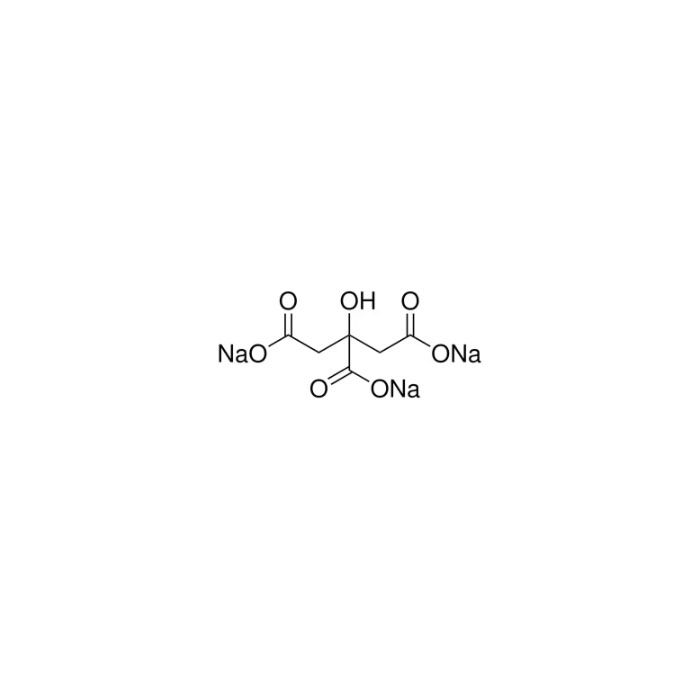
Trisodium citrate has a molecular weight of 258 Da. It has a high sodium content and a filtration coefficient.
Product Application:
Trisodium citrate has been used as a component of mobile phase buffer for HPLC analysis of dorsal striatum homogenate. As NiW codeposition electrolyte; As a component of sodium citrate buffer (SSC), it is used in the washing step of probe hybridization
Comprehensive hazard, handling, storage, and regulatory compliance document.
Download SDS →Lot-specific quality data. Enter your lot number to retrieve the exact COA.
Look up COA →Full quality attributes and acceptance criteria for this grade.
View spec sheet →Taxonomy Tree
| Kingdom | Organic compounds |
|---|---|
| Superclass | Organic acids and derivatives |
| Class | Carboxylic acids and derivatives |
| Subclass | Tricarboxylic acids and derivatives |
| Intermediate Tree Nodes | Not available |
| Direct Parent | Tricarboxylic acids and derivatives |
| Alternative Parents | Tertiary alcohols Carboxylic acid salts Carboxylic acids Organic sodium salts Organic oxides Hydrocarbon derivatives Carbonyl compounds |
| Molecular Framework | Aliphatic acyclic compounds |
| Substituents | Tricarboxylic acid or derivatives - Tertiary alcohol - Carboxylic acid salt - Organic alkali metal salt - Carboxylic acid - Organic oxygen compound - Organic oxide - Hydrocarbon derivative - Organic sodium salt - Organic salt - Organooxygen compound - Carbonyl group - Alcohol - Aliphatic acyclic compound |
| Description | This compound belongs to the class of organic compounds known as tricarboxylic acids and derivatives. These are carboxylic acids containing exactly three carboxyl groups. |
| External Descriptors | organic sodium salt |
| Activity Type | Relation | Activity value | Units | Action Type | Journal | PubMed Id | doi | Assay Aladdin ID |
|---|
| Activity Type | Relation | Activity value | Units | Action Type | Journal | PubMed Id | doi | Assay Aladdin ID |
|---|
| Activity Type | Relation | Activity value | Units | Action Type | Journal | PubMed Id | doi | Assay Aladdin ID |
|---|
| Activity Type | Relation | Activity value | Units | Action Type | Journal | PubMed Id | doi | Assay Aladdin ID |
|---|
| Activity Type | Relation | Activity value | Units | Action Type | Journal | PubMed Id | doi | Assay Aladdin ID |
|---|
| Activity Type | Relation | Activity value | Units | Action Type | Journal | PubMed Id | doi | Assay Aladdin ID |
|---|
Find and download the COA for your product by matching the lot number on the packaging.
| Lot Number | Certificate Type | Date | Item |
|---|---|---|---|
 G2614337 | Certificate of Analysis | Jun 01, 2026 | S189183 |
| G2614340 | Certificate of Analysis | Jun 01, 2026 | S189183 |
| G2614411 | Certificate of Analysis | Jun 01, 2026 | S189183 |
| F2313723 | Certificate of Analysis | Mar 18, 2026 | S189183 |
| A2630459 | Certificate of Analysis | Jan 21, 2026 | S189183 |
| A2630601 | Certificate of Analysis | Jan 21, 2026 | S189183 |
| A2630629 | Certificate of Analysis | Jan 21, 2026 | S189183 |
| H2507471 | Certificate of Analysis | Aug 14, 2025 | S189183 |
| I2501658 | Certificate of Analysis | May 12, 2025 | S189183 |
| I2501412 | Certificate of Analysis | May 12, 2025 | S189183 |
| I2501657 | Certificate of Analysis | May 12, 2025 | S189183 |
| D2527269 | Certificate of Analysis | Apr 21, 2025 | S189183 |
| D2527268 | Certificate of Analysis | Apr 21, 2025 | S189183 |
| D2527267 | Certificate of Analysis | Apr 21, 2025 | S189183 |
| C2504549 | Certificate of Analysis | Jan 06, 2025 | S189183 |
| C2504619 | Certificate of Analysis | Jan 06, 2025 | S189183 |
| C2504628 | Certificate of Analysis | Jan 06, 2025 | S189183 |
| K2420613 | Certificate of Analysis | Nov 12, 2024 | S189183 |
| K2420609 | Certificate of Analysis | Nov 12, 2024 | S189183 |
| I2419267 | Certificate of Analysis | Sep 09, 2024 | S189183 |
| I2419266 | Certificate of Analysis | Sep 09, 2024 | S189183 |
| I2419265 | Certificate of Analysis | Sep 09, 2024 | S189183 |
| F2411445 | Certificate of Analysis | May 29, 2024 | S189183 |
| F2411444 | Certificate of Analysis | May 29, 2024 | S189183 |
| F2411443 | Certificate of Analysis | May 29, 2024 | S189183 |
| C2430199 | Certificate of Analysis | Mar 12, 2024 | S189183 |
| D2403530 | Certificate of Analysis | Mar 11, 2024 | S189183 |
| D2403528 | Certificate of Analysis | Mar 11, 2024 | S189183 |
| D2403531 | Certificate of Analysis | Mar 11, 2024 | S189183 |
| C2421726 | Certificate of Analysis | Mar 04, 2024 | S189183 |
| B2422163 | Certificate of Analysis | Jan 22, 2024 | S189183 |
| B2422162 | Certificate of Analysis | Jan 22, 2024 | S189183 |
| K2329052 | Certificate of Analysis | Nov 18, 2023 | S189183 |
| K2329053 | Certificate of Analysis | Nov 18, 2023 | S189183 |
| F2313727 | Certificate of Analysis | May 10, 2023 | S189183 |
| K2302074 | Certificate of Analysis | May 10, 2023 | S189183 |
| A2409061 | Certificate of Analysis | May 10, 2023 | S189183 |
| F2313737 | Certificate of Analysis | May 10, 2023 | S189183 |
| K2223724 | Certificate of Analysis | Nov 15, 2022 | S189183 |
| K2223722 | Certificate of Analysis | Nov 15, 2022 | S189183 |
| A2331459 | Certificate of Analysis | Nov 15, 2022 | S189183 |
| K2223720 | Certificate of Analysis | Nov 15, 2022 | S189183 |
| K2223718 | Certificate of Analysis | Nov 15, 2022 | S189183 |
| F2225487 | Certificate of Analysis | Jun 16, 2022 | S189183 |
| F2225484 | Certificate of Analysis | Jun 16, 2022 | S189183 |
| F2225483 | Certificate of Analysis | Jun 16, 2022 | S189183 |
| D2211021 | Certificate of Analysis | Mar 15, 2022 | S189183 |
| D2211017 | Certificate of Analysis | Mar 15, 2022 | S189183 |
| D2211008 | Certificate of Analysis | Mar 15, 2022 | S189183 |
| A2215009 | Certificate of Analysis | Dec 16, 2021 | S189183 |
| A2215012 | Certificate of Analysis | Dec 16, 2021 | S189183 |
| A2215010 | Certificate of Analysis | Dec 16, 2021 | S189183 |
| Solubility | Soluble in water.425 g/l at 25℃ |
|---|---|
| Sensitivity | Hygroscopic. |
| Melt Point(°C) | 150 °C (decomposition) |
| Molecular Weight | 258.070 g/mol |
| XLogP3 | |
| Hydrogen Bond Donor Count | 1 |
| Hydrogen Bond Acceptor Count | 7 |
| Rotatable Bond Count | 2 |
| Exact Mass | 257.973 Da |
| Monoisotopic Mass | 257.973 Da |
| Topological Polar Surface Area | 141.000 Ų |
| Heavy Atom Count | 16 |
| Formal Charge | 0 |
| Complexity | 211.000 |
| Isotope Atom Count | 0 |
| Defined Atom Stereocenter Count | 0 |
| Undefined Atom Stereocenter Count | 0 |
| Defined Bond Stereocenter Count | 0 |
| Undefined Bond Stereocenter Count | 0 |
| The total count of all stereochemical bonds | 0 |
| Covalently-Bonded Unit Count | 4 |