
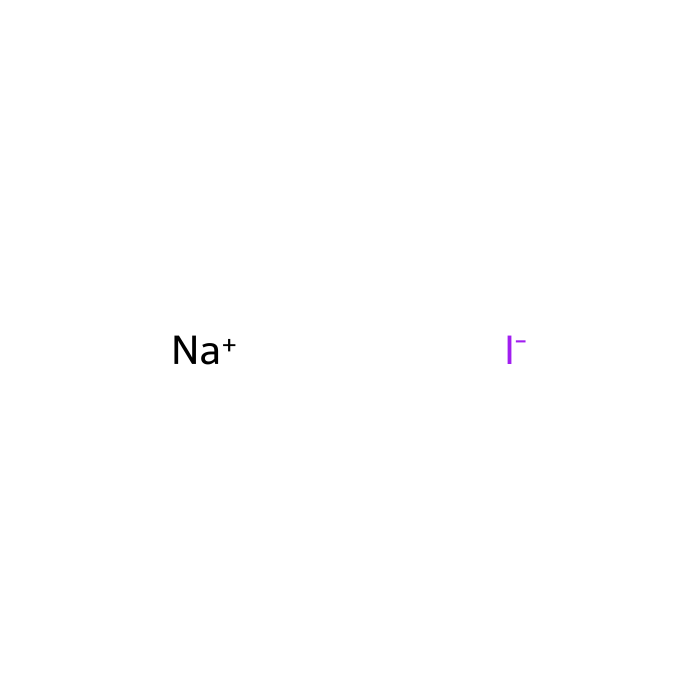
 K2323484
Determine the necessary mass, volume, or concentration for preparing a solution.
| Activity Type | Relation | Activity value | Units | Action Type | Journal | PubMed Id | doi | Assay Aladdin ID |
|---|
Taxonomy Tree
| Kingdom | Inorganic compounds |
|---|---|
| Superclass | Mixed metal/non-metal compounds |
| Class | Alkali metal salts |
| Subclass | Alkali metal iodides |
| Intermediate Tree Nodes | Not available |
| Direct Parent | Alkali metal iodides |
| Alternative Parents | Inorganic sodium salts |
| Molecular Framework | Not available |
| Substituents | Alkali metal iodide - Inorganic sodium salt - Inorganic salt |
| Description | This compound belongs to the class of inorganic compounds known as alkali metal iodides. These are inorganic compounds in which the largest halogen atom is Iodine, and the heaviest metal atom is an alkali metal. |
| External Descriptors | inorganic sodium salt - iodide salt |
| Activity Type | Relation | Activity value | Units | Action Type | Journal | PubMed Id | doi | Assay Aladdin ID |
|---|
| Activity Type | Relation | Activity value | Units | Action Type | Journal | PubMed Id | doi | Assay Aladdin ID |
|---|
| Activity Type | Relation | Activity value | Units | Action Type | Journal | PubMed Id | doi | Assay Aladdin ID |
|---|
| Activity Type | Relation | Activity value | Units | Action Type | Journal | PubMed Id | doi | Assay Aladdin ID |
|---|
| Refractive Index | 1.7745 |
|---|---|
| Boil Point | 1304°C |
| Melt Point | 651°C |
| Molecular Weight | 149.89 |
| XLogP3 | |
| Hydrogen Bond Donor Count | 0 |
| Hydrogen Bond Acceptor Count | 1 |
| Rotatable Bond Count | 0 |
| Exact Mass | 149.894 Da |
| Monoisotopic Mass | 149.894 Da |
| Topological Polar Surface Area | 0.000 Ų |
| Heavy Atom Count | 2 |
| Formal Charge | 0 |
| Complexity | 2.000 |
| Isotope Atom Count | 0 |
| Defined Atom Stereocenter Count | 0 |
| Undefined Atom Stereocenter Count | 0 |
| Defined Bond Stereocenter Count | 0 |
| Undefined Bond Stereocenter Count | 0 |
| The total count of all stereochemical bonds | 0 |
| Covalently-Bonded Unit Count | 2 |
H315:Causes skin irritation
H319:Causes serious eye irritation
H335:May cause respiratory irritation
H372:Causes damage to organs through prolonged or repeated exposure
H400:Very toxic to aquatic life
P260:Do not breathe dust/fume/gas/mist/vapors/spray.
P261:Avoid breathing dust/fume/gas/mist/vapors/spray.
P264:Wash hands [and …] thoroughly after handling.
P270:Do not eat, drink or smoke when using this product.
P271:Use only outdoors or in a well-ventilated area.
P273:Avoid release to the environment.
P280:Wear protective gloves/protective clothing/eye protection/face protection.
P321:Specific treatment (see ... on this label).
P391:Collect spillage.
P302+P352:IF ON SKIN: wash with plenty of water.
P304+P340:IF INHALED: Remove person to fresh air and keep comfortable for breathing.
P305+P351+P338:IF IN EYES: Rinse cautiously with water for several minutes. Remove contact lenses if present and easy to do - continue rinsing.
P362+P364:Take off contaminated clothing and wash it before reuse.
P405:Store locked up.
P403+P233:Store in a well-ventilated place. Keep container tightly closed.
P501:Dispose of contents/container to an approved waste disposal plant.
P264+P265:Wash hands [and …] thoroughly after handling. Do not touch eyes.
P337+P317:If eye irritation persists: Get medical help.
P332+P317:If skin irritation occurs: Get medical help.
P319:Get medical help if you feel unwell.
Our grade selection guide covers purity, stabilizer status, and application suitability for all variants in our catalog.
View Anhydrous Grade grade guide → View ACS grade guide →