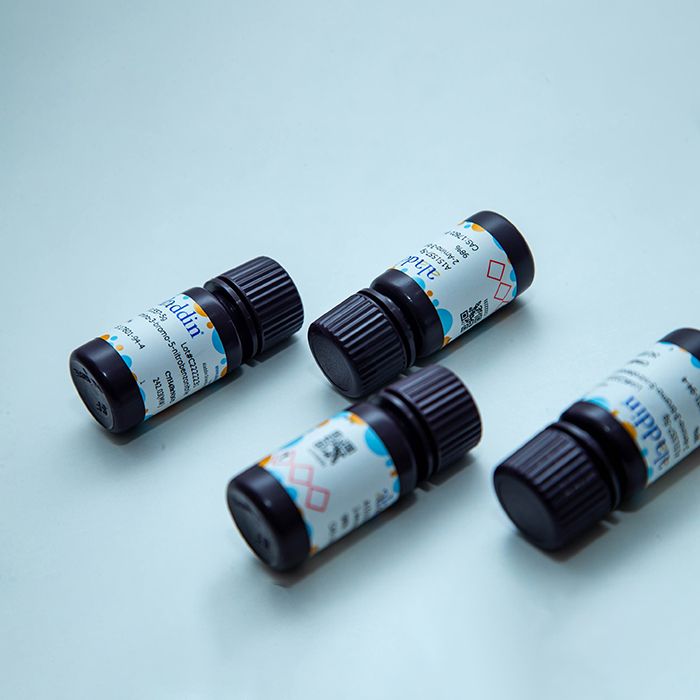
Sofosbuvir impurity H, an diastereoisomer of Sofosbuvir, is the impurity of Sofosbuvir. Sofosbuvir (PSI-7977) is an inhibitor of HCV RNA replication, demonstrates potent anti-hepatitis C virus activity.
Appearance:Solid
IC50& Target:HCV
Biological Activity:Sofosbuvir impurity H, an diastereoisomer of Sofosbuvir, is the impurity of Sofosbuvir. Sofosbuvir (PSI-7977) is an inhibitor of HCV RNA replication, demonstrates potent anti-hepatitis C virus activity.
Specifications
Storage
Store at -20°C
Shipped In
Ice chest + Ice pads
This product requires cold chain shipping. Ground and other economy services are not available.
Determine the necessary mass, volume, or concentration for preparing a solution.
Dilution Calculator
Determine the dilution needed to prepare a stock solution.
Reconstitution Calculator
Reviews
Customer Reviews
Application Protocols
Verified/tested applications in Product Data: Not specified for this item; refer to CoA/Spec Sheet.
General protocol for use as an analytical reference standard:
Allow the vial to equilibrate to room temperature in a desiccator before opening to avoid moisture uptake/condensation.
Accurately weigh or use the provided content to prepare a primary stock in LC-MS grade DMSO, acetonitrile, or methanol. Record solvent, exact concentration, and preparation date.
Filter if necessary through a low-binding 0.2 µm PTFE filter to remove particulates (avoid adsorption by pre-rinsing with solvent).
Prepare calibration levels spanning your reportable range; verify linearity, precision, and accuracy. If response differs from main analyte, determine a relative response factor.
Store aliquots of the stock at sub-zero temperatures; prepare fresh working dilutions daily or per stability data.
For LC-MS: use volatile buffers (e.g., 2–10 mM ammonium formate/acetate); for UV-only: buffer per method needs. Confirm retention-time and purity by a system suitability run.
Documentation: Attach chromatograms, spectra, and calculations to your batch record or method file.
Note: Adjust steps to your institutional SOPs; no item-specific validated method is provided here.
Biological Roles
This product is an impurity reference material and is intended strictly for research and analytical use. No biological role or function is assigned in the Product Data.
General context (literature):
Impurities related to nucleotide prodrugs can arise from process chemistry or degradation pathways; however, without the explicit structure of “Sofosbuvir impurity H,” no inference about biochemical properties can be made.
Recommendation:
Do not use for cellular or in vivo studies unless you have fully characterized the structure, purity, and safety profile and possess appropriate approvals. For this catalog item, treat it solely as an analytical standard.
Buffer Applications
Item-specific buffer data: Not specified for this item; refer to CoA/Spec Sheet if applicable.
Analytical buffer guidance (general for LC/LC-MS work with impurity standards):
Volatile aqueous buffers such as 2–20 mM ammonium formate or ammonium acetate (pH adjusted with formic/acetic acid) are compatible with MS and suitable for stability-indicating RP methods.
For UV-only detection, phosphate buffers (e.g., 10–25 mM, pH 2–7) can offer improved buffering capacity but are not MS-friendly.
Acidic modifiers (0.05–0.2% formic acid or TFA) may improve peak shape; be mindful that TFA suppresses ESI sensitivity.
Practical tips:
Validate pH robustness and ionic strength around target conditions; test adsorption by needle/vial/liner where low-level quantitation is required.
Filter and degas buffers; use low-UV components and LC-MS grade water to minimize background.
Note: No specific pKa or buffer compatibility is provided for this item.
Green Alternatives
Green chemistry context (analytical focus):
Where feasible, favor greener solvents and buffers in chromatographic methods while maintaining resolution and sensitivity.
Comparison of common LC solvents (general guidance):
Methanol (MeOH): renewable routes available; higher viscosity may reduce throughput or increase backpressure.
Ethanol (EtOH): greener profile; different selectivity; can be used with elevated temperature or longer columns to mitigate viscosity.
2-Propanol (IPA): useful for highly hydrophobic analytes; higher viscosity; good for flushing and adsorption mitigation.
Greener buffer choices:
Volatile buffers such as ammonium formate/acetate at low ionic strength support MS detection and reduce inorganic waste compared with phosphate buffers.
Practical strategy:
Start with MeOH/H2O or EtOH/H2O and assess selectivity; if inadequate, transition to MeCN while optimizing column chemistry (e.g., polar-embedded or phenyl phases) to retain greener eluents.
Use temperature programming or smaller particle columns to maintain efficiency with greener, more viscous eluents.
Tradeoffs:
Greener eluents may alter retention and sensitivity, requiring additional method development time. Ensure robustness and specificity for impurity H are preserved before adoption.
Note: These are general recommendations; no item-specific solvent requirements are provided in the Product Data.
Pharmaceutical Uses
Use context (non-clinical; formulation-agnostic):
Supplied for analytical control of sofosbuvir-related impurities in drug substance and finished product testing. Typical roles include identity confirmation, retention-time/mass spectral matching, and calibration/limit tests per internal specifications aligned with ICH guidance.
Pharmacopeial status:
Not specified for this item; refer to CoA/Spec Sheet and relevant compendia for any monograph references.
Manufacturing/QC relevance (general):
Supports development of stability-indicating methods, shelf-life studies, and batch release trending for related substances.
Facilitates root-cause analysis during process changes by enabling targeted monitoring of the specific impurity.
Regulatory note:
For GMP use, qualify the reference standard per internal SOPs: verification of identity, purity, assignment of content, and documented storage conditions. This catalog item is for research use only as provided in the Product Data.
Physical Properties
Appearance: Not specified for this item; refer to CoA/Spec Sheet.
Melting point (MP): Not specified for this item; refer to CoA/Spec Sheet.
Boiling point (BP): Not specified for this item; refer to CoA/Spec Sheet.
Density: Not specified for this item; refer to CoA/Spec Sheet.
Solubility: Not specified for this item; refer to CoA/Spec Sheet.
LogP, pKa, refractive index: Not specified for this item; refer to CoA/Spec Sheet.
Comment on characterization strategy (general guidance):
For unknown/undisclosed impurity structures, determine practical solubility by micro-screening in LC-MS grade solvents (e.g., acetonitrile, methanol) and polar aprotics (e.g., DMSO). Record concentration limits and stability at analysis temperature and under light.
If crystalline, differential scanning calorimetry (DSC) and thermogravimetric analysis (TGA) can provide thermal profile; if amorphous, thermal events may be broad or absent.
Note: All specific numerical values for this item are not provided here and must be confirmed from the lot-specific CoA/Spec Sheet.
Quality & Grades
Grade/Purity: Not specified for this item; refer to CoA/Spec Sheet.
What “impurity standard” typically implies (general guidance):
Supplied for method development, identification, and quantitation of related substances in drug substance/product matrices.
Purity is commonly established by HPLC/UPLC area % and orthogonal techniques (NMR, MS). Water/volatile content may be determined by KF/LOD; identity by HRMS and/or NMR. Note: These are typical practices and not item-specific specifications.
Trace stabilizers/salts: Not specified for this item; refer to CoA/Spec Sheet.
Documentation you should expect for regulated workflows:
CoA with declared purity basis (area %, mass %, or qNMR), chromatogram, and identification data.
Where applicable, reference to analytical method conditions used for release testing.
Suitability:
For research and analytical use only (per Product Data). If applying to GMP/GLP settings, verify supplier documentation and perform in-house qualification.
Lot-to-lot consistency:
Always match your analytical method to the CoA conditions where possible, or perform a bridging verification when conditions differ.
Reaction & Applications
Item-specific synthetic/reactive uses: This product is supplied as an impurity standard; it is not typically used as a reagent or building block in preparative synthesis.
Analytical applications (general and widely applicable to API impurity standards):
Method development for related-substance profiling of sofosbuvir drug substance/product by RP-UPLC/HPLC with UV and/or MS detection.
Calibration standards for quantitation (external calibration) and to support limit tests aligned with ICH Q3A/Q3B expectations.
Peak identification by co-injection and retention-time/HRMS matching; support for mass spectral library building.
Stability-indicating method validation: evaluate forced-degradation samples (acid/base hydrolysis, oxidative, thermal, photolytic) and confirm separation of impurity H from other degradants.
System suitability: verify resolution factors, tailing, and sensitivity at specification levels.
Practical tips:
Use amber glassware and minimize exposure to heat and light until stability is understood.
Prepare fresh working standards daily or as supported by your stability study; store master stocks at low temperature in aliquots to avoid freeze–thaw cycles.
When establishing response factors, assess linearity across the reportable range and evaluate relative response vs. main analyte.
Note: No item-specific reactivity or transformation data are provided; the above guidance is general to impurity reference materials.
Reaction Conditions
Preparative/synthetic reaction conditions: Not typically applicable for an impurity reference standard.
Stock solutions: Prepare at known concentration in LC-MS grade DMSO, acetonitrile, or methanol, based on empirical solubility screening. Store frozen in aliquots to minimize freeze–thaw.
Chromatography: Reverse-phase LC with water/organic mobile phases (MeOH or MeCN) and volatile buffers (ammonium formate/acetate) is standard for related-substance methods. Column choices include C18, phenyl-hexyl, or polar-embedded phases; optimize temperature (25–50°C) and gradient slope for resolution.
Detection: UV at low-UV wavelengths or MS (ESI±) depending on analyte ionization; exact wavelengths/masses are item- and structure-dependent and must be established experimentally.
Yields/kinetics: Not applicable.
Note: No item-specific conditions are provided in the Product Data; tailor all parameters to your validated method and confirm with your CoA.
Safety & Handling
GHS/CLP classification: Not specified for this item; refer to SDS.
Signal word, H-statements, pictograms: Not specified for this item; refer to SDS.
General laboratory precautions (good practice for unknown small-molecule impurities):
Wear appropriate PPE: lab coat, safety glasses, and suitable gloves (e.g., nitrile). Handle inside a fume hood to avoid inhalation of dust or solvent vapors.
Avoid skin/eye contact and inhalation. Prevent release to the environment.
For potential sensitizers or bioactive analogs, minimize exposure; use dedicated tools and spill pads.
Incompatibilities (general):
Until stability is known, avoid strong oxidizers/reductants, strong acids/bases, and elevated temperatures or UV exposure.
First aid (overview; defer to SDS for authoritative instructions):
If inhaled: move to fresh air; seek medical attention if symptoms persist.
Skin/eye contact: rinse with water for at least 15 minutes; remove contaminated clothing; obtain medical advice.
Ingestion: rinse mouth; do not induce vomiting; seek medical attention.
Waste: Collect in halogenated or non-halogenated organic waste as appropriate to solvent; follow institutional and local regulations.
Special risk note: Impurity reference materials may have unknown toxicological profiles—handle as potentially harmful. Always consult the lot-specific SDS.
Solvent Selection
Item-specific solubility data: Not specified for this item; refer to CoA/Spec Sheet.
Practical approach (general for small-molecule impurity standards):
Prepare primary stock in a strong, anhydrous solvent compatible with LC-MS: DMSO, acetonitrile, or methanol are common starting points. Confirm solubility at your target concentration by visual inspection and test injection.
For RP-LC methods, dilute working solutions with water or aqueous buffer (e.g., 0.1% formic acid or ammonium formate) immediately before analysis to minimize precipitation.
If the compound is lipophilic, isopropanol or acetonitrile-rich mixtures can reduce adsorption to vial surfaces.
Polarity/miscibility (general remarks):
DMSO, methanol, and acetonitrile are mutually miscible with water and are standard for impurity reference solutions; choose based on your detector (UV vs. MS), analyte stability, and chromatographic selectivity.
Small comparison (general):
Acetonitrile: low viscosity, strong eluent in RP-LC, excellent for MS; may be preferable for narrow peaks.
Methanol: greener, different selectivity; higher viscosity; good UV transparency above ~205 nm.
DMSO: high solvency; limit injection plug to avoid peak distortion.
Container considerations: Keep tightly closed in the original amber vial or transfer to chemically compatible, low-bind containers. Protect from moisture and light until stability is confirmed.
Prepare initial stock solutions in dry LC-MS grade solvents such as acetonitrile, methanol, or DMSO. Start with 1–10 mg/mL trial concentrations and adjust based on solubility observation; do not assume complete dissolution without verification.
If particulate persists, gentle warming (not exceeding ambient-to-30°C) and sonication can help; avoid prolonged heat or UV exposure.
Aliquoting and stability:
Divide stock into single-use aliquots and store at -20°C or below to minimize freeze–thaw. Record freeze–thaw cycles and discard aliquots showing precipitation or discoloration.
For long-term storage, consider -80°C if compatible with container and solvent; confirm stability by periodic re-analysis.
Expiry and retest:
Follow any retest/expiry date on the CoA. If absent, establish an internal retest interval based on trend stability data.
Note: No item-specific hygroscopicity, photostability, or solution stability data are provided; consult the SDS/CoA for lot-specific guidance.
Structure & Identity
Item-specific identifiers (from Product Data):
Product Name: Sofosbuvir impurity H (SKU: S658888)
CAS: S658888 (as provided in Product Data)
Molecular Formula: Not specified for this item; refer to CoA/Spec Sheet.
Molecular Weight: Not specified for this item; refer to CoA/Spec Sheet.
SMILES: Not specified for this item; refer to CoA/Spec Sheet.
InChIKey: Not specified for this item; refer to CoA/Spec Sheet.
Structural features:
Item-specific structure is not disclosed in the Product Data. Please consult the Certificate of Analysis (CoA) or structure sheet supplied with your lot for exact functional groups and stereochemistry.
General context (literature):
“Sofosbuvir impurities” are typically structurally related to the phosphoramidate nucleotide prodrug sofosbuvir and may include process-related byproducts, degradation products, or isomeric/analog species. Without the explicit structure for “impurity H,” no definitive functional group description can be provided here.
2D structural description:
Not available for this item in the Product Data; see CoA/Spec Sheet for structural diagram if provided.
Synthetic Utility
Item-specific use as reagent/building block: Not typically applicable. As an impurity reference standard, this item is not intended for use as a synthetic intermediate or coupling partner.
General chemistry note:
If the structure becomes available and exhibits representative functional groups (e.g., phosphoramidate, nucleoside core, esters), derivatization may be used for characterization (e.g., silylation for GC-MS, phosphate tagging for LC-MS sensitivity). Such procedures are analytical, not preparative, and are not item-specific recommendations.
Recommendation:
Use this material to support analytical method development and characterization of process streams rather than as a substrate in reactions.
Target Specificity
Not applicable. This product is a small-molecule impurity standard and does not have biological target specificity, antigen binding, clone, or isotype attributes.
No item-specific bioassay data are provided.
Frequently Asked Questions
How should this product be stored?
Store at ?20 °C. Freezer storage is required to maintain the specified shelf life.
How is this product shipped?
This product ships in an insulated container with ice pads. Unpack on arrival and transfer it to the storage condition stated above.
What are the CAS number, molecular formula and molecular weight?
The CAS Number is S658888, the molecular formula is C29H33FN3O10P, and the molecular weight is 633.56 g/mol.
What documentation is provided?
Available product documentation, including Certificates of Analysis (COA), Safety Data Sheets (SDS), and specification sheets, is shown in the product document area. Document availability and access follow the current site policy.
We use cookies to ensure the website functions properly and, where permitted, to improve your experience. You can manage your preferences at any time in Settings. Learn more in our Cookie Policy.
Shall we send you a message when we have discounts available?
Remind me later
Thank you! Please check your email inbox to confirm.
Products are supplied to verified businesses, institutions, and qualified professionals for research and development use only. Not for use in humans, animals, diagnosis, or therapy.