
Determine the necessary mass, volume, or concentration for preparing a solution.
| Activity Type | Activity Value -log(M) | Mechanism of Action | Activity Reference | Publications (PubMed IDs) |
|---|
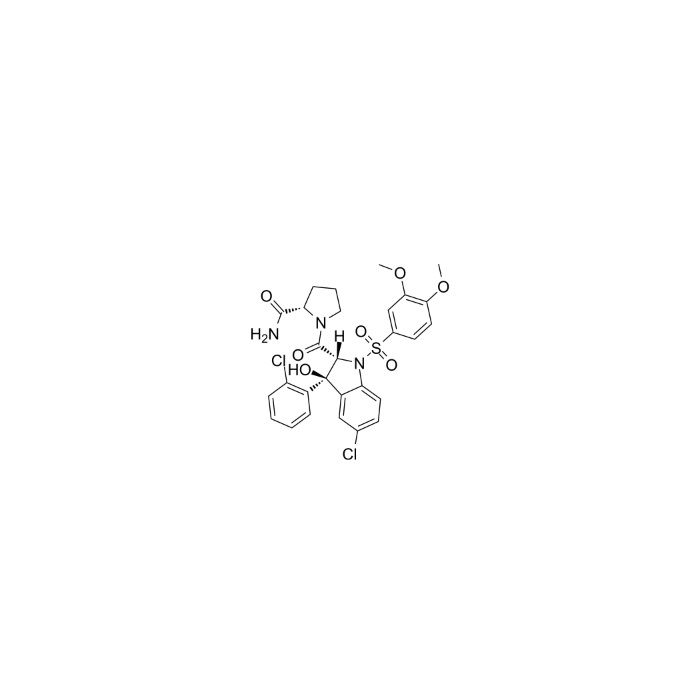
SR 49059 (SR-49059) is a potent, orally active, selective Vasotocin V1a antagonist with a Ki vaule of 1.4 nM.
Application:
SR 49059 has been used to study the V1AR (Vasotocin type 1A receptor) signaling mediated β adrenergic receptor responsiveness and its contribution to the development of heart failure.
SR 49059 may be used in Arginine Vasotocin (AVP) V1a-receptor-mediated cell signaling studies.
Taxonomy Tree
| Kingdom | Organic compounds |
|---|---|
| Superclass | Organic acids and derivatives |
| Class | Carboxylic acids and derivatives |
| Subclass | Amino acids, peptides, and analogues |
| Intermediate Tree Nodes | Peptides |
| Direct Parent | Dipeptides |
| Alternative Parents | Proline and derivatives Alpha amino acid amides Indolecarboxylic acids and derivatives Benzenesulfonamides Dimethoxybenzenes Benzenesulfonyl compounds Anisoles Pyrrolidinecarboxamides N-acylpyrrolidines Phenoxy compounds Alkyl aryl ethers Chlorobenzenes Organosulfonamides Aryl chlorides Tertiary carboxylic acid amides Sulfonyls Tertiary alcohols Primary carboxylic acid amides Azacyclic compounds Organochlorides Organic oxides Hydrocarbon derivatives Carbonyl compounds Organonitrogen compounds Organopnictogen compounds |
| Molecular Framework | Aromatic heteropolycyclic compounds |
| Substituents | Alpha-dipeptide - Proline or derivatives - Alpha-amino acid amide - Indolecarboxylic acid derivative - Dimethoxybenzene - O-dimethoxybenzene - Alpha-amino acid or derivatives - Benzenesulfonamide - Indole or derivatives - Benzenesulfonyl group - Phenoxy compound - Methoxybenzene - Pyrrolidine carboxylic acid or derivatives - Pyrrolidine-2-carboxamide - Phenol ether - N-acylpyrrolidine - Anisole - Alkyl aryl ether - Chlorobenzene - Halobenzene - Benzenoid - Organosulfonic acid amide - Aryl chloride - Aryl halide - Monocyclic benzene moiety - Organic sulfonic acid or derivatives - Pyrrolidine - Tertiary alcohol - Tertiary carboxylic acid amide - Sulfonyl - Organosulfonic acid or derivatives - Primary carboxylic acid amide - Carboxamide group - Organoheterocyclic compound - Azacycle - Ether - Organosulfur compound - Alcohol - Organic nitrogen compound - Carbonyl group - Organic oxide - Hydrocarbon derivative - Organohalogen compound - Organochloride - Organopnictogen compound - Organic oxygen compound - Organonitrogen compound - Organooxygen compound - Aromatic heteropolycyclic compound |
| Description | This compound belongs to the class of organic compounds known as dipeptides. These are organic compounds containing a sequence of exactly two alpha-amino acids joined by a peptide bond. |
| External Descriptors | Not available |
| Activity Type | Activity Value -log(M) | Mechanism of Action | Activity Reference | Publications (PubMed IDs) |
|---|
| Activity Type | Activity Value -log(M) | Mechanism of Action | Activity Reference | Publications (PubMed IDs) |
|---|
| Activity Type | Activity Value -log(M) | Mechanism of Action | Activity Reference | Publications (PubMed IDs) |
|---|
| Activity Type | Activity Value -log(M) | Mechanism of Action | Activity Reference | Publications (PubMed IDs) |
|---|
| Activity Type | Relation | Activity value | Units | Action Type | Journal | PubMed Id | doi | Assay Aladdin ID |
|---|
| Activity Type | Relation | Activity value | Units | Action Type | Journal | PubMed Id | doi | Assay Aladdin ID |
|---|
| Activity Type | Relation | Activity value | Units | Action Type | Journal | PubMed Id | doi | Assay Aladdin ID |
|---|
| Activity Type | Relation | Activity value | Units | Action Type | Journal | PubMed Id | doi | Assay Aladdin ID |
|---|
| Activity Type | Relation | Activity value | Units | Action Type | Journal | PubMed Id | doi | Assay Aladdin ID |
|---|
| Activity Type | Relation | Activity value | Units | Action Type | Journal | PubMed Id | doi | Assay Aladdin ID |
|---|
| Activity Type | Relation | Activity value | Units | Action Type | Journal | PubMed Id | doi | Assay Aladdin ID |
|---|
| Activity Type | Relation | Activity value | Units | Action Type | Journal | PubMed Id | doi | Assay Aladdin ID |
|---|
| Activity Type | Relation | Activity value | Units | Action Type | Journal | PubMed Id | doi | Assay Aladdin ID |
|---|
| Activity Type | Relation | Activity value | Units | Action Type | Journal | PubMed Id | doi | Assay Aladdin ID |
|---|
| Activity Type | Relation | Activity value | Units | Action Type | Journal | PubMed Id | doi | Assay Aladdin ID |
|---|
| Activity Type | Relation | Activity value | Units | Action Type | Journal | PubMed Id | doi | Assay Aladdin ID |
|---|
| Activity Type | Relation | Activity value | Units | Action Type | Journal | PubMed Id | doi | Assay Aladdin ID |
|---|
| Activity Type | Relation | Activity value | Units | Action Type | Journal | PubMed Id | doi | Assay Aladdin ID |
|---|
| Activity Type | Relation | Activity value | Units | Action Type | Journal | PubMed Id | doi | Assay Aladdin ID |
|---|
| Activity Type | Relation | Activity value | Units | Action Type | Journal | PubMed Id | doi | Assay Aladdin ID |
|---|
| Activity Type | Relation | Activity value | Units | Action Type | Journal | PubMed Id | doi | Assay Aladdin ID |
|---|
| Activity Type | Relation | Activity value | Units | Action Type | Journal | PubMed Id | doi | Assay Aladdin ID |
|---|
| Activity Type | Relation | Activity value | Units | Action Type | Journal | PubMed Id | doi | Assay Aladdin ID |
|---|
| Activity Type | Relation | Activity value | Units | Action Type | Journal | PubMed Id | doi | Assay Aladdin ID |
|---|
| Activity Type | Relation | Activity value | Units | Action Type | Journal | PubMed Id | doi | Assay Aladdin ID |
|---|
| Activity Type | Relation | Activity value | Units | Action Type | Journal | PubMed Id | doi | Assay Aladdin ID |
|---|
| Activity Type | Relation | Activity value | Units | Action Type | Journal | PubMed Id | doi | Assay Aladdin ID |
|---|
| Activity Type | Relation | Activity value | Units | Action Type | Journal | PubMed Id | doi | Assay Aladdin ID |
|---|
| Activity Type | Relation | Activity value | Units | Action Type | Journal | PubMed Id | doi | Assay Aladdin ID |
|---|
| Activity Type | Relation | Activity value | Units | Action Type | Journal | PubMed Id | doi | Assay Aladdin ID |
|---|
| Activity Type | Relation | Activity value | Units | Action Type | Journal | PubMed Id | doi | Assay Aladdin ID |
|---|
| Activity Type | Relation | Activity value | Units | Action Type | Journal | PubMed Id | doi | Assay Aladdin ID |
|---|
| Activity Type | Relation | Activity value | Units | Action Type | Journal | PubMed Id | doi | Assay Aladdin ID |
|---|
| Activity Type | Relation | Activity value | Units | Action Type | Journal | PubMed Id | doi | Assay Aladdin ID |
|---|
| Activity Type | Relation | Activity value | Units | Action Type | Journal | PubMed Id | doi | Assay Aladdin ID |
|---|
| Activity Type | Relation | Activity value | Units | Action Type | Journal | PubMed Id | doi | Assay Aladdin ID |
|---|
| Activity Type | Relation | Activity value | Units | Action Type | Journal | PubMed Id | doi | Assay Aladdin ID |
|---|
| Activity Type | Relation | Activity value | Units | Action Type | Journal | PubMed Id | doi | Assay Aladdin ID |
|---|
| Activity Type | Relation | Activity value | Units | Action Type | Journal | PubMed Id | doi | Assay Aladdin ID |
|---|
| Activity Type | Relation | Activity value | Units | Action Type | Journal | PubMed Id | doi | Assay Aladdin ID |
|---|
| Activity Type | Relation | Activity value | Units | Action Type | Journal | PubMed Id | doi | Assay Aladdin ID |
|---|
| Activity Type | Relation | Activity value | Units | Action Type | Journal | PubMed Id | doi | Assay Aladdin ID |
|---|
| Solubility | Solvent:DMSO, Max Conc. mg/mL: 18.61, Max Conc. mM: 30 |
|---|---|
| Sensitivity | light & Moisture sensitive |
| Molecular Weight | 620.500 g/mol |
| XLogP3 | 3.800 |
| Hydrogen Bond Donor Count | 2 |
| Hydrogen Bond Acceptor Count | 8 |
| Rotatable Bond Count | 7 |
| Exact Mass | 619.095 Da |
| Monoisotopic Mass | 619.095 Da |
| Topological Polar Surface Area | 148.000 Ų |
| Heavy Atom Count | 41 |
| Formal Charge | 0 |
| Complexity | 1090.000 |
| Isotope Atom Count | 0 |
| Defined Atom Stereocenter Count | 3 |
| Undefined Atom Stereocenter Count | 0 |
| Defined Bond Stereocenter Count | 0 |
| Undefined Bond Stereocenter Count | 0 |
| The total count of all stereochemical bonds | 0 |
| Covalently-Bonded Unit Count | 1 |
No item-specific, validated application protocols are provided in the Product Data. The following general frameworks are commonly used for small-molecule GPCR antagonists and should be adapted and validated by the user.
Calcium mobilization assay (general outline):
IP1 accumulation or PLC activity assay:
Binding assay (radioligand or BRET-based):
Notes:
All protocols must be optimized for the specific cell line, receptor expression level, and instrumentation.
Context from literature (not item-specific claims):
Applications enabled by V1a antagonism:
Experimental considerations:
All uses are for research only. No claims are made regarding therapeutic properties or clinical performance.
This item is a bioactive small-molecule ligand, not a buffering agent. It does not define or maintain pH and is not used to formulate classical biological buffers.
Practical note:
For buffer recipes and pH ranges, refer to standard buffering agents rather than this ligand.
As a finished bioactive ligand, SR 49059 is not typically interchangeable with “green alternative” chemicals in the way solvents or common reagents are. However, greener choices can be made around its use:
Solvent considerations (general):
Process and waste minimization:
Alternatives at the biology level (literature context):
There are no direct “greener chemical substitutes” for SR 49059 itself without changing the pharmacological probe. Optimize handling, solvent choice, and experimental design to improve sustainability.
This product is provided strictly for research use only.
Context (general, non-clinical):
Formulation/analytical considerations (general):
No therapeutic, diagnostic, or clinical claims are made for this item. Any use beyond laboratory research must be independently validated and fall under appropriate regulatory oversight.
Item-specific physicochemical specifications are not supplied in the Product Data for this listing.
General literature guidance for small-molecule GPCR ligands (context, not item-specific specifications):
Practical notes:
About Moligand (general description of the grade/series):
What this means for the user:
Recommendations:
This product is supplied as a bioactive research ligand rather than a synthetic reagent.
Synthetic reaction use: SR 49059 is not typically employed as a reagent, catalyst, or building block in preparative organic synthesis. Accordingly, there are no standard reaction families or named transformations in which it serves as a substrate.
Research applications (general, literature-based context):
Practical tips for assay use (general guidance):
For users seeking synthetic methodology content, refer instead to the sections on Biological Roles, Target Specificity, and Application Protocols, which are most relevant for this compound type.
Not typically applicable. SR 49059 is a finalized bioactive ligand and is not used as a reagent in standard organic reactions.
Assay preparation conditions (general, literature-based guidance):
These conditions are general recommendations for small-molecule GPCR ligands. For chemical reaction conditions (e.g., coupling, reductions), there is no standard use case for this product.
Safety details specific to this item are not provided in the Product Data.
General laboratory precautions (non-item-specific, good practice):
First-aid overview (consult SDS for details):
Waste: Collect in organic solid/liquid waste according to institutional and local regulations.
Item-specific solubility data are not provided.
Practical guidance for small-molecule GPCR ligands (general, literature-based):
Comparison (general considerations, not item-specific):
Always confirm actual solubility, stability, and adsorption to plastics/glass for this specific item/lot under your conditions.
Storage conditions (from Product Data): Store at −20°C, protected from light. Shipment: ice chest with ice pads.
Reconstitution (general guidance for small-molecule ligands; not item-specific specifications):
Handling and stability:
Solution storage (general):
Item-specific parameters such as exact solubility, hygroscopicity, and solution stability are not specified for this item; refer to the lot-specific CoA and SDS for definitive guidance.
SR 49059 is a small-molecule research ligand supplied under Aladdin’s Moligand series. Item-specific identifiers provided are limited; see notes below.
Item identifiers (from Product Data)
Structural features (general literature description, not item-specific specs)
2D structure (descriptive, literature-based)
SR 49059 is supplied as a bioactive, target-directed small molecule and is not typically used as a synthetic intermediate or reagent.
If your objective is chemical synthesis or conjugation:
For most users, the primary value of this product lies in its role as a selective receptor antagonist in biological assays rather than as a building block.
Target information from literature (contextual; not item-specific testing data):
Implications for experimental design:
Item-specific bioactivity testing, clone/isotype, species cross-reactivity, and epitope data are not applicable, as this is a small molecule and not an antibody or biologic. For verified potency/selectivity values, consult primary literature or the lot-specific CoA if provided.
Our grade selection guide covers purity, stabilizer status, and application suitability for all variants in our catalog.
View Moligand™ grade guide →