
Determine the necessary mass, volume, or concentration for preparing a solution.
| Activity Type | Activity Value -log(M) | Mechanism of Action | Activity Reference | Publications (PubMed IDs) |
|---|
≥99% for sensitive chromatographic and analytical workflows requiring minimal baseline interference.
Store at -20°C Ships Ice chest + Ice pads Check lot-specific COA for exact specifications.
SDS, COA, datasheet, and spec sheet available for download. Lot-specific COA accessible via lot number lookup.
Cited in 0 peer-reviewed publications across chromatography, organic synthesis, and cross-coupling reactions.
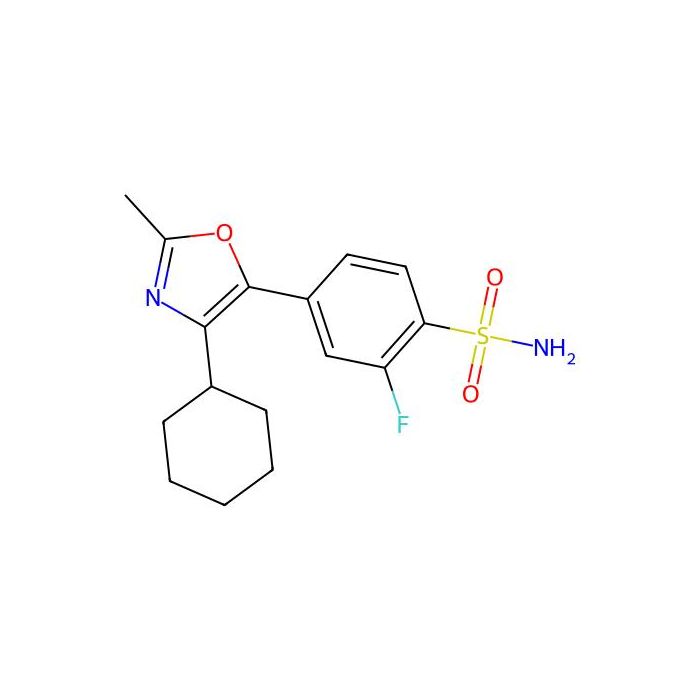
Tilmacoxib (JTE522) is a highly selective, time-dependent and irreversible human COX-2 inhibitor with an IC 50 of 85 nM in an enzyme assay.
In Vitro
Inhibitory activity and the mechanism of action of Tilmacoxib (JTE-522), a novel selective cyclooxygenase (COX)-2 inhibitor, on human COX-1 and COX-2 are investigated and compared with those of reference compounds. In an enzyme assay, Tilmacoxib inhibits yeast-expressed human recombinant COX-2 with an IC 50 of 0.085 μM. In contrast, Tilmacoxib does not inhibit human COX-1 prepared from human platelets at concentrations up to 100 μM. In a cell-based assay, Tilmacoxib diminishes lipopolysaccharide-induced prostaglandin E2 production in human peripheral blood mononuclear cells (COX-2) (IC 50 =15.1 nM). On the other hand, Tilmacoxib is less potent at inhibiting calcium ionophore-induced thromboxane B2 production in washed human platelets (COX-1) (IC 50 =6.21 μM). Tilmacoxib shows highly selective inhibition of human COX-2, and its activity is more selective than that of other COX-2 inhibitors (NS-398 and SC-58635). Human recombinant COX-2 activity is attenuated by Tilmacoxib in a dose-dependent and time-dependent manner. Inhibition of proliferation of gastric epithelial cells by a cyclooxygenase 2 inhibitor, Tilmacoxib (JTE522), is also mediated by a PGE 2 -independent pathway Combination of Tilmacoxib and Arachidonic acid results in a marked retardation of wound healing compared to the control, but Tilmacoxib does not completely suppress the increase in cellular PGE 2 content following the addition of arachidonate. MCE has not independently confirmed the accuracy of these methods. They are for reference only.
In Vivo
The present experiment is designed to assess the potential chemopreventive properties of Tilmacoxib (JTE-522), a new selective cyclooxygenase-2 inhibitor, on the induction of 1,2-dimethylhydrazine (DMH)-induced colonic aberrant crypt foci (ACF), a marker of rat colon carcinogenesis. A total of 80 male F344 rats are treated with 3 or 10 mg/kg of body weight Tilmacoxib or vehicle by oral gavage five times weekly from the start of the experiment. One week later, rats receive s.c. injections of saline or 20 mg/kg of body weight DMH once weekly for four successive weeks. At the end of 12 weeks after the start of experiment, all rats are sacrificed and colons are evaluated for ACF. 10 mg/kg Tilmacoxib significantly suppresses the total ACF/colon. No inhibitory effect is observed in the 3 mg/kg Tilmacoxib treatment group. Administration of 10 mg/kg Tilmacoxib significantly suppresses ACF formation with a 30% reduction in total ACF/colon (p<0.01). Furthermore, the data on crypt multiplicity show that 10 mg/kg Tilmacoxib significantly reduces the formation of foci containing 1-3 crypts but not foci containing four crypts or more. Administration of the low dose of Tilmacoxib (3 mg/kg) has no inhibitory effects on either the total ACF or crypt multiplicity. MCE has not independently confirmed the accuracy of these methods. They are for reference only.
Cell Assay
Tilmacoxib is resolved with DMSO prior to the experiment and concentrations of 1-100 μM are assessed. Effects of Arachidonic acid are assessed at concentrations of 0, 5 and 20 μg/mL. Further, the combination of Tilmacoxib (100 μM) with Arachidonic acid (20 μg/mL) is assessed in additional experiments. Circular artificial wounds are created after formation of complete monolayer cell sheets. Tilmacoxib and Arachidonic acid are added just after wound formation. The process of epithelial restoration is monitored by measuring the cell-free area using an inverted phase-contrast microscope every 24 h. Changes in the cell-free area during restoration are analyzed quantitatively with an image analyser. MCE has not independently confirmed the accuracy of these methods. They are for reference only.
Form:Solid
IC50& Target:Human COX-2 85 nM (IC 50 )
| Canonical Smiles | CC1=NC(=C(O1)C2=CC(=C(C=C2)S(=O)(=O)N)F)C3CCCCC3 |
|---|---|
| IUPAC Name | 4-(4-cyclohexyl-2-methyl-1,3-oxazol-5-yl)-2-fluorobenzenesulfonamide |
| InChIKey | MIMJSJSRRDZIPW-UHFFFAOYSA-N |
| INCHI | 1S/C16H19FN2O3S/c1-10-19-15(11-5-3-2-4-6-11)16(22-10)12-7-8-14(13(17)9-12)23(18,20)21/h7-9,11H,2-6H2,1H3,(H2,18,20,21) |
| Isomeric SMILES | CC1=NC(=C(O1)C2=CC(=C(C=C2)S(=O)(=O)N)F)C3CCCCC3 |
| Alternate CAS | 180200-68-4 |
| PubChem CID | 159271 |
| MeSH Entry Terms | 4-(4-cyclohexyl-2-methyloxazol-5-yl)-2-fluorobenzenesulfonamide;JTE 522;JTE-522 |
| Molecular Weight | 338.40 |
Comprehensive hazard, handling, storage, and regulatory compliance document.
Download SDS →Lot-specific quality data. Enter your lot number to retrieve the exact COA.
Look up COA →Full quality attributes and acceptance criteria for this grade.
View spec sheet →Taxonomy Tree
| Kingdom | Organic compounds |
|---|---|
| Superclass | Organoheterocyclic compounds |
| Class | Azoles |
| Subclass | Oxazoles |
| Intermediate Tree Nodes | Not available |
| Direct Parent | Phenyl-1,3-oxazoles |
| Alternative Parents | Benzenesulfonamides Benzenesulfonyl compounds 2,4,5-trisubstituted oxazoles Fluorobenzenes Organosulfonamides Aryl fluorides Aminosulfonyl compounds Heteroaromatic compounds Oxacyclic compounds Azacyclic compounds Hydrocarbon derivatives Organic oxides Organofluorides Organonitrogen compounds Organooxygen compounds Organopnictogen compounds |
| Molecular Framework | Aromatic heteromonocyclic compounds |
| Substituents | Phenyl-1,3-oxazole - Benzenesulfonamide - Benzenesulfonyl group - 2,4,5-trisubstituted 1,3-oxazole - Fluorobenzene - Halobenzene - Aryl fluoride - Aryl halide - Monocyclic benzene moiety - Organosulfonic acid amide - Benzenoid - Heteroaromatic compound - Organic sulfonic acid or derivatives - Organosulfonic acid or derivatives - Sulfonyl - Aminosulfonyl compound - Oxacycle - Azacycle - Organosulfur compound - Organooxygen compound - Organonitrogen compound - Organofluoride - Organohalogen compound - Organic nitrogen compound - Hydrocarbon derivative - Organic oxygen compound - Organopnictogen compound - Organic oxide - Aromatic heteromonocyclic compound |
| Description | This compound belongs to the class of organic compounds known as phenyl-1,3-oxazoles. These are aromatic heterocyclic compounds containing a 1,3-oxazole substituted at one or more positions by a phenyl group. |
| External Descriptors | organofluorine compound - 1,3-oxazoles - sulfonamide |
| Activity Type | Activity Value -log(M) | Mechanism of Action | Activity Reference | Publications (PubMed IDs) |
|---|
| Activity Type | Relation | Activity value | Units | Action Type | Journal | PubMed Id | doi | Assay Aladdin ID |
|---|
| Activity Type | Relation | Activity value | Units | Action Type | Journal | PubMed Id | doi | Assay Aladdin ID |
|---|
| Activity Type | Relation | Activity value | Units | Action Type | Journal | PubMed Id | doi | Assay Aladdin ID |
|---|
| Activity Type | Relation | Activity value | Units | Action Type | Journal | PubMed Id | doi | Assay Aladdin ID |
|---|
| Activity Type | Relation | Activity value | Units | Action Type | Journal | PubMed Id | doi | Assay Aladdin ID |
|---|
| Molecular Weight | 338.400 g/mol |
|---|---|
| XLogP3 | 3.300 |
| Hydrogen Bond Donor Count | 1 |
| Hydrogen Bond Acceptor Count | 6 |
| Rotatable Bond Count | 3 |
| Exact Mass | 338.11 Da |
| Monoisotopic Mass | 338.11 Da |
| Topological Polar Surface Area | 94.600 Ų |
| Heavy Atom Count | 23 |
| Formal Charge | 0 |
| Complexity | 504.000 |
| Isotope Atom Count | 0 |
| Defined Atom Stereocenter Count | 0 |
| Undefined Atom Stereocenter Count | 0 |
| Defined Bond Stereocenter Count | 0 |
| Undefined Bond Stereocenter Count | 0 |
| The total count of all stereochemical bonds | 0 |
| Covalently-Bonded Unit Count | 1 |