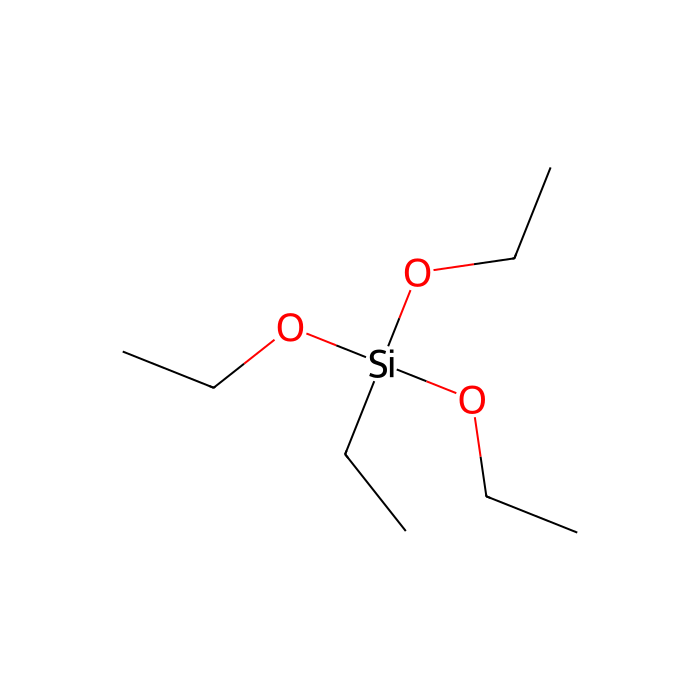
This compound belongs to the class of organic compounds known as trialkoxysilanes. These are organosilicon compounds with the general formula RO[Si](R')(OR'')OR''' (R-R''' = aliphatic organyl group).
External Descriptors
Not available
1. Djoumbou Feunang Y, Eisner R, Knox C, Chepelev L, Hastings J, Owen G, Fahy E, Steinbeck C, Subramanian S, Bolton E, Greiner R, and Wishart DS. ClassyFire: Automated Chemical Classification With A Comprehensive, Computable Taxonomy. Journal of Cheminformatics, 2016, 8:61.
1.Xiaohui Meng, Dong Qiu. (2022) Surface morphology regulation of colloidal Nanoparticles: A convenient Kinetically-Controlled seeded growth strategy. JOURNAL OF COLLOID AND INTERFACE SCIENCE, [PMID:36459933][10.1016/j.jcis.2022.11.087]
2.Wu Zhonghan, He Zhechao, Xu Yinke, Wang Jing, Lu Xinhuan, Xia Qinghua, Zhou Dan. (2021) One-step non-templating synthesis of hybrid zeolite catalyst for Knoevenagel condensation at room temperature efficiently. JOURNAL OF POROUS MATERIALS, 28 (4):(1041-1048). [PMID:][10.1007/s10934-021-01057-5]
3.Heng Zhang, Hu Li, Hu Pan, Anping Wang, Sadra Souzanchi, Chunbao (Charles) Xu, Song Yang. (2018) Magnetically recyclable acidic polymeric ionic liquids decorated with hydrophobic regulators as highly efficient and stable catalysts for biodiesel production. APPLIED ENERGY, [PMID:][10.1016/j.apenergy.2018.04.061]
4.Gang Xu, Baojun Sun, Xiaowei Zhang, Jie Gao, Xiaomei Li, Limin Bai, Ying Zhang, Shihan Li, Yang Wang. (2026) Fabrication of a highly sensitive and stable fluorinated xerogel/cellulose acetate film optical sensor for application in dissolved oxygen detection. Analytical Methods, [PMID:][10.1039/D6AY00197A]
Solution Calculators
Molarity Calculator
Determine the necessary mass, volume, or concentration for preparing a solution.
Dilution Calculator
Determine the dilution needed to prepare a stock solution.
Reconstitution Calculator
Reviews
Customer Reviews
Application Protocols
No assay-format protocols (WB, IHC, IF, FC, etc.) are applicable to this small-molecule reagent. For practical usage, see Reaction Conditions for:
Preparing hydrolysis/condensation baths for sol–gel and primers.
Surface silanization procedures for glass/silica.
Co-precursor blending and curing of ORMOSIL coatings.
Always validate conditions on your substrate and scale, and consult the SDS/CoA for lot-specific constraints.
Biological Roles
This product is an organosilane surface/modification reagent and does not have intrinsic biological roles in metabolism, signaling, or enzymatic pathways.
General chemistry note: Organosilanes of this type are used to functionalize materials that may interface with biological systems (e.g., controlling surface hydrophobicity), but they are not biomolecules and are not used as nutrients or cofactors.
If employing treated materials in bioassays, thoroughly cure and wash to remove residual monomers/byproducts (e.g., ethanol) that can affect cell culture outcomes.
For bioconjugation or bioactive surface creation, functional silanes bearing amino, epoxy, thiol, or polyethylene glycol groups are typically chosen; the ethyl group here is nonfunctional and primarily modulates surface energy.
No medical or clinical claims are made. For research use only (per Product Data).
Buffer Applications
Not typically applicable. Triethoxy(ethyl)silane is a moisture-sensitive organosilane reagent, not a buffering agent. In aqueous buffers it will hydrolyze and condense, leading to loss of function and possible gelation. For relevant guidance, see Reaction & Applications and Solvent Selection for controlled hydrolysis conditions in alcohol–water mixtures.
Green Alternatives
Perspective on greener selection for this chemistry:
Alcohol byproduct profile:
Trialkoxysilanes release the corresponding alcohol upon hydrolysis. Ethoxy variants release ethanol (lower toxicity, better EHS profile) compared with methoxy analogs that release methanol. Choosing triethoxy(ethyl)silane over trimethoxy(ethyl)silane can be a greener choice from a hydrolysis byproduct standpoint.
Solvent choices around this reagent:
Prefer bio-based or higher-boiling, recyclable solvents (e.g., 2-MeTHF, CPME, propylene carbonate for post-hydrolysis stages) where compatible.
Use ethanol or isopropanol as carriers for sol–gel since they align with the hydrolysis product, simplifying solvent recovery.
Process design:
Run hydrolysis/condensation at ambient temperature and near-neutral catalysts (acetic acid) to reduce energy and corrosivity compared with strong mineral acids/bases.
Minimize excess water and operate at higher solids in continuous flow or aerosol-assisted processes to cut solvent use and waste.
Comparison (general):
Triethoxy(ethyl)silane vs trimethoxy(ethyl)silane
Hydrolysis rate: slower/moderate vs faster (MeO)
Alcohol released: ethanol (preferred) vs methanol (toxic)
Volatility: slightly lower vs higher
Handling: improved pot life vs faster gelation
Notes: Selection should be guided by performance targets, regulatory constraints, and LCA; validate substitutions in your process.
Pharmaceutical Uses
No therapeutic or clinical use is implied. For research and manufacturing context only:
Potential roles (general materials science):
As a co-precursor for silica-like barrier or primer layers on device components or packaging films to modulate surface energy and adhesion.
In adhesion-promoting primers for inks/coatings on glass or metal components used in non-clinical device fabrication.
Regulatory/compendial status: Not specified for this item; verify if any pharmacopeial monograph or device-material listings apply to your application.
If used near GMP contexts, control and document residual monomers and byproducts (ethanol) and ensure complete cure and extractables/leachables assessments. Always qualify material to internal specifications; this listing is for research use only (per Product Data).
Appearance: Not specified for this item; refer to CoA/Spec Sheet.
Grade/Purity: Not specified for this item; refer to CoA/Spec Sheet.
Literature/typical values for ethyltriethoxysilane (for method development; not product specifications):
Physical state: clear, low-viscosity liquid (literature, organoalkoxysilanes of this class)
Boiling point: typically in the 160–175 °C range at 1 atm (literature for C2-substituted trialkoxysilanes)
Density (20/25 °C): often ~0.88–0.91 g/mL (literature ranges)
Refractive index (nD20): commonly ~1.389–1.395 (literature ranges)
Vapor pressure: low at ambient temperature (literature, qualitative)
Solubility: miscible with many aprotic organic solvents (hexanes, toluene, ethers); undergoes hydrolysis in water and protic media (general behavior of trialkoxysilanes)
Hydrolysis products: ethanol and silanols, which may further condense to siloxanes (general)
Notes for practitioners:
Because trialkoxysilanes hydrolyze, measured properties can drift in humid air; use freshly opened or properly blanketed material for precise measurements.
For chromatographic purity checks, minimize exposure to aqueous mobile phases to avoid on-column hydrolysis.
Quality & Grades
Item-specific grade/purity: Not specified for this item; refer to CoA/Spec Sheet.
Guidance for this class of materials:
Typical grades encountered for organosilanes include “reagent grade,” “synthesis grade,” or “surface treatment grade.” When stated, these indicate general suitability for laboratory synthesis or surface modification but do not guarantee trace specifications unless explicitly listed.
For chromatographic or electronics uses, suppliers may specify moisture content (Karl Fischer), hydrolyzable chloride, acidity, color (APHA), and metal ion content. None of these are specified for this item; refer to CoA/Spec Sheet for your lot.
Stabilizers: Many trialkoxysilanes are shipped without added stabilizers; some lots may include trace acid to control hydrolysis rate. For this item, stabilizers are not specified; verify on the CoA/SDS if present.
Implications for use:
Moisture content is critical in sol–gel and surface silanization; dry solvents and inert atmosphere handling improve consistency.
Low UV impurity burden benefits optical coatings; if using for optical applications, confirm UV–Vis baseline of your lot.
For adhesion promotion, trace acidity can influence hydrolysis/condensation kinetics; adjust catalyst loading accordingly.
Reaction & Applications
Triethoxy(ethyl)silane (ethyltriethoxysilane) is a versatile coupling/precursor reagent in materials and surface chemistry.
Key application families (literature/general):
Sol–gel precursor: Hydrolysis of Si–OEt groups followed by condensation affords siloxane networks. The ethyl substituent remains pendant, lowering crosslink density versus tetraalkoxysilanes and imparting greater hydrophobicity and flexibility to ORMOSIL films.
Surface modification (silanization): Reacts with hydroxylated surfaces (glass, silica, metal oxides, cellulose) after hydrolysis to silanols, producing covalent Si–O–substrate linkages. The non-hydrolyzable ethyl tail yields hydrophobic, low-surface-energy coatings.
Adhesion promotion and primers: Blended with other alkoxysilanes (e.g., amino- or epoxy-functional) to tailor interphase properties in composites, sealants, and coatings. Ethyltriethoxysilane can reduce brittleness and moisture uptake.
Co-precursor with TEOS/MTES: Adjusts porosity, refractive index, and mechanical properties of silica-like films for anti-reflective and barrier coatings.
Moisture-curing systems: Participates in room-temperature cure formulations where ambient moisture drives hydrolysis/condensation, often acid- or tin-catalyzed.
Practical notes:
Control water content (0.5–4 eq per Si–OEt) and catalyst (acetic acid, HCl, NH3) to tune hydrolysis rate and gel time.
Use alcohol carriers (EtOH/iPrOH) when releasing the same alcohol as a byproduct to minimize compositional drift.
Avoid strong base at high concentrations which can cause rapid, inhomogeneous condensation and premature gelation.
Reaction Conditions
General, literature-based guidance for handling and transforming triethoxy(ethyl)silane; adapt to scale and equipment:
Controlled hydrolysis (sol–gel or silanization baths):
Solvent: ethanol or isopropanol are typical carriers.
Water: 0.5–4.0 molar equivalents per Si–OEt depending on desired rate and extent; start with sub-stoichiometric amounts to form silanols, then adjust.
Catalyst: acetic acid (pH ~4–5) for moderated rates; HCl (pH 1–2) for faster hydrolysis; NH3 or amines for base-catalyzed routes (faster condensation, risk of rapid gelation).
Temperature: ambient (20–25 °C) to 40 °C; cooling may be required on scale due to exotherm.
Time: minutes to hours until clear, slightly more viscous solution forms; use within pot-life to avoid gelation.
Surface priming (glass/silica):
Clean substrate (piranha/plasma), rinse, dry.
Dip or spin in 0.5–5 vol% silane in ethanol with 0.1–1 vol% water and acetic acid; dwell 2–10 min.
Cure 80–120 °C for 10–60 min to drive condensation and remove volatiles.
Coating/film formation:
Co-precursor blends with TEOS/MTES; solids 2–20 wt% in alcohol; aging 0.5–24 h before deposition (spin, dip, spray); cure at 100–200 °C as substrate allows.
Incompatibilities: Strong base at high concentration, excess water without sufficient dilution, and high humidity during application can cause premature gelation and hazy films.
All values are general literature guidance, not product specifications. Verify with small-scale trials.
Safety & Handling
Authoritative safety information must be taken from the SDS for your specific lot. The following are general considerations for trialkoxy organosilanes like triethoxy(ethyl)silane:
GHS classification, signal word, pictograms: Not specified for this item; refer to SDS. Many trialkoxysilanes are classified as flammable liquids and eye/skin irritants.
Principal hazards (general):
Flammable liquid and vapor; ignition possible from heat/sparks/open flames.
Hydrolyzes with moisture to ethanol (flammable) and silanols; exothermic hydrolysis/condensation can occur in bulk with acids/bases.
Irritation to eyes, skin, and respiratory tract; high vapor concentrations may cause CNS effects typical of organic vapors.
PPE and engineering controls:
Use in a fume hood with good ventilation.
Wear chemical splash goggles, solvent-resistant gloves (e.g., nitrile; verify compatibility), and lab coat.
Ground/bond containers during transfer; avoid sources of ignition.
Handling/storage incompatibilities:
Avoid moisture, acids, bases, and oxidizers; contact with water/protic solvents initiates hydrolysis and releases ethanol.
Incompatible with strong acids/bases that catalyze rapid condensation/gelation.
First-aid overview (general):
Inhalation: Move to fresh air; seek medical attention if symptoms persist.
Skin/eye contact: Rinse with water for ≥15 min; remove contaminated clothing; seek medical attention if irritation persists.
Ingestion: Rinse mouth; do not induce vomiting; seek medical advice.
Fire-fighting: Use alcohol-resistant foam, dry chemical, or CO2; water spray for cooling only. Combustion/thermal decomposition may produce silicon oxides and carbon oxides.
Shipping: Shipped via FedEx DG Service (from Product Data). Defer to package markings and SDS for UN number and packing group.
Solvent Selection
This product is a reactive organosilane reagent rather than a general solvent. Nevertheless, its handling and application depend strongly on solvent choice:
Polarity/miscibility (general behavior of ethyltrialkoxysilanes):
Miscible with many aprotic organics (alkanes, aromatics, ethers, esters).
Limited compatibility with protic solvents; water/alcohol mixtures trigger hydrolysis, releasing ethanol and forming silanols that may condense.
Dielectric considerations: Nonpolar to moderately polar aprotic solvents (hexanes, toluene, xylenes, CPME, MTBE) are typically chosen for storage, dilution, or deposition where hydrolysis is undesired.
When to choose what:
For controlled hydrolysis/condensation (sol–gel, primer solutions): use anhydrous alcohols with a defined amount of water and an acid/base catalyst. Ethanol or isopropanol are common carriers since ethanol is the hydrolysis byproduct.
For surface grafting on hydrophobic substrates before hydrolysis: use toluene, heptane, or CPME to limit premature reaction.
For silica/glass silanization: employ aqueous–alcohol mixtures with pH ~4–5 (acetic acid) or basic conditions depending on desired rate; keep solids content low to avoid gelation.
Practical tips:
Dry all solvents (molecular sieves) for moisture-sensitive steps.
Add water last and in stoichiometric excess only when initiating hydrolysis; control temperature during exothermic stages.
Practical storage guidance (general for trialkoxysilanes):
Keep tightly sealed under inert gas (argon or nitrogen) to limit moisture ingress and oxidative discoloration.
Store in a dry place away from heat, sparks, and open flame. Use original, moisture-barrier packaging when possible.
After opening, promptly blanket headspace with inert gas and recap; for long-term storage consider transferring to anhydrous, amber glass with PTFE-lined cap.
Do not store in contact with acids/bases; avoid wet lines and hygroscopic septa.
Reconstitution: Not applicable—supplied as a neat liquid reagent. If dilution is needed for application, use dry, compatible solvents (see Solvent Selection) and add water/catalyst only when ready to initiate hydrolysis.
Shelf-life: Not specified for this item; refer to CoA/Spec Sheet. Inspect periodically for haze, viscosity increase, or ethanol odor indicative of hydrolysis; discard compromised material according to local regulations.
Structure & Identity
Brief description: Triethoxy(ethyl)silane is an organoalkoxysilane bearing one ethyl substituent on silicon and three ethoxy groups; it is a typical trialkoxysilane precursor to siloxane networks via hydrolysis/condensation.
Item-specific identifiers (from Product Data):
CAS: 78-07-9
PubChem CID: 6515
InChIKey: 61369 (as provided; full InChIKey not specified for this item)
SKU: T109375
Product Name: Triethoxy(ethyl)silane
Literature/computed identifiers and features (verify against CoA/SDS for your lot):
Hydrolyzable Si–OEt groups enable conversion to silanols under controlled aqueous/alcoholic conditions; subsequent condensation produces Si–O–Si linkages, forming silsesquioxane/organosilica networks.
The non-hydrolyzable Si–C2H5 group is retained in the final network, lowering crosslink density and tuning hydrophobicity, refractive index, and mechanical compliance—useful in ORMOSIL coatings and hybrid materials.
Transesterification: In presence of alcohols and catalysts (e.g., titanium or tin alkoxides, acids), Si–OEt groups can exchange with other alkoxy groups, allowing adjustment of hydrolysis profiles (e.g., partial ethoxy→isopropoxy exchange).
Surface chemistry: After partial hydrolysis, the silanol-bearing intermediate can condense to hydroxylated substrates (glass, silica, alumina, cellulose), providing durable siloxane bonds and an outward-facing ethyl group for low surface energy.
Co-precursor strategies: Blending with TEOS or organofunctional silanes (APTMS, GPTMS, MTES) enables fine control over porosity, adhesion, and chemical resistance in coatings and fillers.
What it is not suited for:
Lacks Si–H; therefore not a hydrosilylation hydrogen source and not directly applicable to Pt-catalyzed Si–H addition to alkenes/alkynes. Choose appropriate hydrosilanes if Si–H reactivity is required.
Target Specificity
Not applicable. This product is a small-molecule organosilane reagent, not a biological targeting reagent (e.g., antibody, probe, or inhibitor). There is no antigen, epitope, clone, isotype, or species reactivity associated with this item.
We use cookies to ensure the website functions properly and, where permitted, to improve your experience. You can manage your preferences at any time in Settings. Learn more in our Cookie Policy.
Shall we send you a message when we have discounts available?
Remind me later
Thank you! Please check your email inbox to confirm.
Products are supplied to verified businesses, institutions, and qualified professionals for research and development use only. Not for use in humans, animals, diagnosis, or therapy.

 L2227061