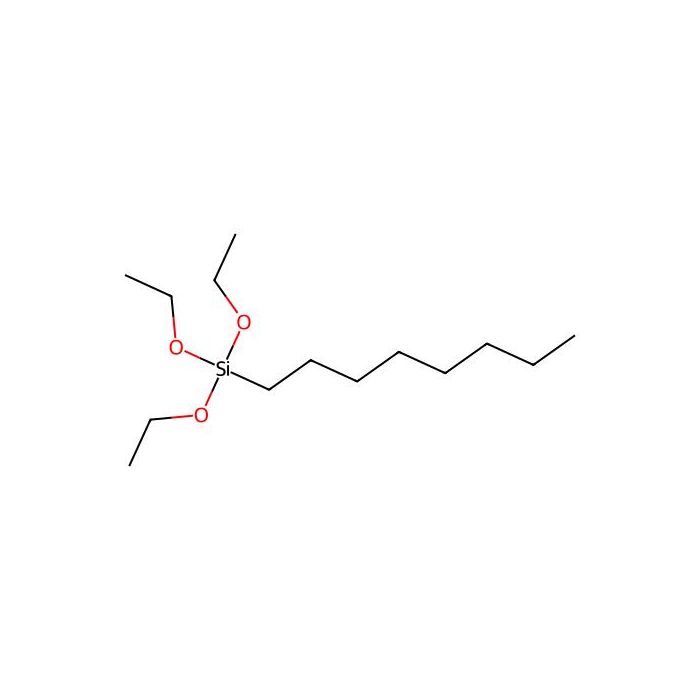
Triethoxyoctylsilane - Moligand™, 10 mM in DMSO , CAS No.2943-75-1

CAS: 2943-75-1 Cat. No.: T1499257 Formula: C14H32O3Si Molecular Weight: 276.49 Beilstein Registry Number: 2325287 EC Number: 220-941-2 PubChem CID: 76262
AVAILABLE TO ORDER
GRADE & PURITY Moligand™ ? Moligand™ — Aladdin's line of ligands and bioactive small molecules. Use for receptor, pathway, and binding studies needing defined small-molecule tools. 10 mM in DMSO
Storage
Desiccated,Store at -80°C
Shipped In
Dry ice packs + Cold packs
★
Size
Germany (EU)
USA*
Price
Qty
1ml
T1499257-1ml
Made to order · 8–12 wks
€25.08
Enter a quantity for the sizes you want to add.

Overview

Triethoxyoctylsilane is a compound used in plastic applications and can be utilized to produce waterproof coatings with hydrophobic properties .

Specifications

Specifications & Purity
Moligand™, 10 mM in DMSO
Storage
Desiccated,Store at -80°C
Shipped In
Dry ice packs + Cold packs
This product requires cold chain shipping. Ground and other economy services are not available.
Grade
Moligand™
Names and Identifiers
Isomeric SMILES
CCCCCCCC[Si](OCC)(OCC)OCC
WGK Germany
1
RTECS
VV6695500
PubChem CID
76262
Molecular Weight
276.49
Beilstein
2325287
Reaxys
2325287

Advanced Data

Certificates (CoA,COO,BSE/TSE and Analysis Chart)
C of A & Other Certificates(BSE/TSE, COO):
Analytical Chart:
Chemical and Physical Properties
Refractive Index1.417
Flash Point212 °F
Flash Point100 °C
Boil Point98°C
Safety and Hazards(GHS)
Pictogram(s)
Signal
Warning
Hazard Statements

H315:Causes skin irritation

H319:Causes serious eye irritation

H335:May cause respiratory irritation

Precautionary Statements

P261:Avoid breathing dust/fume/gas/mist/vapors/spray.

P305+P351+P338:IF IN EYES: Rinse cautiously with water for several minutes. Remove contact lenses if present and easy to do - continue rinsing.

P280:Wear protective gloves/protective clothing/eye protection/face protection.

P302+P352:IF ON SKIN: wash with plenty of water.

P321:Specific treatment (see ... on this label).

P405:Store locked up.

P501:Dispose of contents/container to an approved waste disposal plant.

P264:Wash hands [and …] thoroughly after handling.

P271:Use only outdoors or in a well-ventilated area.

P304+P340:IF INHALED: Remove person to fresh air and keep comfortable for breathing.

P403+P233:Store in a well-ventilated place. Keep container tightly closed.

P362+P364:Take off contaminated clothing and wash it before reuse.

P264+P265:Wash hands [and …] thoroughly after handling. Do not touch eyes.

P337+P317:If eye irritation persists: Get medical help.

P332+P317:If skin irritation occurs: Get medical help.

P319:Get medical help if you feel unwell.

WGK Germany
1
RTECS
VV6695500
Reaxys
2325287
Documents & Articles
A Hygrothermal Interface Guide for Silane Coupling Agents: From Failure Mechanisms to Evidence-Chain Troubleshooting and Selection (with Product Tables A–C)
Why Material Properties Are Limited by Interfaces: Mechanism of Action and Selection Guide for Silane Coupling Agents (Tables 1–4)
Silane Precursors in Sol-Gel Film Formation: Precursor Selection and Its Influence on Film-Formation Outcomes
Application Scenarios and Selection Considerations for Silane Impregnation Agents in the Protection of Concrete and Absorptive Masonry
Alkylsilanes: Structural Features, Surface Reactions, Applications, and Product Selection
Preparation Methods and Precautions for Silane Coupling Agent Primer Solutions
Which Fillers and Substrates Are Suitable for Silane Coupling Agents: Surface Hydroxyls, Interfacial Bonding, and Experimental Verification
How Matting Agents in Coatings Build Low-Gloss Coating Surfaces: Mechanisms, Formulation Trade-Offs, and Product Selection
Structure–Property Relationship of Silicone Resins: Mechanisms of Heat Resistance, Weatherability, Hydrophobicity, and Coating Performance Analysis
Color-Development Mechanisms, Formulation Forms, and Selection/Application Logic of Colorants in Personal Care Products
Mechanism of Action of Porous Silica in Oil-Control Loose Powder: Pore Structure, Capillary Imbibition, and Surface Modification
UVA Absorption Mechanism of Avobenzone: Keto–Enol Tautomerism, Photochemical Instability, and Formulation Photostabilization Strategies
Citations of This Product
Solution Calculators
Reviews

Customer Reviews

Frequently Asked Questions

What are the CAS number, molecular formula and molecular weight?
The CAS Number is 2943-75-1, the molecular formula is C14H32O3Si, and the molecular weight is 276.49 g/mol.
What is Moligand??
Moligand? is one of Aladdin Scientific's premium product lines, formulated for high-purity applications across multiple workflows. Compared to standard grades in the same workflow, Moligand? products typically offer tighter specifications, more rigorous QC, and stronger lot-to-lot consistency.
How should this product be stored?
Store at ?80 °C, desiccated. Keep the container tightly closed with desiccant — the material is moisture-sensitive.
How is this product shipped?
This product ships frozen with dry ice and cold packs. Unpack on arrival and transfer it to the storage condition stated above; handle dry ice with insulated gloves in a ventilated area.
What documentation is provided?
Available product documentation, including Certificates of Analysis (COA), Safety Data Sheets (SDS), and specification sheets, is shown in the product document area. Document availability and access follow the current site policy.

Shall we send you a message when we have discounts available?

Remind me later

Thank you! Please check your email inbox to confirm.

Oops! Notifications are disabled.