Determine the necessary mass, volume, or concentration for preparing a solution.
product description:
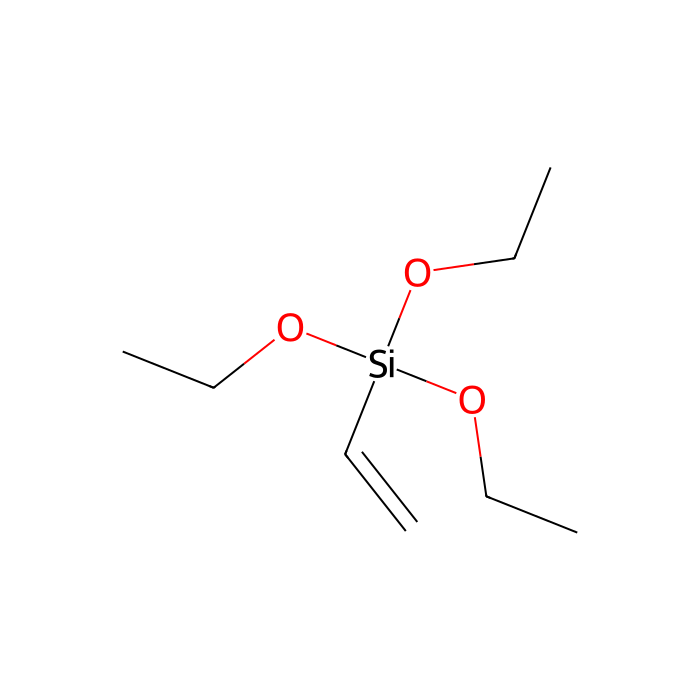
Triethoxyvinylsilane(TEVS) is a silane coupling agent and an adhesion promoter which can be used for cross-linking and for providing an insulating layer with good mechanical and thermal properties.
Taxonomy Tree
| Kingdom | Organic compounds |
|---|---|
| Superclass | Organometallic compounds |
| Class | Organometalloid compounds |
| Subclass | Organosilicon compounds |
| Intermediate Tree Nodes | Alkoxysilanes |
| Direct Parent | Trialkoxysilanes |
| Alternative Parents | Silyl ethers Organoheterosilanes Organic metalloid salts Organooxygen compounds Hydrocarbon derivatives |
| Molecular Framework | Aliphatic acyclic compounds |
| Substituents | Trialkoxysilane - Silyl ether - Organoheterosilane - Organic metalloid salt - Organic oxygen compound - Hydrocarbon derivative - Organic salt - Organooxygen compound - Aliphatic acyclic compound |
| Description | This compound belongs to the class of organic compounds known as trialkoxysilanes. These are organosilicon compounds with the general formula RO[Si](R')(OR'')OR''' (R-R''' = aliphatic organyl group). |
| External Descriptors | Not available |
Find and download the COA for your product by matching the lot number on the packaging.
| Lot Number | Certificate Type | Date | Item |
|---|---|---|---|
| Certificate of Analysis | Nov 11, 2026 | T103647 | |
| Certificate of Analysis | Nov 11, 2026 | T103647 | |
| Certificate of Analysis | Nov 11, 2026 | T103647 | |
| Certificate of Analysis | Feb 05, 2026 | T103647 | |
| Certificate of Analysis | Feb 05, 2026 | T103647 | |
| Certificate of Analysis | Feb 05, 2026 | T103647 | |
| Certificate of Analysis | Feb 05, 2026 | T103647 | |
| Certificate of Analysis | Feb 05, 2026 | T103647 | |
| Certificate of Analysis | Oct 20, 2025 | T103647 | |
| Certificate of Analysis | Oct 20, 2025 | T103647 | |
| Certificate of Analysis | Oct 20, 2025 | T103647 | |
| Certificate of Analysis | Oct 20, 2025 | T103647 | |
| Certificate of Analysis | Aug 14, 2025 | T103647 | |
| Certificate of Analysis | Aug 14, 2025 | T103647 | |
| Certificate of Analysis | Aug 14, 2025 | T103647 | |
| Certificate of Analysis | Aug 14, 2025 | T103647 | |
| Certificate of Analysis | May 09, 2025 | T103647 | |
| Certificate of Analysis | Mar 20, 2025 | T103647 | |
| Certificate of Analysis | Mar 20, 2025 | T103647 | |
| Certificate of Analysis | Mar 20, 2025 | T103647 | |
| Certificate of Analysis | Mar 20, 2025 | T103647 | |
| Certificate of Analysis | Aug 28, 2024 | T103647 | |
| Certificate of Analysis | Aug 28, 2024 | T103647 | |
| Certificate of Analysis | Jul 29, 2024 | T103647 | |
| Certificate of Analysis | Jul 29, 2024 | T103647 | |
| Certificate of Analysis | Jul 29, 2024 | T103647 | |
| Certificate of Analysis | May 13, 2024 | T103647 | |
| Certificate of Analysis | May 13, 2024 | T103647 | |
| Certificate of Analysis | Apr 07, 2024 | T103647 | |
| Certificate of Analysis | Apr 07, 2024 | T103647 | |
| Certificate of Analysis | Apr 07, 2024 | T103647 | |
| Certificate of Analysis | Apr 07, 2024 | T103647 | |
| Certificate of Analysis | Mar 15, 2024 | T103647 | |
| Certificate of Analysis | Mar 15, 2024 | T103647 | |
| Certificate of Analysis | Mar 15, 2024 | T103647 | |
| Certificate of Analysis | Sep 12, 2023 | T103647 | |
| Certificate of Analysis | Aug 21, 2023 | T103647 | |
| Certificate of Analysis | May 23, 2023 | T103647 | |
| Certificate of Analysis | May 23, 2023 | T103647 | |
| Certificate of Analysis | May 23, 2023 | T103647 | |
| Certificate of Analysis | May 23, 2023 | T103647 | |
| Certificate of Analysis | Nov 14, 2022 | T103647 | |
| Certificate of Analysis | Oct 28, 2022 | T103647 | |
| Certificate of Analysis | Oct 28, 2022 | T103647 | |
| Certificate of Analysis | Oct 28, 2022 | T103647 |
| Solubility | Miscible with organic solvents. |
|---|---|
| Sensitivity | Moisture sensitive. |
| Refractive Index | 1.398 |
| Flash Point | 93.2 °F |
| Flash Point | 34℃ |
| Boil Point | 160-161°C |
| Molecular Weight | 190.31 |
| XLogP3 | |
| Hydrogen Bond Donor Count | 0 |
| Hydrogen Bond Acceptor Count | 3 |
| Rotatable Bond Count | 7 |
| Exact Mass | 190.103 Da |
| Monoisotopic Mass | 190.103 Da |
| Topological Polar Surface Area | 27.700 Ų |
| Heavy Atom Count | 12 |
| Formal Charge | 0 |
| Complexity | 110.000 |
| Isotope Atom Count | 0 |
| Defined Atom Stereocenter Count | 0 |
| Undefined Atom Stereocenter Count | 0 |
| Defined Bond Stereocenter Count | 0 |
| Undefined Bond Stereocenter Count | 0 |
| The total count of all stereochemical bonds | 0 |
| Covalently-Bonded Unit Count | 1 |
H226:Flammable liquid and vapor
H316:Causes mild skin irritation
H319:Causes serious eye irritation
H333:May be harmful if inhaled
H335:May cause respiratory irritation
P210:Keep away from heat, hot surface, sparks, open flames and other ignition sources. - No smoking.
P233:Keep container tightly closed.
P240:Ground/bond container and receiving equipment.
P241:Use explosion-proof [electrical/ventilating/lighting/.../] equipment.
P242:Use only non-sparking tools.
P243:Take precautionary measures against static discharge.
P261:Avoid breathing dust/fume/gas/mist/vapors/spray.
P264:Wash hands [and …] thoroughly after handling.
P271:Use only outdoors or in a well-ventilated area.
P280:Wear protective gloves/protective clothing/eye protection/face protection.
P303+P361+P353:IF ON SKIN (or hair): Take off Immediately all contaminated clothing. Rinse SKIN with water [or shower].
P305+P351+P338:IF IN EYES: Rinse cautiously with water for several minutes. Remove contact lenses if present and easy to do - continue rinsing.
P332+P313:IF SKIN irritation occurs: Get medical advice/attention.
P337+P313:IF eye irritation persists: Get medical advice/attention.
P370+P378:In case of fire: Use ... to extinguish.
P405:Store locked up.
P403+P233:Store in a well-ventilated place. Keep container tightly closed.
P403+P235:Store in a well-ventilated place. Keep cool.
P501:Dispose of contents/container to an approved waste disposal plant.
P304+P340+P312:IF INHALED: Remove person to fresh air and keep comfortable for breathing.Call a POISON CENTER or doctor. if you feel unwell.
No antibody/biologic application data (WB, IHC, IF, FC) apply to this small-molecule organosilane.
General laboratory protocol examples (literature; for planning only):
These are illustrative, non-validated procedures. Optimize and validate for your system. Always consult the SDS and your institutional EHS guidelines before scaling.
TEVS is a synthetic organosilane coupling agent without inherent biological function. It is used to engineer material–biomolecule interfaces rather than to participate in metabolism.
Relevant context (literature; for research materials science/bioconjugation):
Caveats
TEVS is not a buffering agent and is not used to prepare biochemical buffers. It is a moisture-reactive organosilane employed for surface functionalization.
Practical note (literature for silanization workflows):
Sustainability considerations with TEVS center on solvent choice, VOCs, and moisture-reactive processing rather than the reagent itself.
Greener process options (literature/guidance):
Comparison snapshot (qualitative, literature)
Waste and EHS
No therapeutic applications are claimed. TEVS is supplied strictly for research use.
Formulation/manufacturing context (general, non-clinical):
Important: This product is labeled For research use only and is not intended for human or animal therapeutic, diagnostic, or clinical applications.
Item-specific specs are not provided in the Product Data; consult the CoA/Spec Sheet for definitive values. The following are typical literature properties of triethoxyvinylsilane (for technical planning only):
Important: Do not treat these literature values as the item’s specifications. For compliance-sensitive work (e.g., validated processes), use the lot-specific CoA.
Context for professional users (general guidance):
TEVS serves as a bifunctional coupling agent: hydrolyzable trialkoxysilane for bonding to inorganic surfaces and a vinyl handle for subsequent polymerization or click-like transformations.
Key application families (literature):
Practical tips
The following literature-based conditions provide practical starting points; optimize per system and consult primary sources.
Notes
Authoritative safety information resides in the SDS. Product-specific GHS details (signal word, pictograms, H-statements, classification) are Not specified for this item; refer to SDS. The guidance below reflects general handling of vinyl trialkoxysilanes.
Always consult and follow the SDS and institutional EHS policies.
TEVS is a reactive liquid reagent rather than a bulk solvent. Solvent choice pertains to its application (hydrolysis/condensation for surface treatment or copolymerization of the vinyl group).
Brief comparison (literature; qualitative)
Always inspect containers periodically and consult the SDS for additional storage and incompatibility guidance.
Triethoxyvinylsilane (TEVS) is a vinyl-functional trialkoxysilane coupling agent combining a hydrolytically labile Si(OEt)3 group with a polymerizable vinyl group.
Notes
TEVS is a versatile synthon that integrates silicon-based surface chemistry with carbon–carbon and radical transformations via its vinyl group.
Limitations
Not applicable. This product is a small-molecule organosilane, not an antibody, probe, or biologic. No antigen/epitope specificity, species reactivity, clone, or isotype applies.